By Paul Roggemans, Denis Vida, Damir Šegon, Milan Kalina, James M. Scott, Jeff Wood
Abstract: The tau-Cetids (TCT#598) were included in the IAU-MDC Working List of Meteor Showers without an orbit solution. This study proves that the tau-Cetids coincide with the start of the eta-Eridanids. The reference orbit computed for the tau-Cetids is the same as the reference orbit for the eta-Eridanids, and therefore both streams have the same parent body, C/1852 K1 (Chacornac). The entry for the tau-Cetids should be moved with the eta-Eridanids or simply removed from the IAU-MDC list. The early eta-Eridanids activity has been investigated and the start of distinct daily shower activity has been determined at λʘ = 111.6°.
1 Introduction
The epsilon-Eridanids were known as a minor shower by Australian visual observers since the 1980s. A more formal discovery as the eta-Eridanids was presented at the Meteoroids conference in Kuruna, Sweden by Ohtsuka et al. (2001). Since then different researchers have investigated the eta-Eridanids and the solutions differ a lot for the activity duration of the shower. For the GMN, the activity starts at λʘ = 118° when the radiant in equatorial coordinates is in the constellation of Cetus. In Sun-centered geocentric ecliptic coordinates, the radiant position is very stable with almost no drift during the long activity period (Figure 1).
Browsing the radiant density maps with the IAU-MDC radiant data, the tau-Cetids (TCT#598) radiant coincides with the eta-Eridanids (ERI#191) radiant position between solar longitude 115° and 121° (Figures 2 and 3).
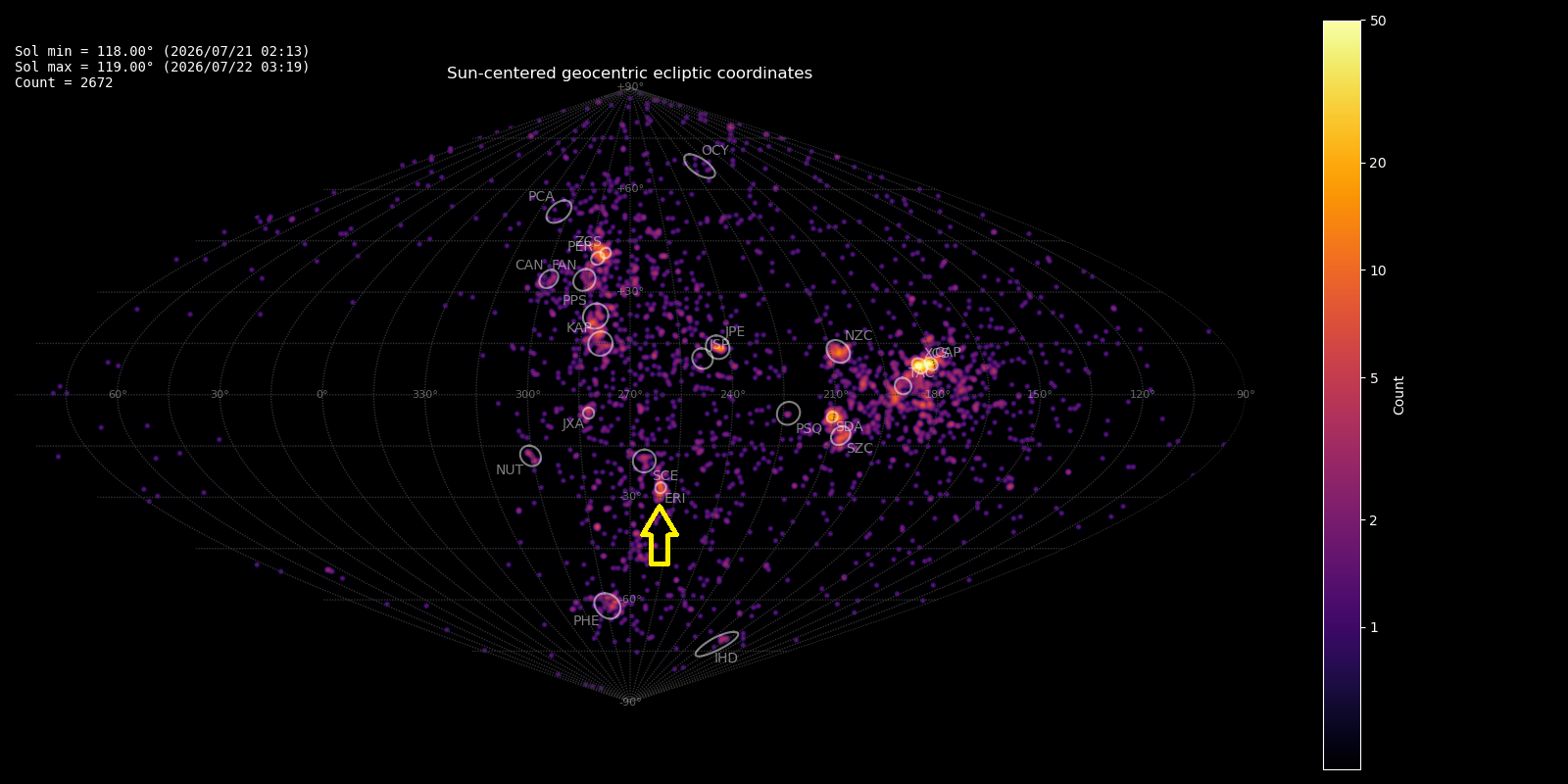
Figure 1 – Radiant density map with 2672 radiants obtained by the Global Meteor Network between solar longitudes 118°–119° in 2026. The position of the tau-Cetids and eta-Eridanids in Sun-centered geocentric ecliptic coordinates is marked with a yellow arrow.
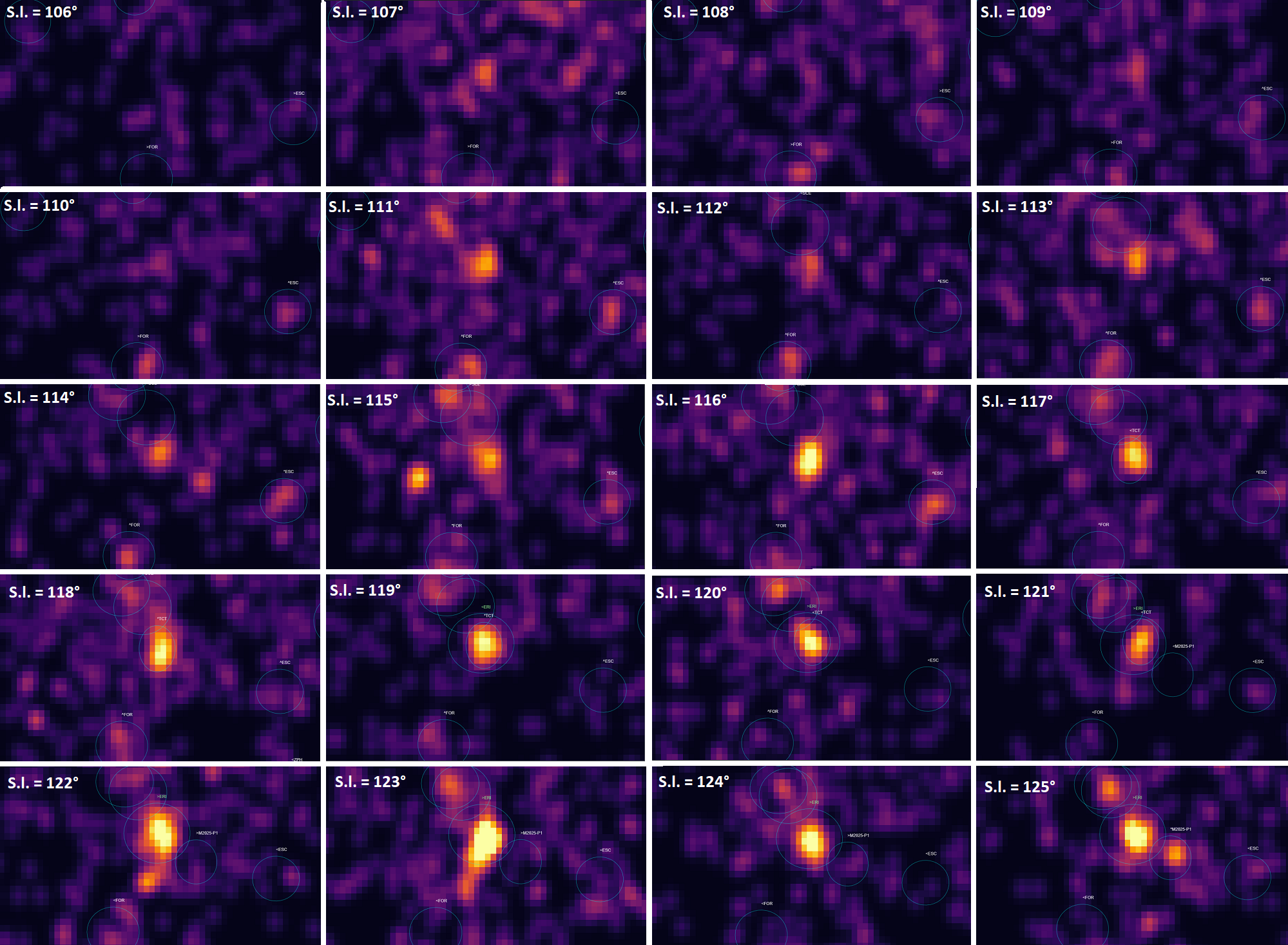
Figure 2 – The daily variation on the GMN RadiantMap from λʘ = 106° to λʘ = 125, centered on the ERI#191 radiant in Sun-centered geocentric ecliptic coordinates. The position of the tau-Cetids coincides completely with the eta-Eridanids radiant.
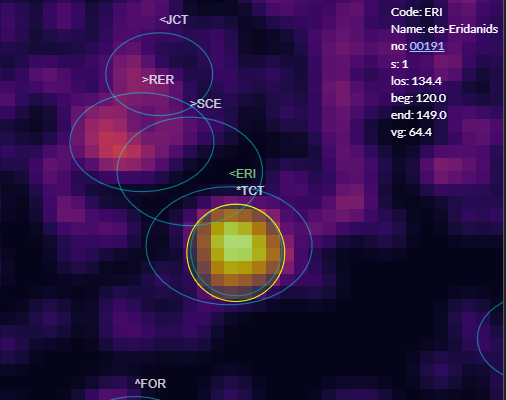
Figure 3 – Screenshot from the RadiantMap with the selected region of interest for the tau-Cetids alias eta-Eridanids activity source in 2026, marked in the yellow circle. Close-up at λʘ = 119°.
The RadiantMap tool allows the visualization of the meteor shower radiants in different coordinate systems and different projections with either the GMN shower references or the actual IAU-MDC Working List of Meteor Showers. The radiant viewer displays the actually observed radiant density and compares this directly to the different theoretical reference sources. Figure 2 shows the evolution of the radiant density distribution near the eta-Eridanids radiant. This plot displays several interesting features. From λʘ = 111° we see continuous activity at the ERI-radiant position, confirming the start of the shower activity at λʘ = 110.75° as determined by Shiba (2023). There is some very weak activity at λʘ = 107° but nothing is seen the next day. The snapshot for λʘ = 117° shows that the early eta-Eridanid activity is labelled as TCT or tau-Cetids. At λʘ = 119° this activity coincides with the eta-Eridanids radiant. Figure 3 shows a close-up with the tau-Cetids completely embedded within the radiant of the eta-Eridanids. Some other interesting features appear in Figure 2. At λʘ = 115° the radiant of the recently discovered shower M2026-R1 appears left from the ERI-radiant (Roggemans et al., 2026a). In the frames from λʘ = 121° to λʘ = 123° a so far unknown activity appears just south of the ERI-radiant, and in the frame λʘ = 125° we see that the new shower M2025-P1 produced again activity in 2026 (Šegon et al., 2025).
The tau-Cetids were reported based on single-station video camera measurements where triangulated trajectories were not available (Molau and Kerr, 2014). A possible explanation for this duplicate entry in the IAU-MDC Working List of Meteor Showers might be that the precise start of the eta-Eridanids was not known at that time and the shower was assumed to start later. The tau-Cetids were added to the IAU-MDC as a new shower. In order to test whether the tau-Cetids are actually the eta-Eridanids, a radiant and orbit based analysis has been made.
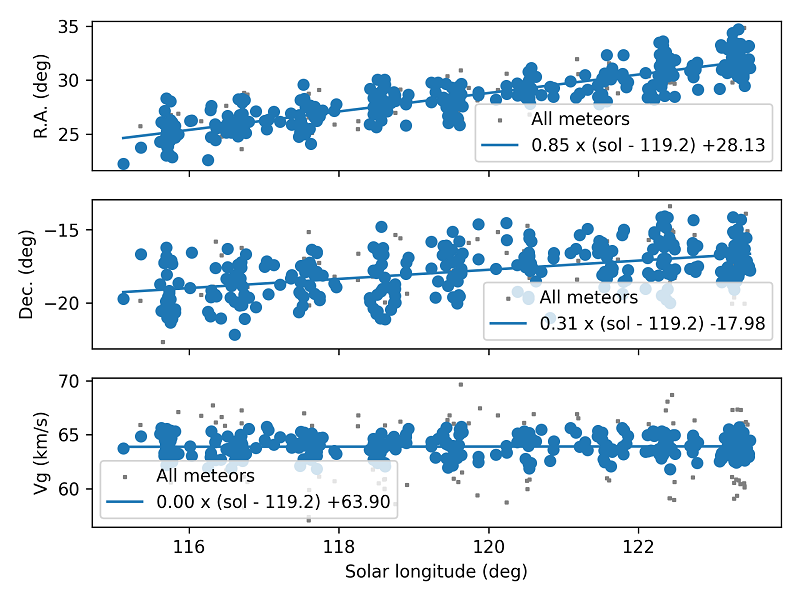
Figure 4 – The CTC-radiant drift in 2026.
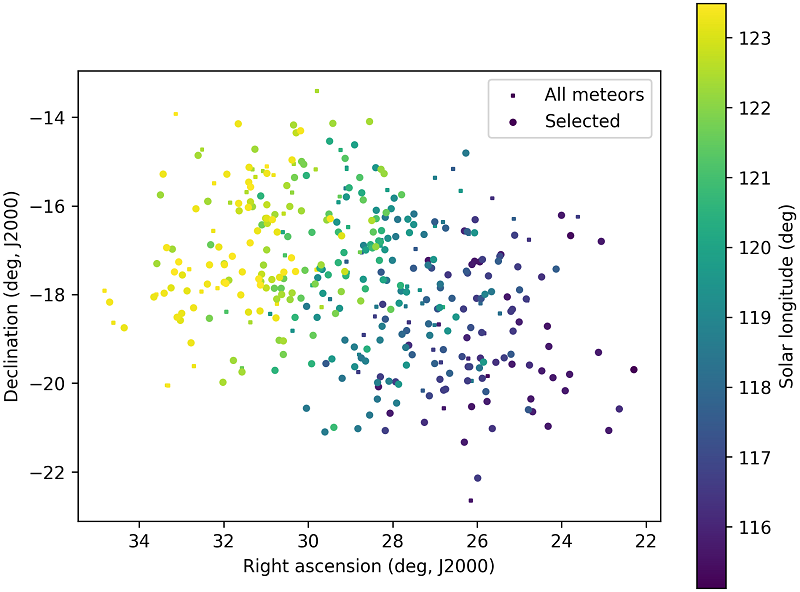
Figure 5 – The radiant distribution in 2026 during the solar-longitude interval 115.1° – 123.5° in equatorial coordinates.
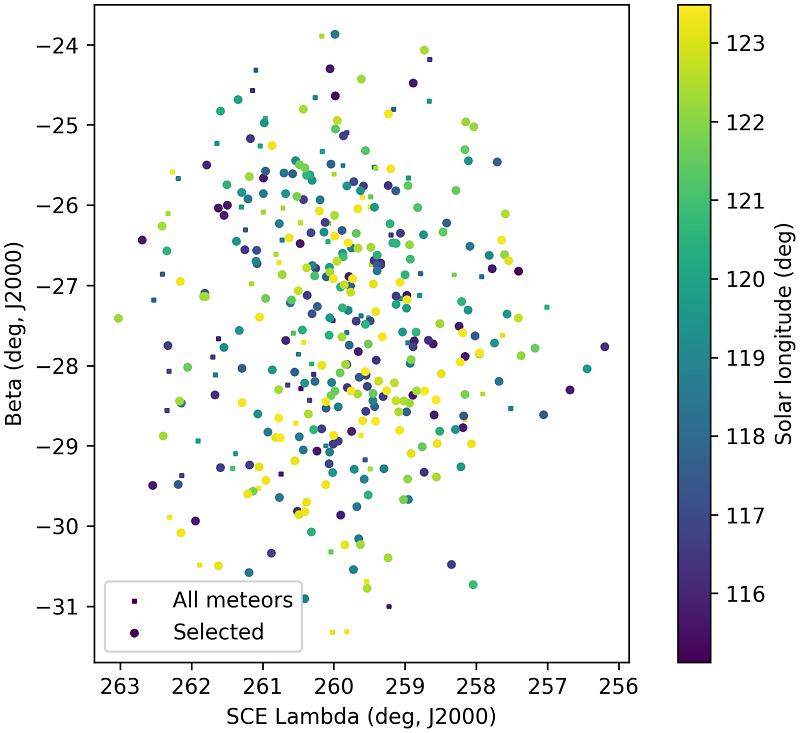
Figure 6 – The radiant distribution during the solar-longitude interval 115.1° – 123.5° in Sun-centered ecliptic coordinates.
The radiant drift computed for the solar-longitude interval 115.1° – 123.5° aligns the expected tau-Cetids activity perfectly with the early eta-Eridanids (Figure 4). This radiant drift is also very obvious in the radiant plot in equatorial coordinates (Figure 5). In Sun-centered geocentric ecliptic coordinates the shower radiant contracts into a rather stable compact area (Figure 6). The radiant drift in Sun-centered ecliptic coordinates is almost nihil during the long activity period of the eta-Eridanids.
Since the original discovery of the tau-Cetids was without orbital elements, it is difficult to prove any association. The best we can do is to compute the mean orbit for the selection of meteor radiants that coincide with the assumed tau-Cetids region of interest.
The radiant shower association criteria assume that meteors within 1° in solar longitude, within 4.0° in radiant in this case, and within 10% in geocentric velocity of a shower reference location are members of that shower. Further details about the shower association are explained in Vida et al. (2021). Using the 2026 data, initially 397 possible shower members were selected and after removal of outliers, 310 members remained for final analysis. The result is listed in Table 1.
A complete independent meteoroid stream search has been applied to orbit data obtained between solar longitude 108° and 130° during the years 2019–2026. The method has been described in detail in a separate publication (Roggemans et al., 2026b). 280307 orbits were available within this time interval and a final mean orbit has been computed by the method of Jopek et al. (2006) for the thresholds DSH < 0.125 and DD < 0.05 and DJ < 0.125 (Southworth and Hawkins, 1963; Drummond, 1981; Jopek, 1993), based upon the Rayleigh fit in Figure 7 The resulting mean orbits based upon 223 meteors recorded within the activity period of the tau-Cetids (118° to 121° in solar longitude) and for 918 meteors identified as eta-Eridanids between solar longitude 111.6° and 128.5° are listed in Table 1.
The number of ERI-meteors as a percentage relative to the total number of meteors recorded in a 24 hours interval results in the profile plotted in Figure 8.
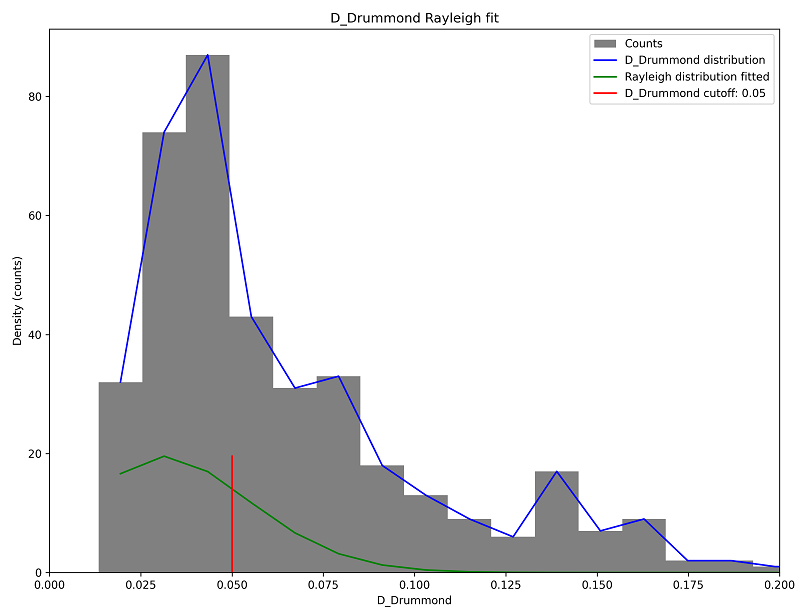
Figure 7 – Rayleigh fit on the Drummond criterion for tau-Cetids. The 2026 data result in a cutoff value of DD = 0.05.
Table 1 – Comparing solutions derived by two different methods, TCT based on radiant positions for 2026, TCT based on the orbit association method for DD < 0.05 for 2019–2026 and the first 17 days of eta-Eridanids activity.
| TCT radiant method 2026 | TCT orbit method 2019–2026 DD < 0.05 |
ERI orbit method 2019–2026 DD < 0.05 |
|
| λʘ (°) | 119.6 | 119.6 | 121.3 |
| λʘb (°) | 115.1 | 118.0 | 111.6 |
| λʘe (°) | 123.5 | 121.0 | 128.5 |
| αg (°) | 28.1 | 28.4 | 29.6 |
| δg (°) | –18.0 | –17.7 | –17.4 |
| Δαg (°) | +0.85 | +0.72 | +0.78 |
| Δδg (°) | +0.31 | +0.41 | +0.34 |
| vg (km/s) | 63.9 | 64.1 | 64.0 |
| Hb (km) | 110.4 | 111.6 | 111.4 |
| He (km) | 97.0 | 98.1 | 97.7 |
| Hp (km) | 102.1 | 102.3 | 102.3 |
| MagAp | –1.0 | –1.1 | –1.2 |
| λg (°) | 19.4 | 19.3 | 20.8 |
| λg – λʘ (°) | 259.8 | 259.8 | 259.7 |
| βg (°) | –27.5 | –27.4 | –27.5 |
| a (A.U.) | 12.5 | 14.3 | 14.0 |
| q (A.U.) | 0.948 | 0.949 | 0.946 |
| e | 0.924 | 0.934 | 0.933 |
| i (°) | 131.9 | 132.1 | 132.0 |
| ω (°) | 30.1 | 30.0 | 30.2 |
| Ω (°) | 299.9 | 299.6 | 300.9 |
| Π (°) | 329.9 | 329.6 | 331.2 |
| Tj | –0.37 | –0.43 | –0.42 |
| N | 310 | 223 | 918 |
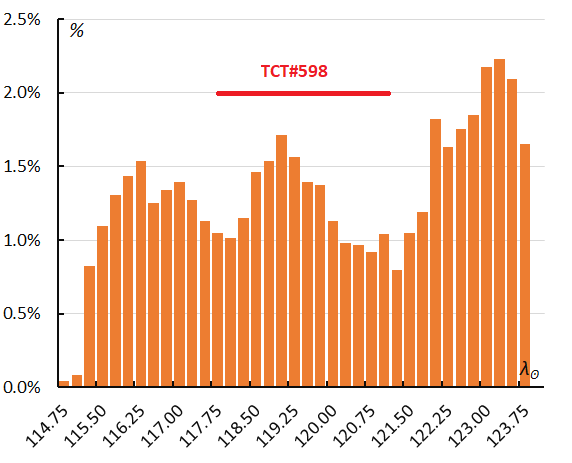
Figure 8 – The percentage of TCT (alias ERI)-meteors relative to the total number of meteors recorded in 2026 (radiant method).
The shower identification methods are not suitable to cover very long duration shower activity using a single mean orbit as a reference. The reason is that the orientation of the meteoroid stream orbit changes during the transit of the Earth. In the case of the eta-Eridanids, the orbit is very stable in perihelion distance, eccentricity and inclination but the longitude of perihelion shows a strong drift of 1.27° per degree in λʘ (see Figure 9). The trend is very obvious from λʘ = 112°. For showers with a long activity period a single reference orbit without the drift in orbital elements can be misleading. The orbits identified as tau-Cetids fit perfectly within this trend (Figure 9).
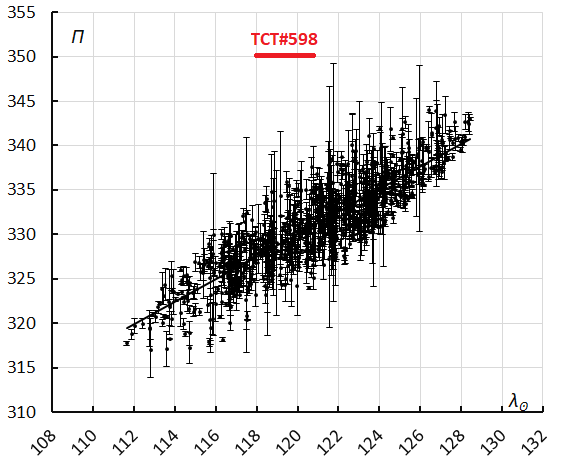
Figure 9 – The change in longitude of perihelion Π in function of the solar longitude.
The activity of the ERI-meteors fluctuates with successive sub-peaks. This irregular activity is also visible in Figure 2 as the intensity of the radiant density fluctuates a lot from day to day.
With a Tisserand relative to Jupiter TJ = –0.42 this is a long-period comet meteoroid stream from a Halley-type comet on a retrograde orbit. The orbit solutions in Table 1 for the TCT activity period and the early ERI activity show that this is the same meteoroid stream. This is also obvious in the plotted version of the orbits (Figure 10).
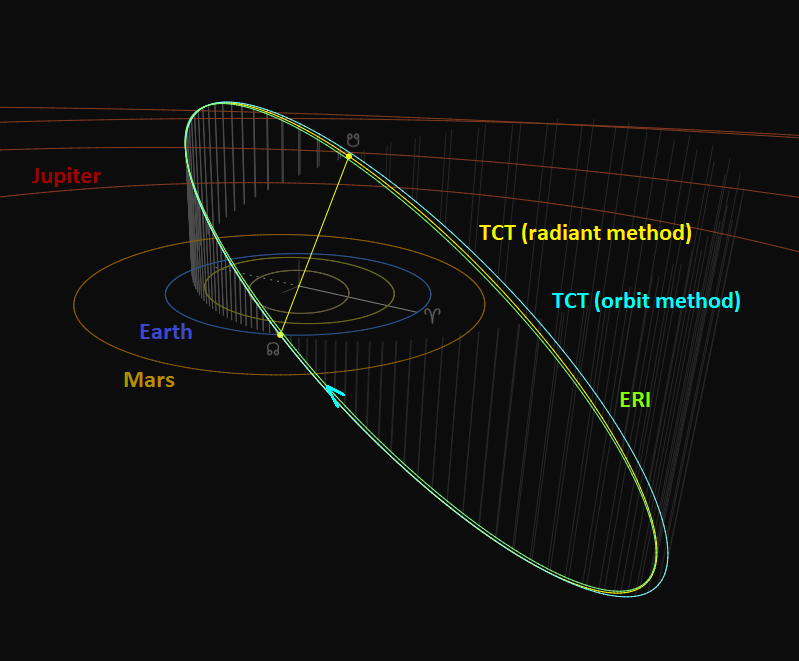
Figure 10 – The orbit determined solutions for 2026 with the radiant method (yellow), for the orbit method applied to TCT 2019–2026 (blue) and for the first weeks of ERI-activity 2019–2026 (green). (Plotted with the Orbit visualization app provided by Pető Zsolt).
Table 2 – Top ten matches of a search for possible parent bodies with DD < 0.25, based upon the mean orbit derived from the radiant classification method on 2026 data.
| Name | DD |
| C/1852 K1 (Chacornac) | 0.118 |
| C/2020 H2 (Pruyne) | 0.153 |
| C/2013 UQ4 (Catalina) | 0.163 |
| 273P/Pons-Gambart | 0.184 |
| C/1877 G1 (Winnecke) | 0.187 |
| C/2020 R4 (ATLAS) | 0.206 |
| C/1886 J1 (Brooks) | 0.215 |
| C/1947 S1 (Bester) | 0.228 |
| C/1994 G1-A (Takamizawa-Levy) | 0.235 |
| C/1946 K1 (Pajdusakova-Rotbart-Weber) | 0.236 |
A search for possible parent bodies reveals C/1852 K1 (Chacornac) as most likely parent for the tau-Cetids activity, which is also the likely parent body for the eta-Eridanids.
2 Conclusion
The RadiantMap tool shows that the tau-Cetids (TCT#598) radiant coincides with the eta-Eridanids radiant at the start of its activity. Global Meteor Network data allowed computation of the missing reference orbit for the TCT-entry in the IAU-MDC Working List of Meteor Showers which proves to be the same as the ERI-orbit. Both showers have the same likely parent body, C/1852 K1 (Chacornac).
The early eta-Eridanids activity has been investigated and the start of the shower activity has been determined at λʘ = 111° in good agreement with the result obtained by Shiba (2023). The eta-Eridanid radiant shows almost no drift in Sun-centered geocentric ecliptic coordinates.
The entry for the tau-Cetids (TCT#598) should be either moved under the solutions for the eta-Eridanids (ERI#191) or archived with the removed showers.
Acknowledgments
This report is based on the data of the Global Meteor Network (Vida et al., 2020a; 2020b; 2021) which is released under the CC BY 4.0 license. We thank all 927 participants in the Global Meteor Network project for their contribution and perseverance. A list with the names of the volunteers who contribute to GMN has been published in the 2025 annual report (Roggemans et al., 2026c). The following 732 cameras in 34 countries (Antarctica, Austria, Australia, Bosnia Herzegovina, Belgium, Bulgaria, Brazil, Canada, Chile, Croatia, Czech Republic, France, Germany, Greece, Hungary, Israel, Italy, Japan, Malaysia, Mexico, Netherlands, New Zealand, Poland, Portugal, Romania, Russia, Slovakia, Slovenia, South Africa, South Korea, Spain, Switzerland, United Kingdom and the United States). contributed to paired meteors used in this study:
AQ0003, AQ000A, AT0004, AU0001, AU0002, AU0003, AU0004, AU0006, AU000A, AU000B, AU000C, AU000D, AU000E, AU000F, AU000G, AU000L, AU000Q, AU000R, AU000S, AU000T, AU000U, AU000V, AU000W, AU000X, AU000Y, AU000Z, AU0010, AU001A, AU001B, AU001C, AU001D, AU001E, AU001F, AU001G, AU001K, AU001L, AU001N, AU001P, AU001Q, AU001R, AU001S, AU001T, AU001U, AU001V, AU001W, AU001X, AU001Y, AU001Z, AU0028, AU0029, AU002A, AU002B, AU002C, AU002D, AU002E, AU002F, AU0030, AU0031, AU0035, AU0038, AU003E, AU003F, AU003H, AU003J, AU0040, AU0042, AU0043, AU0045, AU0046, AU0047, AU0048, AU004B, AU004H, AU004K, AU004L, AU004M, AU004Q, AU004R, AU004U, BA0001, BA0005, BE0005, BE000D, BE000H, BE000L, BE000P, BE000T, BE000U, BE000Z, BE0010, BE0011, BE0012, BE001A, BE001B, BG0001, BG0003, BG0004, BG0008, BG000B, BG000D, BG000G, BG000L, BR0001, BR0002, BR0003, BR000F, BR000G, BR000J, BR000Q, BR000S, BR000T, BR000W, BR000Y, BR0013, BR0014, BR0015, BR001F, BR001H, BR001J, BR001M, BR001R, BR001T, BR001W, BR0021, BR0029, BR002B, BR002C, CA0005, CA0009, CA000F, CA000L, CA000P, CA000Q, CA000R, CA000W, CA0012, CA0015, CA001A, CA001R, CA0022, CA0023, CA002F, CA0036, CA003C, CAC0B1, CAC0B4, CAC0B6, CAWEC1, CH0002, CH0003, CH0005, CL0002, CL0003, CZ0007, DE0001, DE0002, DE0005, DE0008, DE0009, DE0015, DE0016, ES0001, ES0003, ES0005, ES0006, ES0008, ES000B, ES000C, ES000D, ES000E, ES000F, ES000H, ES000N, ES000P, ES000Q, ES000T, ES000U, ES000V, ES000W, ES000X, ES000Z, ES0013, ES0016, ES0019, ES001A, ES001D, ES001F, ES001J, FR0006, FR000G, FR000V, FR000X, FR000Y, FR000Z, FR0011, FR0013, GR0002, GR0003, GR0004, GR0006, GR0007, GR0008, GR0009, HR0001, HR0002, HR0004, HR0006, HR0008, HR000D, HR000F, HR000H, HR000J, HR000K, HR000M, HR000P, HR000Q, HR000R, HR000S, HR000T, HR000V, HR000Z, HR0010, HR0016, HR0018, HR001A, HR001E, HR001G, HR001X, HR001Z, HR0024, HR0025, HR002D, HR002F, HR002H, HR002J, HR002K, HR002L, HR002M, HR002R, HR002T, HR002V, HR002W, HR002X, HR002Y, HR002Z, HU0001, HU0002, HU0003, HU0004, HU0007, HU0008, HU000B, HU000D, HU000E, IL0002, IL0004, IL000A, IT0001, IT0004, IT0008, JP0005, JP0006, KR0002, KR0003, KR0004, KR0005, KR0006, KR0007, KR0008, KR000A, KR000B, KR000C, KR000E, KR000F, KR000H, KR000J, KR000K, KR000L, KR000N, KR000P, KR000R, KR000S, KR000Z, KR0010, KR0011, KR0012, KR0013, KR0015, KR0016, KR0017, KR0018, KR0019, KR001A, KR001B, KR001C, KR001D, KR001E, KR001F, KR001G, KR001H, KR001J, KR001K, KR001N, KR001P, KR001Q, KR001U, KR001W, KR001X, KR001Y, KR001Z, KR0022, KR0023, KR0024, KR0025, KR0027, KR0028, KR0029, KR002A, KR002B, KR002C, KR002D, KR002E, KR002F, KR002G, KR002H, KR002J, KR002N, KR002P, KR002Q, KR002R, KR002S, KR0039, KR003A, KR003B, KR003C, KR003D, KR003E, KR003F, KR003H, KR003K, KR003M, KR003N, KR003R, KR003X, MX0003, MX0007, MX0009, MX000D, MY0005, MY0009, NL0006, NL000Z, NL0010, NZ0001, NZ0002, NZ0003, NZ0004, NZ0007, NZ0008, NZ0009, NZ000A, NZ000B, NZ000D, NZ000F, NZ000G, NZ000H, NZ000J, NZ000K, NZ000L, NZ000M, NZ000N, NZ000P, NZ000Q, NZ000R, NZ000S, NZ000T, NZ000U, NZ000V, NZ000W, NZ000X, NZ000Y, NZ000Z, NZ0010, NZ0011, NZ0012, NZ0013, NZ0014, NZ0015, NZ0016, NZ0017, NZ0018, NZ0019, NZ001A, NZ001B, NZ001C, NZ001D, NZ001E, NZ001G, NZ001H, NZ001J, NZ001K, NZ001L, NZ001N, NZ001P, NZ001Q, NZ001R, NZ001S, NZ001V, NZ001W, NZ001X, NZ001Z, NZ0020, NZ0021, NZ0022, NZ0023, NZ0024, NZ0025, NZ0026, NZ0027, NZ0028, NZ0029, NZ002B, NZ002C, NZ002D, NZ002E, NZ002F, NZ002G, NZ002H, NZ002J, NZ002K, NZ002L, NZ002N, NZ002P, NZ002Q, NZ002R, NZ002S, NZ002T, NZ002U, NZ002V, NZ002W, NZ002X, NZ002Y, NZ0030, NZ0032, NZ0033, NZ0034, NZ0035, NZ0036, NZ0037, NZ0038, NZ003A, NZ003B, NZ003C, NZ003E, NZ003F, NZ003G, NZ003H, NZ003K, NZ003L, NZ003M, NZ003N, NZ003Q, NZ003R, NZ003S, NZ003T, NZ003U, NZ003V, NZ003W, NZ003X, NZ003Y, NZ003Z, NZ0040, NZ0041, NZ0042, NZ0044, NZ0045, NZ0046, NZ0049, NZ004A, NZ004B, NZ004C, NZ004D, NZ004E, NZ004F, NZ004H, NZ004J, NZ004L, NZ004M, NZ004N, NZ004R, NZ004S, NZ004T, NZ004U, NZ004V, NZ004X, NZ004Y, NZ004Z, NZ0051, NZ0059, NZ005A, NZ005B, NZ005C, NZ005D, NZ005E, NZ005F, NZ005G, NZ005H, NZ005J, NZ005K, NZ005L, NZ005M, NZ005N, NZ005Q, NZ005R, NZ005S, NZ005T, NZ005U, NZ005Y, NZ005Z, NZ0061, NZ0063, NZ0065, NZ0066, NZ0067, NZ0068, NZ0069, NZ006A, NZ006B, NZ006C, NZ006D, NZ006E, NZ006F, NZ006J, NZ006K, NZ006L, NZ006M, NZ006N, NZ006P, NZ006Q, NZ006R, NZ006S, NZ006T, NZ006U, NZ006V, NZ0073, NZ007B, NZ007C, NZ007D, NZ007E, NZ007F, PL000A, PL000B, PL000E, PL000N, PLM005, PT0002, PT0003, RO0001, RO000A, RO000C, RO000H, RO000Y, RO0019, RU0001, RU0002, RU0003, RU0004, RU0007, RU000B, RU000E, RU000F, RU000L, RU000M, RU000N, RU000Q, RU0011, SI0001, SI0002, SI0005, SI0006, SK0005, UK0001, UK0006, UK0009, UK000H, UK000T, UK001K, UK0024, UK0025, UK002Z, UK0038, UK003J, UK003M, UK003Z, UK004B, UK004F, UK004J, UK0051, UK0055, UK005H, UK0078, UK0089, UK008V, UK008X, UK009C, UK009G, UK009S, UK009W, UK00A1, UK00A5, UK00AM, UK00C7, UK00CE, UK00CJ, US0001, US0002, US0003, US0004, US0005, US0006, US0007, US0008, US0009, US000A, US000C, US000D, US000E, US000G, US000H, US000J, US000K, US000L, US000M, US000N, US000P, US000R, US000U, US000V, US001P, US001R, US001Z, US0020, US0021, US0022, US0023, US002A, US002B, US002D, US002R, US002X, US0030, US0035, US0036, US0038, US0039, US003G, US003M, US003N, US003Q, US003S, US003T, US004B, US004C, US004J, US004N, US004P, US004Q, US0055, US005A, US005B, US005C, US005D, US005E, US005F, US005H, US005N, US005W, US005X, US005Y, US005Z, US0061, US0062, US0066, USC0G4, USC0G5, USL001, USL002, USL003, USL004, USL005, USL006, USL008, USL009, USL00A, USL00B, USL00C, USL00D, USL00E, USL00F, USL00G, USL00J, USL00K, USL00L, USL00M, USL00N, USL00P, USL00Q, USL00V, USL00Z, USL011, USL012, USL013, USL014, USL015, USL016, USL018, USL019, USL01A, USL01B, USL01C, USL01D, USL01E, USV002, USV003, ZA0001, ZA0002, ZA0006, ZA0007, ZA0008, ZA000A, ZA000C and ZA000D.
References
Drummond J. D. (1981). “A test of comet and meteor shower associations”. Icarus, 45, 545–553.
Jopek T. J. (1993). “Remarks on the meteor orbital similarity D-criterion”. Icarus, 106, 603–607.
Jopek T. J., Rudawska R. and Pretka-Ziomek H. (2006). “Calculation of the mean orbit of a meteoroid stream”. Monthly Notices of the Royal Astronomical Society, 371, 1367–1372.
Molau S., Kerr S. (2014). “Meteor showers of the southern hemisphere”. WGN, Journal of the International Meteor Organization, 42, 68–75.
Ohtsuka K., Tanigawa T., Murayama H., Hasegawa I. (2001). “The new meteor shower η Eridanids”. ESA SP-495, 109–112.
Roggemans P., Vida D., Šegon D., Kalina M., Scott J.M., Wood J. (2026a). “New meteor shower in Cetus (M2026-R1)”. eMetN Meteor Journal, 11, TBP.
Roggemans P., Vida D., Šegon D., Scott J.M. (2026b). “Meteoroid orbit shower identification”. eMetN Meteor Journal, 11, 189–204.
Roggemans P., Campbell-Burns P., Kalina M., McIntyre M., Scott J. M., Šegon D., Vida D. (2026c). “Global Meteor Network report 2025”. eMetN Meteor Journal, 11, 89–129.
Šegon D., Vida D., Roggemans P. (2025). “New meteor shower in Eridanus”. eMetN Meteor Journal, 10, 282–286.
Shiba Y. (2023). “Halley Type and Long Period Meteor Shower Luminous Altitude Characteristics”. WGN, Journal of the International Meteor Organization, 51, 93–108.
Southworth R. B. and Hawkins G. S. (1963). “Statistics of meteor streams”. Smithsonian Contributions to Astrophysics, 7, 261–285.
Vida D., Gural P., Brown P., Campbell-Brown M., Wiegert P. (2020a). “Estimating trajectories of meteors: an observational Monte Carlo approach – I. Theory”. Monthly Notices of the Royal Astronomical Society, 491, 2688–2705.
Vida D., Gural P., Brown P., Campbell-Brown M., Wiegert P. (2020b). “Estimating trajectories of meteors: an observational Monte Carlo approach – II. Results”. Monthly Notices of the Royal Astronomical Society, 491, 3996–4011.
Vida D., Šegon D., Gural P. S., Brown P. G., McIntyre M. J. M., Dijkema T. J., Pavletić L., Kukić P., Mazur M. J., Eschman P., Roggemans P., Merlak A., Zubrović D. (2021). “The Global Meteor Network – Methodology and first results”. Monthly Notices of the Royal Astronomical Society, 506, 5046–5074.