By Milan Kalina, Denis Vida, Damir Šegon, Paul Roggemans, James M. Scott, Jeff Wood
Abstract: A new meteor shower on a retrograde Halley-type comet orbit (TJ = 0.31) was detected in 2026 by the Global Meteor Network, with activity above the sporadic background between solar longitude 164° and 168°. The radiant-method solution, based on 109 meteors selected between solar longitude 161.5° and 168.5°, gives a radiant at R.A. = 93.3° and Decl. = +69.3° (λʘ = 165.0°) in the constellation of Camelopardalis, with a geocentric velocity of 54.3 km/s. The new meteor shower has been listed in the IAU-MDC Working List of Meteor Showers under the temporary name-designation: M2026-S1.
1 Introduction
The Perseids are beyond doubt the best observed and studied meteor shower but still its precise activity period remains a topic of debate. The activity period for the solutions listed by the IAU-MDC (Jopek and Kaňuchová, 2017; Jenniskens et al., 2020) varies a lot among different researchers. The longest activity period covers almost two months, from solar longitude 115° until 175° (Jenniskens, 2023). The GMN shower reference considers Perseid activity until λʘ = 150°. A radiant concentration appears on the radiant density map close to the theoretically expected Perseid radiant at λʘ = 166.0°, but the orbits are different from those of the Perseids.
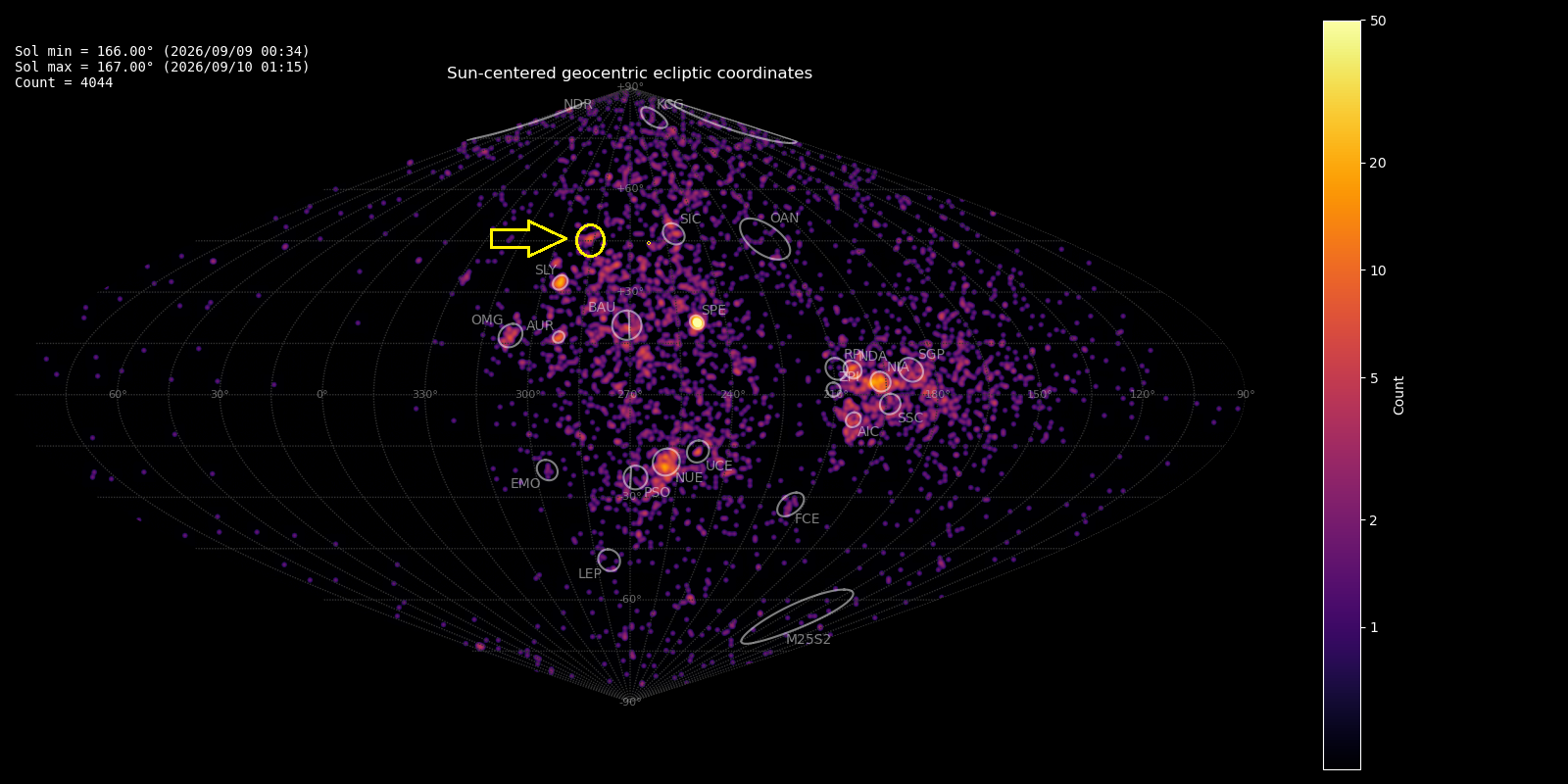
Figure 1 – Radiant density map in sinusoidal projection with 4044 radiants obtained by the Global Meteor Network between solar longitudes 166° and 167° in 2026. A concentration is visible in Sun-centered geocentric ecliptic coordinates which was identified as a new meteor shower with the temporary identification M2026-S1, marked in yellow on the map.
Using the RadiantMap tool (Kalina, unpublished) in Mercator projection with the expected shower radiants according to the IAU-MDC Working List of Meteor Showers in Figure 2, the unexpected activity becomes better visible than in Figure 1.
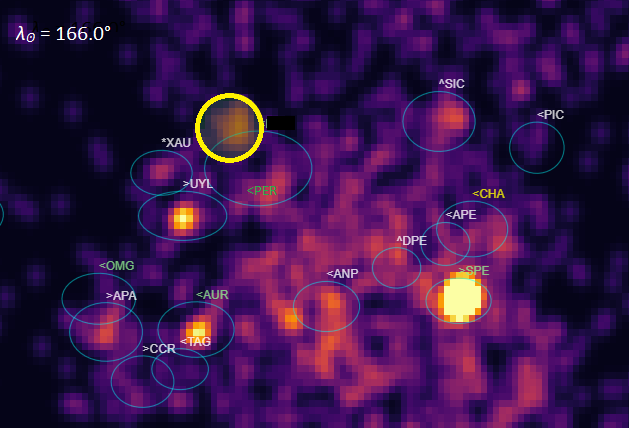
Figure 2 – Screenshot from the RadiantMap with the selected region of interest at λʘ = 166° for the unknown activity source in 2026 marked in the yellow circle. The circles are the expected radiants of the IAU-MDC Working List. Just left of the yellow circle is the xi-Aurigid radiant (XAU#205). The expected Perseid radiant is just below the new activity.
2 Shower classification based on radiants
The RadiantMap tool found 164 meteors. The sample includes a few duplicate solutions which were not removed in the analysis. The radiant offset threshold is 6.5° and the vg deviation threshold 2.0 km/s. Using these values to remove outliers, 109 meteors remained for final analysis. The final median dispersion is 2.1° giving an association radius (×2.5) of 5.2°. This selection includes a considerable sporadic background: in 2026 about 60% of the meteors within 6.5° of the Sun-centered radiant in 161.5°–168.5° are expected from the sporadic level in the flanks. The 55 meteors within 2.5° of the radiant in 164°–168° (about 28% background) give practically the same radiant, R.A. = 92.0°, Decl. = +69.5° and vg = 54.9 km/s at λʘ = 165.0°, with a median dispersion of 1.24°.
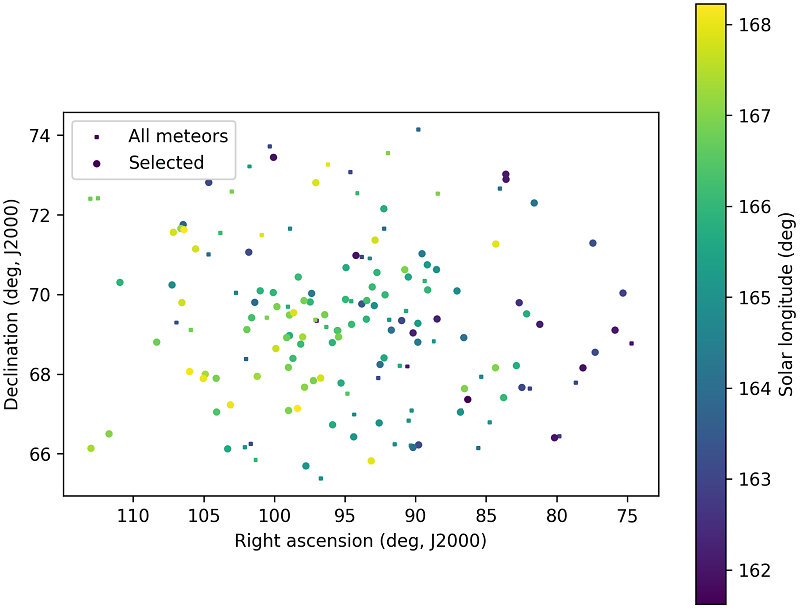
Figure 3 – The radiant distribution during the solar-longitude interval 161.5° – 168.5° in equatorial coordinates.
The closest shower in the IAU-MDC Working List is the xi-Aurigids (XAU#205). The solution by Jenniskens (2023), λʘ = 165.9°, R.A. = 111.6°, Decl. = +61.4°, vg = 55.8 km/s, lies 10.9° from the M2026-S1 radiant with Δvg = +1.5 km/s, and its orbit gives DD = 0.175 and DSH = 0.48 relative to the radiant-method orbit. The maximum-sigma test of Jopek et al. (2024) rejects a duplicate: Δ(λ–λʘ) = 10.8° (limit 5°), Δβ = 6.9° (limit 3°) and Δω = 27.5° (limit 9°) exceed the limits, while Δvg = 1.5 km/s, ΔΩ = 0.5° and Δi = 4.8° are within them.
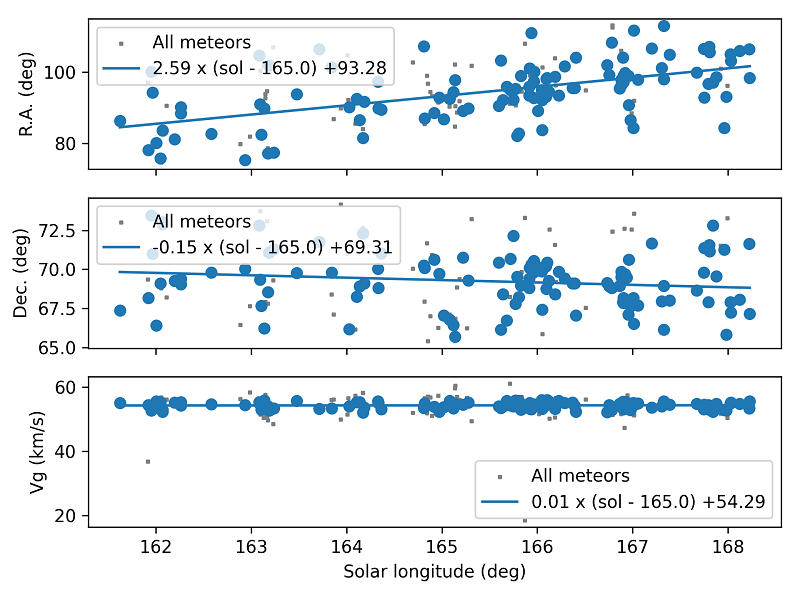
Figure 4 – The radiant drift.
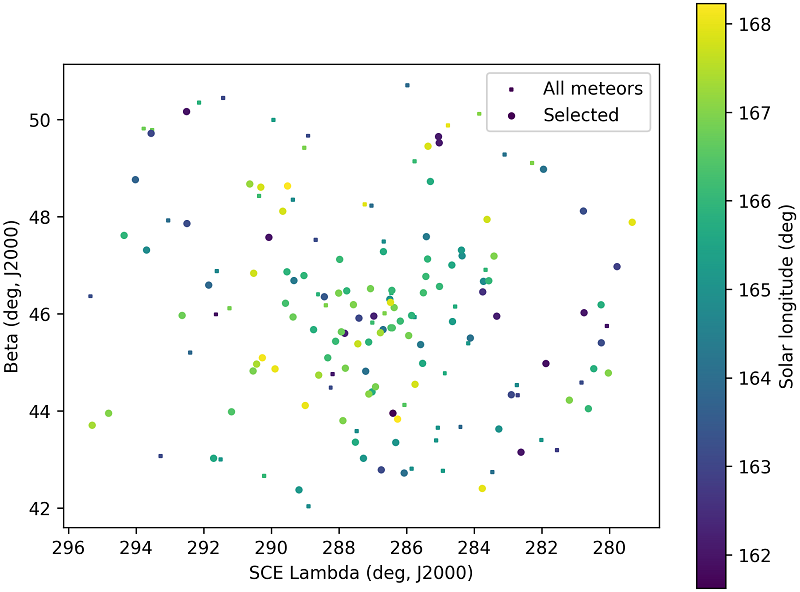
Figure 5 – The radiant distribution during the solar-longitude interval 161.5° – 168.5° in Sun-centered geocentric ecliptic coordinates.
The radiant plot in equatorial coordinates is shown in Figure 3 and the radiant drift in Figure 4. The radiant distribution in Sun-centered ecliptic coordinates is plotted in Figure 5. The shower parameters as obtained by the GMN radiant-based method are listed in Table 1.
3 Shower classification based on orbits
A completely independent meteoroid stream search has been applied to orbit data obtained between solar longitude 161° and 171° during 2019–2026. The method has been described in detail in a separate publication (Roggemans et al., 2026a). 124694 orbits were available within this time interval and a final mean orbit has been computed by the method of Jopek et al. (2006) for the thresholds DSH < 0.125 and DD < 0.05 and DJ < 0.125 (Southworth and Hawkins, 1963; Drummond, 1981; Jopek, 1993). Figure 6 shows the DD distribution of the 2026 RadiantMap candidates. Duplicate solutions of the same meteor were not removed; they make up about 2% of the orbits near this radiant (5 of 219 in 2019–2026). The resulting mean orbit based upon 198 meteors for 2019–2026 is listed in Table 1. Figures 7, 8, 10 and 12 plot the combined thresholds DSH < 0.15 and DD < 0.06 and DJ < 0.15 (marked as DD < 0.06), DSH < 0.125 and DD < 0.05 and DJ < 0.125 (marked as DD < 0.05), DSH < 0.10 and DD < 0.04 and DJ < 0.10 (marked as DD < 0.04) and DSH < 0.05 and DD < 0.02 and DJ < 0.05 (marked as DD < 0.02).
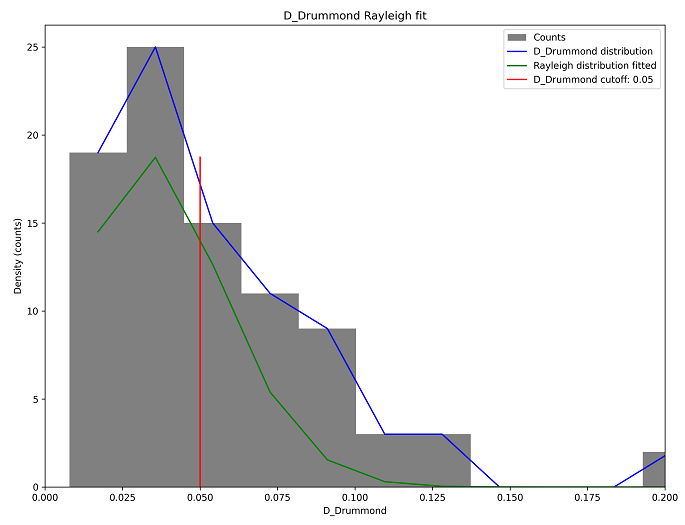
Figure 6 – DD distribution of the 2026 RadiantMap candidates with a Rayleigh curve; DD < 0.05 was adopted.
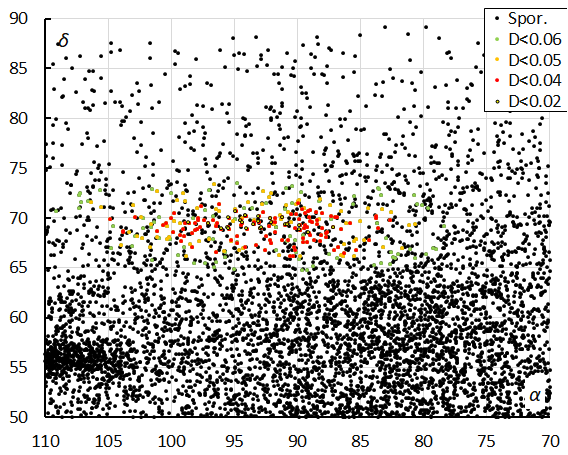
Figure 7 – The radiant distribution during the solar-longitude interval 161° – 171° (2019–2026) in equatorial coordinates, color-coded for different threshold values of the combined similarity criteria.
The radiant in geocentric equatorial coordinates (Figure 7) appears stretched in Right Ascension because of the high declination and map projection. The diffuse concentration just below and to the right of the M2026-S1 meteors is due to late Perseids. The dense concentration near declination +55° and Right Ascension 105°–110° are meteors identified as September Lyncids (SLY#81) by GMN. In Figure 2 this activity has been labelled as UY-Lyncids (UYL#705). This looks like a duplication or mix-up in the Working List of Meteor Showers. The SLY#81 solution of Shiba (2023) and UYL#705 of Jenniskens (2023) pass all six maximum-sigma limits of Jopek et al. (2024) (Δ(λ–λʘ) = 0.17°, Δβ = 0.25°, Δvg = 0.50 km/s, Δω = 0.40°, ΔΩ = 0.20°, Δi = 0.60°), so they are duplicate candidates. The SLY#81 solution of Molau and Rendtel (2009) at λʘ = 167° belongs to the same group. The SLY solutions at λʘ 186° (Decl. +48°, vg 65–67 km/s) are a different source. In the geocentric Sun-centered ecliptic coordinates (Figure 8) the radiants appear more compact.
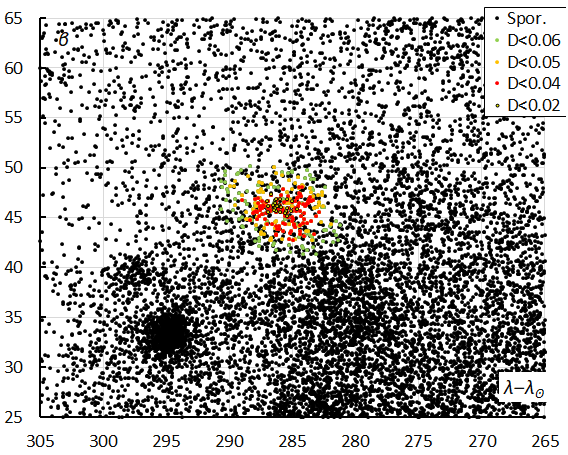
Figure 8 – The radiant distribution during the solar-longitude interval 161° – 171° (2019–2026) in Sun-centered geocentric ecliptic coordinates, color-coded for different threshold values of the combined similarity criteria.
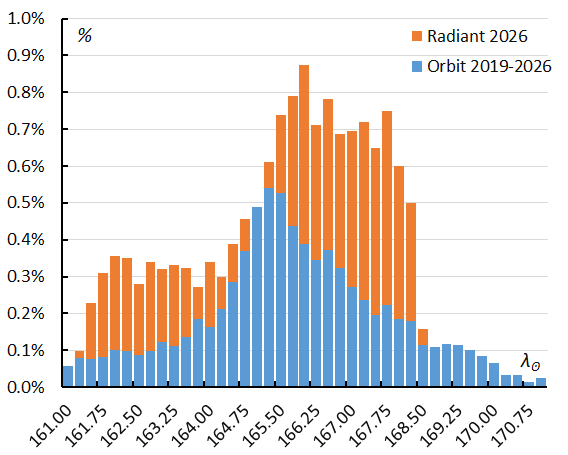
Figure 9 – The percentage of shower meteors relative to the total number of meteors with the beginning point at northern latitudes, with a bin-width of 1° in steps of 0.25° in solar longitude. The orange bars display the 2026 radiant-method selection and blue the 2019–2026 orbit-method selection.
The number of shower meteors as a percentage relative to the total number of meteors recorded with the beginning point at northern latitude results in the profile plotted in Figure 9. The highest percentage occurred at λʘ = 165.5 ± 0.5°. Outside the peak, orbits similar to the shower orbit occur over the whole search window at about the sporadic level. To find the activity limits, the 2026 profile was recomputed over the wider window λʘ = 155°–185° in 0.5° bins, for meteors within 2.5° of the Sun-centered radiant (λ–λʘ = 286.7°, β = +46.0°) with vg 48.9–59.7 km/s, after quality cuts and removal of duplicate solutions, relative to all orbits with the same quality cuts and a beginning point at northern latitudes. The background, 0.12%, is the pooled percentage in the outer quarters of the window (155°–162.5° and 177.5°–185°). Four bins between 164.0° and 167.0° are more than 3σ above this background, with marginal excesses at 164.5°–165.0° and 167.5°–168.0°, and the peak is in the 165.5°–166.0° bin (1.06 ± 0.28%). The pooled 2019–2026 data give the same limits and peak bin. The activity therefore covers about 4 days (164°–168°); the plateau of about 0.3% in the radiant-method profile at 161.5°–164.5° is at the sporadic level of the wider RadiantMap selection. Relative to all northern orbits in 161°–171°, the yearly orbit-method counts correspond to 2.2, 1.2, 1.7, 2.4, 2.1, 2.0, 1.6 and 2.5 per mille for 2019 to 2026, so the shower was about as strong in earlier years, although it was only noticed in 2026. The number of M2026-S1 meteors identified by the D-criteria based method per year was 2019: 4, 2020: 5, 2021: 17, 2022: 16, 2023: 34, 2024: 33, 2025: 23 and 2026: 66. In 2026, 55 meteors lie within 2.5° of the radiant in 164°–168° against 15.4 expected from the 161°–164° and 168°–171° flanks (Poisson P = 5 × 10–15).
4 Orbit and parent body
Radiant method in Table 1: λʘ is the reference solar longitude of the radiant and drift, as reported to the IAU MDC; the highest percentage is at 165.5°. λʘb and λʘe are the limits of the detection windows; activity above the sporadic background is 164°–168° (see Section 3).
The diagram of the inclination i versus the longitude of perihelion Π shows a diffuse distribution (Figure 10). This is mainly due to a considerable scatter in longitude of perihelion and its drift during the shower activity. The longitude of perihelion shows a drift of 0.79° per degree in λʘ (Figure 11). The scatter on the longitude of perihelion is much larger than the uncertainties on the measured values, the one-sigma errors have been plotted in Figure 11. The M2026-S1 orbits have similar perihelion distances as the Perseids but appear at a distinctly lower inclination (Figure 12). Late Perseids lie to the right of the new shower at inclinations of 110° to 115°.
The Tisserand value relative to Jupiter indicates this is a Halley-type comet orbit (Tancredi, 2014; TJ = 0.31 and P = 33 years for the radiant method, TJ = 0.11 and P = 63 years for the orbit method), with an inclination ~100° on a retrograde orbit steeply inclined to the ecliptic plane. The shower encounters the Earth at its descending node while the ascending node is close to Saturn’s orbit (8.1 AU for the radiant method and 10.4 AU for the orbit method; Figure 13). The uncertainty on the semi-major axis explains the difference in the position of the ascending node, inside the orbit of Saturn for the radiant method and outside for the D-criteria based method.
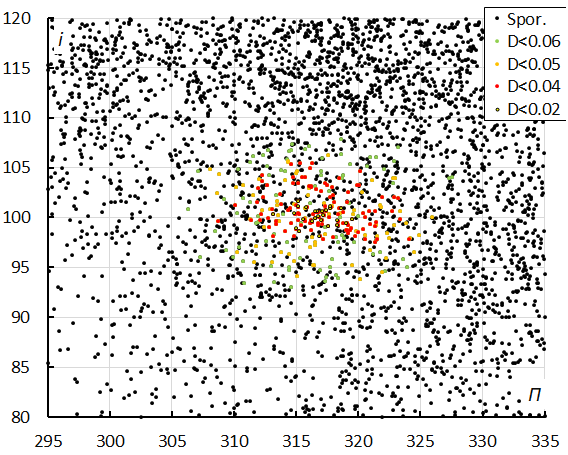
Figure 10 – Inclination i versus the longitude of perihelion Π color-coded for different classes of D-criteria thresholds, for λʘ between 161° – 171° (2019–2026). Spor. = sporadics.
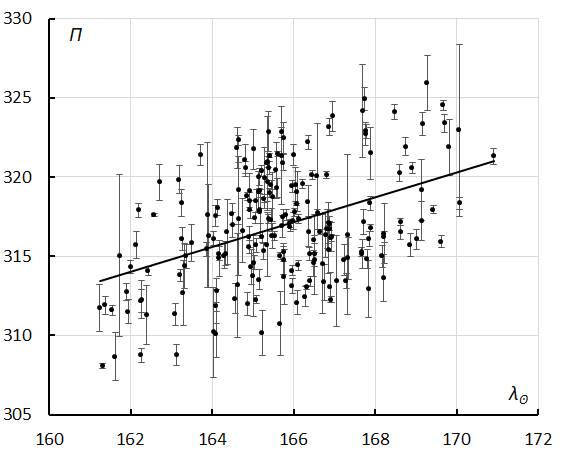
Figure 11 – The variation in longitude of perihelion Π as a function of solar longitude.
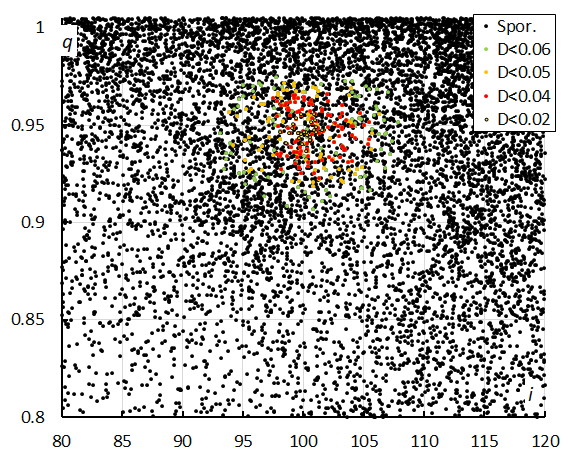
Figure 12 – Perihelion distance q versus the inclination i color-coded for different classes of D-criteria thresholds, for λʘ between 161° – 171° (2019–2026). Spor. = sporadics.
Table 1 – Comparing solutions derived by two different methods, GMN-RadiantMap tool and the D-criteria based orbit association for DSH < 0.125 and DD < 0.05 and DJ < 0.125 (DD < 0.05). Hb, He, Hp are the begin-, end- and peak-brightness heights and MagAp is the average peak absolute magnitude, normalized to 100 km.
| Radiant method
2026 |
Orbit method 2019–2026DD < 0.05 |
|
| λʘ (°) | 165.0 | 165.6 |
| λʘb (°) | 161.5 | 161.2 |
| λʘe (°) | 168.5 | 171.0 |
| αg (°) | 93.3 | 92.3 |
| δg (°) | +69.3 | +69.4 |
| Δαg (°/λʘ) | +2.59 | +2.29 |
| Δδg (°/λʘ) | –0.15 | +0.07 |
| vg (km/s) | 54.3 | 54.9 |
| Hb (km) | 107.3 | 108.7 |
| He (km) | 94.8 | 95.7 |
| Hp (km) | 99.5 | 100.8 |
| MagAp | –0.8 | –1.0 |
| λg (°) | 91.66 | 91.2 |
| λg – λʘ (°) | 286.66 | 285.8 |
| βg (°) | +46.02 | +45.9 |
| a (A.U.) | 10.387 | 15.8 |
| q (A.U.) | 0.936 | 0.945 |
| e | 0.910 | 0.940 |
| i (°) | 99.4 | 100.4 |
| ω (°) | 148.9 | 151.2 |
| Ω (°) | 165.4 | 165.7 |
| Π (°) | 314.4 | 317.0 |
| Tj | 0.31 | 0.11 |
| N | 109 | 198 |
A search for parent bodies (Table 2) did not result in a positive match. The shower has a perihelion distance and argument of perihelion similar to those of the Perseids (q = 0.94 vs 0.95 AU, ω = 149° vs 150°), but differs in inclination (99° vs 113°) and node (165° vs 140°). Against the Perseid orbit of Jenniskens (2023), DD = 0.18 and DSH = 0.50. The parent body of the Perseids, 109P/Swift-Tuttle, appears among the best matching candidate objects but with too poor similarity. 109P has DD = 0.19 but DSH = 0.53, and its descending node is at 1.01 AU but at longitude 319°, 26° from where the Earth meets M2026-S1 (345.4°, r = 1.005 AU). No candidate in Table 2 passes near 1 AU at that longitude (C/2002 Y1: 0.88 AU at 346°; C/1994 N1: 1.48 AU; C/1929 Y1: 0.70 AU), which supports the negative result. Stream modelling may prove if there is any possible physical relationship between this source and 109P/Swift-Tuttle.
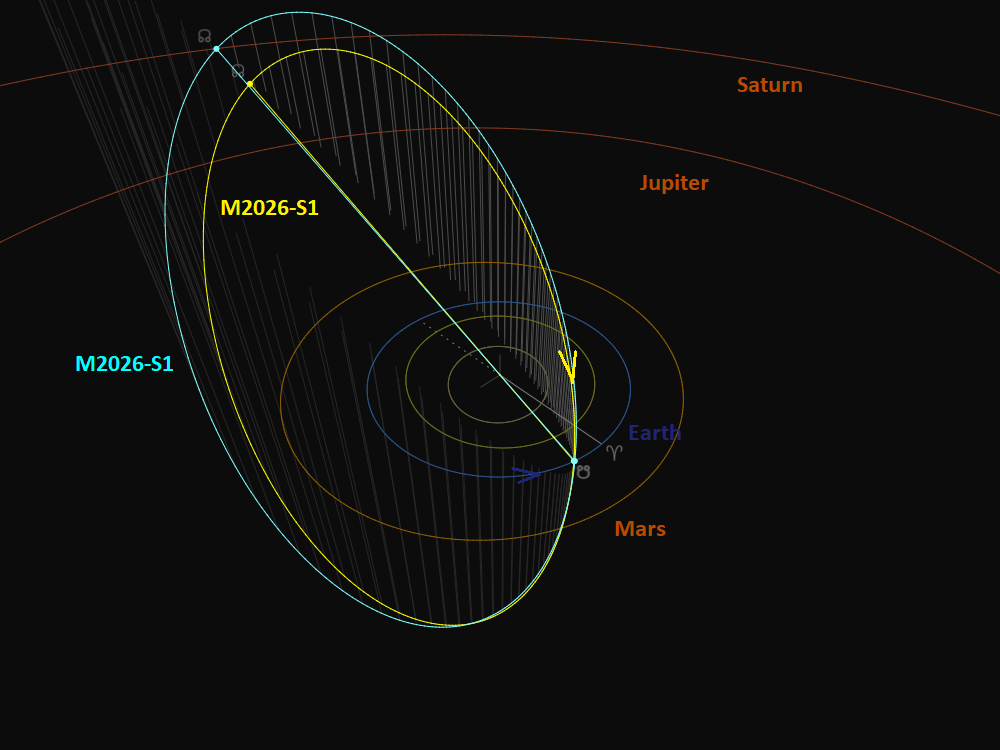
Figure 13 – Comparing the radiant determined shower solution for M2026-S1 (yellow) with the orbit determined solution for M2026-S1 (blue). (Plotted with the Orbit visualization app provided by Pető Zsolt).
Table 2 – Top ten matches of a search for possible parent bodies according to the Drummond criteria, based upon the mean orbit derived from the RadiantMap classification method on 2026 data. Reproduced with JPL ELEMENTS.COMET of 2026-09-28.
| Name | q (AU) | e | i (°) | ω (°) | Ω (°) | DD | DSH |
| C/2002 Y1 (Juels-Holvorcem) | 0.714 | 0.997 | 103.78 | 128.82 | 166.22 | 0.18 | 0.42 |
| C/1994 N1 (Nakamura-Nishimura-Machholz) | 1.140 | 1.000 | 94.38 | 123.07 | 158.91 | 0.18 | 0.49 |
| 109P/Swift-Tuttle | 0.960 | 0.963 | 113.45 | 152.98 | 139.38 | 0.19 | 0.53 |
| C/1840 E1 (Galle) | 0.749 | 1.000 | 79.85 | 138.04 | 188.27 | 0.22 | 0.59 |
| C/2002 Q2 (LINEAR) | 1.303 | 0.978 | 96.77 | 125.47 | 154.29 | 0.22 | 0.55 |
| C/2002 Q3-A (LINEAR) | 1.305 | 0.994 | 96.86 | 125.70 | 154.19 | 0.22 | 0.56 |
| C/2002 Q3 (LINEAR) | 1.306 | 0.998 | 96.90 | 125.70 | 154.15 | 0.22 | 0.56 |
| C/2025 T1 (ATLAS) | 1.109 | 1.000 | 123.43 | 114.14 | 140.50 | 0.25 | 0.74 |
| C/1939 V1 (Friend) | 0.945 | 0.997 | 92.95 | 126.78 | 197.11 | 0.25 | 0.70 |
| C/1929 Y1 (Wilk) | 0.672 | 0.999 | 124.51 | 157.49 | 179.97 | 0.26 | 0.57 |
5 Conclusion
This GMN meteoroid orbit data case study documents a new activity source with a radiant in Camelopardalis and a Halley-type comet orbit. The best activity occurred around λʘ = 165.5 ± 0.5°. The shower caught attention in 2026 but shower members were found each year since 2020, clearly from 2022 onward. The new shower has been reported to the IAU-MDC and received the preliminary designation M2026-S1.
Acknowledgments
This report is based on the data of the Global Meteor Network (Vida et al., 2020a; 2020b; 2021) which is released under the CC BY 4.0 license. We thank all 927 participants in the Global Meteor Network project for their contribution and perseverance. A list with the names of the volunteers who contribute to GMN has been published in the 2025 annual report (Roggemans et al., 2026b). The following 554 cameras contributed to paired meteors used in this study:
AT0002, BA0003, BE0001, BE0003, BE0004, BE0005, BE0006, BE0008, BE0009, BE000A, BE000B, BE000C, BE000G, BE000H, BE000J, BE000K, BE000L, BE000M, BE000N, BE000P, BE000Q, BE000S, BE000T, BE000U, BE000V, BE000W, BE000X, BE0011, BE0012, BE0014, BE0015, BE0017, BE001A, BE001B, BG0003, BG0005, BG000B, BG000D, CA0009, CA000B, CA000E, CA000F, CA000L, CA000R, CA000Y, CA0011, CA001A, CA001D, CA0021, CA0022, CA0026, CA0027, CA002F, CA002J, CA002Q, CA002R, CA002U, CA002V, CA0031, CA0032, CA0035, CA0036, CA0037, CA003E, CAC0B1, CAC0B4, CAWE08, CAWEC2, CAWEC3, CZ0001, CZ0002, CZ0003, CZ0004, CZ0007, CZ0009, CZ000A, CZ000D, CZ000F, CZ000H, CZ000J, CZ000L, CZ000N, CZ000P, CZ000Q, CZ000R, CZ000U, CZ000X, CZ000Z, CZ0012, DE0004, DE0005, DE0006, DE0007, DE0008, DE0009, DE000B, DE000C, DE000G, DE000P, DE000R, DE000V, DE000W, DE000X, DE000Y, DE0011, DE0014, DE001D, DK0002, DK0003, DK0004, DK000B, DK000D, DK000J, DK000R, ES0002, ES0003, ES0004, ES0005, ES000D, ES000E, ES000H, ES000K, ES000L, ES000T, ES000V, ES000Z, ES0013, ES0016, ES001D, ES001J, ES001M, FR0003, FR0006, FR000A, FR000F, FR000G, FR000H, FR000P, FR000R, FR000X, FR000Y, FR000Z, FR0012, FR0013, FR0016, FR0019, HR0001, HR0002, HR0004, HR000D, HR000K, HR000M, HR000N, HR000P, HR000S, HR000V, HR0017, HR0018, HR001E, HR001H, HR001Q, HR001U, HR001Z, HR0024, HR0025, HR0027, HR002D, HR002J, HR002L, HR002V, HR002W, HR002X, HR002Z, HU0001, HU0002, HU0003, HU0004, HU0005, HU0006, HU0007, HU0008, HU000A, HU000B, HU000C, HU000D, HU000E, HU000F, IE0004, IE000N, IT0001, IT0004, IT000B, KR0004, KR0005, KR0009, KR000A, KR000B, KR000D, KR000E, KR000G, KR000H, KR000J, KR000K, KR000N, KR000P, KR000Q, KR000S, KR0011, KR0012, KR0014, KR0018, KR001H, KR001N, KR001U, KR001Y, KR001Z, KR0020, KR0021, KR0022, KR0024, KR0025, KR0026, KR0027, KR0028, KR002A, KR002B, KR002C, KR002D, KR002E, KR002G, KR002H, KR002J, KR002K, KR002L, KR002P, KR002Q, KR002R, KR002T, KR002U, KR002V, KR002W, KR0036, KR0038, KR003A, KR003G, KR003J, KR003M, KR003N, KR003P, KR003R, KR003T, KR003W, LU0001, MD0002, MX0001, MX0003, NL0003, NL0009, NL000B, NL000C, NL000D, NL000G, NL000H, NL000L, NL000M, NL000N, NL000P, NL000Q, NL000T, NL000Z, NL001E, PL0005, PL0008, PL000A, PL000B, PL000C, PL000D, PL000L, PL000M, PLM008, PLM00B, RO0001, RO0002, RO0003, RO0004, RO0005, RO0006, RO0007, RO000A, RO000B, RO000E, RO000G, RO000H, RO000N, RO000R, RO000U, RO000V, RO000W, RO000Y, RO0011, RO0012, RO0016, RO001E, RO001F, RO001L, RU0003, RU0004, RU0007, RU000H, RU000Q, RU000T, RU0019, SI0001, SI0002, SI0006, SK0002, SK0003, SK0005, SK0006, UA0008, UA0009, UK0001, UK0006, UK0009, UK000D, UK000F, UK000H, UK000J, UK000P, UK000S, UK000U, UK000Z, UK001K, UK001M, UK001S, UK001U, UK001X, UK001Y, UK0020, UK0022, UK0024, UK0026, UK002F, UK002K, UK002L, UK002Q, UK002U, UK0030, UK0032, UK0034, UK0035, UK003B, UK003D, UK003E, UK003J, UK003P, UK003X, UK003Y, UK003Z, UK0041, UK004B, UK004C, UK004D, UK004E, UK004M, UK004N, UK004R, UK004U, UK004V, UK0050, UK0051, UK0057, UK005C, UK005G, UK005H, UK005N, UK005S, UK005V, UK0062, UK0063, UK0067, UK006C, UK006D, UK006E, UK006L, UK006P, UK006U, UK006X, UK006Z, UK0070, UK0072, UK0074, UK0078, UK0079, UK007A, UK007E, UK007H, UK007N, UK007P, UK007Q, UK007R, UK007U, UK007Y, UK007Z, UK0080, UK0082, UK0084, UK0085, UK0086, UK0087, UK0088, UK0089, UK008A, UK008B, UK008F, UK008R, UK008U, UK008V, UK008W, UK008X, UK0092, UK0096, UK0099, UK009A, UK009D, UK009F, UK009G, UK009K, UK009P, UK009Q, UK009S, UK009V, UK009W, UK00A0, UK00A4, UK00AD, UK00AE, UK00AJ, UK00AM, UK00AP, UK00AT, UK00AU, UK00B1, UK00B2, UK00B6, UK00BA, UK00BB, UK00BC, UK00BF, UK00BH, UK00BK, UK00BW, UK00C1, UK00C6, UK00CA, UK00CC, UK00CK, UK00DB, UK00DN, US0001, US0003, US0004, US0005, US0006, US0007, US0008, US0009, US000C, US000D, US000E, US000H, US000K, US000L, US000M, US000N, US000P, US000R, US000U, US001L, US001N, US001P, US001U, US001Z, US002A, US002D, US002L, US002W, US002X, US0030, US0035, US0036, US0038, US0039, US003G, US003M, US003N, US003P, US003T, US003Y, US0045, US004N, US004Q, US0055, US005B, US005F, US005H, US005J, US005W, US005X, US005Y, US0061, US0062, US006B, US006D, US007F, USC0B3, USC0G1, USC0G4, USC0G5, USC0H1, USC0H5, USL001, USL003, USL004, USL005, USL007, USL008, USL00A, USL00B, USL00C, USL00D, USL00E, USL00F, USL00G, USL00H, USL00J, USL00L, USL00M, USL00N, USL00P, USL00Q, USL00V, USL011, USL013, USL014, USL015, USL017, USL018, USL019, USL01A, USL01B, USL01C, USL01D and USL01E.
References
Drummond J. D. (1981). “A test of comet and meteor shower associations”. Icarus, 45, 545–553.
Jenniskens P. (2023). Atlas of Earth’s meteor showers. Elsevier, Cambridge, United States. ISBN 978-0-443-23577-1.
Jenniskens P., Jopek T. J., Janches D., Hajduková M., Kokhirova G. I., Rudawska R. (2020). “On removing showers from the IAU Working List of Meteor Showers”. Planetary and Space Science, 182, 104821.
Jopek T. J. (1993). “Remarks on the meteor orbital similarity D-criterion”. Icarus, 106, 603–607.
Jopek T. J., Rudawska R. and Pretka-Ziomek H. (2006). “Calculation of the mean orbit of a meteoroid stream”. Monthly Notices of the Royal Astronomical Society, 371, 1367–1372.
Jopek T. J., Kaňuchová Z. (2017). “IAU Meteor Data Center – the shower database: A status report”. Planetary and Space Science, 143, 3–6.
Jopek T. J., Neslušan L., Rudawska R., Hajduková M. (2024). “Search for duplicates of showers in the IAU MDC database. Methods and general results”. Astronomy & Astrophysics, 682, id.A159, 12 pp.
Molau S., Rendtel J. (2009). “A comprehensive list of meteor showers obtained from 10 years of observations with the IMO Video Meteor Network”. WGN, Journal of the International Meteor Organization, 37, 98–121.
Roggemans P., Vida D., Šegon D., Scott J.M. (2026a). “Meteoroid orbit shower identification method and its application in meteor shower case studies”. eMetN Meteor Journal, 11, 189–204.
Roggemans P., Campbell-Burns P., Kalina M., McIntyre M., Scott J. M., Šegon D., Vida D. (2026b). “Global Meteor Network report 2025”. eMetN Meteor Journal, 11, 89–129.
Shiba Y. (2023). “Halley Type and Long Period Meteor Shower Luminous Altitude Characteristics”. WGN, Journal of the International Meteor Organization, 51, 93–108.
Southworth R. B. and Hawkins G. S. (1963). “Statistics of meteor streams”. Smithsonian Contributions to Astrophysics, 7, 261–285.
Tancredi G. (2014). “A criterion to classify asteroids and comets based on the orbital parameters”. Icarus, 234, 66–80.
Vida D., Gural P., Brown P., Campbell-Brown M., Wiegert P. (2020a). “Estimating trajectories of meteors: an observational Monte Carlo approach – I. Theory”. Monthly Notices of the Royal Astronomical Society, 491, 2688–2705.
Vida D., Brown P. G., Campbell-Brown M., Wiegert P., Gural P. S. (2020b). “Estimating trajectories of meteors: an observational Monte Carlo approach – II. Results”. Monthly Notices of the Royal Astronomical Society, 491, 3996–4011.
Vida D., Šegon D., Gural P. S., Brown P. G., McIntyre M. J. M., Dijkema T. J., Pavletić L., Kukić P., Mazur M. J., Eschman P., Roggemans P., Merlak A., Zubrović D. (2021). “The Global Meteor Network – Methodology and first results”. Monthly Notices of the Royal Astronomical Society, 506, 5046–5074.