During this period the moon will reach its last quarter phase on Sunday November 1. The half-illuminated moon will rise near 22:00 local standard time (LST). As the week progresses the waning crescent moon will rise later with each passing night allowing the meteor observer to view under darker conditions. Near the end of this period the slender crescent moon will offer no interference at all.
This week evening observers can expect total hourly rates of four from mid-northern latitudes (45°N) and near three from tropical southern locations (25°S). Morning observers may see rates near seventeen from mid-northern latitudes and near nine from tropical southern locations. Morning rates are slightly reduced this week due to moonlight.
The actual rates observed will also depend on factors such as personal light and motion perception, local weather conditions, alertness, and experience in watching meteor activity. Note that the hourly rates listed below are estimates based on observations from dark-sky sites away from urban light sources. Observers viewing from urban areas will see less activity, as only the brighter meteors will be visible from such locations.
The radiant (the area of the sky from which meteors appear to originate) positions and rates listed below are exact for Saturday night/Sunday morning, October 31/November 1. These positions do not change greatly from day to day, so the listed coordinates may be used throughout this entire period. Most star atlases (available online, in bookstores, and at planetariums) include maps with celestial coordinate grids that can help you locate these positions in the sky.
I have also included charts of the sky that display the radiant positions for evening, midnight, and morning. The center of each chart represents the sky directly overhead at the corresponding hour. These charts are oriented towards facing south but can be used for any direction by rotating them accordingly. A planisphere or planetarium app is also useful for showing the sky at any time of night on any date of the year.
Activity from each radiant is best seen when it is positioned highest in the sky (culmination), either due north or south along the meridian, depending on your latitude. Radiants that rise after midnight will not reach their highest point until daylight; therefore, it is best to view them during the last few hours of the night.
It must be remembered that meteor activity is rarely seen directly at the radiant position. Rather, meteors shoot outward from the radiant, so it is best to center your field of view so that the radiant lies near the edge rather than the center. Viewing in this way allows you to trace the path of each meteor back to the radiant (if it belongs to a shower) or in another direction if it is sporadic. Meteor activity is not visible from radiants located far below the horizon.
The positions below are listed in west-to-east order by right ascension (celestial longitude). The positions listed first are located farther west and are therefore accessible earlier in the night, while those listed farther down the list rise later.
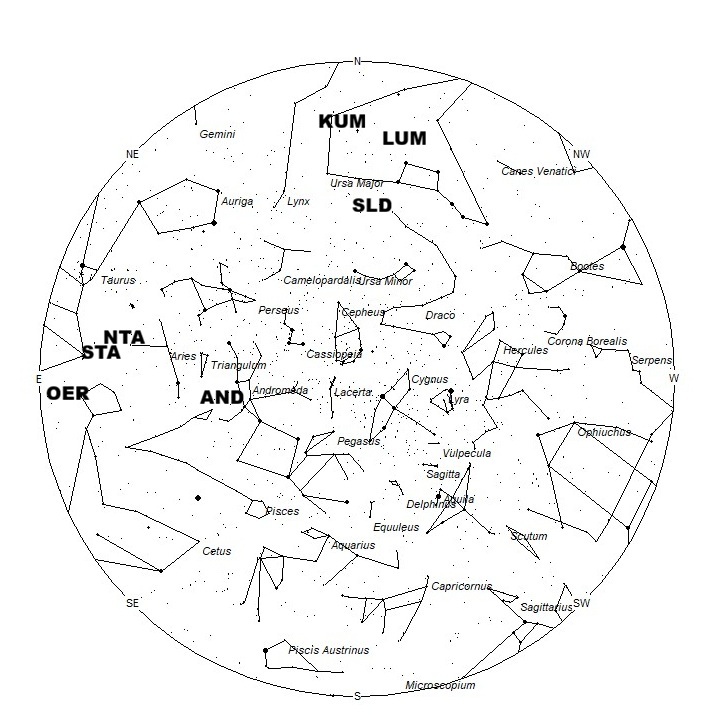
Radiant Positions at 19:00 Local Standard Time
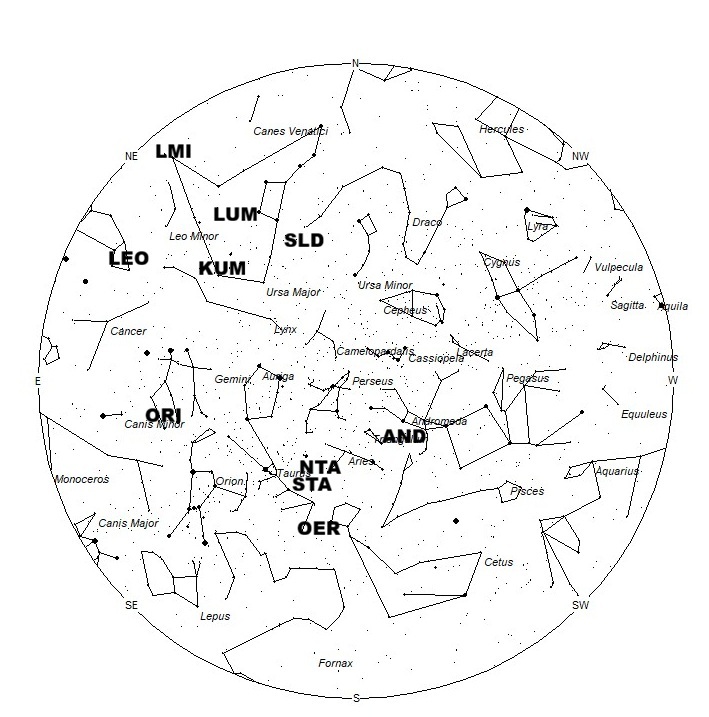
Radiant Positions at Midnight Local Standard Time
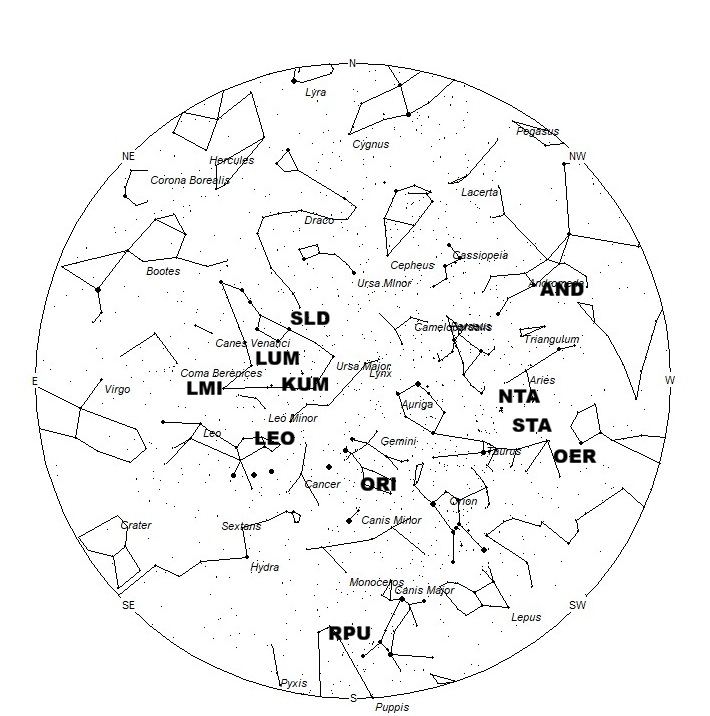
Radiant Positions at 05:00 Local Standard Time
The following sources of meteoric activity are expected to be active this week:
The Andromedids (AND) are the annual debris encountered from the remains of comet 3D/Biela. These meteors should not be mistaken for the great meteor storms of the 19th century as those meteors are in a slightly different orbit and irregularly encountered in early December. They are known as the December phi Cassiopeiids (DPC). It is interesting that during November, this radiant moves northward toward the area of the DPC’s but ends before reaching the DPC radiant. The radiant currently is located near 01:08 (017) +27. This position lies in northeastern Pisces, nine degrees southeast of the second magnitude star known as Mirach (beta Andromedae). This part of the sky is best placed near 23:00 LST, when the radiant lies highest above the southern horizon. Face toward the north near this time to best see these meteors. Current rates would most likely be less than 1 per hour no matter your location. With an entry velocity of 18 km/sec., the average Andromedid meteor would be of slow velocity.
The omicron Eridanids (OER) was discovered by the Japanese video meteor network SonotaCo from video data obtained during 2007-2008. These meteors are active from October 23 through December 2nd. Maximum activity is ill-defined and may occur anytime from October 28 to November 17. The date listed in the table represents the midpoint of the activity curve and not the actual date of maximum activity. The radiant is currently located at 03:20 (050) +03, which is located in northeastern Cetus, 3 degrees east of the second magnitude star known as Menkar (alpha Ceti). This radiant is best placed near 0100 LST, when it lies on the meridian and is located highest in the southern sky. Rates at this time should be less than 1 per hour no matter your location. With an entry velocity of 29 km/sec., the average OER meteor would be of medium-slow velocity.
The Northern Taurids (NTA) should be active from a wide radiant located at 03:50 (050) +21. This area of the sky lies in eastern Aries, 1 degree northeast of the fourth magnitude star known as Botein (delta Arietis). To best see these meteors, observers should face southward near 01:00 LST. To differentiate between the Northern and Southern Taurids, face toward these radiants, as they lie close together in the sky. Rates at this time should be near two per hour, as seen from the northern hemisphere and one as seen from south of the equator. With an entry velocity of 29 km/sec, the average NTA meteor would be of medium-slow velocity.
The wide radiant for the Southern Taurids (STA) is centered near 03:28 (052) +14. This area of the sky lies in western Taurus, one degree north of the 4th-magnitude star 5 Tauri. This radiant is best placed near 01:00 LST, when it lies on the meridian and is highest in the southern sky. Rates at this time should be near three per hour as seen from the Northern Hemisphere and two per hours as seen from south of the equator. With an entry velocity of 27 km/sec, the average STA meteor would also be of medium-slow velocity.
The Orionids (ORI) are active from October 2 through November 12, with maximum activity occurring on October 23rd. The radiant is currently located at 06:56 (104) +16, which places it in southern Gemini, four degrees east of the second magnitude star known as Alhena (gamma Geminiorum). This area of the sky is best placed for observing near 4:00 LST, when it lies highest in the southern sky. Current rates are expected to be less than 1 per hour no matter your location. With an entry velocity of 65 km/sec, the average ORI meteor would be of swift velocity
The rho Puppids (RPU) were discovered by Željko Andreić and the Croatian Meteor Network team based on studying SonotaCo and CMN observations (SonotaCo 2007-2011, CMN 2007-2010). These meteors are active from October 28 through November 22 with maximum activity occurring on November 8th. The radiant is currently located at 07:48 (117) -25. This area of the sky lies in western Puppis, two degrees west of the 2nd magnitude star known as Azmidi (xi Puppis). To best see these meteors face southward during the last dark hour prior to dawn. Rates at this time should be less than 1 per hour no matter your location. With an entry velocity of 58 km/sec., the average RPU meteor would be of medium-swift velocity.
The kappa Ursae Majorids (KUM) were discovered by cameras of the SonotaCo network in Japan during an outburst of activity on November 5, 2009. This radiant is active from October 28-November 17, with maximum activity occurring on the 6th. The radiant is currently located at 09:20 (140) +47. This position lies in southwestern Ursa Majoris, two degrees east of the fourth magnitude star known as Alkaphrah (kappa Ursae Majoris). Rates are expected to be less than one no matter your location. These meteors are best seen during the last hour before dawn when the radiant lies highest above the northern horizon in a dark sky. With an entry velocity of 56 km/sec., the average Kappa Ursae Majorid meteor would be of medium-swift velocity. Due to the high northern location of this radiant, these meteors are not well seen from the southern hemisphere.
The Leonids (LEO) are active from October 27 to December 7 with maximum activity occurring on November 18. The radiant is currently located at 09:36 (144) +28.0 This position lies in northwestern Leo, three degrees northwest of the fourth magnitude star known as Rasalas (mu Leonis). The Leonid radiant is best placed in the eastern sky during the last hour before morning twilight when the radiant lies highest in a dark sky. Leonids may be seen from the southern hemisphere, but the viewing conditions are not quite as favorable as those north of the equator. Current rates are expected to be less than one per hour no matter your location. With an entry velocity of 69 km/sec., most activity from this radiant would be of swift speed with numerous persistent trains on the brighter meteors.
The Southern lambda Draconids (SLD) were discovered by Željko Andreić and the Croatian Meteor Network team based on studying SonotaCo and CMN observations (SonotaCo 2007-2011, CMN 2007-2010). These meteors are active from October 30-November 8 with maximum activity occurring on November 3. The radiant is currently located at: 10:28 (157) +70. This area of the sky is currently located in northwestern Ursa Major, five degrees west of the fourth magnitude star known as Giausar (lambda Draconis). This area of the sky is best placed in the sky during the last hour before dawn, when it lies highest above the northern horizon in a dark sky. Current rates should be less than 1 per hour no matter your location. With an entry velocity of 49km/sec., most activity from this radiant would be of medium speed. Due to the high northern location, these meteors are poorly seen from the southern hemisphere.
The lambda Ursa Majorids (LUM) are active from a radiant located near 10:52 (163) +48. This area of the sky lies in southwestern Ursa Major, 3 degrees northwest of the 3rd magnitude star known as psi Ursae Majoris. This area of the sky is best placed in the sky during the last hour before dawn, when it lies highest above the northern horizon in a dark sky. Current rates should be less than 1 per hour no matter your location. With an entry velocity of 61km/sec., most activity from this radiant would be of swift speed. Like the other showers located in Ursa Major and Draco, these meteors are not well seen from the southern hemisphere.
The last of the Leonis Minorids (LMI) are expected this week from a radiant located at 11:24 (171) +33. This position lies in southern Ursa Major, one degree east of the third magnitude star known as Alula Borealis (nu Ursae Majoris). This area of the sky is best placed in the sky during the last hour before dawn, when it lies highest above the northeastern horizon in a dark sky. Current rates should be less than 1 per hour no matter your location. With an entry velocity of 61km/sec., most activity from this radiant would be of swift speed.
Sporadic meteors are those meteors that cannot be associated with any known meteor shower. All meteor showers are evolving and disperse over time to the point where they are no longer recognizable. Away from the peaks of the major annual showers, these sporadic meteors make up the bulk of the activity seen each night.
As seen from the mid-Northern Hemisphere (45N), one would expect to see during this period approximately eight sporadic meteors per hour during the last hour before dawn as seen from rural observing sites. Evening rates would be near three per hour. As seen from the tropical southern latitudes (25S), morning rates would be near six per hour as seen from rural observing sites and two per hour during the evening hours.
The list below provides information in tabular form on active showers within reach of the visual observer. Hourly rates are often less than one, so these sources are rarely listed as visual targets in most meteor shower catalogs. If you wish to associate as many meteors as possible with known sources, you will appreciate these listings.
Before claiming to have observed meteors from these Class IV showers, determine whether they truly belong to them and are not chance alignments of sporadic meteors. Note parameters such as duration, length, radiant distance, and elevation to help compute the probability of shower association.
It should be remembered that slow meteors can appear in fast showers, but fast meteors cannot be produced by slow showers. Slower showers have velocities less than 35 km/sec. Slow meteors from fast showers usually occur close to the radiant or low in the sky.
Recognizing meteors from obscure showers is not for beginning observers—it takes many hours of practice to develop an instinct for what you are seeing. It is our hope that you will move beyond simply watching meteors as a celestial fireworks display and help expand our knowledge by classifying each meteor you observe.
Rates and positions on the table are exact for Saturday night/Sunday morning Oct 31/Nov 01
| SHOWER | DATE OF MAXIMUM | CELESTIAL POSITION | ENTRY VELOCITY | CULMINATION | HOURLY RATE | CLASS |
| ACTIVITY | RA (RA in Deg.) DEC | Km/Sec | Local Standard Time | North-South | ||
| Andromedids (AND) | Nov 07 | 01:08 (017) +27 | 18 | 23:00 | <1 – <1 | IV |
| omicron Eridanids (OER) | Nov 05 | 03:20 (050) +03 | 29 | 01:00 | <1 – <1 | IV |
| Northern Taurids (NTA) | Nov 09 | 03:20 (050) +21 | 29 | 01:00 | 3 – 2 | II |
| Southern Taurids (STA) | Nov 04 | 03:28 (052) +14 | 29 | 01:00 | 2 – 1 | II |
| Orionids (ORI) | Oct 23 | 06:56 (104) +16 | 65 | 04:00 | <1 – <1 | I |
| rho Puppids (RPU) | Nov 08 | 07:48 (117) -25 | 58 | 05:00 | <1 – <1 | IV |
| kappa Ursae Majorids (KUM) | Nov 05 | 09:20 (140) +47 | 56 | 07:00 | 1 – <1 | IV |
| Leonids (LEO) | Nov 18 | 09:36 (144) +28 | 69 | 07:00 | <1 – <1 | I |
| Southern lambda Draconids (SLD) | Nov 03 | 10:28 (157) +70 | 49 | 08:00 | 1 – <1 | IV |
| lambda Ursae Majorids (LUM) | Oct 28 | 10:52 (163) +48 | 61 | 08:00 | 1 – <1 | IV |
| Leonis Minorids (LMI) | Oct 22 | 11:24 (171) +33 | 61 | 09:00 | <1 – <1 | II |
You can keep track of the activity of these meteor showers as well as those beyond the limits of visual observing by visiting the NASA Meteor Shower Portal. You can move the sky globe to see different areas of the sky. Colored dots indicate shower meteors while white dots indicate sporadic (random) activity. The large orange disk indicates the position of the sun so little activity will be seen in that area of the sky.
Class Explanation: A scale to group meteor showers by their intensity:
- Class I: the strongest annual showers with Zenith Hourly Rates normally ten or better.
- Class II: reliable minor showers with ZHR’s normally two to ten.
- Class III: showers that do not provide annual activity. These showers are rarely active yet have the potential to produce a major display on occasion.
- Class IV: weak minor showers with ZHR’s rarely exceeding two. The study of these showers is best left to experienced observers who use plotting and angular velocity estimates to determine shower association. These weak showers are also good targets for video and photographic work. Observers with less experience are urged to limit their shower associations to showers with a rating of I to III.