By Paul Roggemans, Denis Vida, Damir Šegon, Milan Kalina, James M. Scott, Jeff Wood
Abstract: A diffuse activity source in the constellation Fornax has been found in the Global Meteor Network data with significant activity between 12 and 22 July (λʘ 110°–120°; search window 12 July to 1 August) from a large radiant at R.A. 40.9° and decl. –29.6° (λʘ = 119.2°) with a geocentric velocity of 57.0 km/s. The activity has been identified as the Fornacids (FOR#1066), a Halley-type meteoroid stream. This shower has been recorded by GMN since 2021, and significantly every year since 2024.This case study confirms that this annual meteor shower fulfils the criteria required to be nominated for established status by the IAU-MDC.
1 Introduction
The IAU-MDC Working List of Meteor Showers (Jopek and Kaňuchová, 2017; Jenniskens et al., 2020) lists a poorly known diffuse activity south of the established eta-Eridanids (ERI#191). This activity was first detected by Jenniskens (2023) in CAMS data from the Southern Hemisphere, listed as the Fornacids (FOR#1066), MDC lists an unpublished solution from 2022. This shower is not included in the GMN reference list used for preliminary shower identification of paired meteors. A case study has been made using the radiant identification method on the 2026 observations and the orbit identification method on the 2019–2026 data. 280307 orbits were available between solar longitude 108° and 130° during these years.
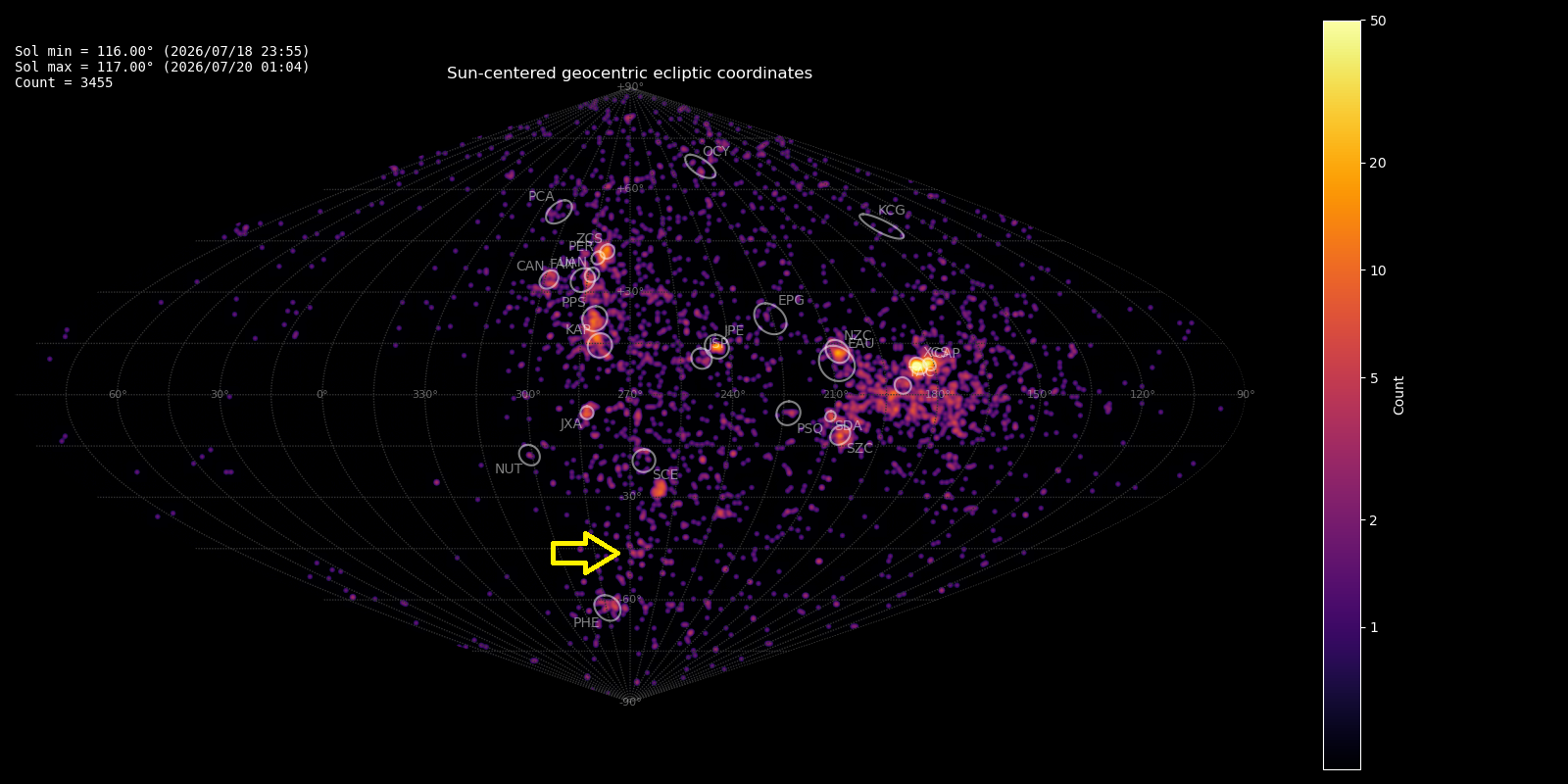
Figure 1 – Radiant density map with 3455 radiants obtained by the Global Meteor Network during solar longitude 116°–117°, 2026. The position of the Fornacids in Sun-centered geocentric ecliptic coordinates is marked with a yellow arrow.
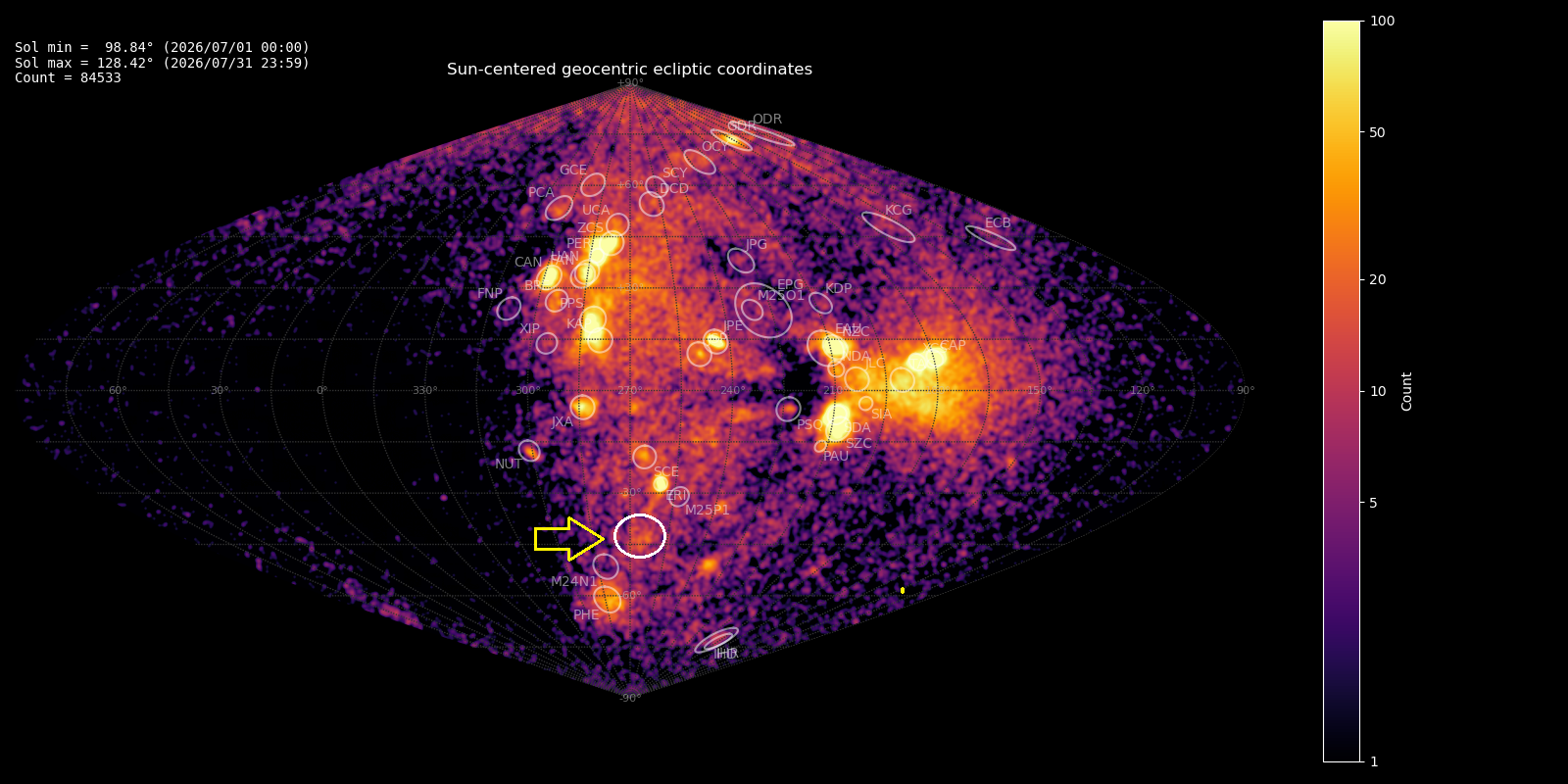
Figure 2 – Radiant density map with 84533 radiants obtained by the Global Meteor Network during July, 2026. The position of the Fornacids in Sun-centered geocentric ecliptic coordinates is marked with a yellow arrow.
2 Shower classification based on radiants
The activity is barely visible on the daily radiant density maps (Figure 1) and appears as a dispersed cluster of radiants on the monthly plot (Figure 2). The Global Meteor Network RadiantMap tool, developed by Milan Kalina, enables the visualization of the observed activity with the theoretical radiant positions based upon the IAU-MDC reference list (Figure 3).
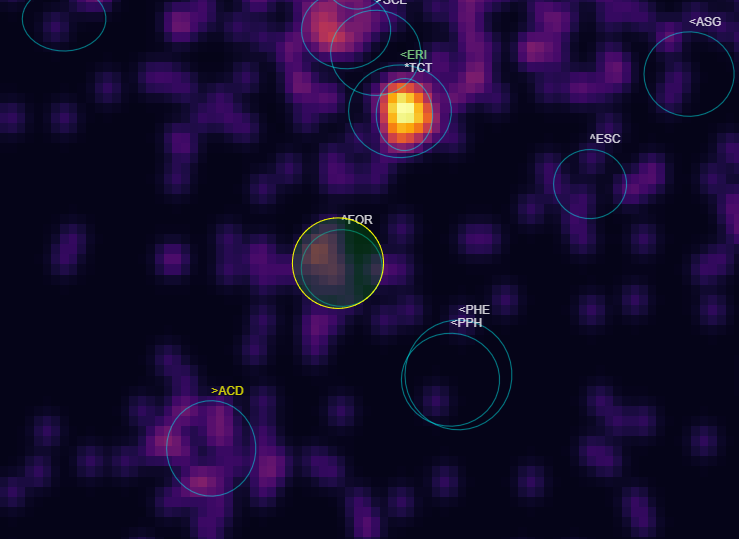
Figure 3 – Screenshot from RadiantMap at λʘ = 120° in 2026 with the selected region of interest for the FOR-activity in Sun-centered ecliptic coordinates in Mercator projection.
A weak and diffuse activity is difficult to extract from the background activity. The RadiantMap tool initially selected 248 meteors within the region of interest. The sample includes some duplicate solutions which were not removed in the analysis. The radiant offset threshold is 6.31° and the vg deviation threshold 2.0 km/s. Using these values to remove outliers, 166 meteors remained for final analysis. The final median dispersion is 2.4° giving an association radius (×2.5) of 6.0° (Vida et al., 2021, implemented in the RadiantMap tool). The final mean orbit solution has a geocentric velocity vg = 57.0 km/s, the velocities of the 166 selected meteors are within the range of 54.8 to 59.2 km/s. The heliocentric velocities are in the range of 37.1 to 43.3 km/s and include hyperbolic orbits.
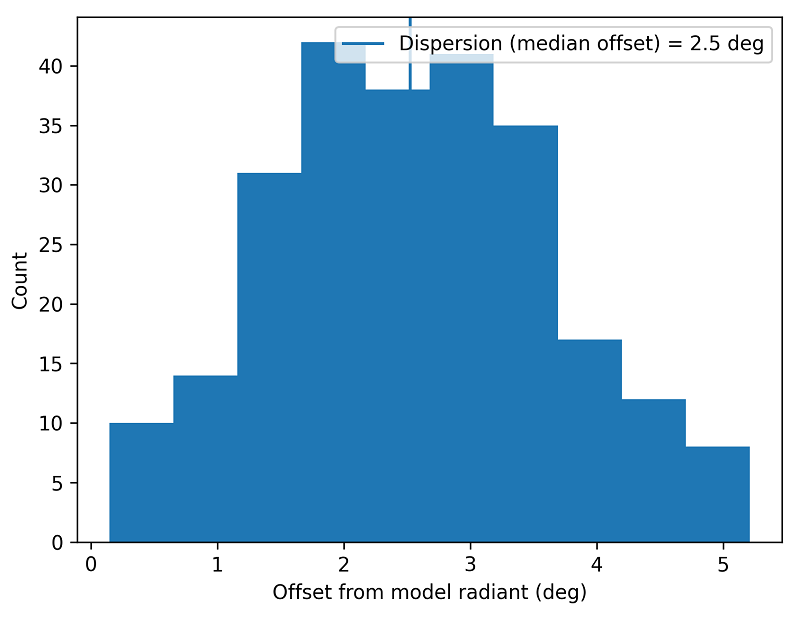
Figure 4 – Median radiant offset of 2.5° showing the 248 initial candidates (2026).
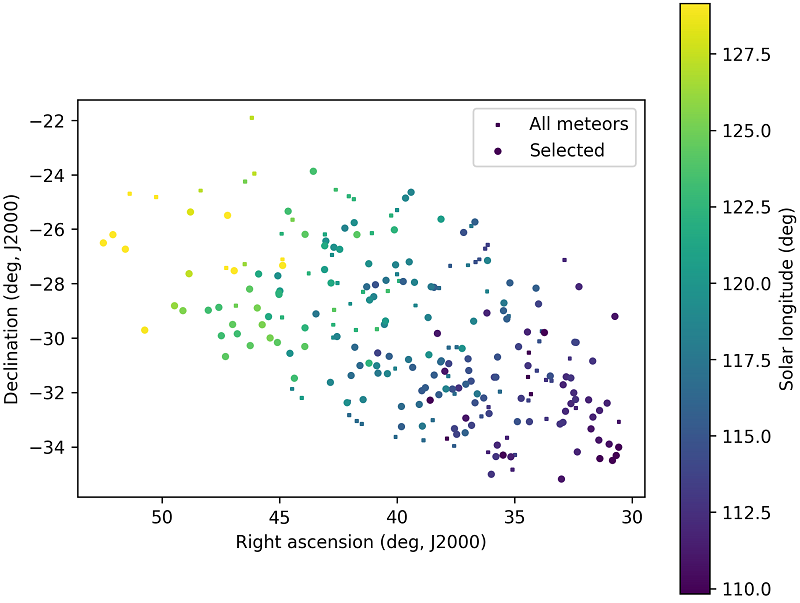
Figure 5 – The radiant distribution in 2026 during the solar-longitude interval 109.8° – 129.2° in equatorial coordinates.
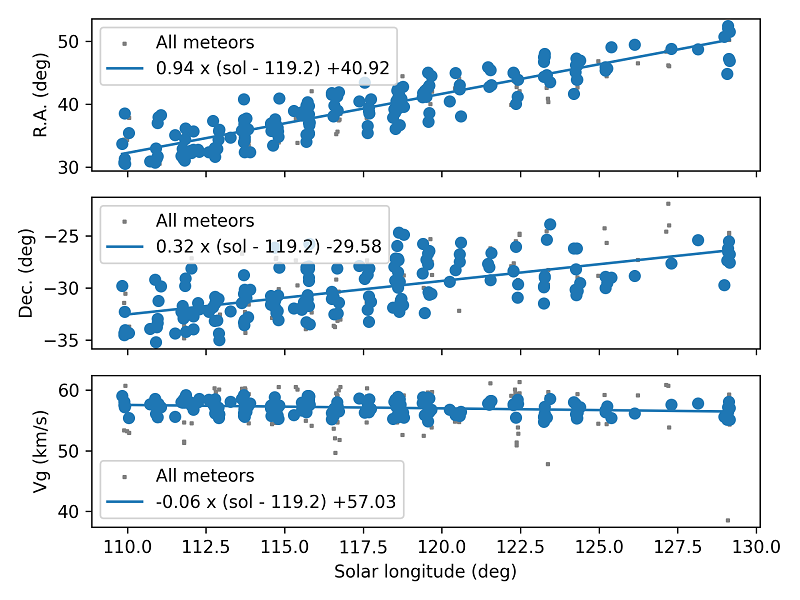
Figure 6 – The radiant drift in 2026.
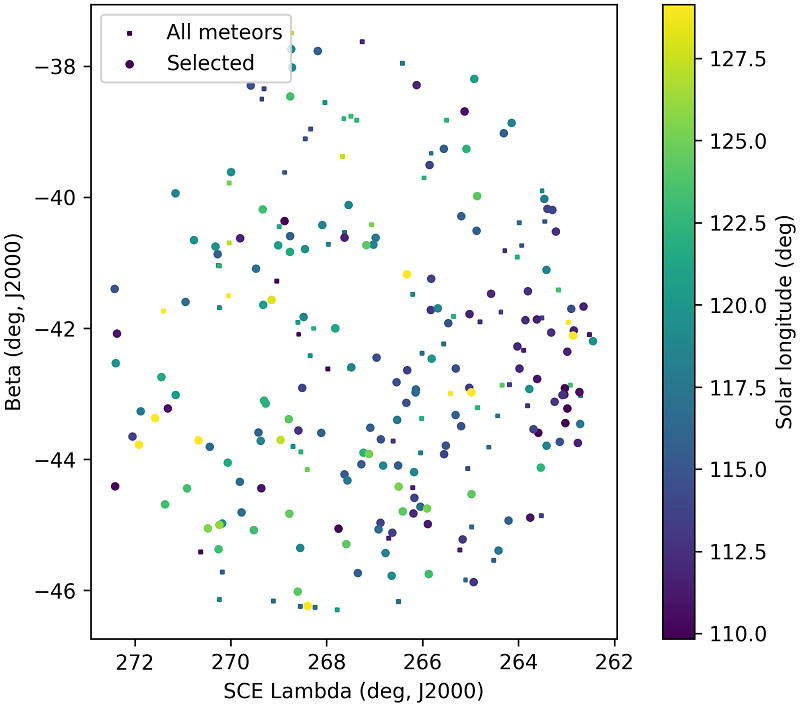
Figure 7 – The radiant distribution in 2026 during the solar-longitude interval 109.8° – 129.2° in Sun-centered geocentric ecliptic coordinates.
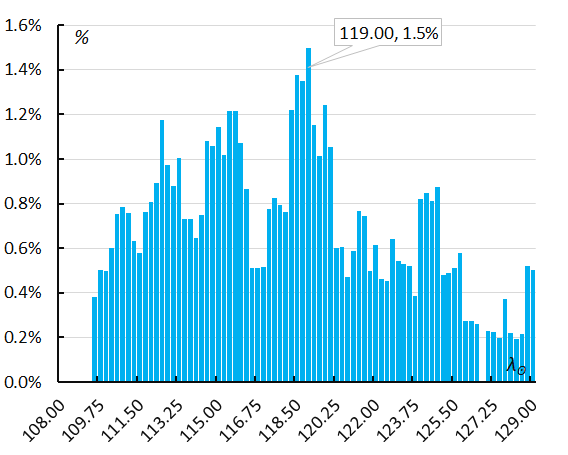
Figure 8 – The percentage of Fornacid-meteors for the radiant shower identification method for meteors relative to the total number of all meteors recorded in 2026 that had their beginpoint at southern latitude.
The velocity tolerance may be too tolerant in this case to exclude contamination with sporadics. The radiant drift is very obvious in the plot in equatorial coordinates (Figure 5). The results for the radiant drift are in Figure 6. In Sun-centered geocentric ecliptic coordinates there is no radiant drift visible, but the radiant is very diffuse (Figure 7).
The relative activity as a percentage of all meteors recorded south of the equator per degree in solar longitude (Figure 8) shows an irregular profile for the radiant determined activity with best percentages at λʘ = 119°. A profile over the wider interval, λʘ 98°–140° (1° bins, southern-hemisphere cameras as the denominator) gives a background of 0.59%, the mean fraction in the outer quarters of the interval, and a maximum of 1.97% at λʘ 118°–119°. Bins more than 3σ above the background run from λʘ 110° to 120° (12 to 22 July 2026); 124°–125° is marginal.
As a fraction of all orbits from southern-hemisphere cameras in λʘ 110°–125°, the Fornacids reached 9.6 ± 1.4‰ in 2023, 11.9 ± 1.1‰ in 2024, 11.3 ± 0.8‰ in 2025 and 12.2 ± 0.9‰ in 2026. The excess over the background is highly significant from 2024 on, marginal in 2023 (P = 0.009) and not significant in 2022. 2021 shows 5 meteors against 0.5 expected, but from only 138 orbits. There were no southern-hemisphere data in this window in 2019–2020.
The significance of the activity was tested against the sporadic background (criterion C3 of Hajduková et al., 2023). Within 5° of λg – λʘ = 267.0°, βg = –43.0° and vg between 51.5 and 62.9 km/s, 197 meteors were recorded by southern-hemisphere cameras between λʘ 110° and 125° in 2026, against 93.2 expected from the flanks (98°–110° and 125°–140°), a Poisson probability of 6·10⁻²¹. About half of these meteors are therefore expected to be sporadic, which illustrates the contamination problem of a diffuse radiant.
3 Shower classification based on orbits
A complete independent meteoroid stream search has been applied to orbit data obtained between solar longitude 108° and 130° during the years 2019–2026. The method has been described in detail in a separate publication (Roggemans et al., 2026a). 280307 orbits were available within this time interval and a final mean orbit has been computed by the method of Jopek et al. (2006) for the thresholds DSH < 0.125 and DD < 0.05 and DJ < 0.125 (Southworth and Hawkins, 1963; Drummond, 1981; Jopek, 1993), chosen as safe thresholds for this type of highly inclined, retrograde Halley-type orbit. The resulting mean orbit based upon 180 meteors recorded from 2021 until 2026 is listed in Table 2.
The orbit method failed to cover the entire activity period. The reason is that the strict threshold of the D-criteria rejects real shower meteors because the D-criteria are time dependent, while the orientation of the meteoroid orbit planes changes during the shower activity. The angle between the orbital planes changes. The longitude of perihelion changes by 0.76° per degree in solar longitude. For a diffuse activity source with a large dispersion, the D-criteria based orbit method is not suitable for activity periods longer than about a week.
Figures 9 to 12 plot the combined thresholds DSH < 0.15 and DD < 0.06 and DJ < 0.15 (marked as DD < 0.06), DSH < 0.125 and DD < 0.05 and DJ < 0.125 (marked as DD < 0.05), DSH < 0.10 and DD < 0.04 and DJ < 0.10 (marked as DD < 0.04) and DSH < 0.05 and DD < 0.02 and DJ < 0.05 (marked as DD < 0.02). The sporadic background (black dots) was limited to 2023–2026 because no Fornacid meteors were recorded in 2019–2020 and only one each in 2021 and 2022 in the orbit-method selection.
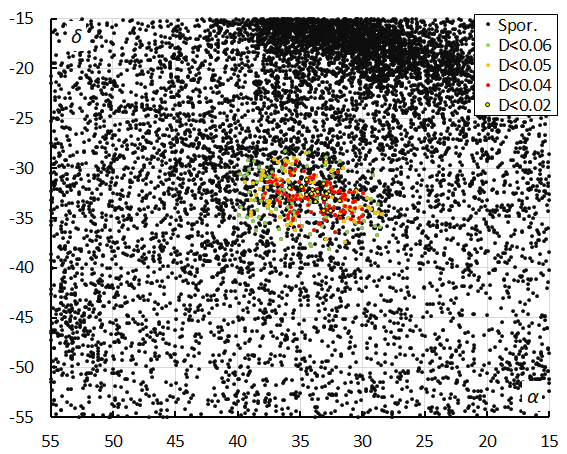
Figure 9 – The radiant distribution during the solar-longitude interval 108.0° – 130.0° in equatorial coordinates, color-coded for different threshold values of the combined similarity criteria in 2023–2026.
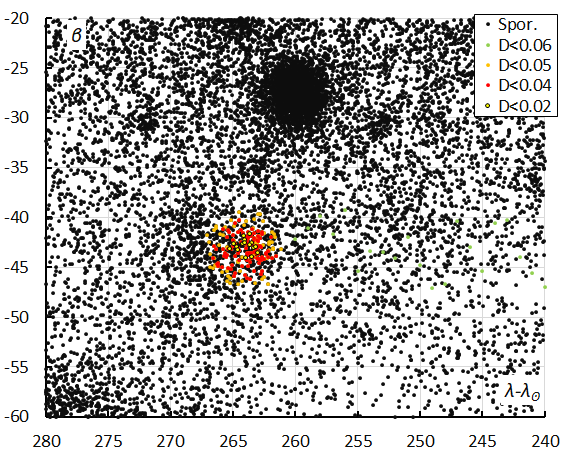
Figure 10 – The radiant distribution during the solar-longitude interval 108.0° – 130.0° in Sun-centered geocentric ecliptic coordinates, color-coded for different threshold values of the combined similarity criteria in 2023–2026.
The iteration based on the D-criteria threshold with DSH < 0.125 and DD < 0.05 and DJ < 0.125 converged to a solution that is only valid for shower members between solar longitude 108.1° and 119.5°, which is the activity before the maximum. This selection effect is well visible in Figure 9 where a concentration of radiants east of the selected radiants are the remaining Fornacids during the second part of the activity period. This is more visible in the Sun-centered ecliptic coordinates in Figure 10. The radiant is diffuse, which is due to the large dispersion on the orbits. The dark concentration north of the Fornacids are the eta-Eridanids. Some other concentrations are visible too.
The case of the Fornacids shows that the solution depends upon the method used and that the D-criteria may not be suitable for all cases. With a diffuse radiant, the radiant method risks contamination from sporadics, while the D-criteria-based method fails to determine a reference orbit valid for the entire activity period.
A way to improve the radiant-based shower identification could be to add a filter to remove outliers in heliocentric velocities by using only orbits with e < 1. The parabolic limit in July is 41.8 km/s. Removing all hyperbolic orbits for the radiant based selected meteors we obtained a solution that is slightly different from those obtained by the orbit method, but still covering the entire activity period (see Table 2). Another run of the D-criteria iteration was applied on 89836 meteors available within solar longitudes 115° and 123°, 4° before and after λʘ = 119° using the threshold class DSH < 0.15 and DD < 0.06 and DJ < 0.15 which is more tolerant for dispersed stream like the Fornacids.
Looking at the geocentric and heliocentric velocity ranges of the different solutions in Table 1, the geocentric velocity range is comparable for all four samples. The heliocentric velocity range for the radiant method has ~6.2 km/s difference between the lowest and highest velocity, while the orbit determined solution for λʘ 108°–119° has only 1.7 km/s difference. Using a more tolerant threshold for the D-criteria with DSH < 0.15 and DD < 0.06 and DJ < 0.15 for λʘ 115°–123°, the difference between the lowest and highest heliocentric velocities is still as low as ~2.1 km/s.
Table 1 – The geocentric and heliocentric velocities for four different solutions.
| Min. | Med. | Max. | Min. | Med. | Max. | |
| vg | vg | vg | vh | vh | vh | |
| Radiant | 54.77 | 57.28 | 59.17 | 37.11 | 41.02 | 43.31 |
| Radiant e < 1 | 54.77 | 57.00 | 59.06 | 37.11 | 40.87 | 41.73 |
| Orbit 108°-119° | 54.72 | 57.24 | 59.53 | 40.33 | 41.25 | 42.06 |
| Orbit 115°-123° | 54.01 | 56.94 | 59.68 | 39.93 | 41.02 | 42.03 |
4 Orbit and parent body
The diagram of the inclination i versus the longitude of perihelion Π shows a diffuse distribution (Figure 11). The D-criteria identified Fornacids represent only half the activity period. Such a large spread in longitude of perihelion and inclinations fails to fit the D-criteria threshold. On the other hand, the radiant based method failed to identify Fornacids that fit the D-criteria threshold but did not fit the assumed radiant size. The dark concentration at left are mainly zeta-Cassiopeiids (ZCS#444) and Perseids (PER#7). A diagram with eccentricity against inclination is not helpful in this case as the inclination range is saturated with zeta-Cassiopeiids and Perseids.
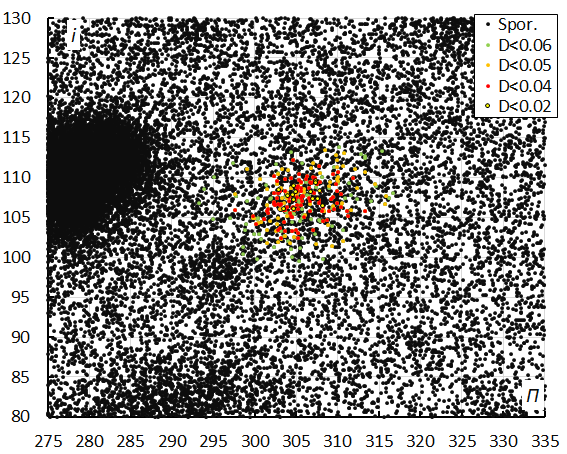
Figure 11 – Inclination i versus the longitude of perihelion Π color-coded for different classes of D-criteria thresholds, for λʘ between 108.0° – 130.0° in 2023–2026. Spor. = sporadics.
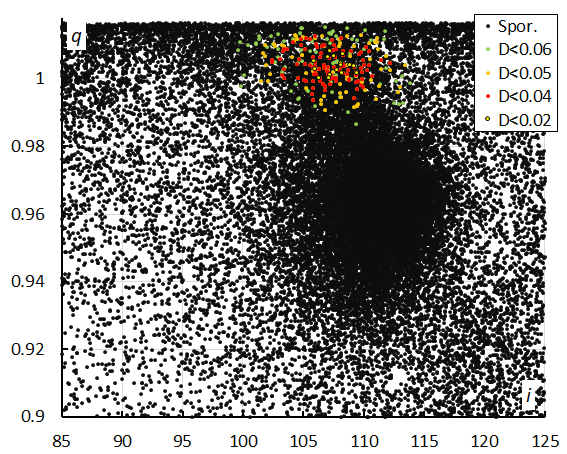
Figure 12 – Perihelion distance q versus the inclination i color-coded for different classes of D-criteria thresholds, for λʘ between 108.0° – 130.0° in 2023–2026. Spor. = sporadics.
Table 2 – Comparing solutions derived by two different methods, radiant method for 2026 and the radiant method limited to e < 1. The orbit method for DSH < 0.125 and DD < 0.05 and DJ < 0.125, 2021–2026, that covers only 108.1°–119.5° in solar longitude. The orbit method applied on a selection limited to solar longitude 115.0°–123.0° with DSH < 0.15 and DD < 0.06 and DJ < 0.15. λʘb and λʘe of the radiant columns are the limits of the search window. R.A./Dec. are drift values at the λʘ given; compare the columns in λg – λʘ and βg. Hb, He, Hp are the begin-, end- and peak-brightness heights and MagAp is the average peak absolute magnitude, normalized to 100 km.
| Radiant
method 2026 |
Radiant
method 2026 |
D-criteria 2021–2026 (λʘ: 108.1°–119.5°) DD<0.05 | D-criteria 2021–2026 (λʘ: 115.0°–123.0°) DD<0.06 | Jenniskens (2023) | |
| λʘ (°) | 119.2 | 117.4 | 113.0 | 118.7 | 117.0 |
| λʘb (°) | 109.8 | 109.8 | 108.1 | 115.1 | 108 |
| λʘe (°) | 129.2 | 129.1 | 119.5 | 123.0 | 129 |
| αg (°) | 40.9 | 38.6 | 33.9 | 40.9 | 39.5 |
| δg (°) | –29.6 | –30.1 | –32.9 | –30.4 | –31.2 |
| Δαg (°/°λʘ) | +0.94 | +0.94 | +0.84 | +0.82 | +1.07 |
| Δδg (°/°λʘ) | +0.32 | +0.33 | +0.46 | +0.55 | +0.45 |
| vg (km/s) | 57.0 | 57.0 | 57.2 | 56.9 | 57.2 |
| Hb (km) | 107.9 | 107.8 | 108.7 | 108.6 | 111.8 |
| He (km) | 95.1 | 95.4 | 94.8 | 94.6 | 94.6 |
| Hp (km) | 99.5 | 99.7 | 99.3 | 99.3 | 99.2 |
| MagAp | –0.8 | –0.8 | –1.1 | –0.9 | +1.8 |
| λg (°) | 26.5 | 24.1 | 17.3 | 25.9 | |
| λg – λʘ (°) | 267.3 | 266.9 | 264.3 | 267.4 | 266.4 |
| βg (°) | –42.7 | –42.9 | –43.1 | –43.2 | –43.3 |
| a (A.U.) | 10.3 | 8.5 | 18.5 | 13.7 | 18.7 |
| q (A.U.) | 1.005 ± 0.006 | 1.004 ± 0.006 | 1.001 ± 0.005 | 1.008 ± 0.004 | 1.001 ± 0.004 |
| e | 0.903 ± 0.097 | 0.881 ± 0.086 | 0.946 ± 0.038 | 0.926 ± 0.046 | 0.946 ± 0.120 |
| i (°) | 108.1 ± 2.8 | 108.2 ± 3.0 | 107.3 ± 2.6 | 107.0 ± 3.6 | 107.2 ± 2.19 |
| ω (°) | 7.1 ± 5.9 | 7.0 ± 5.9 | 12.6 ± 2.9 | 6.2 ± 2.2 | 8.1 ± 3.01 |
| Ω (°) | 297.3 ± 5.0 | 297.4 ± 5.0 | 293.1 ± 2.5 | 298.8 ± 3.7 | 297.0 ± 5.30 |
| Π (°) | 304.4 ± 6.3 | 304.4 ± 6.4 | 305.7 ± 3.4 | 305.0 ± 3.9 | 305.0 ± 3.01 |
| Tj | 0.13 ± 0.50 | 0.24 ± 0.44 | –0.08 ± 0.22 | 0.02 ± 0.26 | –0.07 ± 0.38 |
| N | 166 | 142 | 180 | 174 | 207 |
The diagram of the perihelion distance versus inclination (Figure 12) shows a clear concentration in perihelion distances for the Fornacids within a range of 0.991 to 1.013 AU. Moreover, the radiant-based Fornacids are within a similar range of 0.993 to 1.016 A.U. With the argument of perihelion ω of about 7° the encounter is almost at perihelion, so q is close to the node distance (1.009–1.013 AU for the Table 2 orbits) and cannot exceed the Earth’s distance in July. The narrow q range is therefore mostly geometry. The spread in eccentricity (0.578–1.147), inclination (102.6°–115.6°) and longitude of perihelion (285.4°–327.4°) is much larger for the radiant identified Fornacids than for the D-criteria based solutions with eccentricity (0.865–1.027), inclination (101.5°–113.4°) and longitude of perihelion (297.6°–315.9°). The explanation for this is mainly the very diffuse nature of this meteoroid stream and the selection effect by the D-criteria method.
Table 2 shows the solution found with the two different methods. The first column is the result as derived from the RadiantMap method. The large diffuse radiant may include contamination with sporadics. As an experiment a new solution was calculated after removing outliers in heliocentric velocity by removing all hyperbolic orbits. The resulting solution in the second column covers the entire activity period but still includes too low eccentricity orbits. Both D-criteria based solutions cover the activity period only partially because the large dispersion on the Fornacid orbits fails to fit the similarity criteria for the entire activity period.
All four GMN solutions are within all six limits of the maximum-sigma test against FOR#1066/000 (Jopek et al., 2024). Several other entries of the IAU-MDC list lie near the Fornacids. The iota1-Fornacids (IFR#1169), only 1°–2° away in R.A./Dec., should not be used: this entry is flagged for reference problems and repeats the 77-Cetids (SCE#1070) record (same λʘ = 128.4°, vg = 67.5 km/s, N = 305, q, e, ω and Ω; only R.A., Dec. and i differ). The 77-Cetids themselves (R.A. 37.7°, Dec. –6.4°) are 22° away in Sun-centered coordinates, 11° later in solar longitude and 10.5 km/s faster. M2026-R1 is 12.3° away at λʘ = 115.4° with vg = 62.2 km/s (DD = 0.122, DSH = 0.376), and M2024-N1 is 13.9° away at λʘ = 102.8° (DD = 0.19). Both are separate showers according to the maximum-sigma test (Jopek et al., 2024).
The Tisserand value relative to Jupiter suggests a Halley-type meteor shower (Tancredi, 2014). The retrograde orbit is steep on the ecliptic plane and crosses the Earth orbit at its ascending node (Figure 13). The descending node is situated between 15 and 25 AU, between the orbits of Saturn and Neptune (30.7 AU for Jenniskens, 2023). Figure 14 shows three solutions listed in Table 2 in the inner solar system. The different solutions are still in good agreement, but the orbit solution (108.1°–119.5°) is the exception: DSH = 0.137–0.164 (DD = 0.051–0.060) against the other GMN solutions, which is larger than the DSH threshold of 0.125 used for the selection. The two D-criteria based solutions differ by DSH = 0.164 due to the difference in node (293.1° vs 298.8°). The other GMN solutions agree with each other within DSH = 0.022–0.058 and with Jenniskens (2023) within DSH = 0.049–0.070.
A search for a possible parent body did not result in any positive match, but the ten best results are listed in Table 3. The diffuse nature of this meteoroid stream indicates this is probably an old and dispersed cometary dust trail.
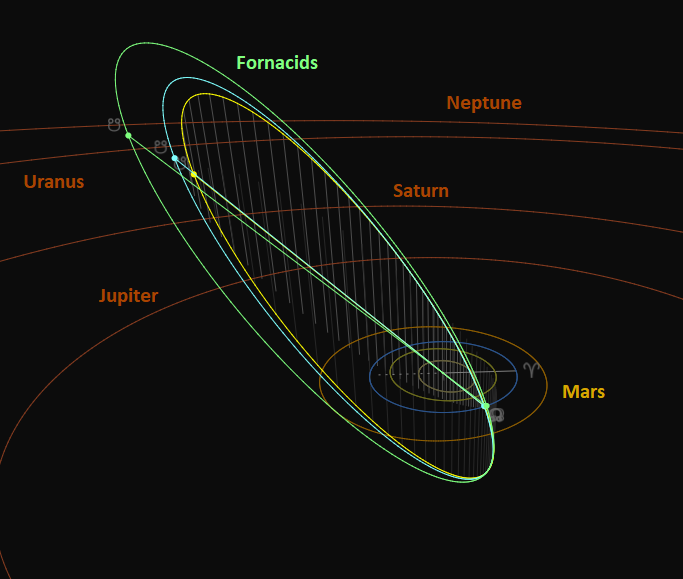
Figure 13 – The radiant determined solution for 2026 (blue), limited to e < 1 (yellow) and the D-criteria based method for solar longitude 115° to 123° (green). (Plotted with the Orbit visualization app provided by Pető Zsolt).
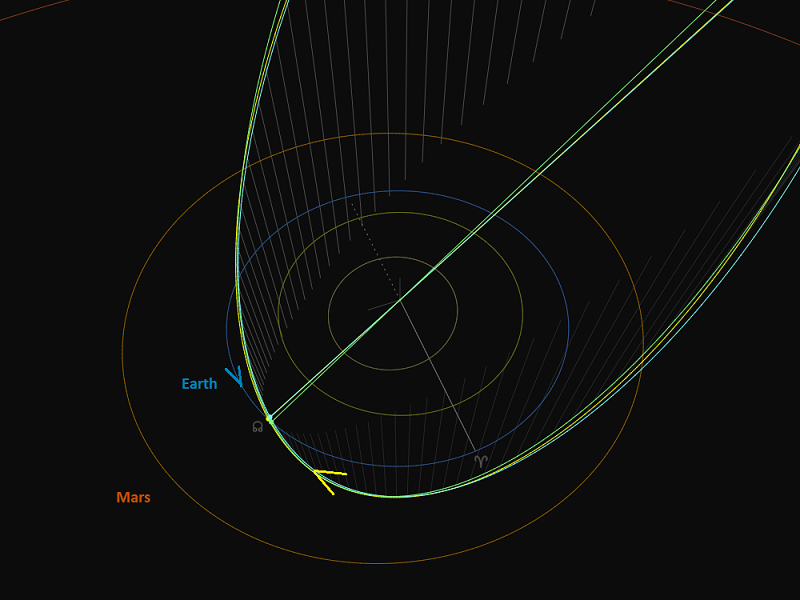
Figure 14 – Close-up in the inner Solar system with the three solutions near the Earth orbit. (Plotted with the Orbit visualization app provided by Pető Zsolt).
Table 3 – Top ten matches of a search for possible parent bodies with DD < 0.30, based upon the mean orbit derived from the radiant classification method on 2026 data. JPL ELEMENTS.COMET (retrieved 2026-09-28).
| Name | DD | DSH |
| C/1500 H1 | 0.137 | 0.375 |
| C/1852 K1 (Chacornac) | 0.211 | 0.617 |
| C/2013 A1 (Siding Spring) | 0.211 | 0.559 |
| C/1886 J1 (Brooks) | 0.213 | 0.610 |
| C/1925 G1 (Orkisz) | 0.225 | 0.572 |
| 273P/Pons-Gambart | 0.231 | 0.623 |
| C/2008 A1 (McNaught) | 0.233 | 0.628 |
| C/2013 UQ4 (Catalina) | 0.233 | 0.699 |
| C/2020 H2 (Pruyne) | 0.254 | 0.659 |
| C/1912 R1 (Gale) | 0.258 | 0.652 |
5 Conclusions
The existence and annual nature of the Fornacids have been confirmed. With the significance test the annual nature is confirmed for 2024–2026 and marginally in 2023, at a constant normalized level of 10–12‰. Nothing significant in 2022 or 2021 while 2019 and 2020 had no southern hemisphere coverage.
The limits of 109.8° and 129.2° in Table 2 are the edges of the RadiantMap window, not measured activity limits. The wider-window GMN profile gives significant activity from 110° to 120° (124°–125° marginal). The large diffuse radiant and large dispersion on the orbits proved a challenge for the shower identification methods. While the radiant based method suffers contamination with the sporadic background, the D-criteria based method fails to cover the entire activity period. The solutions obtained via different methods agree with those published by Jenniskens (2023). The Tisserand value relative to Jupiter and the high ablation heights between 108 and 99 km for a geocentric velocity of 57.0 km/s indicate a cometary origin but no parent body could be identified with any certainty. The solutions obtained by the Radiant method 2026 (unfiltered) and the orbit method for 2021–2026 (λʘ: 115.0°–123.0°) with DD<0.06 have been reported to the IAU-MDC.
Acknowledgments
This report is based on the data of the Global Meteor Network (Vida et al., 2020a; 2020b; 2021) which is released under the CC BY 4.0 license. We thank all 927 participants in the Global Meteor Network project for their contribution and perseverance. A list with the names of the volunteers who contribute to GMN has been published in the 2025 annual report (Roggemans et al., 2026b). The following 284 cameras contributed to paired meteors used in this study:
AU0002, AU0003, AU0004, AU0006, AU000A, AU000B, AU000C, AU000D, AU000E, AU000R, AU000S, AU000U, AU000V, AU000W, AU000Z, AU0010, AU0011, AU001A, AU001B, AU001C, AU001E, AU001F, AU001K, AU001L, AU001P, AU001Q, AU001R, AU001S, AU001V, AU001W, AU001X, AU001Z, AU0028, AU0029, AU002A, AU002B, AU002E, AU0030, AU0035, AU003E, AU003H, AU003J, AU0040, AU0041, AU0042, AU0043, AU0046, AU0047, AU0048, AU004H, AU004J, AU004K, AU004M, AU004Q, AU004R, BR0001, BR000F, BR000G, BR000Q, BR000T, BR000Y, BR0029, BR002A, BR002B, BR002C, MX0006, MX000A, NZ0001, NZ0002, NZ0003, NZ0004, NZ0007, NZ0008, NZ0009, NZ000B, NZ000D, NZ000F, NZ000G, NZ000H, NZ000J, NZ000K, NZ000L, NZ000M, NZ000N, NZ000P, NZ000Q, NZ000R, NZ000S, NZ000U, NZ000W, NZ000X, NZ000Y, NZ000Z, NZ0010, NZ0011, NZ0012, NZ0013, NZ0014, NZ0015, NZ0016, NZ0017, NZ0018, NZ0019, NZ001A, NZ001C, NZ001D, NZ001E, NZ001G, NZ001H, NZ001J, NZ001K, NZ001L, NZ001N, NZ001P, NZ001Q, NZ001R, NZ001S, NZ001V, NZ001X, NZ001Z, NZ0020, NZ0021, NZ0022, NZ0023, NZ0025, NZ0026, NZ0027, NZ0028, NZ0029, NZ002B, NZ002C, NZ002D, NZ002E, NZ002F, NZ002G, NZ002H, NZ002J, NZ002K, NZ002N, NZ002P, NZ002Q, NZ002R, NZ002S, NZ002T, NZ002U, NZ002V, NZ002W, NZ002X, NZ0030, NZ0032, NZ0033, NZ0034, NZ0035, NZ0036, NZ0037, NZ0038, NZ0039, NZ003A, NZ003B, NZ003C, NZ003E, NZ003F, NZ003G, NZ003H, NZ003K, NZ003N, NZ003Q, NZ003R, NZ003S, NZ003T, NZ003U, NZ003V, NZ003W, NZ003X, NZ003Y, NZ003Z, NZ0040, NZ0041, NZ0042, NZ0044, NZ0045, NZ0049, NZ004A, NZ004B, NZ004C, NZ004D, NZ004E, NZ004F, NZ004H, NZ004J, NZ004L, NZ004N, NZ004R, NZ004S, NZ004T, NZ004U, NZ004Y, NZ0051, NZ0059, NZ005A, NZ005B, NZ005C, NZ005D, NZ005E, NZ005F, NZ005G, NZ005J, NZ005K, NZ005L, NZ005M, NZ005N, NZ005Q, NZ005R, NZ005S, NZ005T, NZ005U, NZ005Y, NZ005Z, NZ0061, NZ0063, NZ0065, NZ0066, NZ0067, NZ0068, NZ0069, NZ006A, NZ006B, NZ006C, NZ006D, NZ006E, NZ006F, NZ006G, NZ006H, NZ006J, NZ006K, NZ006L, NZ006M, NZ006N, NZ006Q, NZ006R, NZ006S, NZ006T, NZ006U, NZ006V, NZ0073, NZ007B, NZ007C, NZ007D, NZ007E, NZ007F, US0002, US0004, US0005, US0009, US000C, US000G, US000H, US000J, US000K, US000R, US001R, US001Z, US0021, US003P, US005K, US005W, USL004, USL009, USL00A, USL00B, USL00E, USL00F, USL00N, USL00Z, USL013, USL016, USL018, USL01A, ZA0002, ZA0007, ZA000A, ZA000C, ZA000D and ZA000F.
References
Drummond J. D. (1981). “A test of comet and meteor shower associations”. Icarus, 45, 545–553.
Hajduková M., Rudawska R., Jopek T. J., Koseki M., Kokhirova G., Neslušan L. (2023). “Modification of the Shower Database of the IAU Meteor Data Center”. Astronomy & Astrophysics, 671, A155.
Jenniskens P., Jopek T. J., Janches D., Hajduková M., Kokhirova G. I., Rudawska R. (2020). “On removing showers from the IAU Working List of Meteor Showers”. Planetary and Space Science, 182, 104821.
Jenniskens P. (2023). Atlas of Earth’s meteor showers. Elsevier, Cambridge, United States. ISBN 978-0-443-23577-1. Page 435.
Jopek T. J. (1993). “Remarks on the meteor orbital similarity D-criterion”. Icarus, 106, 603–607.
Jopek T. J., Rudawska R. and Pretka-Ziomek H. (2006). “Calculation of the mean orbit of a meteoroid stream”. Monthly Notices of the Royal Astronomical Society, 371, 1367–1372.
Jopek T. J. and Kaňuchová Z. (2017). “IAU Meteor Data Center, the shower database: A status report”. Planetary and Space Science, 143, 3–6.
Jopek T. J., Neslušan L., Rudawska R., Hajduková M. (2024). “Search for duplicates of showers in the IAU MDC database. Methods and general results”. Astronomy & Astrophysics, 682, A159.
Roggemans P., Vida D., Šegon D., Scott J. M. (2026a). “Meteoroid orbit shower identification method and its application in meteor shower case studies”. eMetN Meteor Journal, 11, 189–204.
Roggemans P., Campbell-Burns P., Kalina M., McIntyre M., Scott J. M., Šegon D., Vida D. (2026b). “Global Meteor Network report 2025”. eMetN Meteor Journal, 11, 89–129.
Southworth R. B. and Hawkins G. S. (1963). “Statistics of meteor streams”. Smithsonian Contributions to Astrophysics, 7, 261–285.
Tancredi G. (2014). “A criterion to classify asteroids and comets based on the orbital parameters”. Icarus, 234, 66–80.
Vida D., Gural P., Brown P., Campbell-Brown M., Wiegert P. (2020a). “Estimating trajectories of meteors: an observational Monte Carlo approach – I. Theory”. Monthly Notices of the Royal Astronomical Society, 491, 2688–2705.
Vida D., Brown P. G., Campbell-Brown M., Wiegert P., Gural P. S. (2020b). “Estimating trajectories of meteors: an observational Monte Carlo approach – II. Results”. Monthly Notices of the Royal Astronomical Society, 491, 3996–4011.
Vida D., Šegon D., Gural P. S., Brown P. G., McIntyre M. J. M., Dijkema T. J., Pavletić L., Kukić P., Mazur M. J., Eschman P., Roggemans P., Merlak A., Zubrović D. (2021). “The Global Meteor Network – Methodology and first results”. Monthly Notices of the Royal Astronomical Society, 506, 5046–5074.