By Yury Harachka
Abstract: On 7 September 2026 at 19:17:51 UT, six cameras of the Belarusian Meteor Network recorded a bright, slow fireball that reached a peak absolute magnitude of −9.2. The meteoroid entered the atmosphere at 14.8 km/s, flew almost due north over northern Belarus and ended at a height of 32.5 km near the Belarus–Latvia border. Its orbit is of the Apollo type, with a Tisserand parameter TJ = 3.27. The spectrum, the PE criterion and the strength implied by the dynamic pressure all point to stony, chondritic material. The photometric pre-atmospheric mass is about 2.8 kg. Two independent dynamic estimates give the mass that entered dark flight: 94 g from a local fit of the deceleration and 79 g from the α–β model with μ = 2/3. By the α–β criterion (Sansom et al., 2019) the event lies right at the boundary for fireballs that drop a meteorite of at least 50 g. A dark-flight computation with an ERA5 atmospheric profile places the strewn field in Latvia, between the villages of Karļinova and Ritāni. To our knowledge, no other observations of this fireball have been published.
1. Observations
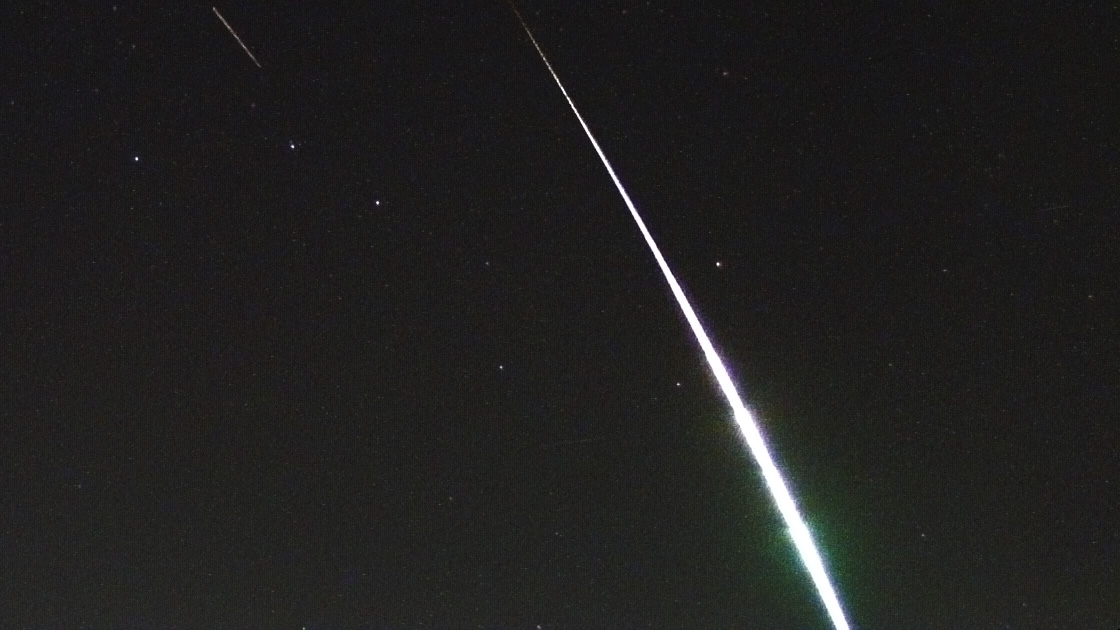
On the evening of 7 September 2026 at 19:17:51 UT (22:17:51 local time), a fireball with a peak absolute magnitude of −9.2 was observed over northern Belarus (Figure 1). It was recorded by six cameras of the Belarusian Meteor Network (Figure 2, Table 1).
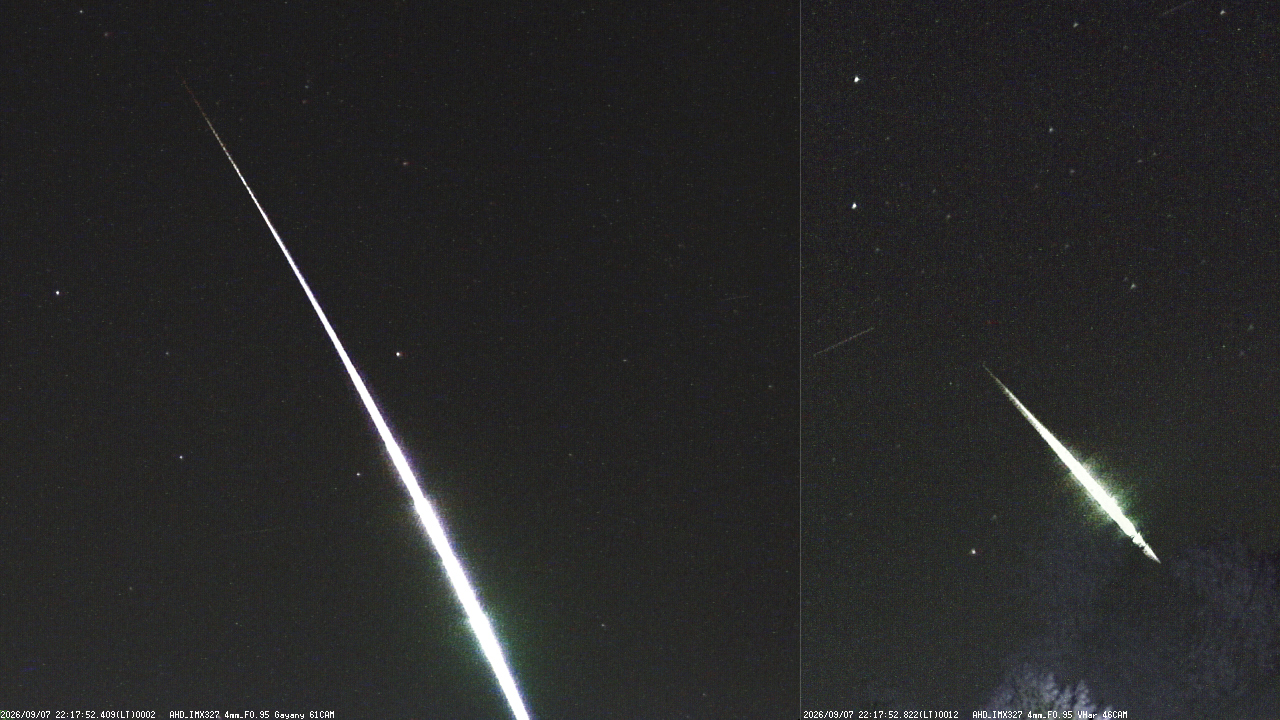
Figure 1 – The fireball of 7 September 2026 as recorded by two cameras of the Belarusian Meteor Network: cam61 (left) and cam46 (right). Tree branches at the bottom of the cam46 frame cover part of the trail near its end; the very end of the trail is free of obstruction.
The meteoroid entered the atmosphere at 14.78 km/s on a fairly shallow trajectory, inclined 29.0° to the horizon. It flew almost due north (azimuth of motion 0.52°). The fireball began to glow at a height of 89.6 km, approximately above Lake Narach. The luminous flight lasted about 9.0 s, during which the meteoroid covered about 120 km in the atmosphere. The fireball ended at a height of 32.5 km above the Belarus–Latvia border.
The final part of the trajectory was seen only by cam46, which was 370 km from the end point and saw it just 3.4° above the horizon. The brightness along the trajectory was smooth, without distinct flares, and peaked (−9.2) at a height of about 51 km, in the second half of the path. The video recordings show no sign of fragmentation.
Table 1 – Cameras that recorded the fireball. Track: heights of the first and last measured points of each camera (above mean sea level). Range: distance from the camera to the last point it saw.
| Camera | Lat, °N | Lon, °E | Alt, m | Track, km | Range, km | Photometry |
|---|---|---|---|---|---|---|
| cam42 | 53.950740 | 27.323417 | 226 | 89.5 → 75.6 | 143 | yes |
| cam46 | 52.521766 | 28.360257 | 139 | 83.4 → 32.5 | 370 | yes |
| cam61 | 54.154871 | 27.604832 | 270 | 87.9 → 42.1 | 168 | yes |
| cam66 | 54.279332 | 26.743848 | 231 | 81.4 → 74.1 | 111 | no |
| cam71 | 52.964457 | 26.458015 | 190 | 83.9 → 68.6 | 251 | no (spectrum) |
| cam80 | 53.641810 | 23.903057 | 158 | 83.2 → 64.8 | 266 | no |
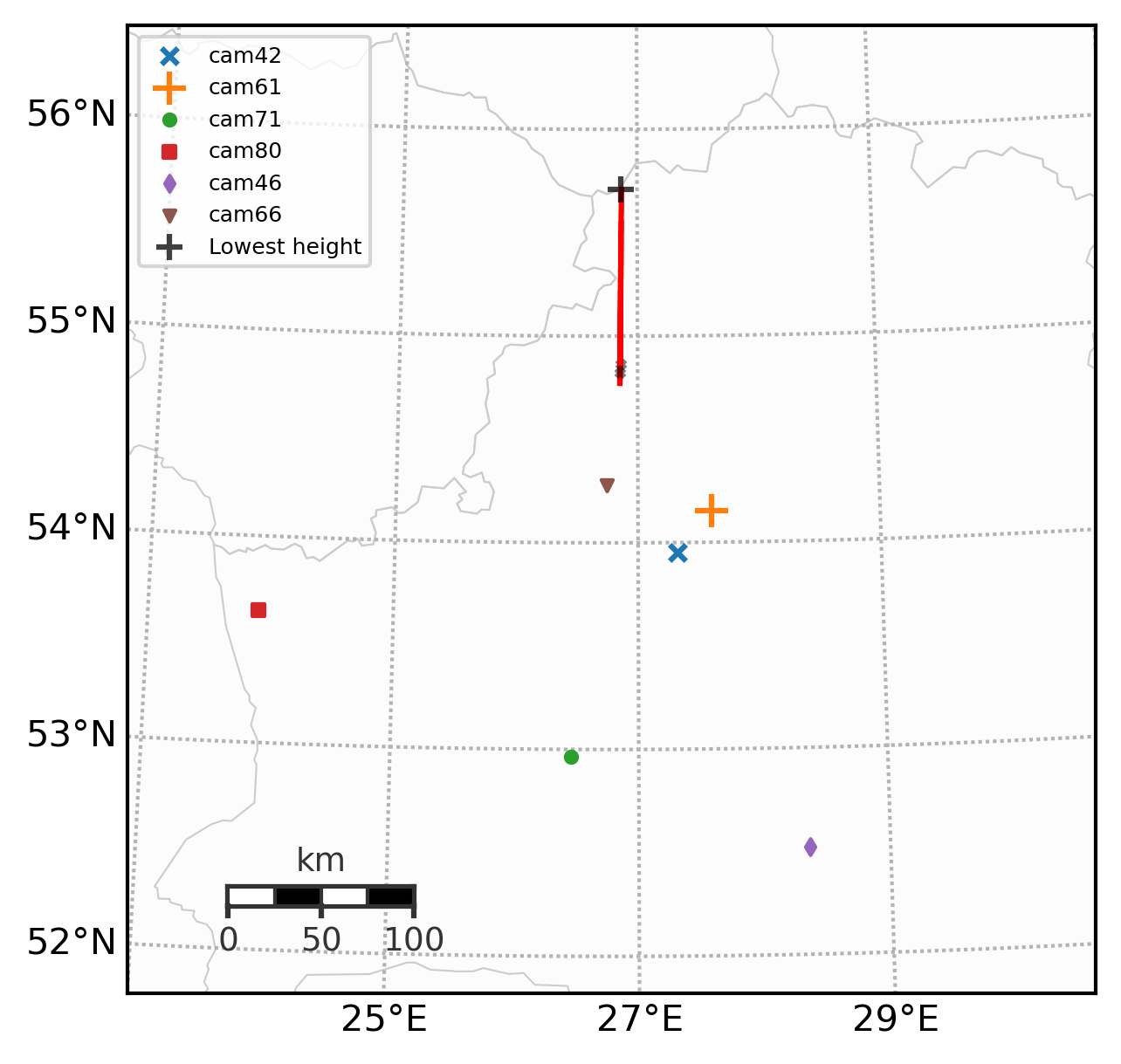
Figure 2 – Locations of the six cameras and the ground projection of the fireball trajectory. The red line is the trajectory recorded by the cameras; the cross marks the lowest measured point.
2. Trajectory and orbit
To refine the trajectory and the orbit, the video recordings of all six cameras were measured manually in SkyFit2 (Vida et al., 2021). The trajectory and the orbit were computed with the WMPL library using the Monte Carlo method (Vida et al., 2020). The solution includes 580 points. The largest convergence angle, 81°, is between cam46 and cam80, and the standard deviation of the timing residuals is 2.1 ms. Table 2 gives the coordinates of the first and last measured points, and Table 4 the radiant and the heliocentric orbit.
Table 2 – Beginning and end of the luminous trajectory (WGS84, WMPL solution), 1σ uncertainties.
| Beginning | End | |
|---|---|---|
| Longitude, °E | 26.851640 ± 0.0001 | 26.863940 ± 0.0002 |
| Latitude, °N | 54.771809 ± 0.0001 | 55.701762 ± 0.0004 |
| Height WGS84, km | 89.563 ± 0.007 | 32.478 ± 0.006 |
The end point of the trajectory and the initial conditions of the dark flight (Section 7) were determined independently, by a least-squares intersection of the planes defined by each camera’s observations (straight-line least squares, SLLS; Borovička, 1990). Table 3 shows how consistently the cameras describe a single straight line: the angle between the fitted trajectory and each camera’s plane, the distance of the trajectory from that plane, and the scatter of the measured points about it. The largest departures are for cam66 and cam71, which saw only a short initial segment, but even for them the trajectory passes within 90 m of the camera’s plane.
Table 3 – Camera convergence in the SLLS solution. Deviation: angle between the fitted trajectory and the plane of the camera. Miss distance: distance of the trajectory from that plane. Plane RMS: scatter of the camera’s own measured points about its plane.
| Camera | Deviation, ° | Miss distance, m | Plane RMS, arcsec |
|---|---|---|---|
| cam42 | 0.0215 | 20 | 25.1 |
| cam46 | 0.0286 | 19 | 31.8 |
| cam61 | 0.0264 | 3 | 24.0 |
| cam66 | 0.0728 | 89 | 43.4 |
| cam71 | 0.0535 | 48 | 23.2 |
| cam80 | 0.0003 | 14 | 24.0 |
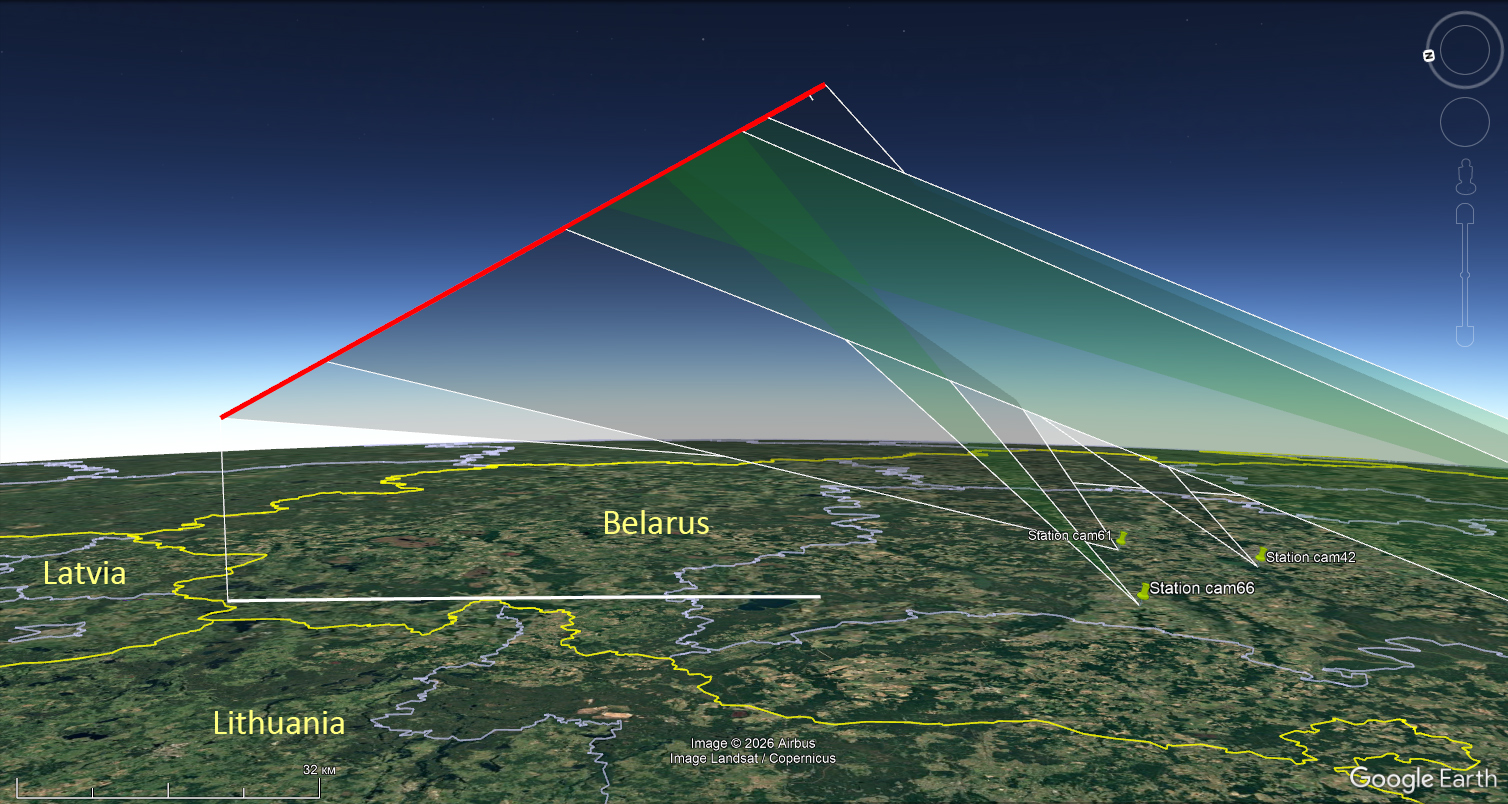
Figure 3 – The luminous trajectory in the atmosphere as recorded by the six cameras. The entry angle is 29.0° to the horizon. Rendered in Google Earth.
Table 4 – Radiant and heliocentric orbit (J2000.0) computed with WMPL, 1σ uncertainties.
| Parameter | Value |
|---|---|
| Apparent right ascension, ° | 302.737 ± 0.008 |
| Apparent declination, ° | −6.287 ± 0.016 |
| Pre-atmospheric velocity, km/s | 14.781 ± 0.002 |
| Geocentric right ascension, ° | 301.029 ± 0.009 |
| Geocentric declination, ° | −20.127 ± 0.019 |
| Geocentric velocity, km/s | 9.744 ± 0.003 |
| Semimajor axis a, AU | 2.383 ± 0.001 |
| Eccentricity e | 0.5984 ± 0.0002 |
| Perihelion distance q, AU | 0.957035 ± 0.000021 |
| Aphelion distance Q, AU | 3.8091 ± 0.0022 |
| Inclination i, ° | 0.067 ± 0.005 |
| Argument of perihelion ω, ° | 207.62 ± 0.33 |
| Longitude of the ascending node Ω, ° | 167.23 ± 0.33 |
| Longitude of perihelion ϖ = Ω + ω, ° | 14.852 ± 0.005 |
| Time of perihelion (Y-M-D) | 2023-01-26.5 ± 0.9 |
| Tisserand parameter TJ | 3.268 ± 0.001 |
The meteoroid moved on a typical Apollo-type orbit (a > 1 AU, q < 1.017 AU) (Figure 4). The perihelion lies just inside the Earth’s orbit and the aphelion (3.8 AU) in the outer part of the main asteroid belt. The Tisserand parameter TJ = 3.27 > 3 indicates an asteroidal rather than a cometary origin.
The inclination deserves a comment: it is very small, only 0.07°. Normally the encounter with the Earth takes place at a node of the meteoroid’s orbit, so the longitude of the node practically equals the solar longitude at the time of the fall and is fixed very precisely by the time of the event. With an almost zero inclination the orbit lies practically in the ecliptic plane and the line of nodes is poorly defined: small radiant errors rotate it by fractions of a degree. This is why the longitude of the node (167.23°) differs noticeably from the solar longitude (164.82°), and why it and the argument of perihelion are each determined only to about 0.3°. Their errors almost exactly cancel, and their sum, the longitude of perihelion ϖ = 14.852°, is determined to a few thousandths of a degree.
We estimated the likely source in the main belt with the near-Earth object model of Granvik et al. (2018), in the same way as Granvik & Brown (2018) did for 25 meteorite falls. For each cell of orbital elements (a, e, i) the model gives the probability that an object arrived from each source region. The model is calibrated on bodies larger than about 35 m, so the result refers to the source of the parent body from which the meteoroid was broken off, not to the meteoroid itself, and the probabilities should be taken as indicative. For this orbit the most likely source is the 3:1 mean-motion resonance with Jupiter (about 60 %), followed by the ν6 secular resonance (about 35 %); the contribution of Jupiter-family comets is about 4 %. Both main sources lie in the inner main belt, which according to Granvik & Brown (2018) is where most meteorites with known orbits come from.
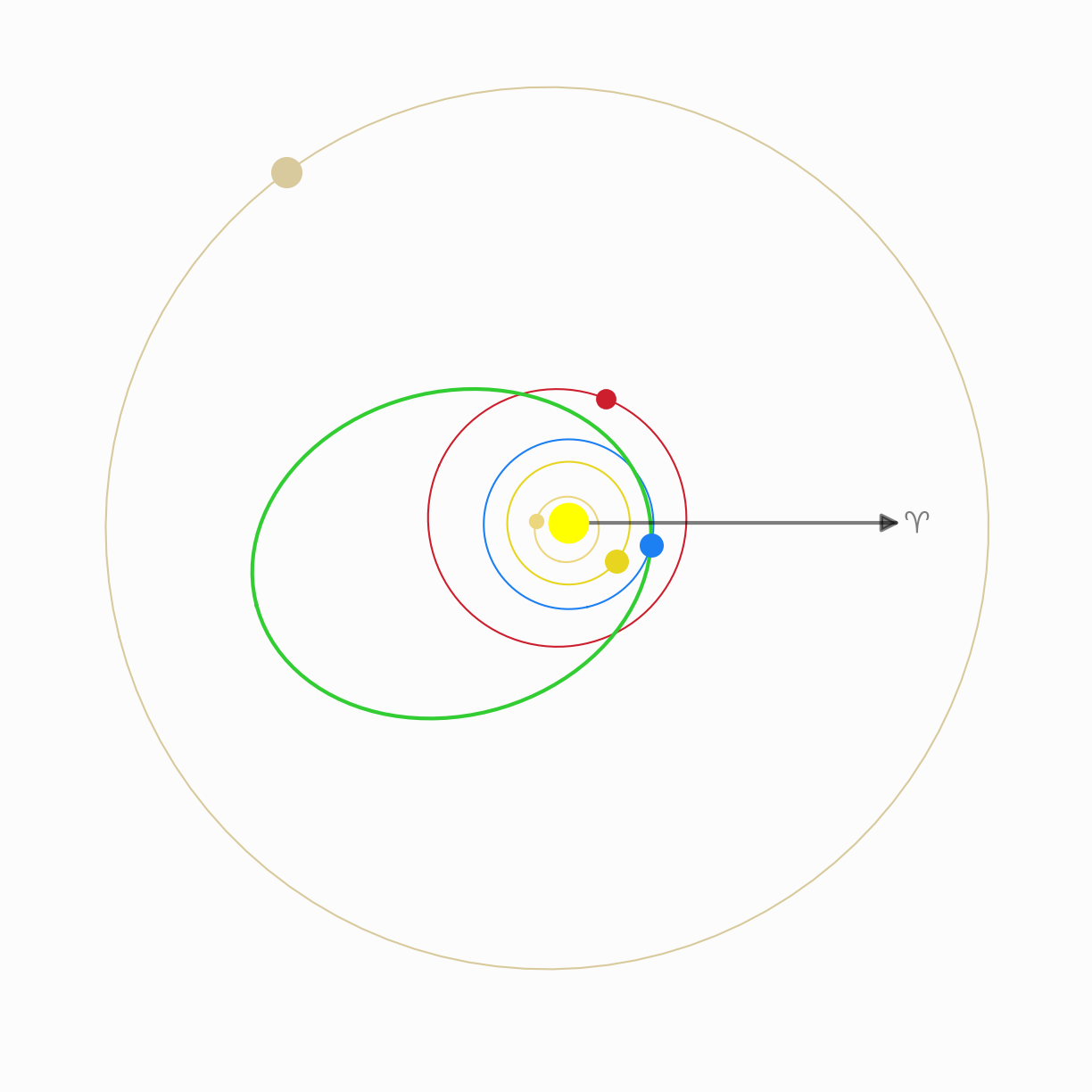
Figure 4 – Orbit of the meteoroid (green) projected onto the ecliptic plane, with the orbits of Mercury, Venus, Earth, Mars and Jupiter and their positions at the time of the event. The arrow points to the vernal equinox.
3. Nature of the meteoroid: spectrum, PE criterion and orbit
The spectrum of the fireball was recorded by cam71 with a 1000 lines/mm diffraction grating (dispersion 7.0 Å/pixel), only at the beginning of the trajectory, at heights of about 80 to 70 km (Figure 5). The spectrum is faint and noisy, but it shows the main emissions: the sodium line Na I-1 dominates, the iron lines of multiplet Fe I-15 are clearly visible, and magnesium Mg I-2 is weaker. Weak Mg and Fe at these heights are expected: the atmosphere there is thin, and at a low speed (about 15 km/s) the Mg and Fe lines are excited less efficiently than the sodium line.
On the Mg I-2 – Na I-1 – Fe I-15 ternary diagram (Borovička et al., 2005) the spectrum lies on the chondritic curve, in the part corresponding to speeds of 14–15 km/s. At low speeds this part of the curve is shifted towards the sodium corner of the diagram, so the enhanced sodium does not indicate an anomalous composition. The clearly visible iron rules out iron-poor types. The classification of Borovička et al. (2005) is based on millimetre-sized meteoroids, so for a fireball we use it only as a qualitative indicator.
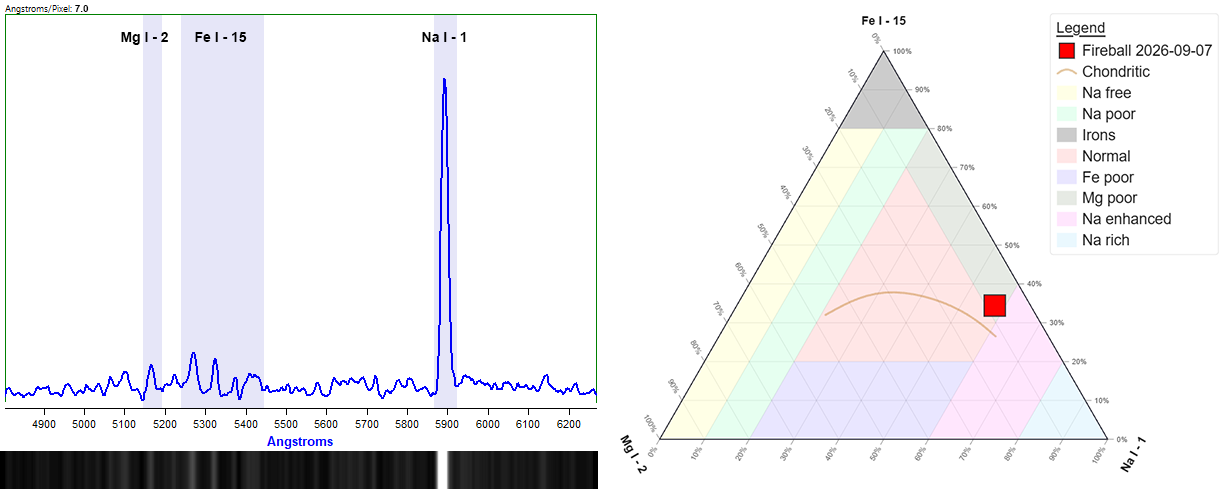
Figure 5 – Left: spectrum of the fireball recorded by cam71 at heights of about 80–70 km. Right: its position on the Mg I-2 – Na I-1 – Fe I-15 ternary diagram (Borovička et al., 2005); the beige line is the expected position of chondritic material at different velocities.
An independent indication comes from the end-height criterion PE (Ceplecha & McCrosky, 1976), which relates the air density at the end point to the mass, velocity and slope of the trajectory. For this fireball PE = −4.47, which corresponds to type I fireballs (the I/II boundary is at PE = −4.60), that is, to strong stony material. The asteroidal orbit (TJ = 3.27) agrees with this.
All indications point to a stony meteoroid, most likely an ordinary chondrite. In the computations below we adopted a bulk density of 3300 kg/m³, typical of ordinary chondrites (Britt & Consolmagno, 2003).
4. Photometry and pre-atmospheric mass
The fireball saturated the camera sensors, so over most of the path ordinary aperture photometry cannot be applied: saturated pixels no longer respond to an increase in brightness. For cam46 and cam61 the magnitude was therefore derived from the area of the isophotes of the scattered-light halo around the saturated core. The relation between isophotal area and magnitude was calibrated on the Moon and bright planets recorded by the same cameras, taking vignetting and atmospheric extinction into account. This is our own software, currently under testing. For cam42, which saw only the beginning of the path, before the fireball saturated the sensor, the aperture photometry from SkyFit2 was used.
Three of the six cameras were used for photometry. Cam42 detected the fireball earliest, cam61 gave the best light curve over most of the path, and cam46 was the only camera that saw the end of the trajectory. The other cameras saw only the initial part, where the body had hardly lost any mass, and add nothing to the combined curve. The curves were merged into one; the cameras agree to 0.07 mag where they overlap. The dips in the cam46 light curve below ~47 km are caused by tree branches in the field of view (Figure 1); the very end of the path was observed without obstruction.
What matters for the mass is not the uncertainty of individual frames but that of the frames near the peak brightness, which dominate the integral. The luminosity-weighted uncertainty estimated by the photometry software is 0.52 mag for cam61 and 0.79 mag for cam46. The cameras agree with each other much better than that (0.07 mag), so the uncertainty is mainly systematic and common to the method, and averaging over the cameras does not reduce it. We therefore adopted the larger of the two, 0.8 mag.
The photometric mass was obtained by integrating the classical luminous equation (Ceplecha et al., 1998) with the velocity-dependent luminous efficiency τ(v) for ordinary chondrites from Borovička et al. (2020). The radiated power of a zero-magnitude meteor was taken as P0m = 1210 W, the value for the passband of Sony CMOS cameras (Weryk & Brown, 2013). The ablated mass is 2.67 kg, and with the terminal mass added the photometric pre-atmospheric mass is 2.78 kg. The photometric uncertainty of 0.8 mag gives a range of 1.5–5.4 kg (68 %). The dynamic estimate (see below) lies within this range.
This mass is, if anything, slightly underestimated because of the branches in the cam46 field of view. At heights of 42–47 km, where the fireball was seen simultaneously by cam46 and by cam61 against a clear sky, cam46 is on average ~20 % fainter in flux, whereas higher up, without obstruction, the two cameras agree. Because of the low speed, about a third of the total mass is ablated below 47 km, so this loss of light underestimates the photometric mass by roughly 5–10 % (0.15–0.3 kg). This is well below the photometric uncertainty and does not affect the dynamic estimates, from which the mass entering dark flight is derived.
The main systematic uncertainty of the photometric mass is the choice of the τ model. Other models applicable to ordinary-chondrite fireballs give similar values: 2.7 kg with the Košice calibration (Borovička et al., 2013) and 3.1 kg with the ReVelle & Ceplecha (2001) model for type I fireballs.
An independent dynamic estimate was obtained with the α–β method (Gritsevich, 2009). The method does not use the light curve and relies only on the deceleration. We used its generalised form, which takes the real atmospheric density profile into account (Lyytinen & Gritsevich, 2016). The profile was taken from the ERA5 reanalysis (Hersbach et al., 2020) up to 74 km and from the U.S. Standard Atmosphere 1976 above. The fit gives a ballistic coefficient α = 51.90 ± 0.48 and a mass-loss parameter β = 1.190 ± 0.030. For a density of 3300 kg/m³ and μ = 2/3 this corresponds to a pre-atmospheric mass of 2.02 kg (1.97–2.08 kg).
The ratio of the photometric to the dynamic mass is 1.4. Agreement within a factor of two usually means that the body flew mostly as a single piece; with heavy fragmentation the photometric mass comes out several times larger than the dynamic one. This is consistent with the video recordings, which show no sign of break-up. We consider it possible that the meteorite fell as a single piece and that there may be no other fragments of significant mass. The main results are summarised in Table 5; the light curve, velocity and mass along the trajectory are shown in Figure 6.
Table 5 – Masses and energy.
| Quantity | Value |
|---|---|
| Ablated mass (from the light curve) | 2.67 kg |
| Pre-atmospheric mass, photometric | 2.78 kg (68 %: 1.5–5.4 kg) |
| Pre-atmospheric mass, dynamic (α–β, μ = 2/3) | 2.02 kg (1.97–2.08 kg) |
| Photometric / dynamic mass ratio | 1.4 |
| Kinetic energy at entry | 3.04 × 10⁸ J (≈ 73 kg TNT) |
| Total radiated energy | 8.2 × 10⁶ J |
| Luminous efficiency τ along the trajectory | 0.3–4.0 % |
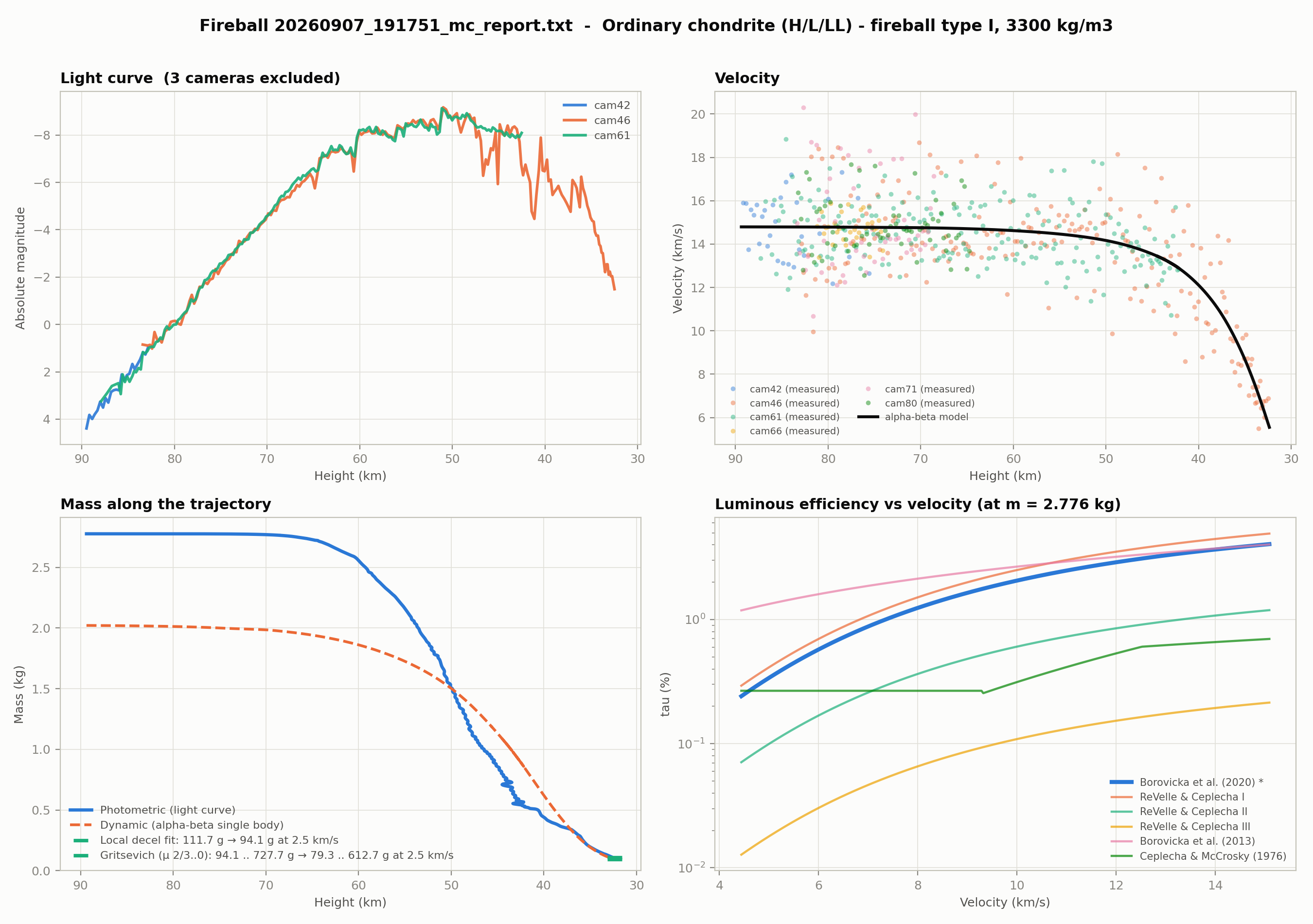
Figure 6 – Light curve from cam42, cam46 and cam61 (top left), measured velocities and the α–β model (top right), photometric and dynamic mass along the trajectory (bottom left), and luminous efficiency τ for several models (bottom right). The dips in the cam46 light curve below ~47 km are caused by tree branches.
5. Dynamic pressure and strength
The aerodynamic load on the leading surface, p = ρ·v² (ρ being the air density), reached a maximum of 0.69 MPa at a height of 36.7 km and a speed of 10.6 km/s (Figure 7); at the last point it was 0.40 MPa. No flares or break-up were observed near the maximum. The cam61 light curve is smooth down to 42 km. Below that only cam46 saw the trail, and over part of that segment the image is obscured by tree branches, so weak flares there could have gone unnoticed. The very end of the path, however, was seen by cam46 against a clear sky, and shows no sign of fragmentation.
Hence 0.69 MPa is a lower limit on the bulk strength of the body. This value falls within the 0.5–5 MPa range typical of the second fragmentation phase of ordinary chondrites (Borovička et al., 2020; Popova et al., 2011). It cannot be excluded that small, weak fragments separated unnoticed at 0.04–0.12 MPa (the first phase), but if they did, it left no trace in the light curve.
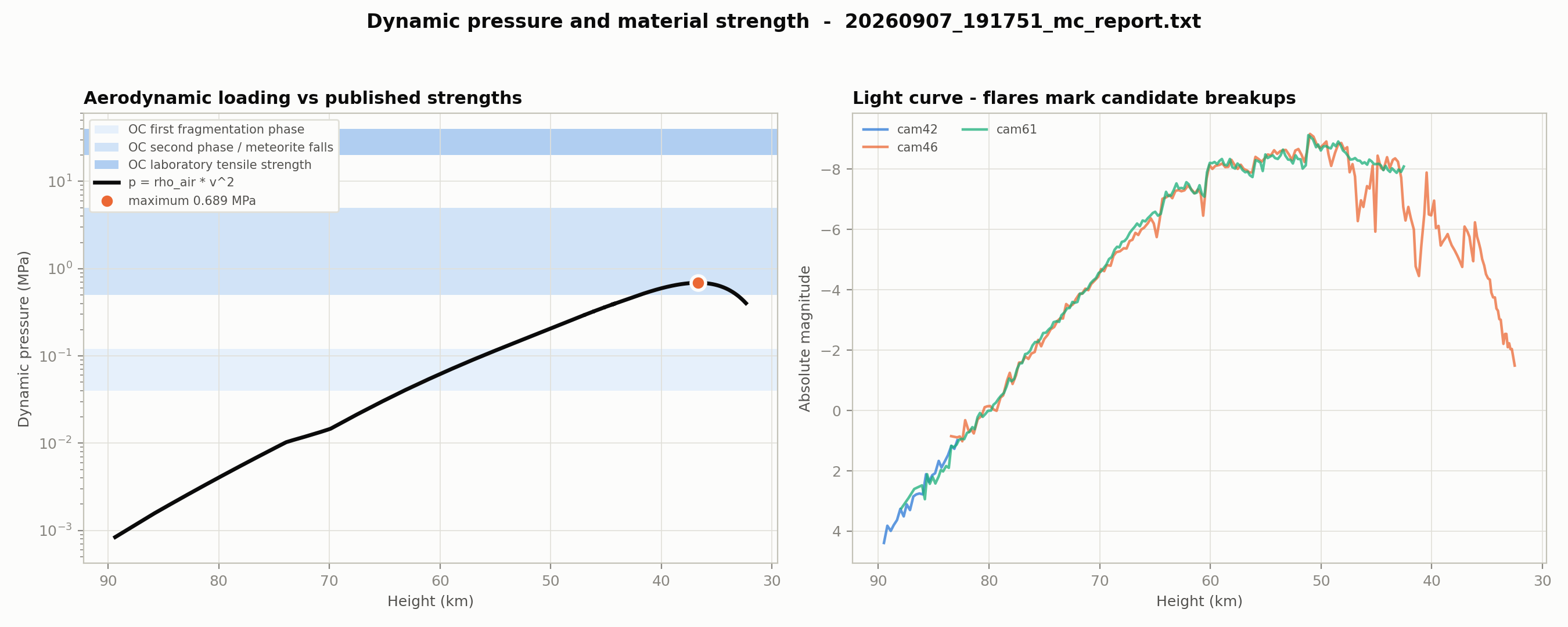
Figure 7 – Left: dynamic pressure along the trajectory against the published strength ranges of ordinary chondrites (Borovička et al., 2020; Popova et al., 2011). Right: light curve. The kinks in the pressure curve at 70–74 km mark where the ERA5 profile joins the U.S. Standard Atmosphere 1976 and are not physical.
6. Terminal mass and meteorite survival
The mass that survived to the end of the luminous path was estimated in two independent ways. We quote the results separately and do not average them, because they rest on different physics and are biased in opposite directions.
- Local deceleration fit. The deceleration was measured only on the lowest part of the trajectory, over the last 3 km in height down to the end point (21 points): 3.54 ± 0.69 km/s² at a height of 34.0 km and a speed of 7.5 km/s. The single-body drag equation (Ceplecha et al., 1998) with a drag-shape factor Γ·A = 0.7 gives a mass of 134 g at that point. Carried down to the last point by the ablation law, it is 112 g (66–213 g). The method measures whatever is still radiating at the end; if the body fragmented, that is only one fragment, so the method tends to underestimate the total mass.
- Global α–β model. The same fit as in Section 4, evaluated at the terminal velocity. The model treats the body as a single piece along the whole trajectory and is weighted by the upper part of the path, where the body has hardly begun to decelerate, so it tends to overestimate the remnant. The result depends strongly on the shape-change parameter μ: 94 g for μ = 2/3 (uniform ablation of a rotating body) and 728 g for μ = 0 (a body that keeps its orientation).
The local estimate and the α–β model with μ = 2/3 are close (112 g and 94 g), even though they are biased in opposite directions. This is a further argument for single-body flight.
Below the last luminous point the body keeps losing mass. We assumed that ablation stops when the speed drops to 2.5 km/s and computed this segment with the single-body ablation law (Ceplecha et al., 1998), using an ablation coefficient σ = 0.014 s²/km² typical of type I fireballs. The mass entering dark flight is therefore 94 g (55–179 g) from the local fit and 79–613 g from the α–β model (μ = 2/3 … 0).
At a density of 3300 kg/m³ a body of about 90 g is a sphere about 3.8 cm across; the 2.8 kg pre-atmospheric body would have had a diameter of about 11.7 cm.
The α–β criterion (Sansom et al., 2019) agrees with this. For α = 51.9 and the entry angle of this fireball, the critical mass-loss parameter for the survival of a body of at least 50 g is βcr = 1.194. The measured β = 1.190 ± 0.030 practically coincides with it, so the fireball lies right on the 50 g line. This is expected: our estimates of the surviving mass, about 80–95 g, are of the same order as the threshold of the criterion. The criterion describes the main surviving body and does not account for break-up into many small fragments.
7. Dark flight and strewn field
The dark flight was computed from the end point of the luminous trajectory. The position and the azimuth of motion were taken from the SLLS solution (Section 2). The speed was derived from the measured speeds over the last kilometres of the trajectory, and the zenith angle was corrected for the bending of the trajectory by gravity. The initial conditions are listed in Table 6.
Table 6 – Initial conditions of the dark flight at the end of the luminous trajectory, 1σ uncertainties.
| Parameter | Value |
|---|---|
| Latitude, °N | 55.706184 ± 0.00023 (± 25 m) |
| Longitude, °E | 26.867256 ± 0.00040 (± 25 m) |
| Height WGS84, m | 32 535 ± 14 |
| Velocity, km/s | 6.61 ± 0.39 |
| Zenith angle of the velocity vector, ° | 61.594 ± 0.016 |
| Azimuth of motion, ° | 0.556 ± 0.008 |
| Mass | 94 g (local deceleration fit); 79–613 g (α–β) |
The wind, temperature and pressure profile was taken from the ERA5 reanalysis (Hersbach et al., 2020) on 137 model levels for the grid node nearest to the fall area, interpolated to the time of the event (Figure 8). Throughout the troposphere the wind blew from the west-northwest, with a maximum of about 27 m/s at 11–12 km. The dark flight was computed with our own program, which integrates the motion of the body through the atmosphere including the wind.
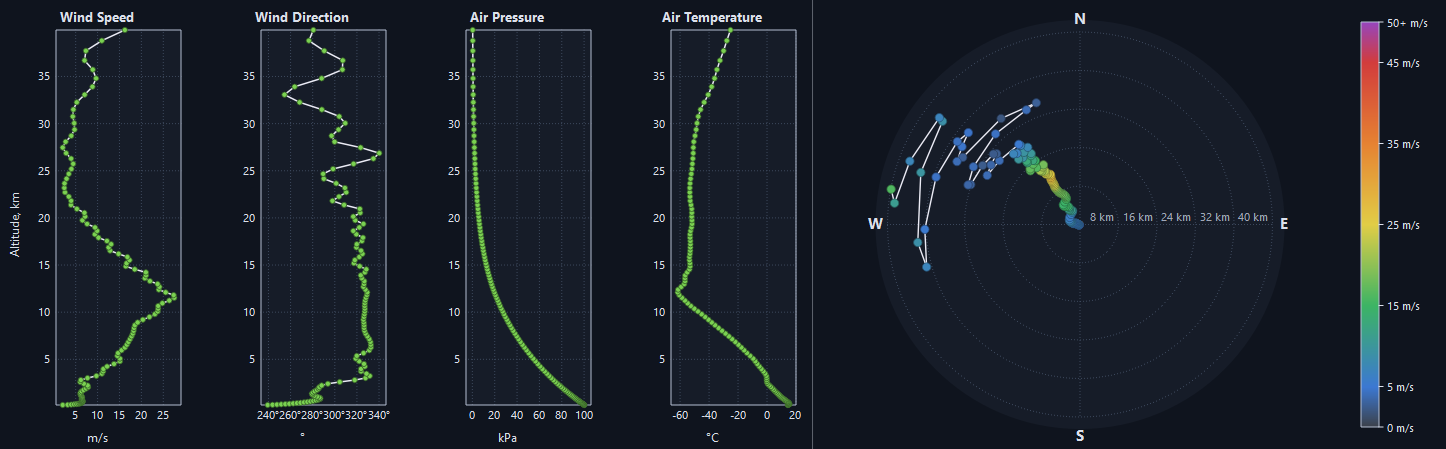
Figure 8 – ERA5 atmospheric profile at the time of the event: wind speed and direction, pressure and temperature (left), and the wind hodograph (right).
The computation places the strewn field in Latvia, approximately between the villages of Karļinova and Ritāni (Figure 9). The field was computed for a 94 g body; its centre is at 55.8521° N, 26.9072° E. The field is elongated along the direction of flight, roughly from south to north: the range of the dark flight depends most strongly on the initial speed, and its uncertainty stretches the field along the track.
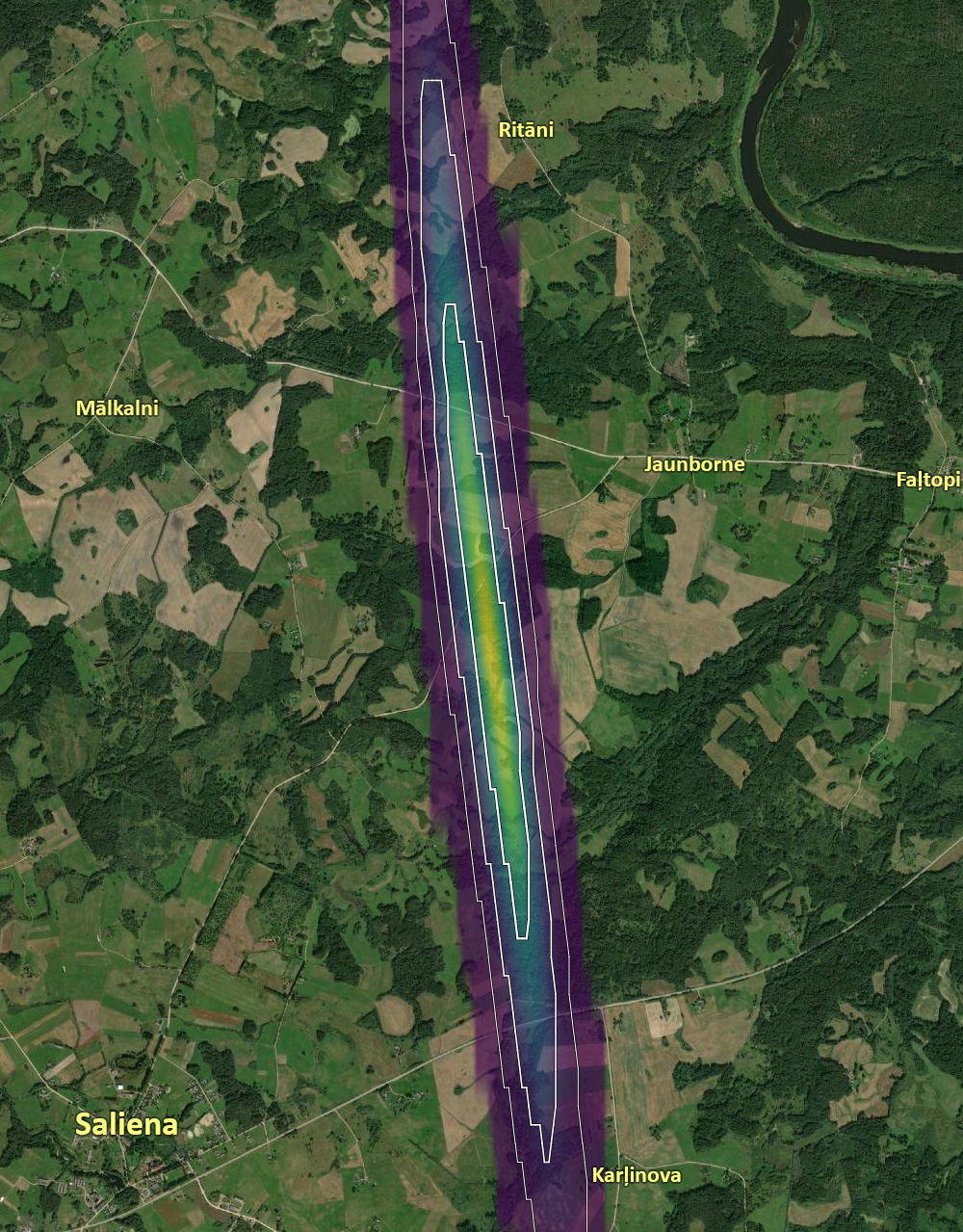
Figure 9 – Computed strewn field for a 94 g body between the villages of Karļinova and Ritāni (Latvia). The contours enclose 50 %, 90 % and 99 % probability.
8. Conclusions
- On 7 September 2026 six cameras of the Belarusian Meteor Network recorded a slow (14.8 km/s), −9.2 magnitude fireball that ended at a height of 32.5 km near the Belarus–Latvia border.
- The orbit is of the Apollo type and asteroidal in character (TJ = 3.27). The spectrum, the PE criterion (type I) and the sustained pressure of 0.69 MPa point to an ordinary chondrite.
- The pre-atmospheric mass is about 2.8 kg from photometry (possibly 5–10 % more because of branches in the field of view of one camera) and 2.0 kg from dynamics. Their agreement and the absence of visible fragmentation indicate single-body flight.
- The mass entering dark flight, from two independent methods, is 94 g (55–179 g) from the local deceleration fit and 79–613 g from the α–β model. By the α–β criterion the event lies right at the boundary for fireballs that drop a meteorite of at least 50 g.
- The computed strewn field lies in Latvia, between Karļinova and Ritāni, centred at 55.8521° N, 26.9072° E.
To our knowledge, no search has been made on the ground. We would be glad if these data help to find the meteorite. Searching on private land is possible only with the owners’ permission.
Acknowledgment
The author thanks all operators and members of the Belarusian Meteor Network whose cameras recorded this event: Alexander Mikulich, Andrey Prokopovich, Andrey Shohan, Ivan Sergei, Konstantin Morozov, Mikhail Abgarian and Ruslan Zavadich. The author is also grateful to Paul Roggemans and Maria Gritsevich for reviewing this report.
References
Borovička J. (1990). The comparison of two methods of determining meteor trajectories from photographs. Bulletin of the Astronomical Institutes of Czechoslovakia 41, 391–396.
Borovička J., Koten P., Spurný P., Boček J., Štork R. (2005). A survey of meteor spectra and orbits: evidence for three populations of Na-free meteoroids. Icarus 174, 15–30.
Borovička J., Spurný P., Shrbený L. (2020). Two strengths of ordinary chondritic meteoroids as derived from their atmospheric fragmentation modeling. The Astronomical Journal 160, 42.
Borovička J., Tóth J., Igaz A., et al. (2013). The Košice meteorite fall: Atmospheric trajectory, fragmentation, and orbit. Meteoritics & Planetary Science 48, 1757–1779.
Britt D. T., Consolmagno G. J. (2003). Stony meteorite porosities and densities: A review of the data through 2001. Meteoritics & Planetary Science 38, 1161–1180.
Ceplecha Z., Borovička J., Elford W. G., ReVelle D. O., Hawkes R. L., Porubčan V., Šimek M. (1998). Meteor phenomena and bodies. Space Science Reviews 84, 327–471.
Ceplecha Z., McCrosky R. E. (1976). Fireball end heights: A diagnostic for the structure of meteoric material. Journal of Geophysical Research 81, 6257–6275.
Granvik M., Brown P. (2018). Identification of meteorite source regions in the Solar System. Icarus 311, 271–287.
Granvik M., Morbidelli A., Jedicke R., Bolin B., Bottke W. F., Beshore E., Vokrouhlický D., Nesvorný D., Michel P. (2018). Debiased orbit and absolute-magnitude distributions for near-Earth objects. Icarus 312, 181–207.
Gritsevich M. I. (2009). Determination of parameters of meteor bodies based on flight observational data. Advances in Space Research 44, 323–334.
Hersbach H., Bell B., Berrisford P., et al. (2020). The ERA5 global reanalysis. Quarterly Journal of the Royal Meteorological Society 146, 1999–2049.
Lyytinen E., Gritsevich M. (2016). Implications of the atmospheric density profile in the processing of fireball observations. Planetary and Space Science 120, 35–42.
Popova O., Borovička J., Hartmann W. K., et al. (2011). Very low strengths of interplanetary meteoroids and small asteroids. Meteoritics & Planetary Science 46, 1525–1550.
ReVelle D. O., Ceplecha Z. (2001). Bolide physical theory with application to PN and EN fireballs. In: Proceedings of the Meteoroids 2001 Conference, ESA SP-495, 507–512.
Sansom E. K., Gritsevich M., Devillepoix H. A. R., et al. (2019). Determining fireball fates using the α–β criterion. The Astrophysical Journal 885, 115.
U.S. Standard Atmosphere (1976). NOAA, NASA, USAF, Washington D.C., NOAA-S/T 76-1562.
Vida D., Gural P. S., Brown P. G., Campbell-Brown M., Wiegert P. (2020). Estimating trajectories of meteors: an observational Monte Carlo approach – I. Theory. Monthly Notices of the Royal Astronomical Society 491, 2688–2705.
Vida D., Šegon D., Gural P. S., et al. (2021). The Global Meteor Network – Methodology and first results. Monthly Notices of the Royal Astronomical Society 506, 5046–5074.
Weryk R. J., Brown P. G. (2013). Simultaneous radar and video meteors – II: Photometry and ionisation. Planetary and Space Science 81, 32–47.
WMPL – Western Meteor Physics Library, https://github.com/wmpg/WesternMeteorPyLib
RMS – Raspberry Pi Meteor Station software (SkyFit2), https://github.com/CroatianMeteorNetwork/RMS