By Paul Roggemans, Denis Vida, Damir Šegon, Milan Kalina, James M. Scott, Jeff Wood
Abstract: The July Phoenicids and psi-Phoenicids have radiants that overlap in Sun-centered ecliptic coordinates, and the orbits for the available modern solutions in the IAU-MDC Working List of Meteor Showers are very similar. We recommend merging the solutions under a single entry in the Working List.
1 Introduction
The July Phoenicids (PHE#176) were first recognized in 1957 by Weiss (1960a) and observed in 1958 data (Weiss, 1960b) using the Adelaide radar observations. Detections during five sessions between 1953 and 1958 led Weiss to conclude this shower may be classed as permanent. The shower was added to the IAU-MDC Working List of Meteor Showers (Jopek and Kaňuchová, 2017) by Jenniskens (2006) based on Cook (1973). This shower has never been detected by optical (visual, photographic or video) techniques and no activity from this source has been detected from Global Meteor Network low-light camera data. A new solution for this shower has been obtained by Jenniskens (2023) based upon SAAMER radar observations for 2017 to 2019.
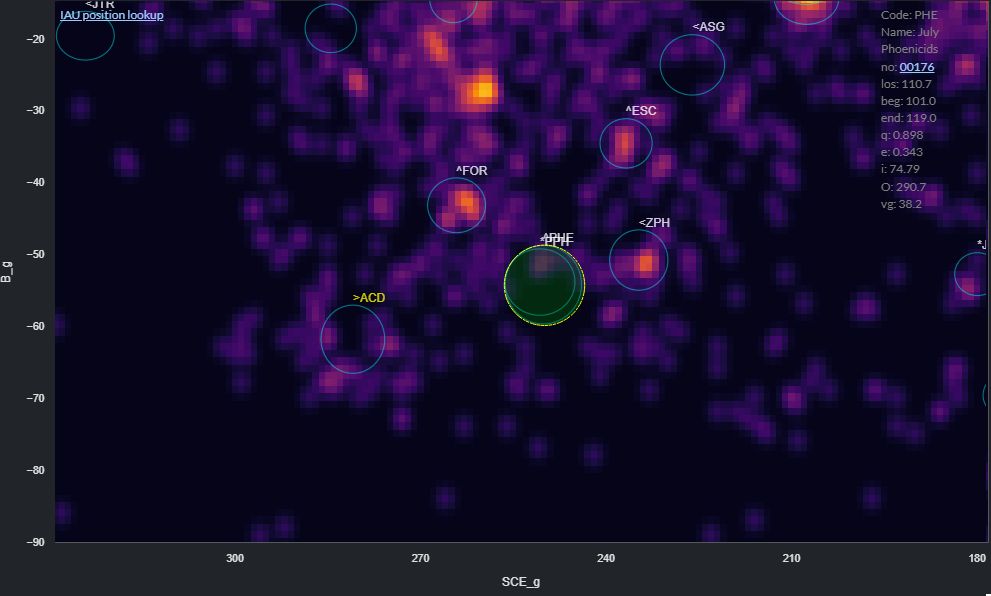
Figure 1 – GMN RadiantMap for λʘ = 112° in 2026 with the radiants for PHE#176 and PPH#769 within the yellow circle.
The psi-Phoenicids (PPH#769) were discovered and reported by Pokorný et al. (2017) using the data from 2012 to 2015 of the Southern Argentina Agile MEteor Radar (SAAMER) but it was not recognized as a solution for the July Phoenicids. This shower was confirmed by Greaves (2026a) using 2020 to 2023 SAAMER data and identifying 899 radar orbits as psi-Phoenicids. This solution has been reported to the IAU-MDC. The psi-Phoenicids were reassessed by Greaves (2026b) against the newly released PANSY radar meteor orbit dataset (Vierinen et al., 2026) using D-criteria. A total of 156 orbits fitted the criteria and provided further independent confirmation of this shower and this solution has also been reported to the IAU-MDC.
2 Overlapping radiants
During a routine check-up, the RadiantMap tool for λʘ = 112° in 2026 in Sun-centered geocentric ecliptic coordinates shows the PHE radiant and the PPH radiant overlapping each other (Figure 1). Some neighboring shower radiants show distinct activity, for instance the zeta-Phoenicids (ZPH#768), the Fornacids (FOR#1066) and the eta-Sculptorids (ESC#1067) but no clear activity can be seen at the position of the PHE and PPH radiants.
Comparing the available solutions in Table 1 for both shower entries it appears that the psi-Phoenicids are identical to the July Phoenicids. The first solution taken from Cook (1973) is misleading. Cook based his data on two papers by Weiss (1960a, 1960b) where only radiant positions, radiant drift and hourly rates were derived. Cook (1973) does not state the source of the adopted velocity; his range of orbital elements corresponds to the Weiss radiant combined with an assumed speed of about 44–50 km/s. The original publication by Cook mentions a range for the orbital elements with semi-major axis between 2.5 A.U. and ∞, eccentricity between 0.62 and 1.00, perihelion distance 0.96 to 0.97 A.U., inclination between 82° and 87°, argument of perihelion between 24° and 31° and an ascending node at 289.6°. The MDC lists an arbitrary end-member of Cook’s range which does not match its own vg so that the MDC entry is internally inconsistent. Recomputing the orbit with the currently known geocentric velocity shows that the Weiss radiant is the psi-Phoenicid radiant: the Southworth and Hawkins (1963) DSH and Drummond (1981) DD values are in good agreement (* in Table 1). The modern solutions agree closely with each other (DSH = 0.007–0.055). The Jenniskens (2023) solution for PHE#176 and the Pokorný et al. (2017) solution for PPH#769 are within all six limits of the maximum-sigma duplicate test of Jopek et al. (2024): the differences are 1.7° in λg – λʘ, 0.7° in βg, 0.6 km/s in vg, 4.4° in ω, 0.3° in Ω and 0.0° in i (limits 5°, 3°, 2.5 km/s, 9°, 7.5° and 5°). Both Greaves (2026a; 2026b) solutions are also within all six limits.
Table 1 – The solutions listed in the IAU-MDC Working List of Meteor Showers for the July Phoenicids and the psi-Phoenicids. The solution for Cook (1973) recomputed with vg = 38.2 km/s (*) has been added. The DSH and DD values are given for each solution with Cook, 1973 (*) as reference orbit.
| PHE#176 Cook, 1973 |
PHE#176 Cook, 1973(*) |
PHE#176 Jenniskens, 2023 |
PPH#769 Pokorný et al. 2017 |
PPH#769 Greaves 2026a |
PPH#769 Greaves 2026b |
|
| λʘ (°) | 110.30 | 110.30 | 110.7 | 111 | 111.4 | 110.6 |
| λʘb (°) | 101.70 | 101.70 | 101.0 | 98 | – | 107.4 |
| λʘe (°) | 116.70 | 116.70 | 119.0 | 120 | – | 114.9 |
| αg (°) | 31.58 | 31.58 | 29.1 | 30.1 | 29.9 | 29.8 |
| δg (°) | –47.78 | –47.78 | –48.3 | –46.9 | –47.2 | –47.0 |
| Δαg (°) | 0.94 | 0.94 | 0.88 | 0.84 | – | – |
| Δδg (°) | 0.38 | 0.38 | 0.58 | 0.59 | – | – |
| vg (km/s) | 47 | 38.2 (*) | 38.2 | 37.6 | 37.3 | 37.7 |
| λg (°) | 2.83 | 2.83 | 0.3 | 2.32 | 1.84 | 2.02 |
| λg – λʘ (°) | 252.53 | 252.53 | 249.6 | 251.32 | 250.44 | 251.41 |
| βg (°) | –55.03 | –55.03 | –54.4 | –53.73 | –53.89 | –53.65 |
| a (AU) | ∞ | 1.36 | 1.34 | 1.26 | 1.26 | 1.26 |
| q (AU) | 0.97 | 0.927 | 0.897 | 0.890 | 0.888 | 0.891 |
| e | 1.0 | 0.320 | 0.339 | 0.291 | 0.295 | 0.293 |
| i (°) | 87.00 | 74.9 | 74.8 | 74.8 | 74.48 | 75.0 |
| ω (°) | 23.89 | 50.3 | 58.9 | 63.3 | 63.65 | 62.8 |
| Ω (°) | 290.30 | 290.3 | 290.7 | 291 | 291.06 | 290.6 |
| Π (°) | 314.19 | 340.6 | 349.6 | 354.3 | 354.71 | 353.4 |
| TJ | – | 4.07 | 4.32 | 4.39 | 4.38 | 4.37 |
| DSH (*) | – | – | 0.062 | 0.085 | 0.087 | 0.081 |
| DD (*) | – | – | 0.037 | 0.056 | 0.052 | 0.053 |
| N | n.a. | n.a. | 6887 | 673 | 899 | 156 |
Without lookup tables and with data that do not match the values in the cited reference, the solution by Cook (1973) does not fulfill the current requirements to be listed in the Working List of Meteor Showers (Hajduková et al., 2023). The solutions by Jenniskens (2023), Pokorný et al. (2017) and Greaves (2026a) are all based upon SAAMER data. Greaves (2026b) based upon PANSY data is the only truly independent confirmation. Note that the inset in Figure 1 is the 2022 MDC submission by Jenniskens but the actual publication in Jenniskens (2023) is different and has been included in Table 1. Also, in Jenniskens (2023) the semi-major axis a = 1.34 AU does not equal q/(1–e) (1.357 AU) and TJ = 4.32 does not follow from its own a, e and i, which give 4.13.
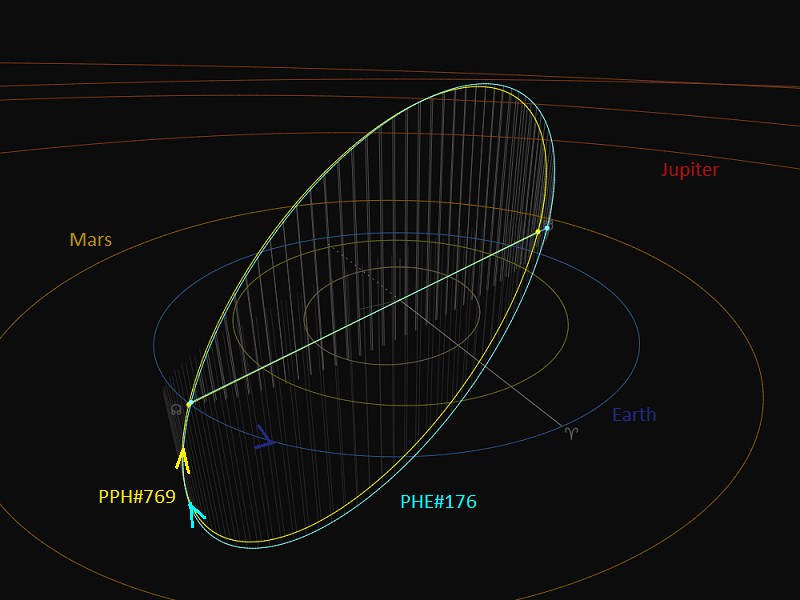
Figure 2 – The solution by Pokorný et al. (2017) for PPH#769 (yellow) compared to the solution by Jenniskens (2023) for PHE#176 (blue). (Plotted with the Orbit visualization app provided by Pető Zsolt).
3 Conclusion
The psi-Phoenicids (PPH#769) are another solution for the July Phoenicids (PHE#176). Therefore, it is recommended to keep the PHE#176 designation, remove the Cook solution (or flag it as radiant-only), and move the PPH#769 solutions under #176 (Jenniskens et al., 2020). The solution cited for Cook (1973) agrees with the original observations published by Weiss (1960a; 1960b) for the radiant position and the activity period, but the listed geocentric velocity has never been measured and is an estimate. The orbital elements listed in the MDC are an arbitrary end-member of the range given by Cook (1973) and do not match the listed geocentric velocity. No activity from this source has been detected from Global Meteor Network low-light camera data (Vida et al., 2020a; 2020b; 2021).
References
Cook A. F. (1973). “A Working List of Meteor Streams”. In, Hemenway C. L., Millman P. M., and Cook A. F., editors, Evolutionary and Physical Properties of Meteoroids, Proceedings of IAU Colloq. 13, held in Albany, NY, 14-17 June 1971. National Aeronautics and Space Administration SP 319, 183–191.
Drummond J. D. (1981). “A test of comet and meteor shower associations”. Icarus, 45, 545–553.
Greaves J. (2026a). “Independent confirmation of meteor shower candidates from the Southern Argentine Agile Meteor Radar”. eMetN Meteor Journal, 11, 151–153.
Greaves J. (2026b). “Independent confirmation of the psi-Phoenicids shower with PANSY radar data”. eMetN Meteor Journal, 11, 340–341.
Hajduková M., Rudawska R., Jopek T. J., Koseki M., Kokhirova G., Neslušan L. (2023). “Modification of the Shower Database of the IAU Meteor Data Center”. Astronomy & Astrophysics, 671, A155.
Jenniskens P. (2006). Meteor Showers and their Parent Comets. Cambridge University Press, Cambridge, UK. 790 pages.
Jenniskens P., Jopek T. J., Janches D., Hajduková M., Kokhirova G. I., Rudawska R. (2020). “On removing showers from the IAU Working List of Meteor Showers”. Planetary and Space Science, 182, 104821.
Jenniskens P. (2023). Atlas of Earth’s meteor showers. Elsevier, Cambridge, United States. ISBN 978-0-443-23577-1. Pages 189–191.
Jopek T. J. and Kaňuchová Z. (2017). “IAU Meteor Data Center, the shower database: A status report”. Planetary and Space Science, 143, 3–6.
Jopek T. J., Neslušan L., Rudawska R., Hajduková M. (2024). “Search for duplicates of showers in the IAU MDC database. Methods and general results”. Astronomy & Astrophysics, 682, A159.
Pokorný P., Janches D., Brown P. G., Hormaechea J. L. (2017). “An orbital meteoroid stream survey using the Southern Argentina Agile MEteor Radar (SAAMER) based on a wavelet approach”. Icarus, 290, 162–182.
Southworth R. B. and Hawkins G. S. (1963). “Statistics of meteor streams”. Smithsonian Contributions to Astrophysics, 7, 261–285.
Vida D., Gural P., Brown P., Campbell-Brown M., Wiegert P. (2020a). “Estimating trajectories of meteors: an observational Monte Carlo approach – I. Theory”. Monthly Notices of the Royal Astronomical Society, 491, 2688–2705.
Vida D., Brown P. G., Campbell-Brown M., Wiegert P., Gural P. S. (2020b). “Estimating trajectories of meteors: an observational Monte Carlo approach – II. Results”. Monthly Notices of the Royal Astronomical Society, 491, 3996–4011.
Vida D., Šegon D., Gural P. S., Brown P. G., McIntyre M. J. M., Dijkema T. J., Pavletić L., Kukić P., Mazur M. J., Eschman P., Roggemans P., Merlak A., Zubrović D. (2021). “The Global Meteor Network – Methodology and first results”. Monthly Notices of the Royal Astronomical Society, 506, 5046–5074.
Vierinen J., Chau J. L., Nishimura K., Hashimoto T., Pfeffer N., Kastinen D., Huyghebaert D. R., Kero J., Tsutsumi M., Sato K. (2026). “The PANSY Meteor Head-echo Orbit Catalogue: Continuous Antarctic Radar Observations of Southern Meteoroid Streams”. arXiv:2608.17589.
Weiss A. A. (1960a). “Radio-echo observations of Southern hemisphere meteor shower activity from 1956 December to 1958 August”. Monthly Notices of the Royal Astronomical Society, 120, 387–403.
Weiss A. A. (1960b). “Southern hemisphere meteor shower activity in July and August”. Australian Journal of Physics, 13, 522–531. DOI 10.1071/PH600522.