By Yury Harachka
Abstract: On 30 October 2026 two spectral cameras of the Belarusian Meteor Network recorded a faint but extremely slow fireball. It entered the atmosphere at 11.51 km/s – almost the minimum speed for a body arriving from interplanetary space – and its orbit is asteroidal and very similar to that of the Earth. The spectrum of the fireball resembles a typical spectrum of an iron meteoroid but shows a weak sodium emission. In several years of our observations such spectra have been rare. We tried to understand what kind of body it was and where it came from. An iron body with a small admixture of silicates seems the most likely to us, but photometry through clouds is too rough for the masses to confirm it, and we cannot exclude a carbonaceous chondrite of unusual composition. The parent body cannot be found from the orbit: close approaches to the Earth erase its history within decades.
1. Observations
On the evening of 30 October 2026 at 16:21:02 UT (19:21:02 local time) a faint but extremely slow fireball flew over southern Belarus. It was recorded by two cameras of the Belarusian Meteor Network – the colour camera cam50 and the monochrome camera cam63 (Figure 1, Table 1). The sky was covered with clouds, which dimmed the light now for one camera, now for the other. On the cam50 video only a few stars were visible through gaps in the clouds, and on the cam63 video no stars were visible at all. Both cameras were equipped with diffraction gratings, so both the trajectory and the spectrum of the fireball are available. The spectrum, which showed the typical features of an iron meteor but at the same time a weak sodium emission, looked unusual to us: in several years of observations we have rarely come across such spectra. This, together with the extremely low speed, is why we decided to study the event in more detail.
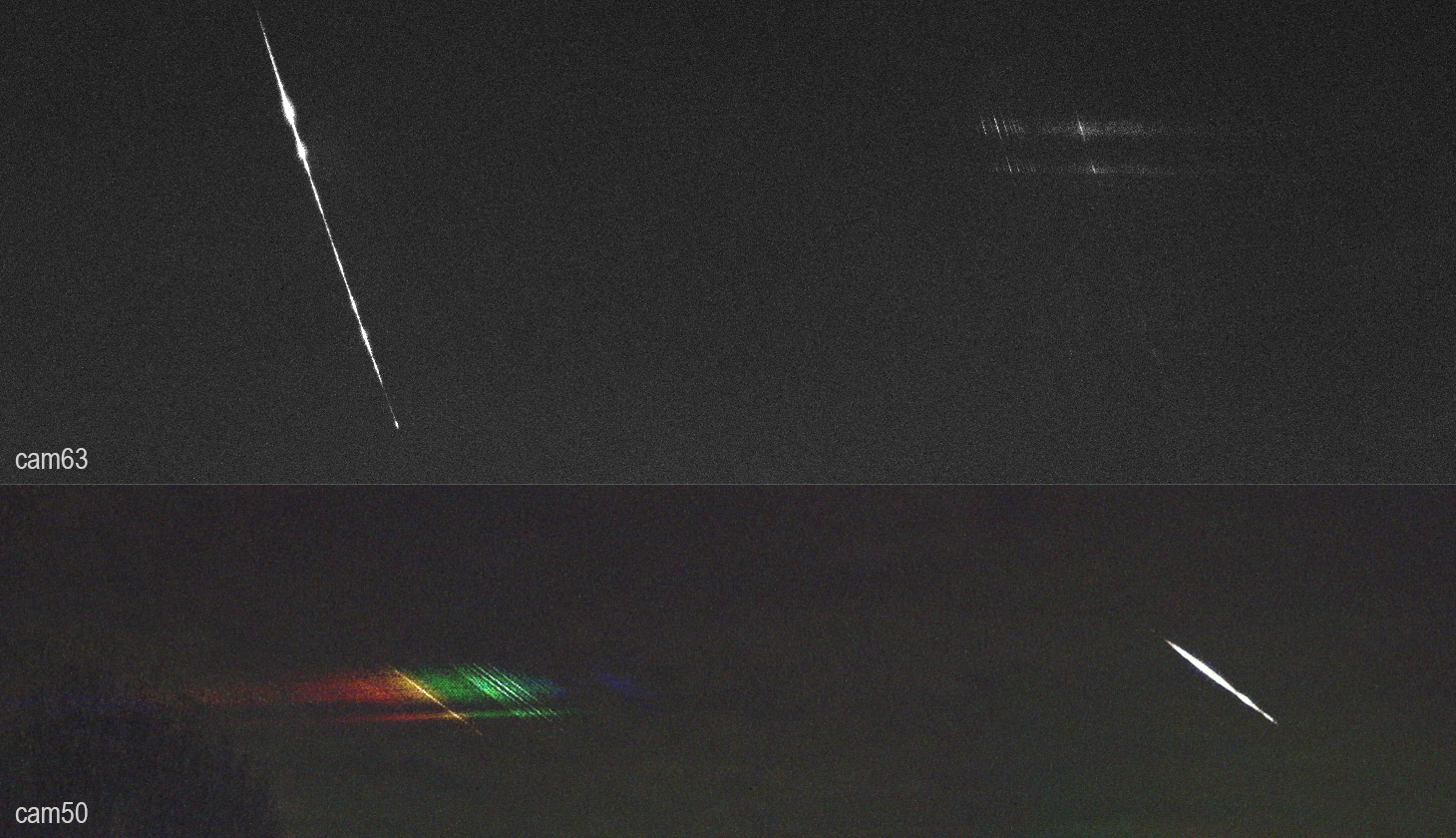
Figure 1 – The fireball of 30 October 2026 and its first-order spectrum as recorded by cam63 (top, monochrome camera) and cam50 (bottom, colour camera).
The meteoroid entered the atmosphere at 11.51 km/s at an angle of 48° to the horizon and moved towards the west-north-west. The luminous flight began at a height of 70.8 km and lasted 2.9 s; during this time the meteor travelled 31.6 km through the atmosphere and faded out at 47.3 km. The maximum absolute brightness, about −4.5 mag, was reached at heights of 58–62 km. Because of the clouds the real luminous path may have been somewhat longer, and the brightness is known only with a large uncertainty (Section 4). There are no signs of fragmentation in the videos: the body moved as a single whole along the entire trajectory. The fireball left no noticeable train, although it may well have been hidden by the clouds. There was no meteorite fall.
Table 1 – Cameras that recorded the fireball. Track: heights of the first and last measured points of each camera (above mean sea level). Range: distance from the camera to the last point it saw. Residuals: scatter of the camera’s points about the WMPL trajectory, angular (RMS) and vertical / horizontal (1σ).
| Camera | Lat, °N | Lon, °E | Alt, m | Track, km | Range, km | Points | Residuals, ″ / m |
|---|---|---|---|---|---|---|---|
| cam50 | 54.129838 | 27.196511 | 227 | 66.3 → 48.4 | 181 | 54 | 25.5 / 22.4, 1.9 |
| cam63 | 52.915503 | 27.542568 | 154 | 70.8 → 47.3 | 89 | 72 | 18.6 / 5.2, 6.3 |
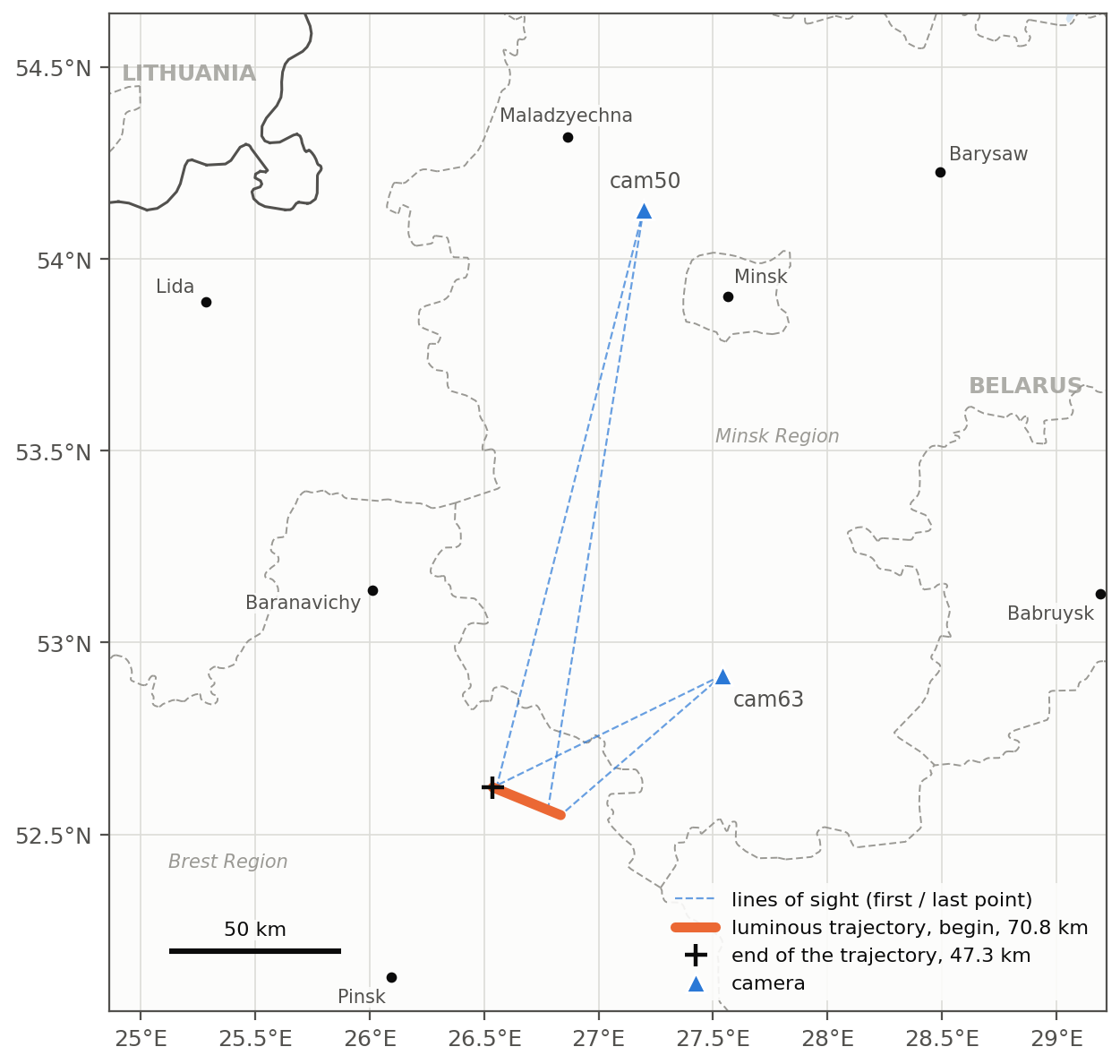
Figure 2 – Locations of the two cameras (triangles), their lines of sight to the first and last points each camera measured (dashed), and the ground projection of the luminous trajectory (orange; WMPL solution). Borders, regions, lakes and towns: Natural Earth.
2. Trajectory and orbit
The video records of both cameras were measured manually in SkyFit2 (Vida et al., 2021), and the trajectory and orbit were computed with the WMPL library using the Monte Carlo method (Vida et al., 2020). The solution includes 126 points; the convergence angle between the camera planes is 45.4° and the standard deviation of the timing residuals is 5.2 ms. Table 2 gives the coordinates of the first and last measured points, and Table 3 the radiant and the heliocentric orbit.
Table 2 – Beginning and end of the luminous trajectory (WGS84, WMPL solution), 1σ uncertainties.
| Beginning | End | |
|---|---|---|
| Longitude, °E | 26.83495 ± 0.00011 | 26.53814 ± 0.00010 |
| Latitude, °N | 52.55005 ± 0.00006 | 52.62244 ± 0.00003 |
| Height WGS84, km | 70.802 ± 0.011 | 47.305 ± 0.005 |
Table 3 – Radiant and heliocentric orbit, WMPL Monte Carlo solution, 1σ uncertainties. Apparent radiant – ECI (non-rotating Earth), epoch of date; geocentric radiant and orbit – J2000.0.
| Parameter | Value |
|---|---|
| Apparent right ascension, ° | 354.213 ± 0.040 |
| Apparent declination, ° | +25.711 ± 0.011 |
| Pre-atmospheric velocity, km/s | 11.508 ± 0.004 |
| Geocentric right ascension, ° | 9.61 ± 0.09 |
| Geocentric declination, ° | +4.88 ± 0.08 |
| Geocentric velocity, km/s | 2.927 ± 0.016 |
| Semimajor axis a, AU | 1.1099 ± 0.0009 |
| Eccentricity e | 0.1433 ± 0.0008 |
| Perihelion distance q, AU | 0.95082 ± 0.00011 |
| Aphelion distance Q, AU | 1.2689 ± 0.0019 |
| Inclination i, ° | 0.065 ± 0.010 |
| Argument of perihelion ω, ° | 228.85 ± 0.10 |
| Longitude of the ascending node Ω, ° | 216.67 ± 0.03 |
| Longitude of perihelion ϖ = Ω + ω, ° | 85.52 ± 0.07 |
| Time of perihelion (Y-M-D) | 2025-10-12.7 ± 0.6 |
| Tisserand parameter TJ | 5.603 ± 0.004 |
The meteoroid moved on an Apollo-type orbit almost coinciding with the orbit of the Earth (Figure 3): the perihelion (0.951 AU) lies just inside the Earth’s orbit, the aphelion (1.269 AU) slightly outside it, and the inclination is only 0.06°. The Tisserand parameter with respect to Jupiter, TJ = 5.60, points to an asteroidal rather than a cometary origin. With respect to the Earth it is TE = 2.99; a value close to 3 means a very Earth-like orbit and a low encounter speed with the Earth, hence the geocentric velocity of only 2.93 km/s. The Earth’s attraction during the approach accelerated the body from 2.9 to 11.5 km/s.
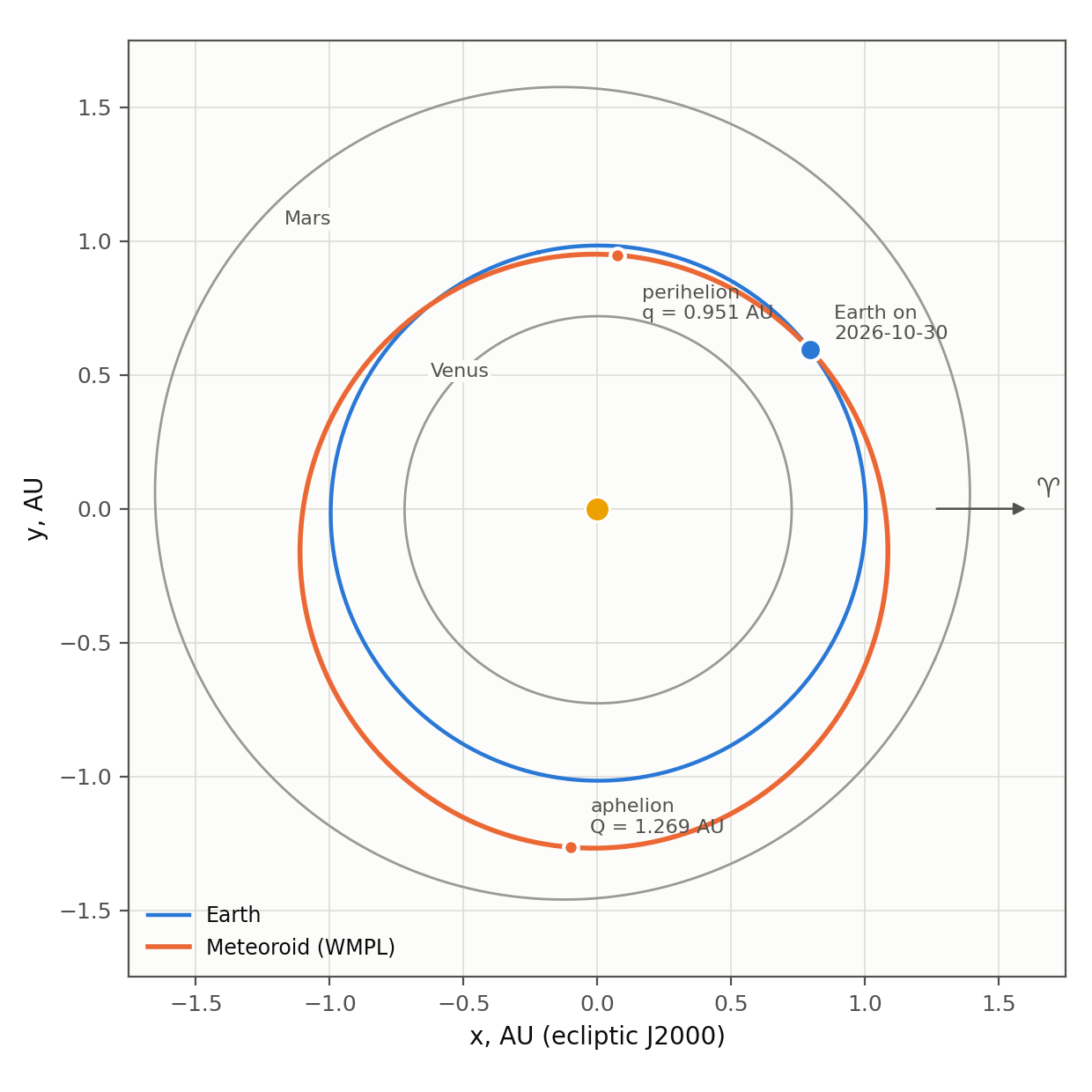
Figure 3 – Orbit of the meteoroid (orange) in the ecliptic plane together with the orbits of Venus, the Earth (blue) and Mars. The dot on the Earth’s orbit is the Earth on 30 October 2026.
The slow entry makes it necessary to check whether this could have been space debris. It could not: the initial speed of 11.51 ± 0.004 km/s exceeds the escape velocity at a height of 70.8 km (11.13 km/s), i.e. the body moved on a hyperbolic path relative to the Earth and came from interplanetary space. Fragments of satellites and rocket stages from Earth orbits enter the atmosphere slower than the escape velocity and almost horizontally, while this fireball descended at 48° to the horizon.
3. Spectrum
The spectrum (sp564) was recorded by both cameras, reduced in RSpec and calibrated for the spectral sensitivity. The dispersion of our spectral cameras is 7.2 Å/pixel. Line intensities were measured as peak areas above a continuum drawn through local minima (thermal radiation and the pseudo-continuum of FeO and N₂; Popov et al., 2021). For comparison we used the spectra of two meteors of similar speed recorded with the same equipment (Figure 4): a chondritic one (sp237, 11.81 km/s) and, as an example of a purely iron spectrum, an iron one (sp060, 11.94 km/s).
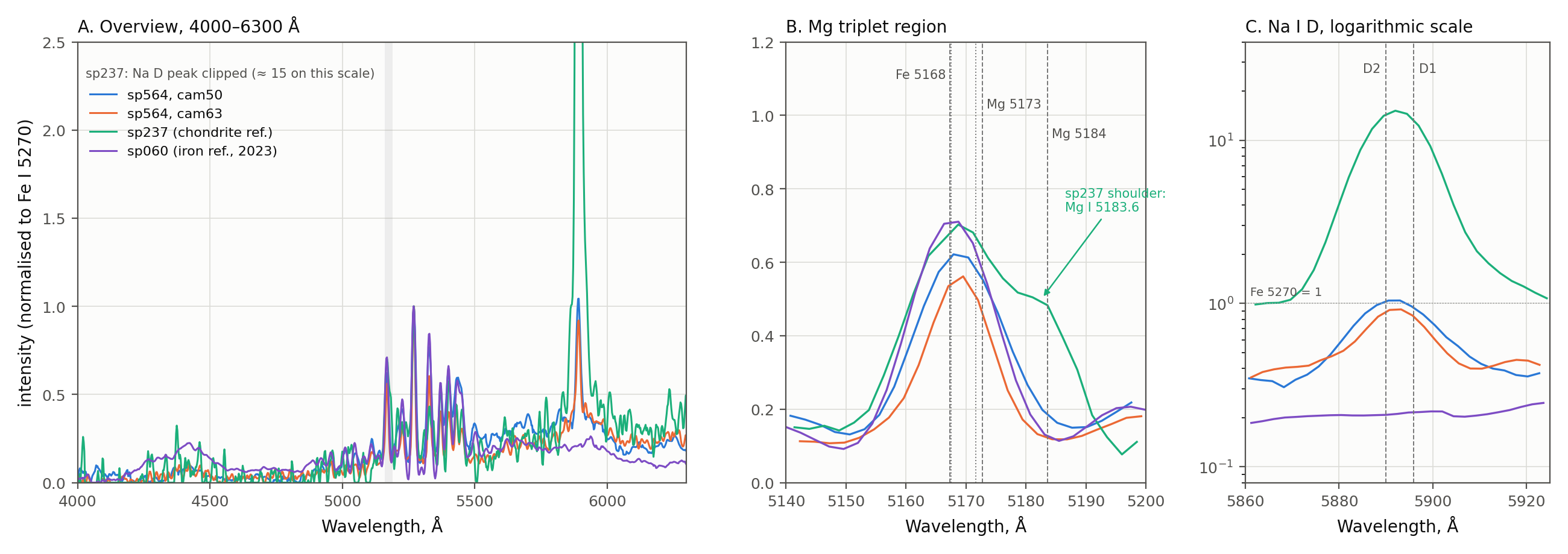
Figure 4 – Spectra of the fireball (cam50, cam63), of a chondritic meteor (sp237) and of an iron meteor (sp060) of similar speeds recorded by the same network, normalised to the Fe I 5270 peak. A – overview (the sp237 Na D peak is clipped); B – the Mg triplet region: dashed lines Mg I 5167.3, 5172.7, 5183.6, dotted lines Fe I 5167.5 and 5171.6; the Mg I 5183.6 shoulder is present in sp237 and absent in the fireball and in sp060; C – Na I D on a logarithmic scale.
Iron spectrum. This is a spectrum in which almost all of the light is emitted by neutral iron atoms and there are no Mg lines. At moderate resolution individual lines can hardly be distinguished, and the spectrum looks like two broad, almost continuous bands made of many unresolved Fe I lines: a blue one around 4200–4500 Å (multiplets Fe I-41, -42 and -2) and a green one around 5100–5500 Å (multiplets Fe I-15 and -37, and Fe I-1). In very slow meteors, bands of the FeO molecule may be added to them. In our fireball, as in sp060, most of the light falls into the green band, and the blue one is much weaker. Broad FeO bands with maxima near 5910 and 6250 Å can also be traced in the spectrum of the fireball.
Magnesium. The spectrum is dominated by Fe I lines. A peak is seen near 5170 Å, but it is a blend of iron lines (mainly Fe I 5167.5 and 5171.6). According to our observations of iron meteors at 11–12 km/s, this blend gives about half of the brightness of Fe I 5270; in the fireball the ratio is 0.51 (cam50) and 0.49 (cam63), so there is no excess that could be attributed to Mg. In the chondrite sp237 the same ratio is 0.82–0.89, and a distinct shoulder is seen at the position of the Mg I 5183.6 triplet line (Figure 4B). In both cameras of the fireball, as in the iron sp060, the wing of the blend falls off smoothly at this position. At low speeds the lines of the magnesium triplet weaken because of their rather high excitation potential (upper level 5.11 eV against 3.2–3.3 eV for the Fe I-15 lines); however, the complete absence of Mg cannot be explained by the low speed: the chondritic spectrum sp237, recorded at a similar speed, does show magnesium.
Sodium. Relative to iron, sodium in the fireball is 15–18 times (on average about 16 times) weaker than in sp237 (Figure 4C). For a slow chondrite one would expect the opposite: at speeds around 10 km/s the Na line of ordinary chondrites is strongly enhanced (Matlovič et al., 2020). The sodium deficit therefore seems to reflect the composition of the material rather than the conditions of the emission. No sodium was detected in the purely iron sp060.
Nickel. Ni I 5477 is seen (in the cam63 spectrum).
Chromium. Cr lines are seen only uncertainly.
In the Fe–Mg–Na ternary diagram (Figure 5) the fireball lies at the Fe apex, near the region of iron spectra. The spectra of the two cameras, reduced independently, almost coincide in the diagram despite the unfavourable conditions (clouds), which indirectly confirms the accuracy of the measurements.
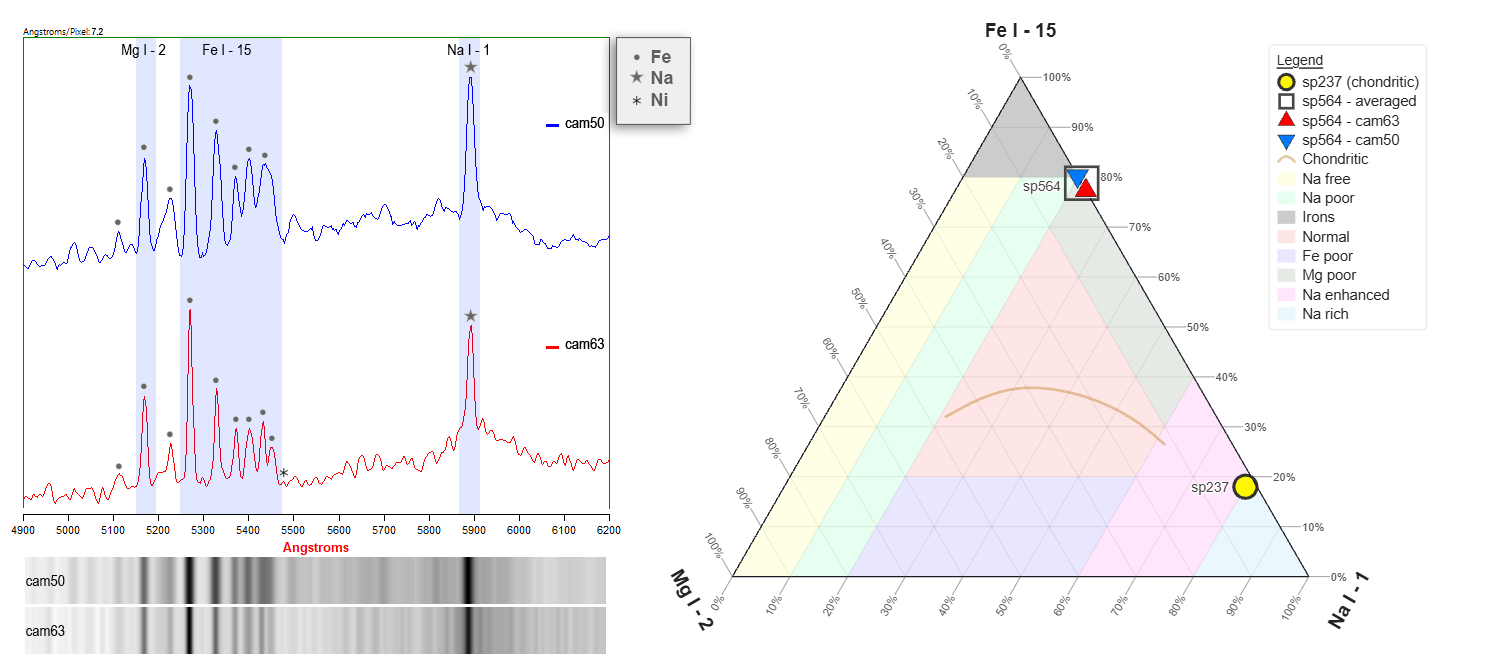
Figure 5 – Fe I-15 / Mg I-2 / Na I-1 ternary diagram with the spectral profiles of the fireball (cam50, cam63) and the chondritic reference sp237. Spectral classes after Borovička et al. (2005); the Mg-poor class is the author’s addition.
Laboratory spectra of meteorites ablated in a plasma wind tunnel (Matlovič et al., 2024) allow the set of lines to be compared with different meteorite types (Table 4). The numbers cannot be compared directly: Matlovič et al. normalise their ratios to Mg, which is absent in our fireball; in addition, the instruments and plasma temperatures differ. Qualitatively, the set of lines of the fireball – strong Fe and no Mg – is closest to the iron meteorite and differs from HED achondrites and from ordinary and carbonaceous chondrites, all of which show Mg. Nickel accompanies iron and is seen in all chondrites; it only distinguishes the fireball from achondrites, which have no Ni. There is one difference from iron – sodium: iron meteors usually show no sodium at all (like sp060), whereas the fireball does show it, albeit weakly.
Table 4 – The fireball spectrum against the laboratory spectra of meteorites (Matlovič et al., 2024, their Tables 1 and 3: strong / weak / missing species). CC – carbonaceous chondrites (CM, CO, CV).
| Feature | This fireball | Iron | HED | Ordinary chondrites | CC (CM, CO, CV) |
|---|---|---|---|---|---|
| Fe I | dominant | strong | weak | comparable to Mg, Si, Mn | as in ordinary |
| Mg I | missing | missing | present | present | as in ordinary |
| Ni I | present | present | missing | present | present |
| Na I | weak (×16 below sp237) | faint (lab); none in iron meteors | weak | strong | strong in CM |
4. Brightness, mass and deceleration
Because of the clouds the photometry is rough: the light curves of the two cameras differ in shape more than the measurement errors allow, and the uncertainty is 1.6 mag for cam50 and 1.8 mag for cam63 (Figure 6). We therefore give ranges rather than single values. The beginning of the cam50 light curve, where the fireball was emerging from the clouds for this camera, was not used. The envelope of the two curves shows a steep rise in brightness – from +3 to −3.5 mag between 70.8 and 65 km – followed by a plateau between −3.5 and −4.2 mag down to about 56 km and a decline. A steep initial rise and a plateau in the first half of the trajectory are typical of iron meteors (Borovička et al., 2005; Vojáček et al., 2020), but with such photometry this is only a qualitative argument.
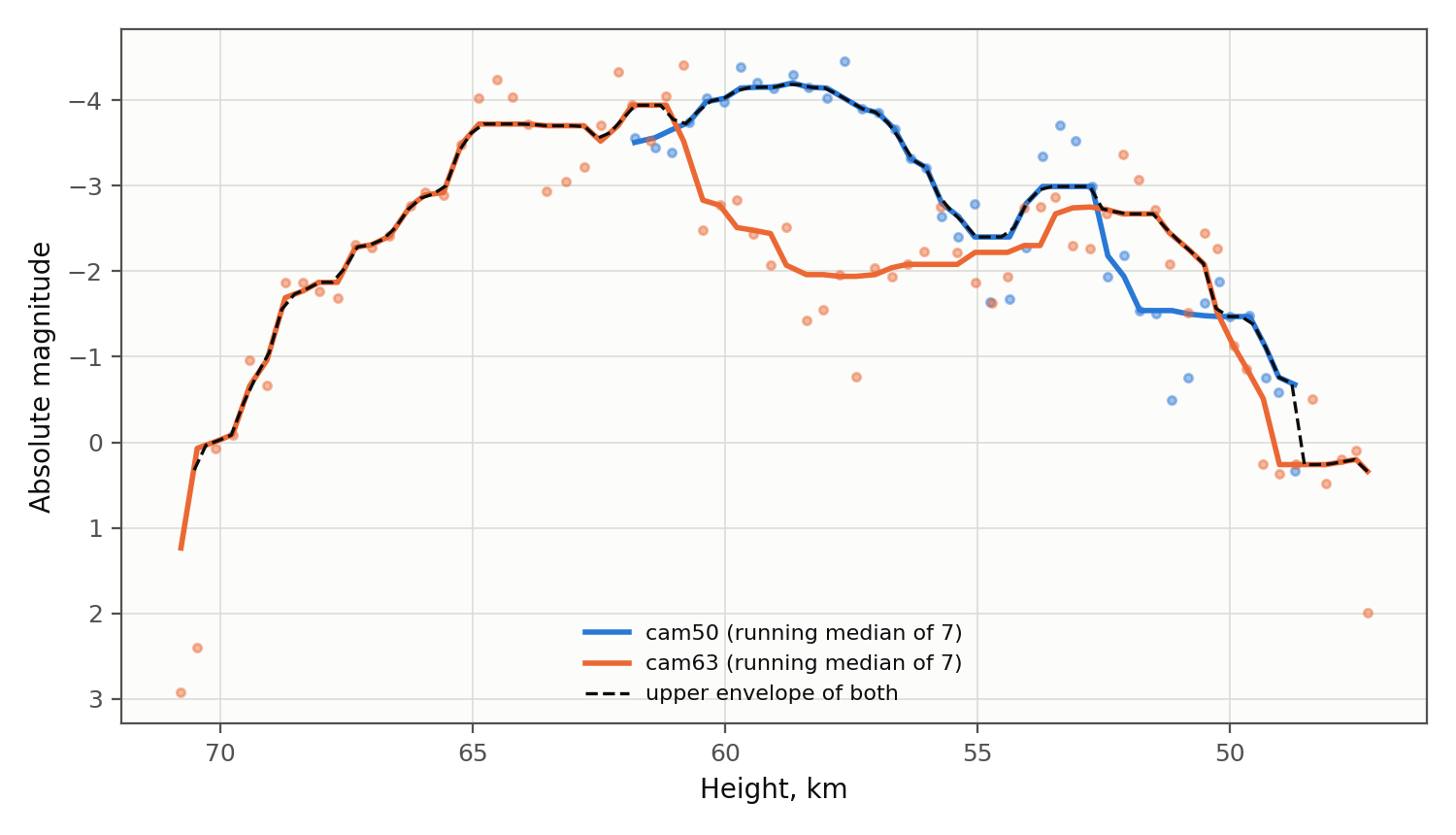
Figure 6 – Light curves of cam50 and cam63 (absolute magnitude vs height) with running medians; the dashed line is the upper envelope of both (at each height the camera less dimmed by clouds). The cam50 curve starts at 61.8 km: earlier frames, when the fireball was emerging from clouds for this camera, are not used.
The luminous efficiency of iron bodies more massive than a few grams has not been calibrated. We used the value adopted by Vojáček et al. (2020) for centimetre-sized iron fireballs: τ = 3 % at 15 km/s with the velocity dependence of Pecina & Ceplecha (1983), which was derived from artificial iron meteors (Ayers et al., 1970) and, according to its authors, is valid for bodies up to several hundred grams. At the speed of the fireball τ ≈ 2 %. For the power radiated by a zero-magnitude meteor we adopted 1500 W (Ceplecha et al., 1998). The photometric pre-atmospheric mass is about 44 g from each camera separately and 54 g from both together, and roughly 11 to 290 g when the photometric error is taken into account. An iron body of this mass is a sphere about 2 cm in diameter.
The deceleration is measured reliably: by the last point the speed had dropped to about 9.5 km/s. The α–β model (Gritsevich, 2009) gives α = 118.6 ± 8.8, β = 2.72 ± 0.64. For a bulk density of 7500 kg/m³ (iron with possible silicates) and Γ·A = 0.8 (we adopted this value for the whole trajectory), the dynamic pre-atmospheric mass is 10.4 g (8.5–13.3 g), i.e. 4–5 times less than the photometric one. The dynamic mass is inversely proportional to the square of the density: for an ordinary chondrite (3500 kg/m³) it would be about 48 g, for a carbonaceous one (2200 kg/m³) about 120 g (we assumed typical densities of these meteorites; Table 5). Nominally the masses would agree at a density of about 3300–3700 kg/m³ (for an irregular body, Γ·A = 1.0, about 4600–5100 kg/m³). But given the photometric error this density could be anything within roughly 1400–7200 kg/m³ (up to 10,000 kg/m³ for Γ·A = 1.0), i.e. the masses are consistent with stone, and with iron at the edge of the error. The comparison of the masses therefore does not allow us to choose between an iron, a stony-iron and a stony body. An excess of the photometric mass over the dynamic one is often attributed to fragmentation of fragile bodies such as carbonaceous chondrites; there is no fragmentation in the videos, and the excess itself is about as large as the photometric error (about 1σ).
The apparent ablation coefficient derived from β is high: 0.04–0.12 s²/km² (depending on whether the body rotates), i.e. 3–8 times the mean for type I fireballs (0.014 s²/km²), corresponding to types II–IIIA (0.042–0.10; Ceplecha, 1988). For iron a high apparent coefficient is expected: mass is lost as droplets of melt. For a stony body it would mean fragile material or fragmentation, which we do not see. However, such values are also typical of carbonaceous material, so they cannot distinguish iron from a carbonaceous chondrite.
The PE criterion (Ceplecha & McCrosky, 1976; Ceplecha, 1988) is −5.08 ± 0.30 (−5.04 and −5.12 from the individual cameras) – type II, which is usually associated with carbonaceous chondrites. The uncertainty is set by the photometry. The nine centimetre-sized iron fireballs of Vojáček et al. (2020) have PE between −5.32 and −5.91; our value lies less than 1σ above this interval. PE reflects the resistance to ablation rather than the composition and, like the ablation coefficient, cannot reliably distinguish iron from carbonaceous material here. The main quantities are collected in Table 5.
Table 5 – Brightness, mass and dynamics. Ranges include the photometric uncertainty (1.6 mag for cam50, 1.8 mag for cam63). The photometric mass does not depend on the bulk density; the dynamic mass is given for three assumed densities (Γ·A = 0.8): iron with possible silicates, ordinary and carbonaceous chondrite.
| Quantity | Value |
|---|---|
| Peak absolute magnitude | ≈ −4.5 at 58–62 km |
| Luminous efficiency τ (Vojáček et al., 2020) | ≈ 2 % at 11.5 km/s |
| Photometric pre-atmospheric mass | 44 g (each camera), 54 g (both); 11–290 g with the photometric error |
| Diameter of an iron body (7500 kg/m³) of this mass | ≈ 2 cm |
| α–β parameters | α = 118.6 ± 8.8, β = 2.72 ± 0.64 |
| Velocity at the last point | ≈ 9.5 km/s |
| Dynamic pre-atmospheric mass, 7500 kg/m³ (iron) | 10.4 g (8.5–13.3 g) |
| Dynamic pre-atmospheric mass, 3500 kg/m³ (ordinary chondrite) | 48 g (39–61 g) |
| Dynamic pre-atmospheric mass, 2200 kg/m³ (carbonaceous chondrite) | 121 g (99–155 g) |
| Bulk density at which the two masses agree | ≈ 3300–3700 kg/m³ (1400–7200 kg/m³ within the photometric error) |
| Apparent ablation coefficient σ | 0.04–0.12 s²/km² |
| PE criterion | −5.08 ± 0.30 (type II) |
5. Nature of the meteoroid
Meteoroids with sodium-poor spectra occur in three populations (Borovička et al., 2005): iron bodies on asteroidal orbits, bodies with very small perihelia (q ≲ 0.2 AU) that have lost their sodium near the Sun, and bodies on Halley-type orbits. With q = 0.95 AU and an asteroidal orbit only the first one fits. The fraction of iron bodies depends on size: about 14 % among millimetre-sized meteoroids (Borovička et al., 2005), about 20 % among slow millimetre-sized ones (Mills et al., 2021), 3.6 % among centimetre-sized ones (Vojáček et al., 2020) and about 0.5 % among bright fireballs (Matlovič et al., 2019).
We considered four versions. (1) An iron body, possibly with a small admixture of silicates. It is supported by the set of lines (strong Fe and no Mg, as in laboratory iron) and by the asteroidal orbit. The weak sodium can be explained by silicate inclusions – grains of stony material, which, unlike the metal, usually also contains sodium. Matlovič et al. (2024) use such inclusions to explain the weak Ca I and Ca II lines that Čapek et al. (2019) saw in the spectra of iron meteors. The high ablation coefficient and the shape of the light curve are consistent with this version but do not prove it by themselves. A metallic piece of a stony-iron meteorite cannot be told from iron by its spectrum and density. (2) An ordinary chondrite that lost its sodium in space: the mechanisms of sodium loss require a small perihelion or a cometary orbit, and a chondrite would have shown Mg, like sp237. (3) A carbonaceous chondrite. Its low density agrees with the mass ratio within the errors, and type II PE and the high ablation coefficient do not contradict it. Against it is the spectrum: in the laboratory spectra of CM, CO and CV chondrites Fe and Mg are the same as in ordinary chondrites, and CM even shows strong sodium (Matlovič et al., 2024, their Table 3), while relative to iron these meteorites contain only 1.2–2.6 times less sodium than H chondrites (ibid., Table 1), not 16 times less. However, carbonaceous chondrites are very diverse, a laboratory experiment is not a meteor, and we have not found any published meteor spectra of bodies reliably linked to carbonaceous chondrites, let alone at such a low speed. We therefore cannot exclude this version. (4) An achondrite: it has weak Fe and no Ni.
In our opinion, the first version – an iron body, possibly with a small admixture of silicates – is the most likely; the second and fourth versions are unlikely. Our data do not exclude a carbonaceous chondrite of unusual composition, and we cannot give a final answer about the nature of the meteoroid.
The iron fireball EN260217_193948 (Vojáček et al., 2020) is close to ours in speed, luminous heights and orbit: 12.2 km/s, luminous path 70.6–52.7 km, PE −5.44, orbit with q = 0.97 AU and i = 1.7°. It was brighter (−5.9 mag) and probably more massive (177 g) than our fireball. The iron meteor sp060 of our network (20 April 2023; its spectrum is shown in Figure 4) has similar parameters: speed 11.94 km/s, luminous path 74.7–45.1 km, maximum about −5.9 mag, photometric mass about 290 g, PE −5.38, orbit with a = 1.12 AU, q = 1.00 AU and i = 7.5°.
6. Source of the orbit
We compared the orbit of the meteoroid with those of all near-Earth asteroids with similar orbits in the JPL Small-Body Database (a = 0.95–1.30 AU, i < 6°, e < 0.35; 2109 objects), using the D-criteria of Southworth & Hawkins (1963), Drummond (1981) and Jopek (1993). The nearest objects (Table 6, Figure 7) are bodies 5–30 m in size; 10 asteroids lie closer than the threshold DJ = 0.05. Six of them belong to the Cyclids-SEAs association identified by Jopek (2020): a large group of near-Earth asteroids on orbits very similar to that of the Earth, which Jopek himself does not regard as a family. Our meteoroid falls into the same region of orbits, so such a coincidence is to be expected. Below we treat all near-Earth asteroids in the same way, regardless of membership in this association.
Table 6 – Near-Earth asteroids nearest to the meteoroid orbit by the DJ criterion (JPL SBDB elements; DSH – Southworth & Hawkins 1963, DD – Drummond 1981, DJ – Jopek 1993). Cyclids-SEAs: member of that association (Jopek 2020).
| NEA | H | a, AU | e | i, ° | DSH | DD | DJ | Cyclids-SEAs |
|---|---|---|---|---|---|---|---|---|
| 2016 TB57 | 26.1 | 1.102 | 0.123 | 0.30 | 0.027 | 0.076 | 0.023 | yes |
| 2013 CY | 28.19 | 1.114 | 0.134 | 0.78 | 0.027 | 0.035 | 0.024 | yes |
| 2024 SH1 | 26.84 | 1.091 | 0.135 | 1.26 | 0.029 | 0.030 | 0.028 | – |
| 2014 UV210 | 26.9 | 1.155 | 0.131 | 0.60 | 0.055 | 0.051 | 0.032 | yes |
| 2017 TA6 | 27.1 | 1.119 | 0.171 | 0.99 | 0.041 | 0.089 | 0.036 | yes |
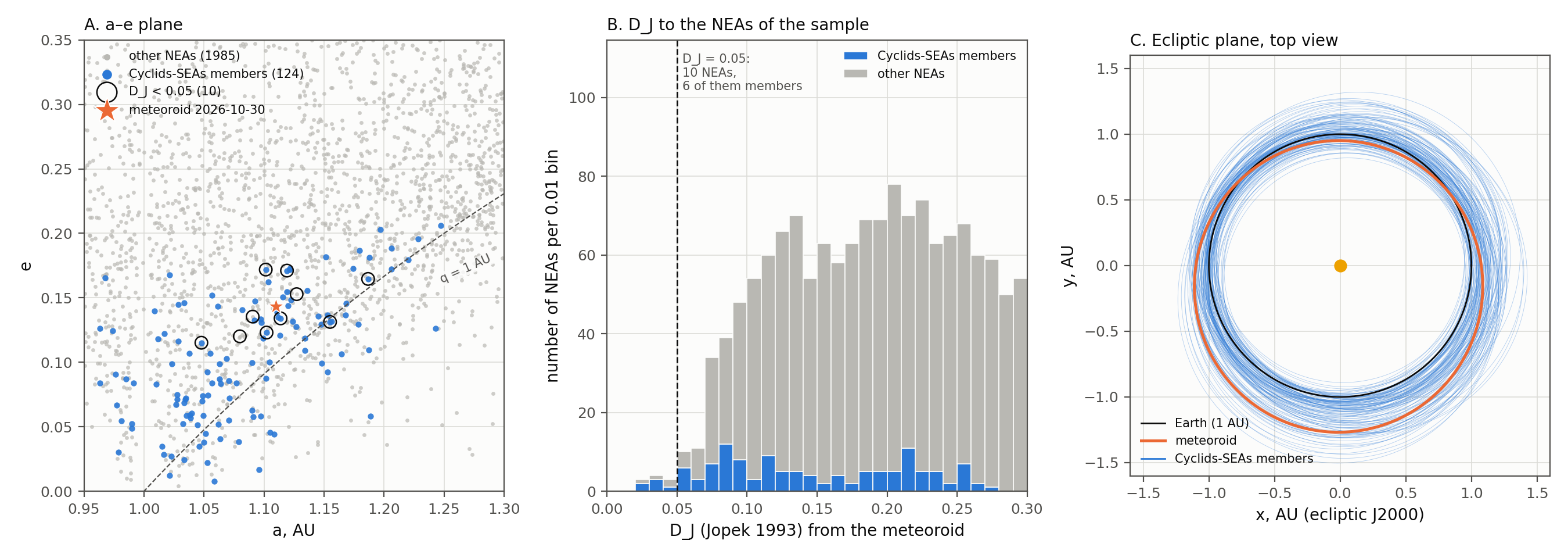
Figure 7 – The meteoroid orbit among the 2109 near-Earth asteroids with similar orbits (JPL SBDB: a = 0.95–1.30 AU, i < 6°, e < 0.35); blue – members of the Cyclids-SEAs association (Jopek 2020). A – semi-major axis and eccentricity, the ten asteroids with DJ < 0.05 are circled; B – distribution of DJ between the meteoroid and the asteroids; C – top view of the ecliptic with the orbits of the association members, the Earth and the meteoroid.
However, the meteoroid lies in a dense cloud of small near-Earth asteroids, where similar orbits occur by chance. We repeated the comparison for 500 samples with randomised node longitudes. We observe 10 asteroids closer than DJ = 0.05 against 8.4 expected by chance, and 3 closer than 0.03 against 1.3 expected (Figure 8). The similarity is not statistically significant.
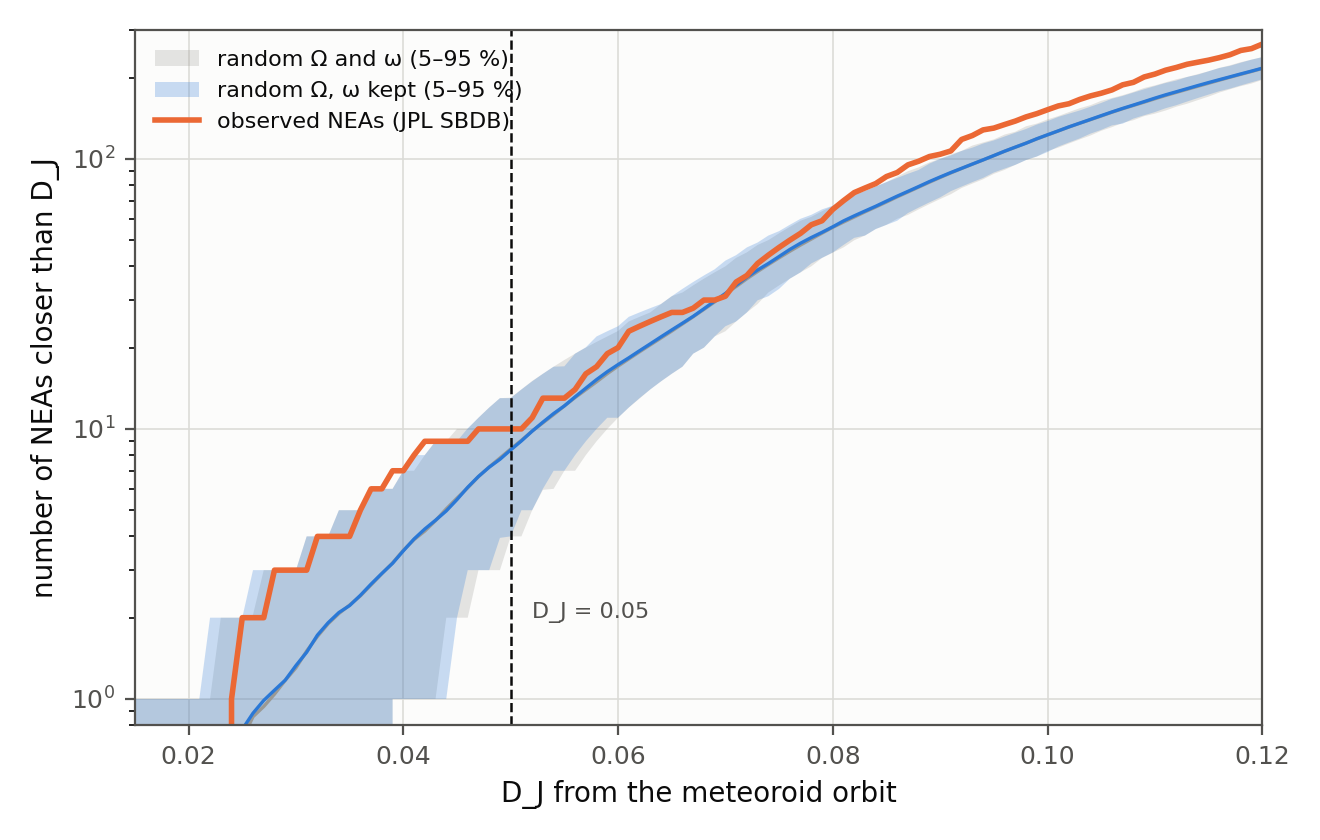
Figure 8 – Number of near-Earth asteroids closer than DJ to the meteoroid orbit (observed, orange) and the number expected by chance for randomised node longitudes (bands: 5–95 % of 500 realisations; grey – Ω and ω random, blue – Ω random, ω kept; dashed line – DJ = 0.05). If the meteoroid had relatives among the NEAs, the observed curve would rise above the bands at small DJ.
To find out how long such a similarity persists, we integrated the orbit backwards for 5000 years together with the Earth, the Moon and the planets (REBOUND, IAS15 integrator; Rein & Liu, 2012; Rein & Spiegel, 2015), starting from the WMPL state vector in the atmosphere. Together with the nominal orbit, 100 clones within its uncertainties and the nearest asteroids were integrated (Figure 9).
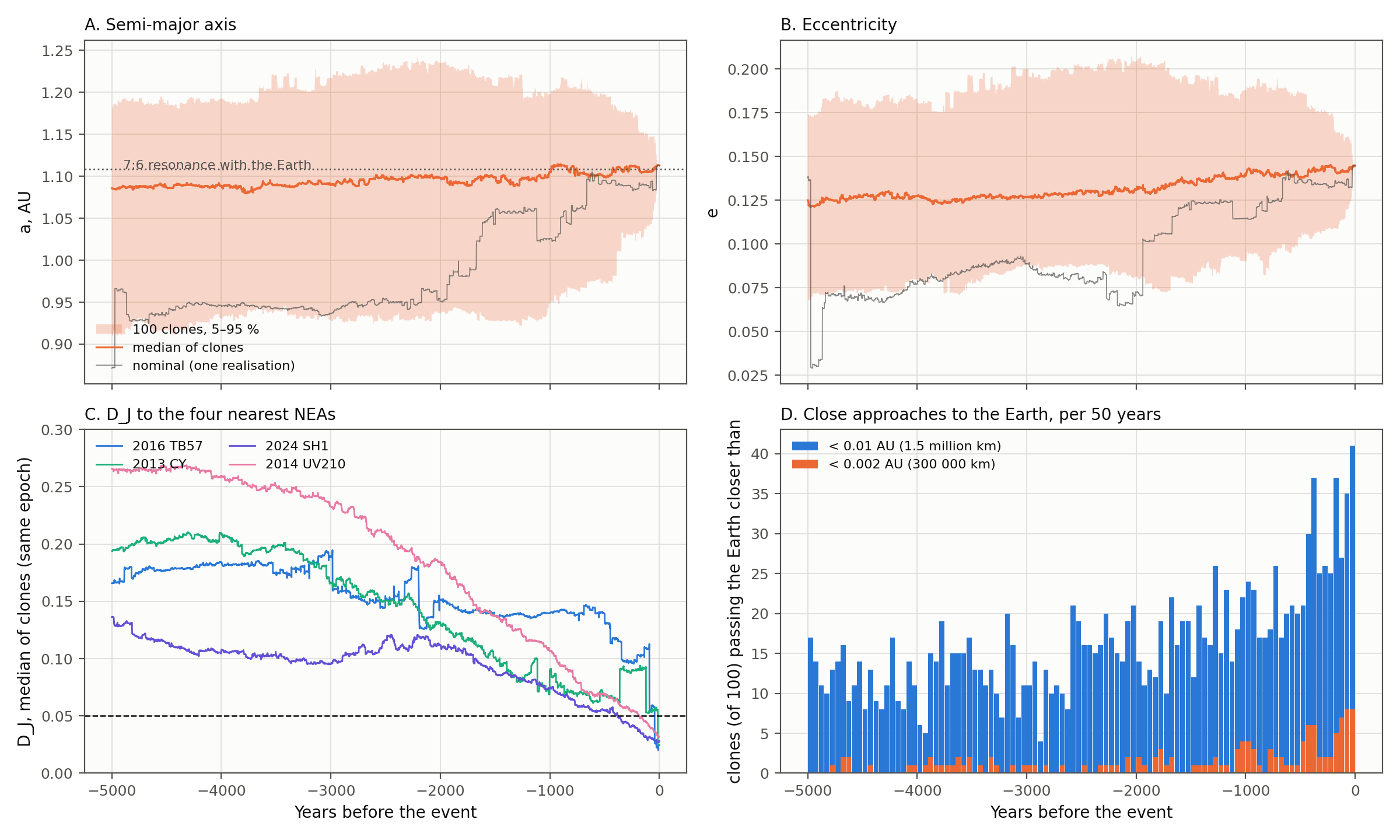
Figure 9 – Backward integration with the Earth (REBOUND, IAS15), 100 clones within the WMPL uncertainties: A – semi-major axis, B – eccentricity (median of the clones, 5–95 % band, and the nominal orbit as one realisation); C – DJ between the meteoroid (median of the clones) and the four nearest asteroids at the same epoch; D – number of clones passing the Earth closer than 0.01 AU and 0.002 AU in each 50-year bin.
The main perturber is the Earth. A typical clone passes closer than 0.01 AU (1.5 million km) to the Earth about 4 times per 1000 years, and each such approach changes the semi-major axis abruptly by hundredths of an AU. The orbit is therefore chaotic: already 20 years back the spread of the clones in semi-major axis exceeds 0.005 AU, and 34 years back 0.02 AU. The similarity to the nearest asteroids disappears within decades to centuries (Figure 9C). At the same time the type of the orbit is stable: the median of the clones hardly changes over 5000 years (a ≈ 1.09–1.11 AU, e ≈ 0.13–0.14), and the inclination slowly grows to ~1.9°. There is no capture in the 7:6 resonance with the Earth, the one closest to the orbit of the meteoroid.
Thus a link to a particular asteroid or group could only be claimed for a very recent separation, which cannot be verified: we cannot find the parent body from the orbit. We can only say that the meteoroid belongs to the population of small near-Earth asteroids on Earth-like orbits and, judging by the integration, may have been part of it for thousands of years.
7. Conclusions
- On 30 October 2026 two spectral cameras of the Belarusian Meteor Network recorded a faint (about −4.5 mag) but extremely slow fireball: initial speed 11.51 km/s, geocentric speed 2.93 km/s.
- The orbit is asteroidal, of the Apollo type, almost in the ecliptic plane and very similar to that of the Earth (a = 1.11 AU, q = 0.95 AU, i ≈ 0.06°, TJ = 5.60).
- The spectrum resembles a typical spectrum of an iron meteor (Fe dominates, no Mg) but contains a weak sodium emission – about 16 times weaker than in a typical chondrite of the same speed. In several years of our observations such spectra have been rare.
- The photometric mass is about 44–54 g (11–290 g including the photometric error). Because of the rough photometry, the comparison of the photometric and dynamic masses, the ablation coefficient and PE cannot reliably distinguish iron from stony, including carbonaceous, material.
- In our opinion the meteoroid was most likely iron, possibly with a small admixture of silicates. We cannot exclude a carbonaceous chondrite of unusual composition: to test it, meteor spectra of bodies reliably linked to carbonaceous chondrites at low speeds are needed.
- Similar orbits of small near-Earth asteroids do not stand out above the random background, and close approaches to the Earth erase the history of the orbit within decades to centuries, so we cannot find the parent body from the orbit. The meteoroid belongs to the population of small near-Earth asteroids on Earth-like orbits; if it is iron, this population contains products of differentiation.
Acknowledgment
The author thanks the operators of the Belarusian Meteor Network cameras: Alexander Mikulich, Andrey Prokopovich, Andrey Shohan, Ivan Sergei, Konstantin Morozov, Mikhail Abgarian and Ruslan Zavadich. The author is also grateful to Paul Roggemans for reviewing this report.
References
Ayers W. G., McCrosky R. E., Shao C.-Y. (1970). Photographic observations of 10 artificial meteors. Smithsonian Astrophysical Observatory Special Report 317.
Borovička J., Koten P., Spurný P., Boček J., Štork R. (2005). A survey of meteor spectra and orbits: evidence for three populations of Na-free meteoroids. Icarus 174, 15–30.
Čapek D., Koten P., Borovička J., Vojáček V., Spurný P., Štork R. (2019). Small iron meteoroids. Observation and modeling of meteor light curves. Astronomy & Astrophysics 625, A106.
Ceplecha Z. (1988). Earth’s influx of different populations of sporadic meteoroids from photographic and television data. Bulletin of the Astronomical Institutes of Czechoslovakia 39, 221–236.
Ceplecha Z., McCrosky R. E. (1976). Fireball end heights: A diagnostic for the structure of meteoric material. Journal of Geophysical Research 81, 6257–6275.
Ceplecha Z., Borovička J., Elford W. G., ReVelle D. O., Hawkes R. L., Porubčan V., Šimek M. (1998). Meteor phenomena and bodies. Space Science Reviews 84, 327–471.
Drummond J. D. (1981). A test of comet and meteor shower associations. Icarus 45, 545–553.
Gritsevich M. I. (2009). Determination of parameters of meteor bodies based on flight observational data. Advances in Space Research 44, 323–334.
Jopek T. J. (1993). Remarks on the meteor orbital similarity D-criterion. Icarus 106, 603–607.
Jopek T. J. (2020). The orbital clusters among the near-Earth asteroids. Monthly Notices of the Royal Astronomical Society 494, 680–693.
Matlovič P., Tóth J., Rudawska R., Kornoš L., Pisarčíková A. (2019). Spectral and orbital survey of medium-sized meteoroids. Astronomy & Astrophysics 629, A71.
Matlovič P., Tóth J., Kornoš L., Loehle S. (2020). On the sodium enhancement in spectra of slow meteors and the origin of Na-rich meteoroids. Icarus 347, 113817.
Matlovič P., Pisarčíková A., Pazderová V., Loehle S., Tóth J., Ferrière L., Čermák P., Leiser D., Vaubaillon J., Ravichandran R. (2024). Spectral properties of ablating meteorite samples for improved meteoroid composition diagnostics. Astronomy & Astrophysics 689, A323.
Mills T., Brown P. G., Mazur M. J., Vida D., Gural P. S., Moorhead A. V. (2021). Iron Rain: measuring the occurrence rate and origin of small iron meteoroids at Earth. Monthly Notices of the Royal Astronomical Society 508, 3684–3696.
Pecina P., Ceplecha Z. (1983). New aspects in single-body meteor physics. Bulletin of the Astronomical Institutes of Czechoslovakia 34, 102–121.
Popov A. M., Berezhnoy A. A., Borovička J., Labutin T. A., Zaytsev S. M., Stolyarov A. V. (2021). Tackling the FeO orange band puzzle in meteor and airglow spectra through combined astronomical and laboratory studies. Monthly Notices of the Royal Astronomical Society 500, 4296–4306.
Rein H., Liu S.-F. (2012). REBOUND: an open-source multi-purpose N-body code for collisional dynamics. Astronomy & Astrophysics 537, A128.
Rein H., Spiegel D. S. (2015). IAS15: a fast, adaptive, high-order integrator for gravitational dynamics, accurate to machine precision over a billion orbits. Monthly Notices of the Royal Astronomical Society 446, 1424–1437.
Southworth R. B., Hawkins G. S. (1963). Statistics of meteor streams. Smithsonian Contributions to Astrophysics 7, 261–285.
Vida D., Gural P. S., Brown P. G., Campbell-Brown M., Wiegert P. (2020). Estimating trajectories of meteors: an observational Monte Carlo approach – I. Theory. Monthly Notices of the Royal Astronomical Society 491, 2688–2705.
Vida D., Šegon D., Gural P. S., Brown P. G., McIntyre M. J. M., Dijkema T. J., Pavletić L., Kukić P., Mazur M. J., Eschman P., Roggemans P., Merlak A., Zubović D. (2021). The Global Meteor Network – Methodology and first results. Monthly Notices of the Royal Astronomical Society 506, 5046–5074.
Vojáček V., Borovička J., Spurný P., Čapek D. (2020). The properties of cm-sized iron meteoroids. Planetary and Space Science 184, 104882.
JPL Small-Body Database, https://ssd.jpl.nasa.gov/tools/sbdb_query.html; JPL Horizons, https://ssd.jpl.nasa.gov/horizons/
RSpec – Real-time Spectroscopy software, https://www.rspec-astro.com
WMPL – Western Meteor Physics Library, https://github.com/wmpg/WesternMeteorPyLib
RMS – Raspberry Pi Meteor Station software (SkyFit2), https://github.com/CroatianMeteorNetwork/RMS
Natural Earth – free vector map data (public domain), https://www.naturalearthdata.com