By Paul Roggemans, Denis Vida, Damir Šegon, Milan Kalina, James M. Scott, Jeff Wood
Abstract: A new meteor shower on a Halley-type comet orbit (TJ = –0.35) has been detected during about one day (λʘ 115.0°–116.2°) in 2026, by the Global Meteor Network. In total, 49 meteors from 2019–2026 belong to the new shower from a radiant at R.A. = 36.7° and Decl. = –17.7°, with a geocentric velocity of 63.5 km/s. Maximum activity occurred at λʘ = 115.5°±0.25° (July 18). The shower is also present in GMN data of 2024 and, marginally, 2023. The new meteor shower has been listed in the IAU-MDC Working List of Meteor Showers under the preliminary name-designation: M2026-R1.
1 Introduction
A routine screening of the Global Meteor Network radiant density maps revealed an unexpected and unidentified activity source in the constellation of Cetus on 17–18 July 2026. A first analysis revealed 54 meteors of this possible meteor shower of which 37 remained for further analysis after removal of all outliers. The shower had a geocentric radiant with coordinates R.A. = 36.6°, Decl. = –18.5° (equinox J2000.0) at its discovery. The median Sun-centered ecliptic coordinates were λg – λʘ = 271.9°, βg = –31.1°. The geocentric velocity was 62.2 ± 0.2 km/s. The new meteor shower was reported to the IAU-MDC and registered under the temporary identification M2026-R1.
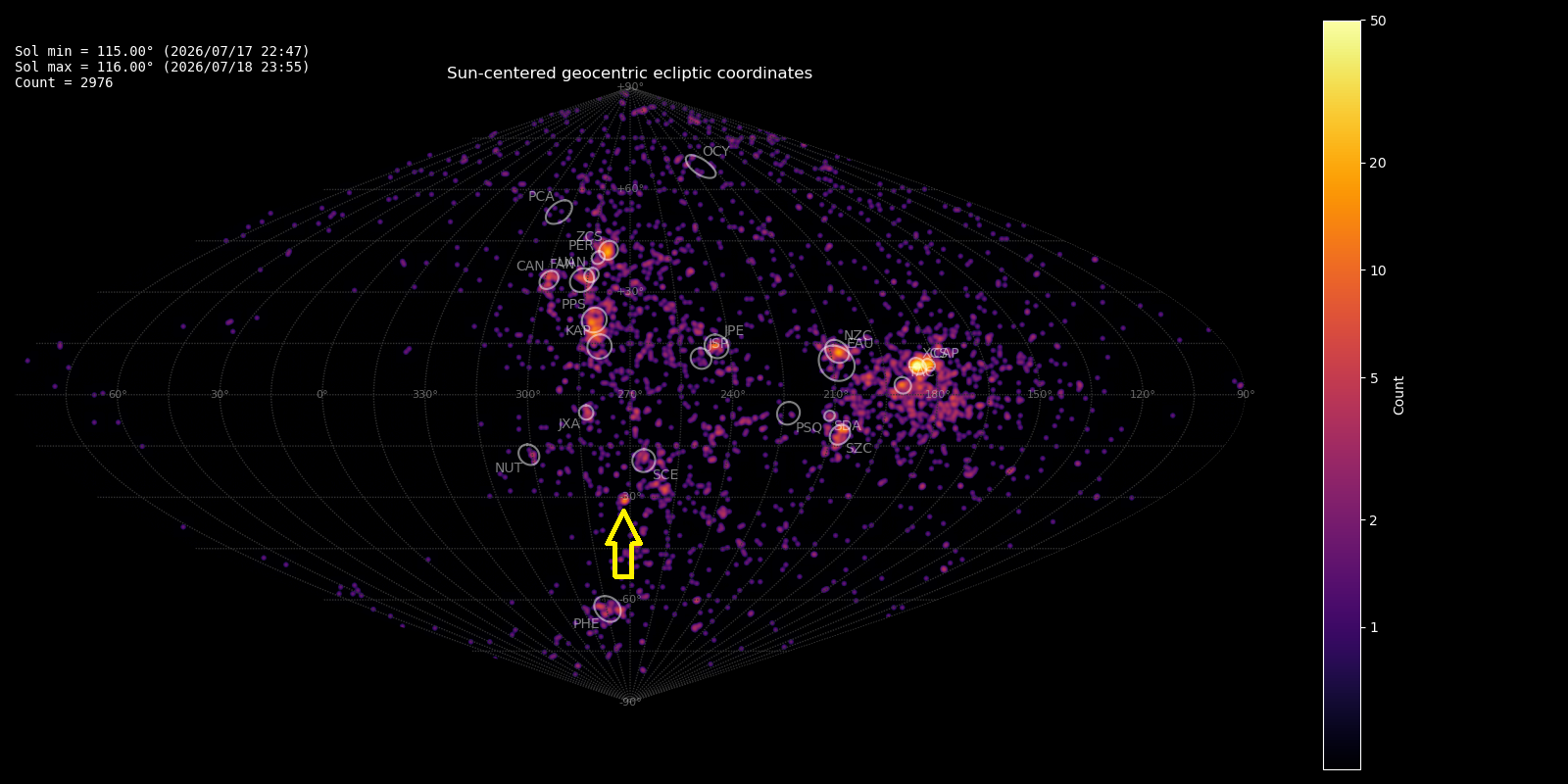
Figure 1 – Radiant density map with 2976 radiants obtained by the Global Meteor Network during the 17th – 18th July, 2026. The position of the possible new shower M2026-R1 in Cetus in Sun-centered geocentric ecliptic coordinates is marked with a yellow arrow.
2 Shower classification based on radiants
The first analysis has been done using the tool RadiantMap developed by Milan Kalina. This tool makes it possible to select radiants on the radiant density map (Figure 2) within a range in solar longitude to run automatically the meteor shower association tools developed by Denis Vida and Damir Šegon. Figure 2 shows no known activity expected according to the IAU-MDC Working List of Meteor Showers (Jopek and Kaňuchová, 2017; Jenniskens et al., 2020) at the region of interest, marked by a yellow circle. The MDC solutions closest to M2026-R1 are M2025-P1 (Šegon et al., 2025; 7.2° away, DD = 0.247, DSH = 0.717), TCT#598 (8.2°, no orbit), FOR#1066 (12.6°, DD = 0.133, DSH = 0.403), SCE#1070 (12.1°, DD = 0.143, DSH = 0.417), RER#738 (14.9°, DD = 0.155, DSH = 0.427) and ERI#191 (DD = 0.165, DSH = 0.449 against Jenniskens, 2023), with D values relative to the radiant-method orbit in Table 1. The maximum-sigma test of Jopek et al. (2024) separates all of them from M2026-R1: they differ by 6° to 19° in λg – λʘ (limit 5°), and those with orbits by 14° to 51° in ω (limit 9°).
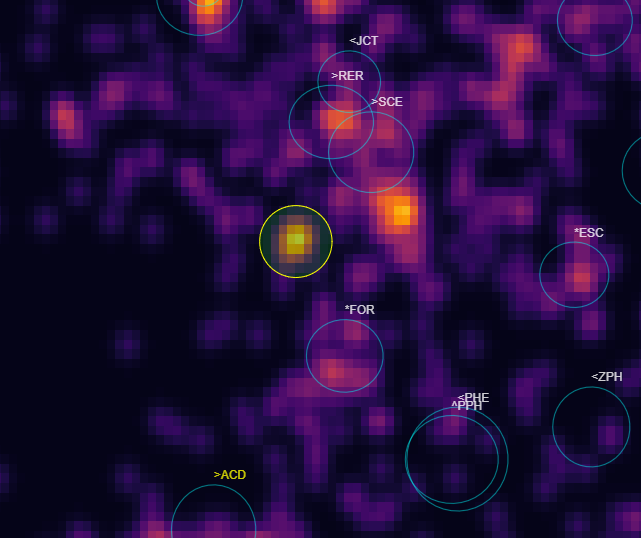
Figure 2 – Screenshot from RadiantMap with the selected region of interest for the unknown activity source in 2026 at λʘ = 116°, marked in the yellow circle.
The RadiantMap tool initially selected 54 meteors within the region of interest. About 15% of the candidates are duplicate solutions of the same meteor. They were not removed, but the activity in 115.0°–116.2° remains significant without them (Section 3). The initial radiant offset threshold is 4.35° and the vg deviation threshold 2.5 km/s. Using these values to remove outliers, 37 meteors remained for final analysis. The final median dispersion is 1.7° giving an association radius (×2.5) of 4.2° (Vida et al., 2021, implemented in the RadiantMap tool). 98 GMN-cameras in 9 countries (Australia, Brazil, Croatia, Czech Republic, Hungary, New Zealand, Poland, Slovakia and the United States) contributed data to this dataset for the radiant based analysis. The shower parameters as obtained by the radiant method for 2026 are listed in Table 1.
Figures 4 and 6 show the relatively compact radiant of M2026-R1 whose activity occurred above the minimal level of detectability only between solar longitude 115.0° and 116.2°.
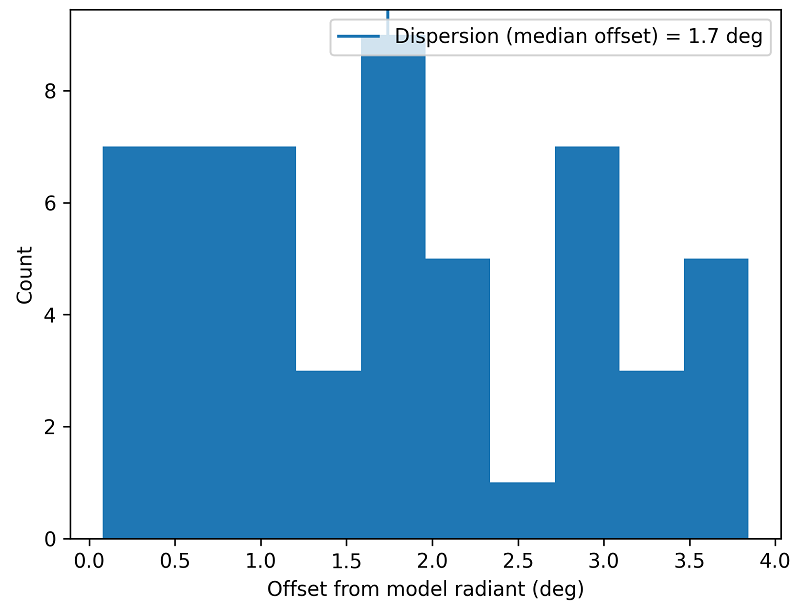
Figure 3 – Offsets of the 54 candidate radiants from the first drift fit (first pass, before outlier removal); the median offset is 1.7°.
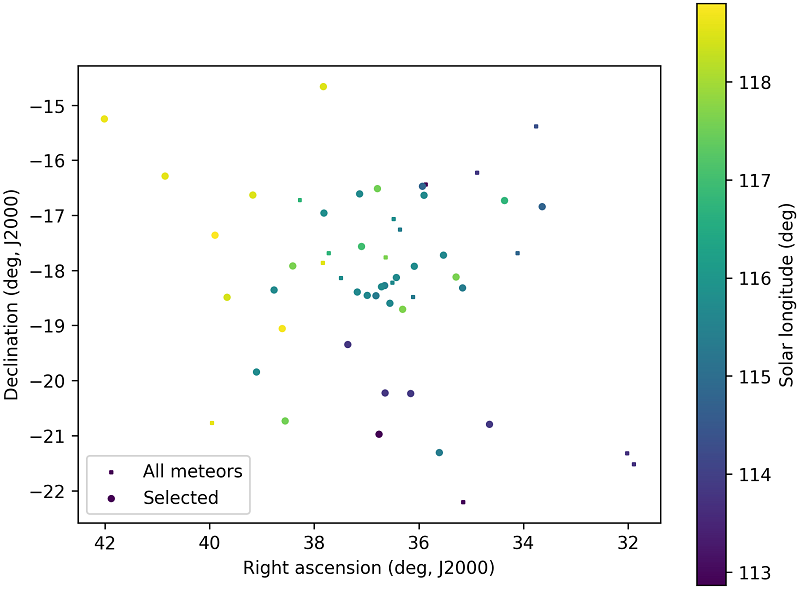
Figure 4 – The radiant distribution in 2026 during the solar-longitude interval 112.8° – 118.8° in equatorial coordinates.
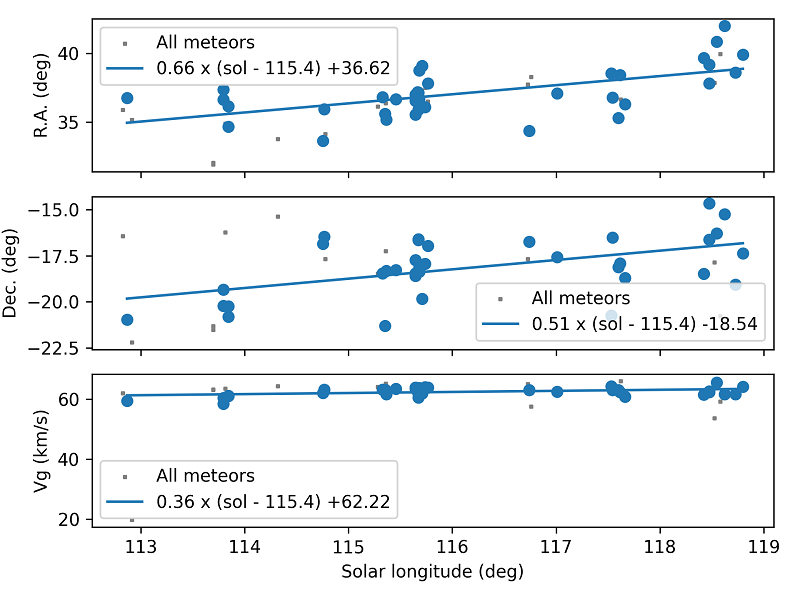
Figure 5 – The radiant drift in 2026.
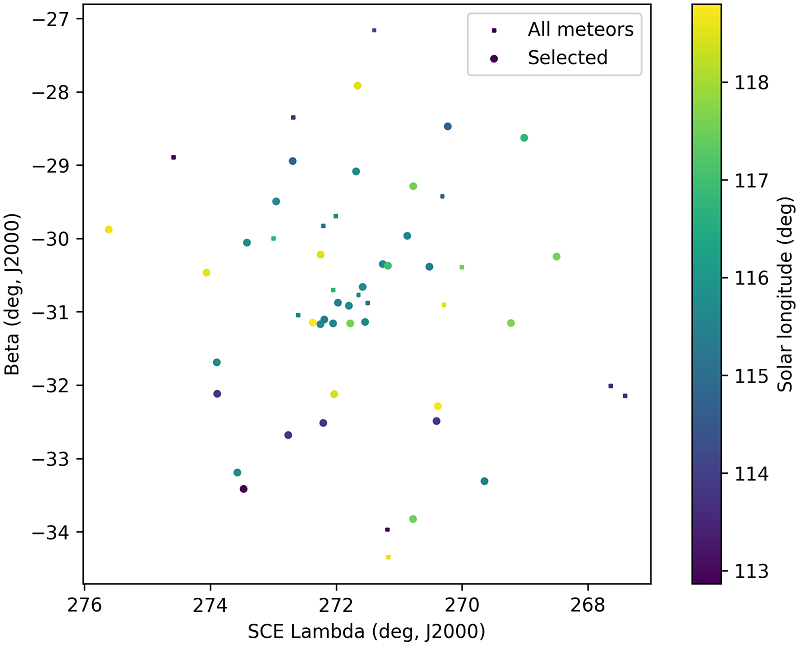
Figure 6 – The radiant distribution during the solar-longitude interval 112.8° – 118.8° in Sun-centered ecliptic coordinates.
3 Shower classification based on orbits
A completely independent meteoroid stream search has been applied to orbit data obtained between solar longitude 112° and 119° during the years 2019–2026. The method has been described in detail in a separate publication (Roggemans et al., 2026a). 70217 orbits were available within this time interval and a final mean orbit has been computed by the method of Jopek et al. (2006) for the thresholds DSH < 0.125 and DD < 0.05 and DJ < 0.125 (Southworth and Hawkins, 1963; Drummond, 1981; Jopek, 1993). The Rayleigh fit failed in this case. The threshold was chosen as a safe criterion to assess the similarity among these high-eccentricity retrograde orbits. The resulting mean orbit based upon 49 meteors recorded from 2019 until 2026 is listed in Table 1.
Figures 7, 8, and 10 to 13 plot the combined thresholds DSH < 0.15 and DD < 0.06 and DJ < 0.15 (marked as DD < 0.06), DSH < 0.125 and DD < 0.05 and DJ < 0.125 (marked as DD < 0.05), DSH < 0.10 and DD < 0.04 and DJ < 0.10 (marked as DD < 0.04) and DSH < 0.05 and DD < 0.02 and DJ < 0.05 (marked as DD < 0.02).
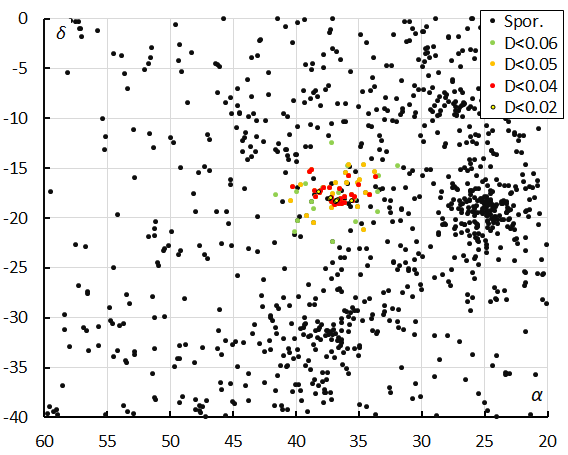
Figure 7 – The radiant distribution during the solar-longitude interval 114.5° – 116.5° in equatorial coordinates, color-coded for different threshold values of the combined similarity criteria.
A radiant concentration is visible between λʘ 114.5° and 116.5° (Figure 7) but beyond this period nothing stands out of the background activity. The eta-Eridanids appear at the same declination west of the new activity. Just south of it are the Fornacids (FOR#1066). The radiant of M2026-R1 is more distinct in the geocentric Sun-centered ecliptic coordinates (Figure 8). The dark cluster right of M2026-R1 are the eta-Eridanids, which have their maximum twenty days later. The concentration south of these is the Fornacids.
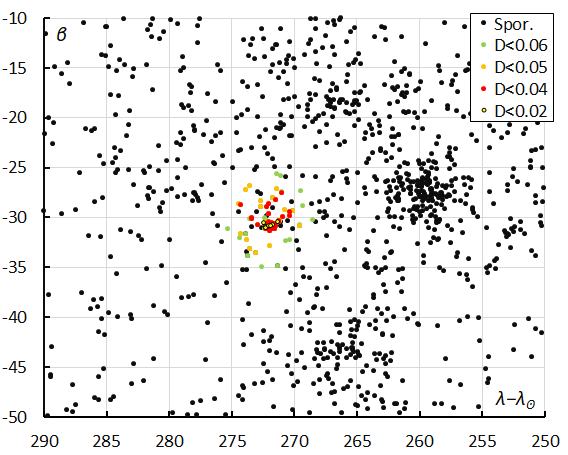
Figure 8 – The radiant distribution during the solar-longitude interval 114.5° – 116.5° in Sun-centered geocentric ecliptic coordinates, color-coded for different threshold values of the combined similarity criteria.
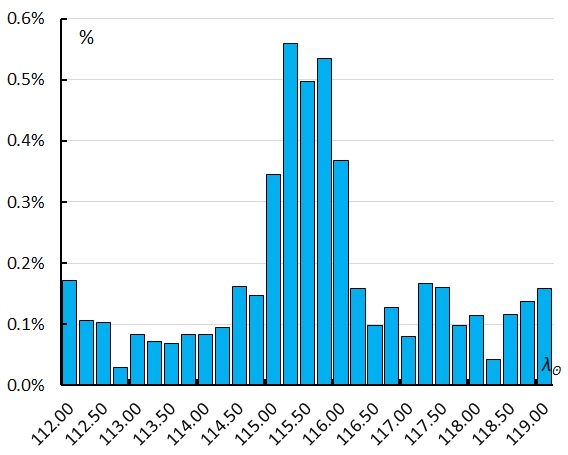
Figure 9 – The percentage of M2026-R1 meteors relative to the total number of meteors recorded in 2019–2026.
The number of shower meteors as a percentage relative to the total number of meteors recorded in a 24 hours interval results in the profile plotted in Figure 9. The highest percentages occurred at λʘ = 115.5° ± 0.25° although similar orbits were detected during the entire search window λʘ = 112° until λʘ = 119°. The possible shower members outside the about one day (λʘ 115.0°–116.2°) interval are likely sporadic meteors that fit the similarity criteria by chance. The radiant based method suffered contamination with sporadics that fit the radiant and geocentric velocity selection criteria (41 candidates against 27 expected sporadics over 112.1°–118.8° in 2026, but 15 against 4.8 within 115.0°–116.2°), but with a heliocentric velocity that is slightly lower than for M2026-R1 meteors. The presence of meteors with a lower heliocentric velocity results in a mean orbit with a lower eccentricity and consequent shorter semi-major axis. The activity period in Table 1 is the search window and represents mainly sporadic contamination beyond the about one day (λʘ 115.0°–116.2°) activity.
We also counted GMN orbits within 4° of the Sun-centered radiant (λg – λʘ = 271.9°, βg = –31.1°) with vg within 10% of 62.2 km/s, after quality cuts and removal of duplicates, in the window 115.0°–116.2° of each year. The expected number of sporadics was obtained from the fraction of all orbits in the same selection outside this window (λʘ 105°–126°, same year) times the number of all orbits inside it, and P is the Poisson probability of at least the observed number arising from this background alone. The shower fraction was 4.7 per mille in 2023 (5 meteors, 1.4 expected, P = 0.013), 7.3 in 2024 (8, 1.9 expected, P = 0.0009), 3.2 in 2025 (7, 4.1 expected, P = 0.13) and 5.5 in 2026 (15, 4.8 expected, P = 0.0002), with one meteor in 2019 and none in 2020–2022. With the same selection, the 2019–2026 data also show a weaker excess between solar longitude 118.5° and 121.5°: 58 meteors against 36.1 expected (P = 5 × 10⁻⁴). Its relation to M2026-R1 is not yet clear.
4 Orbit and parent body
The diagram of the inclination i versus the longitude of perihelion Π shows quite some dispersion in both inclination and longitude of perihelion (Figure 10). The dense cloud between 270° and 280° in longitude of perihelion and near 110° in inclination are the zeta-Cassiopeiids (ZCS#444).
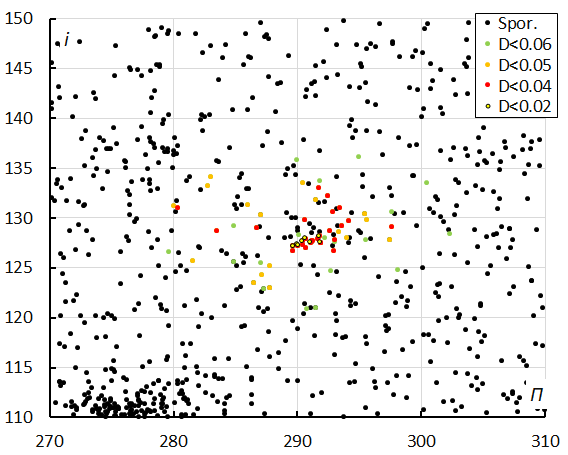
Figure 10 – Inclination i versus the longitude of perihelion Π color-coded for different classes of D-criteria thresholds, for λʘ between 114.5° – 116.5°. Spor. = sporadics.
The eccentricity e versus the longitude of perihelion Π appears dispersed in e and in Π (Figure 11) because of the sensitivity of the eccentricity for the uncertainty on the velocity measurement for high eccentricity values. The diagram e versus i (Figure 12) also shows a large dispersion. The diagram with the perihelion distance q versus i (Figure 13) shows a dense concentration at the upper limit for the perihelion distance. The ascending node lies at 1.013–1.014 AU and the argument of perihelion is about 355°, so the perihelion sits just inside the node and q of about 1.01 AU follows from the encounter geometry. The q concentration is expected for any stream met at this node and says little about compactness.
Table 1 – Comparing solutions derived by two different methods, RadiantMap-method based on radiant positions for 2026 as reported to the IAU MDC, and the orbit association method (2019–2026) for DSH < 0.125 and DD < 0.05 and DJ < 0.125 (DD < 0.05). Hb, He, Hp are the begin-, end- and peak-brightness heights and MagAp is the average peak absolute magnitude, normalized to 100 km. The RadiantMap 2026 selection includes orbits with e > 1. The D-criteria based method eliminated all e > 1.
| RadiantMap
method 2026 |
Orbit method 2019–2026 DD < 0.05 |
|
| λʘ (°) | 115.4 | 115.6 |
| λʘb (°) | 112.1 | 112.1 |
| λʘe (°) | 118.8 | 118.9 |
| αg (°) | 36.6 | 36.7 |
| δg (°) | –18.5 | –17.7 |
| Δαg (°/°λʘ) | +0.66 | +0.70 |
| Δδg (°/°λʘ) | +0.51 | +0.13 |
| vg (km/s) | 62.2 | 63.5 |
| Hb (km) | 109.5 | 109.9 |
| He (km) | 96.1 | 95.8 |
| Hp (km) | 100.9 | 100.0 |
| MagAp | –1.6 | –1.6 |
| λg (°) | 27.27 | 27.5 |
| λg – λʘ (°) | 271.87 | 272.0 |
| βg (°) | –31.11 | –30.5 |
| a (A.U.) | 7.316 | 12.6 |
| q (A.U.) | 1.011 | 1.012 |
| e | 0.862 | 0.920 |
| i (°) | 127.1 | 128.7 |
| ω (°) | 355.2 | 354.5 |
| Ω (°) | 296.2 | 295.7 |
| Π (°) | 291.5 | 290.2 |
| TJ | –0.01 | –0.35 |
| N | 37 | 49 |
The orbit-based solution removed orbits with too low heliocentric velocities at each step of the iteration procedure until it converged on the final mean orbit listed in Table 1. This solution has a higher eccentricity, larger semi-major axis and slightly higher inclination because of the higher heliocentric velocity with a median vh = 41.0 km/s as the iteration removed all outliers below 40.12 km/s and above 41.66 km/s so that no e > 1 orbits remain in the threshold class DSH < 0.125 and DD < 0.05 and DJ < 0.125. The radiant based method has a median vh = 40.1 km/s with outliers between 37.22 km/s and 43.22 km/s and contains considerable sporadic contamination. The semi-major axis remains poorly constrained (about 10–15 AU) because it depends on how near-parabolic and hyperbolic orbits are treated.
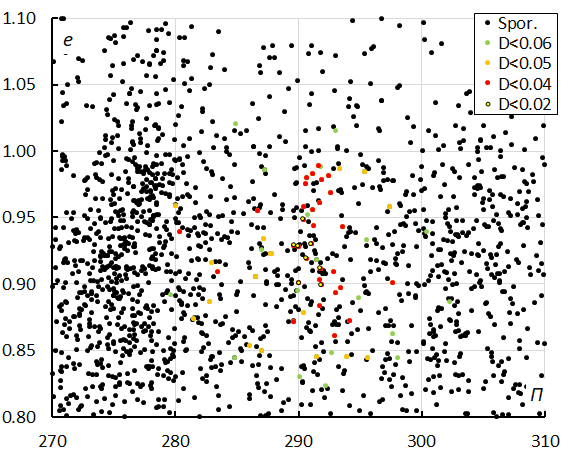
Figure 11 – Eccentricity e versus the longitude of perihelion Π color-coded for different classes of D-criteria thresholds, for λʘ between 114.5° – 116.5°. Spor. = sporadics.
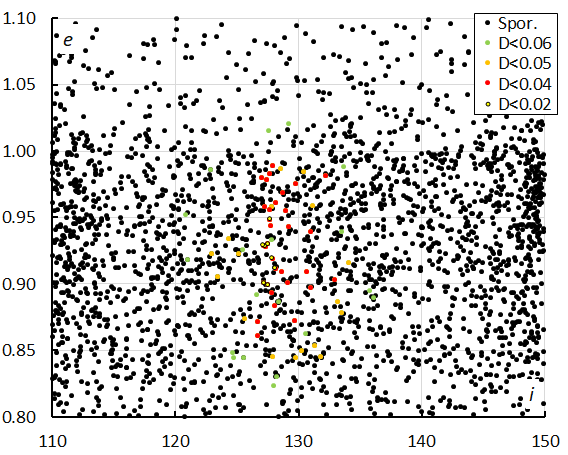
Figure 12 – Eccentricity e versus the inclination i color-coded for different classes of D-criteria thresholds, for λʘ between 114.5° – 116.5°. Spor. = sporadics.
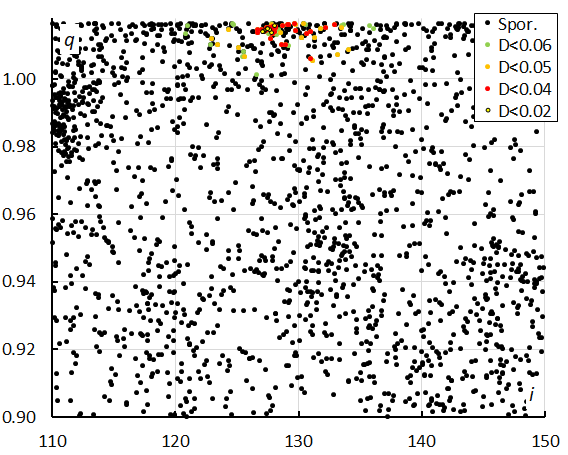
Figure 13 – Perihelion distance q versus the inclination i color-coded for different classes of D-criteria thresholds, for λʘ between 114.5° – 116.5°. Spor. = sporadics. The q axis ends at 1.018 AU.
With a Tisserand value relative to Jupiter of –0.35, this is a Halley-type comet orbit (Tancredi, 2014; TJ = –0.01 and P = 19.8 years for the radiant method, TJ = –0.35 and P = 44.7 years for the orbit method). The descending node lies at 13.3 A.U. for the radiant method (between the orbits of Saturn and Uranus) and at 23.1 A.U. for the orbit method (between the orbits of Uranus and Neptune) (Figure 14). With a high eccentricity, the slightest observational or instrumental uncertainty on the velocity results in a huge difference in aphelion. The radiant method identification includes some meteors with smaller heliocentric velocities that result in a mean orbit with a lower eccentricity. The orbit based mean orbit (blue in Figure 14) is probably the best representative orbit for this shower. The meteoroid stream M2026-R1 with its retrograde orbit encounters the Earth orbit at its ascending node close to its perihelion (Figure 15).
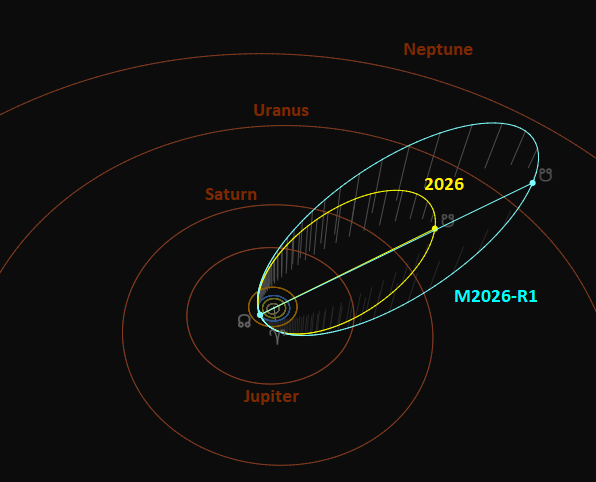
Figure 14 – The radiant determined solution for 2026 (yellow) and the orbit determined solution for 2019–2026 (blue). (Plotted with the Orbit visualization app provided by Pető Zsolt).
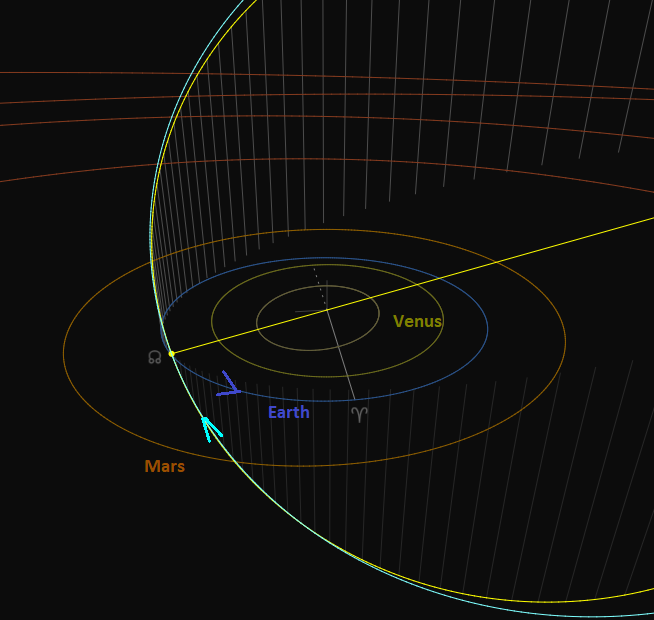
Figure 15 – Close-up in the inner Solar system with the radiant determined solution for 2026 (yellow) and the orbit determined solution for 2019–2026 (blue). (Plotted with the Orbit visualization app provided by Pető Zsolt).
A search for a possible parent body based upon the mean orbit of the radiant method did not result in any positive match, the ten best results are listed in Table 2. The DSH values are between 0.41 and 0.80 for the top ten and none of the candidates passes within 0.05 AU of the Earth’s orbit near Ω = 296°.
Table 2 – Top ten matches of a search for possible parent bodies with DD < 0.30, based upon the mean orbit derived from the orbit method (Table 1, 2019–2026). JPL ELEMENTS.COMET (2026-10-26).
| Name | DD |
| C/2013 UQ4 (Catalina) | 0.160 |
| C/1874 G1 (Winnecke) | 0.162 |
| C/2013 A1 (Siding Spring) | 0.171 |
| C/1500 H1 | 0.187 |
| 273P/Pons-Gambart | 0.188 |
| C/1110 K1 | 0.200 |
| C/1852 K1 (Chacornac) | 0.210 |
| C/2018 N1 (NEOWISE) | 0.218 |
| C/1947 S1 (Bester) | 0.221 |
| C/2020 R4 (ATLAS) | 0.256 |
5 Conclusions
The radiant density maps show a distinct concentration of the M2026-R1 radiant on July 18 in 2026. M2026-R1 was also detected in 2024 and marginally in 2023 at about the 2026 level, so it may be a weak annual shower. Similar orbits were detected with the orbit-based method during about a week and in previous years. Although a distinct concentration is visible in radiant positions, the diagrams with the orbital elements i versus Π, e versus Π, e versus i show a relatively large spread which comes mainly from vg errors near the parabolic limit, while the core radiant is compact (median offset 0.66° for the 15 members with solar longitude 115.0° – 116.2°) and the main activity lasts about one day (λʘ 115.0°–116.2°) each year. Only the perihelion distance q appears as a concentration. M2026-R1 is a barely detectable footprint of a dust remnant of an unknown Halley-type comet. Future observations may reveal whether this activity becomes stronger or drops back below the threshold of detectability. The revised solution (annual activity) will be submitted to the MDC as an additional solution of M2026-R1.
Acknowledgments
This report is based on the data of the Global Meteor Network (Vida et al., 2020a; 2020b; 2021) which is released under the CC BY 4.0 license. We thank all 927 participants in the Global Meteor Network project for their contribution and perseverance. A list with the names of the volunteers who contribute to GMN has been published in the 2025 annual report (Roggemans et al., 2026b). The following 160 cameras contributed to paired meteors by either of the two methods used in this study:
AU0003, AU000D, AU000F, AU000U, AU000V, AU000W, AU000Z, AU001A, AU001B, AU001Q, AU001U, AU002B, AU0038, AU0039, AU004L, AU004Q, BR000F, BR000J, BR000Q, BR000S, BR0013, BR001H, BR001W, BR002C, CZ000Q, CZ000R, ES0019, ES001H, HR0002, HR000S, HR001Z, HR0027, HR002J, HR002X, HU0001, HU0003, HU0009, HU000B, HU000F, KR0016, KR001P, KR001Z, KR002C, MX0001, MX0003, NZ0001, NZ0003, NZ0004, NZ0007, NZ000M, NZ000N, NZ000Q, NZ000W, NZ000Z, NZ0012, NZ0014, NZ0017, NZ0018, NZ001H, NZ001Q, NZ001R, NZ001S, NZ001V, NZ001Z, NZ0020, NZ0022, NZ0023, NZ0025, NZ0026, NZ0027, NZ002A, NZ002C, NZ002D, NZ002E, NZ002H, NZ002J, NZ002K, NZ002L, NZ002N, NZ002P, NZ002R, NZ002S, NZ002U, NZ002W, NZ002X, NZ002Y, NZ0030, NZ0033, NZ0034, NZ0035, NZ0036, NZ0037, NZ0038, NZ003A, NZ003B, NZ003C, NZ003E, NZ003G, NZ003H, NZ003N, NZ003Q, NZ003R, NZ003S, NZ003U, NZ003X, NZ003Y, NZ0040, NZ0042, NZ0044, NZ0045, NZ004A, NZ004D, NZ004H, NZ004L, NZ004N, NZ004S, NZ004T, NZ004V, NZ004X, NZ004Y, NZ0051, NZ0059, NZ005B, NZ005C, NZ005D, NZ005G, NZ005H, NZ005J, NZ005K, NZ005L, NZ005Q, NZ005S, NZ005T, NZ005U, NZ005Y, NZ005Z, NZ0061, NZ0065, NZ0068, NZ006F, NZ006J, NZ006K, NZ006M, NZ006N, NZ006P, NZ006V, NZ0073, NZ007C, NZ007E, PL0008, SK0006, US0004, US0007, US0008, US0009, US003T, US0066, USL006, USL00C and USL00M.
References
Drummond J. D. (1981). “A test of comet and meteor shower associations”. Icarus, 45, 545–553.
Jenniskens P., Jopek T. J., Janches D., Hajduková M., Kokhirova G. I., Rudawska R. (2020). “On removing showers from the IAU Working List of Meteor Showers”. Planetary and Space Science, 182, 104821.
Jenniskens P. (2023). Atlas of Earth’s Meteor Showers. Elsevier (ISBN 978-0-443-23577-1).
Jopek T. J. (1993). “Remarks on the meteor orbital similarity D-criterion”. Icarus, 106, 603–607.
Jopek T. J., Rudawska R. and Pretka-Ziomek H. (2006). “Calculation of the mean orbit of a meteoroid stream”. Monthly Notices of the Royal Astronomical Society, 371, 1367–1372.
Jopek T. J., Kaňuchová Z. (2017). “IAU Meteor Data Center – the shower database: A status report”. Planetary and Space Science, 143, 3–6.
Jopek T. J., Neslušan L., Rudawska R., Hajduková M. (2024). “Search for duplicates of showers in the IAU MDC database. Methods and general results”. Astronomy & Astrophysics, 682, id.A159, 12 pp.
Roggemans P., Vida D., Šegon D., Scott J. M. (2026a). “Meteoroid orbit shower identification method and its application in meteor shower case studies”. eMetN Meteor Journal, 11, 189–204.
Roggemans P., Campbell-Burns P., Kalina M., McIntyre M., Scott J. M., Šegon D., Vida D. (2026b). “Global Meteor Network report 2025”. eMetN Meteor Journal, 11, 89–129.
Šegon D., Vida D., Roggemans P. (2025). “New meteor shower in Eridanus”. eMetN Meteor Journal, 10, 282–286.
Southworth R. B. and Hawkins G. S. (1963). “Statistics of meteor streams”. Smithsonian Contributions to Astrophysics, 7, 261–285.
Tancredi G. (2014). “A criterion to classify asteroids and comets based on the orbital parameters”. Icarus, 234, 66–80.
Vida D., Gural P., Brown P., Campbell-Brown M., Wiegert P. (2020a). “Estimating trajectories of meteors: an observational Monte Carlo approach – I. Theory”. Monthly Notices of the Royal Astronomical Society, 491, 2688–2705.
Vida D., Brown P. G., Campbell-Brown M., Wiegert P., Gural P. S. (2020b). “Estimating trajectories of meteors: an observational Monte Carlo approach – II. Results”. Monthly Notices of the Royal Astronomical Society, 491, 3996–4011.
Vida D., Šegon D., Gural P. S., Brown P. G., McIntyre M. J. M., Dijkema T. J., Pavletić L., Kukić P., Mazur M. J., Eschman P., Roggemans P., Merlak A., Zubrović D. (2021). “The Global Meteor Network – Methodology and first results”. Monthly Notices of the Royal Astronomical Society, 506, 5046–5074.