By Alexandra Terentjeva and Elena Bakanas
Abstract: This work is a continuation of our research on Eccentrids in the system of minor bodies. In this paper, we examine Eccentrids among asteroids and minor meteor streams in the Jupiter system. From the Lowell Observatory asteroid catalogue, which contained 1553303 asteroids as of June 30, 2026, we identified 1644 asteroids. The selection criteria were e ≥ 0.4 and 4.70 AU ≤ Q ≤ 5.70 AU. From the catalogue of 249 minor meteoroid streams (Terentjeva, 1966, 1967), 68 Eccentrid streams were identified, containing 100 meteoroid orbits. The distributions of asteroid Eccentrids and Eccentrids of minor meteor streams by eccentricity e and longitude of perihelion Π were studied. The dependence of eccentricity e on orbital period P was examined. Several conclusions were made from these distributions.
1 Introduction
This paper is a continuation of our research on Eccentrids (Terentjeva and Barabanov, 2016; Terentjeva and Bakanas, 2026, et al.), in which we examined the Eccentrids of the Earth group and the Mars family. In this paper, we focus on the Eccentrids of the Jupiter family. Jupiter is one of the large planets in the Solar System, with a significant sphere of influence (0.50 AU).
2 Research results
From the Lowell Observatory asteroid catalogue, which contained 1553303 asteroid orbits as of June 30, 2026, 1644 asteroids belonging to the Eccentrids were selected. The selection criteria were e ≥ 0.4 and 4.70 AU ≤ Q ≤ 5.70 AU.
For the selection of the Eccentrids of the Jupiter Family among the meteoroid streams, we used the most comprehensive catalogue of 249 minor meteor streams (Terentjeva, 1966, 1967). The catalogue was compiled using photographic data, incorporating and analysing catalogues of radiants based on the best visual observations conducted by experienced observers, such as I. S. Astapovich and others. The minor meteor streams in this catalogue represent the smallest bodies in the Solar System’s minor body population, which are the most susceptible to various disturbances and perturbations.
According to our selection criteria for the Eccentrids of the Jupiter family, out of 249 minor meteor streams, we identified 68 streams belonging to the Eccentrids, accounting for 27%. This is a completely different situation from that of the Eccentrids of the Mars family, where, out of 670 orbits of meteoroid streams listed in several catalogues, only one Eccentrid stream of the Mars family was found (Terentjeva and Bakanas, 2026).
Let us examine the 68 Eccentrid streams that were found (they contain 100 meteoroid orbits). The distribution of these 100 values by eccentricity e is shown in Table 1.
Thus, the largest number of the Eccentrid streams of the Jupiter family (78%) have eccentricities of 0.7 and 0.8. The largest number of the Eccentrid asteroids of the Jupiter family have an eccentricity of about 0.6 (Figure 1).
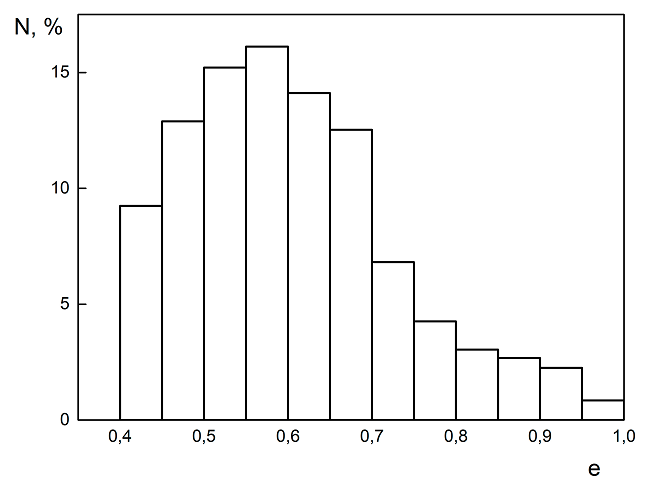
Figure 1 – Distribution by eccentricity e of the Eccentrid asteroids of the Jupiter family.
Table 1 – Distribution of the number of orbits in function of the eccentricity.
| e | 0.4 | 0.5 | 0.6 | 0.7 | 0.8 | 0.9 | 0.96 | Total |
| Number of orbits, % | 0 | 0 | 4 | 39 | 39 | 16 | 2 | 100 |
Figure 2 shows the dependence of eccentricity e on the orbital period P for the Eccentrid asteroids of the Jupiter family. As P decreases, e increases. This may be the effect of secular perturbations from inner planets.
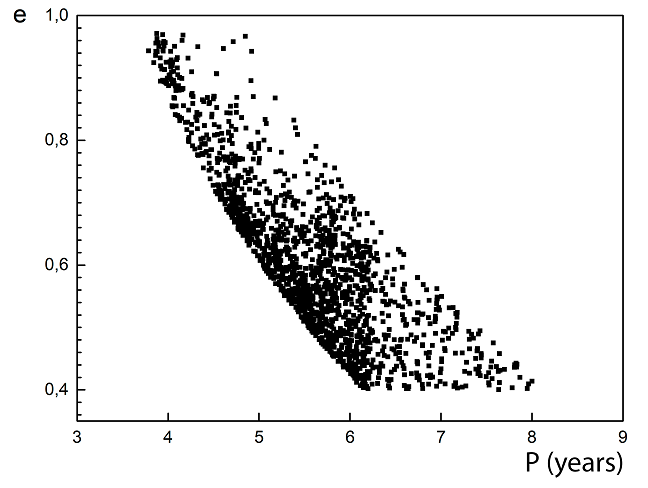
Figure 2 – Eccentricity as a function of orbital period P for the Eccentrid asteroids of the Jupiter family.
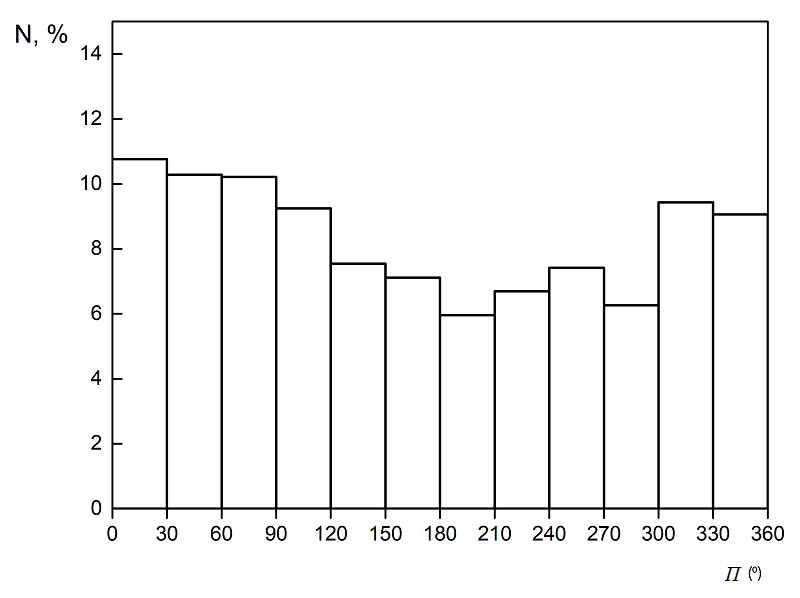
Figure 3 – Distribution of the longitudes of perihelion Π of the Eccentrid asteroids of the Jupiter family.
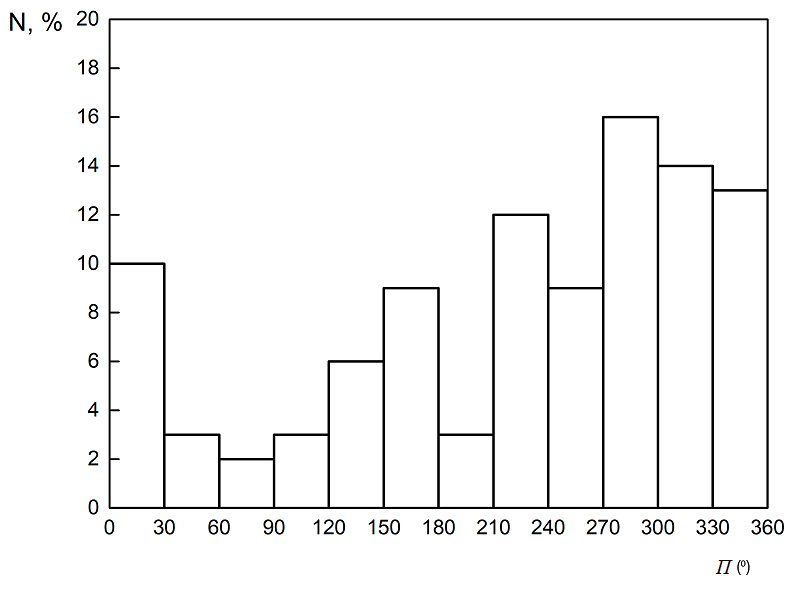
Figure 4 – Distribution of the longitudes of perihelion Π for the Eccentrids of minor meteor streams of the Jupiter family.
Let us now examine the distribution of the longitudes of perihelion Π of the Eccentrid asteroids (Figure 3) and the minor meteoroid streams of the Eccentrids (Figure 4) of the Jupiter family. The variation of Π for asteroids is rather smooth, with the main maximum in the interval of Π = 0°–30° and two minima at the intervals of Π = 180°–210° and Π = 270°–300°. The main maximum includes the now well-known maximum of the Main Belt asteroids in the interval of Π = 0°–20°, discovered by Putilin (1953). Jupiter falls within this interval, at Π = 15°.4. In Figure 3, a broader area of Π = 0°–90°, adjoined by Saturn (Π = 91°.1), can be considered the maximum in the distribution by Π.
Let us further examine the distribution of the longitudes of perihelion Π of the minor meteor streams of the Eccentrids (Figure 4). It cannot be said that this distribution is particularly pronounced. This is evidently a feature of finely dispersed matter, which is easily subject to various perturbations. Nevertheless, we can identify the main maximum in the interval of Π = 270°–300°, the second maximum in the interval of Π = 210°–240°, the third peak in the interval of Π = 0°–30°, and perhaps the fourth maximum in the interval of Π = 150°–180°. The area of the second maximum includes Pluto (Π = 223°.6), and the area of the fourth maximum includes Uranus (Π = 169°.0). The area of the third maximum, Π = 0°–30°, was discussed above.
It should be noted that the main maximum at Π = 270°–300°, which none of the planets of the Solar System falls within, for minor meteor streams (Figure 4) coincides with the minimum for asteroids (Figure 3) and, at the same time, with one of the main maxima for the Eccentrid asteroids of the Mars family (Figure 1, Terentjeva and Bakanas, 2026).
The values of the Tisserand dynamical parameter TJ, with Jupiter as the perturbing planet, were calculated for 11 Eccentrid minor meteor streams. Ten of these fell within the range of TJ = 2.55–2.89, meaning that these streams are of cometary origin. Only one Eccentrid stream has TJ = 3.55, indicating asteroid origin. This result was not unexpected. Minor meteor streams had previously been studied in relation to comets, and links between both individual streams and their families and comets had been identified (Terentjeva, 1968, et al.).
3 Conclusion
Thus, in this paper and in the previously mentioned work, we have examined the Eccentrids of the Jupiter family and the Mars family. There are, of course, considerably more Eccentrids in the Jupiter family.
It would be valuable, for anyone engaged in programmes of calculating planetary perturbations to demonstrate how an almost circular orbit evolves into one with a high eccentricity of e ≥ 0.7–0.8.
Over 30 years ago, Dr E.I. Kazimierczak-Polonskaya, had an outstanding programme researching the evolution of comets under the influence of close encounters with planets. In her works, she provided examples of the catastrophic changes that the elements of a comet’s orbit can undergo as a result of such close encounters. There is, for example, a remarkable case in which the perihelion and aphelion can exchange positions. Her major works, which were extremely complex from a mathematical point of view, were published in the Proceedings of the ITA, St Petersburg, and other publications. The year 2027 will mark the 125th anniversary of the birth and the 35th anniversary of the death of this remarkable scientist and individual.
The authors would like to thank Paul Roggemans for contributing to our understanding of Eccentrids (Roggemans et al., 2026).
Acknowledgments
This paper was translated into English by I. Kurenya.
The authors thank Paul Roggemans for his efforts enabling the preparation and publication of this paper.
References
Putilin I. I. (1953). “Malye planety (Minor Planets)”. Moscow. Izd. Tekhn. Teoret. Lit. (In Russian).
Roggemans P. (2026). “Eccentrids in the GMN orbit dataset”. eMetN Meteor Journal, 11, 60–62.
Terentjeva A. K. (1966). “Minor meteor streams”. Results of researches of international geophysical projects: Meteor Investigations. No. 1. Publishing House “Nauka”, Moscow, pages 62–132. (In Russian).
Terentjeva A. K. (1967). “Orbits of minor meteor streams”. Astron. Tsirk. AN SSSR, No. 415, 1–7. (In Russian).
Terentjeva A. K. (1968). “Investigation of minor meteor streams”. In Kresák L. and Millman P. editors, Physics and dynamics of meteors. Dordrecht–Holland, pages 408–427.
Terentjeva A. K. and Barabanov S. I. (2016). “Asteroids in the Eccentrid meteor system”. Solar System Research, 50, 337–343.
Terentjeva A. and Bakanas E. (2026). “The Eccentrids of the Mars family in the minor bodies system”. eMetN Meteor Journal, 11, 56–59.