By Paul Roggemans, Denis Vida, Damir Šegon, Milan Kalina, James M. Scott, Jeff Wood
Abstract: A concentration of radiants has been recorded each year by GMN between 22 – 30 August since 2019 from a source at R.A. 324° and decl. +76° with a geocentric velocity of 39.5 km/s. The activity has been identified as the beta-Cepheids (BCE#701), a Mellish-type meteoroid stream. This shower has been recorded by GMN each year and this case study confirms that this annual meteor shower fulfils the criteria in order to be nominated for established status by the IAU-MDC.
1 Introduction
In 2025 and 2026 a short duration shower appeared on the GMN radiant density maps, situated north of the established shower August gamma-Cepheids (AGC#523) (Figure 1). This activity is known as the beta-Cepheids (BCE#701) and has been detected in CAMS data since 2014 (Jenniskens, 2023). The beta-Cepheids have the same characteristics as the August gamma-Cepheids and differ only in eccentricity and inclination. Beta-Cepheids have a higher eccentricity and about 10° lower inclination. Both showers may be related. In this case study, Global Meteor Network data have been analyzed in order to check if the shower fulfills the criteria to be nominated for established status.
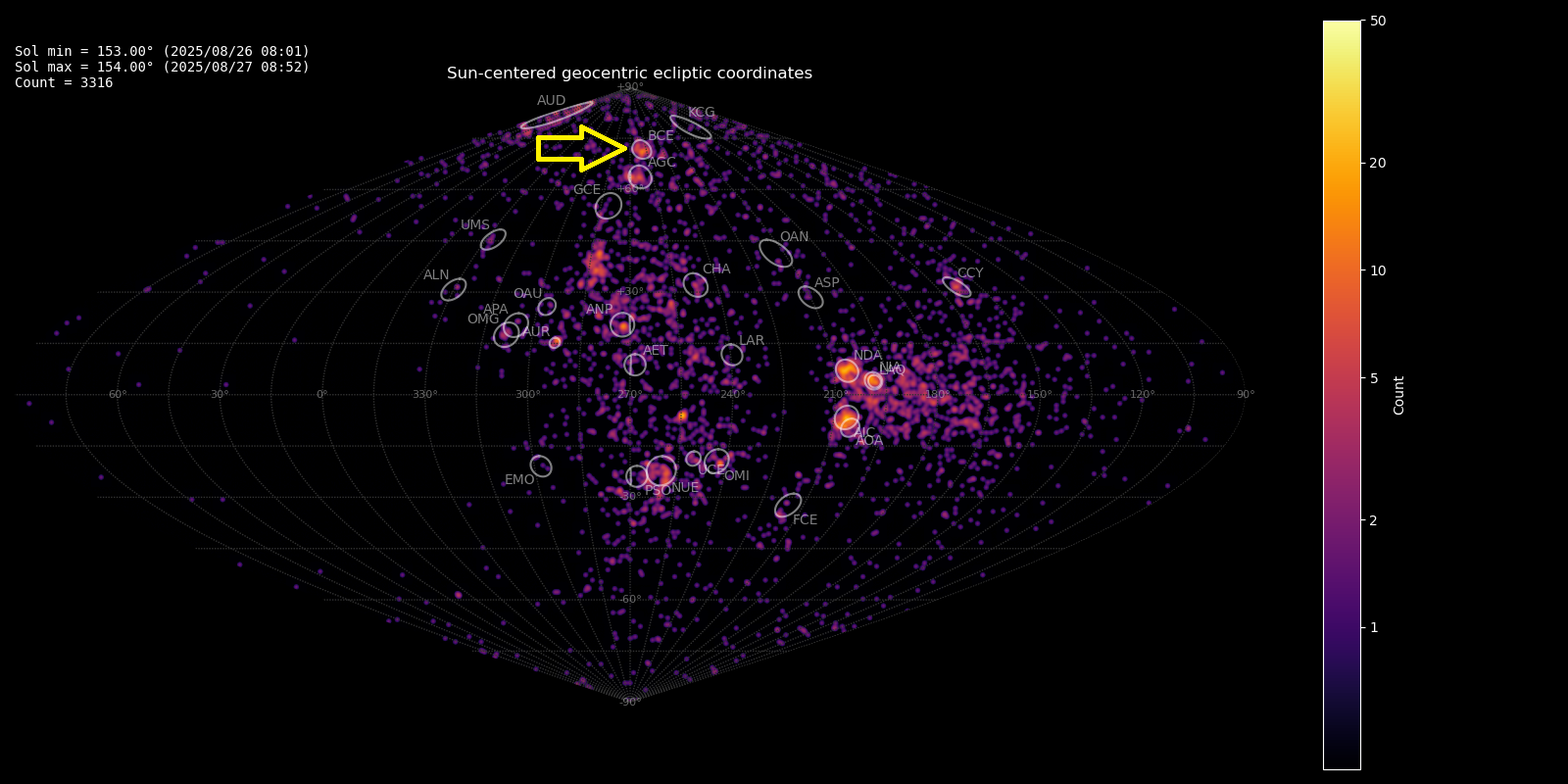
Figure 1 – Radiant density map with 3316 radiants obtained by the Global Meteor Network during the 26th – 27th August, 2025. The position of the beta-Cepheids in Sun-centered geocentric ecliptic coordinates is marked with a yellow arrow.
2 Shower classification based on radiants
The radiant-based shower analyses have been done separately for 2025 and 2026 using the tool RadiantMap developed by Milan Kalina. This tool allows to select radiants on the radiant density map (Figure 2) within a range in solar longitude to run automatically the meteor shower association tools developed by Denis Vida and Damir Šegon. The analyses generate the graphics used in this study, the final mean orbit and related parameters, the files required for reporting new solutions to the IAU-MDC and a check-up for possible parent bodies. Figure 2 shows that the actual activity is slightly shifted relative to the expected activity based upon earlier observations. The tool is still being tested and not (yet) publicly available.
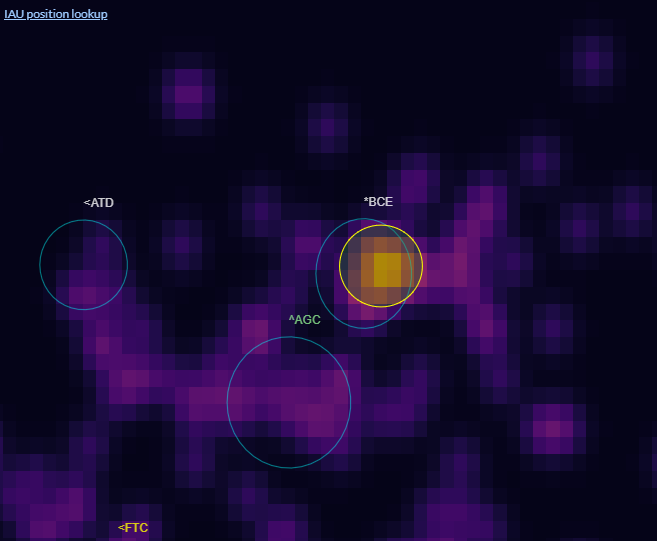
Figure 2 – Screenshot from RadiantMap with the selected region of interest for the BCE-activity in 2026.
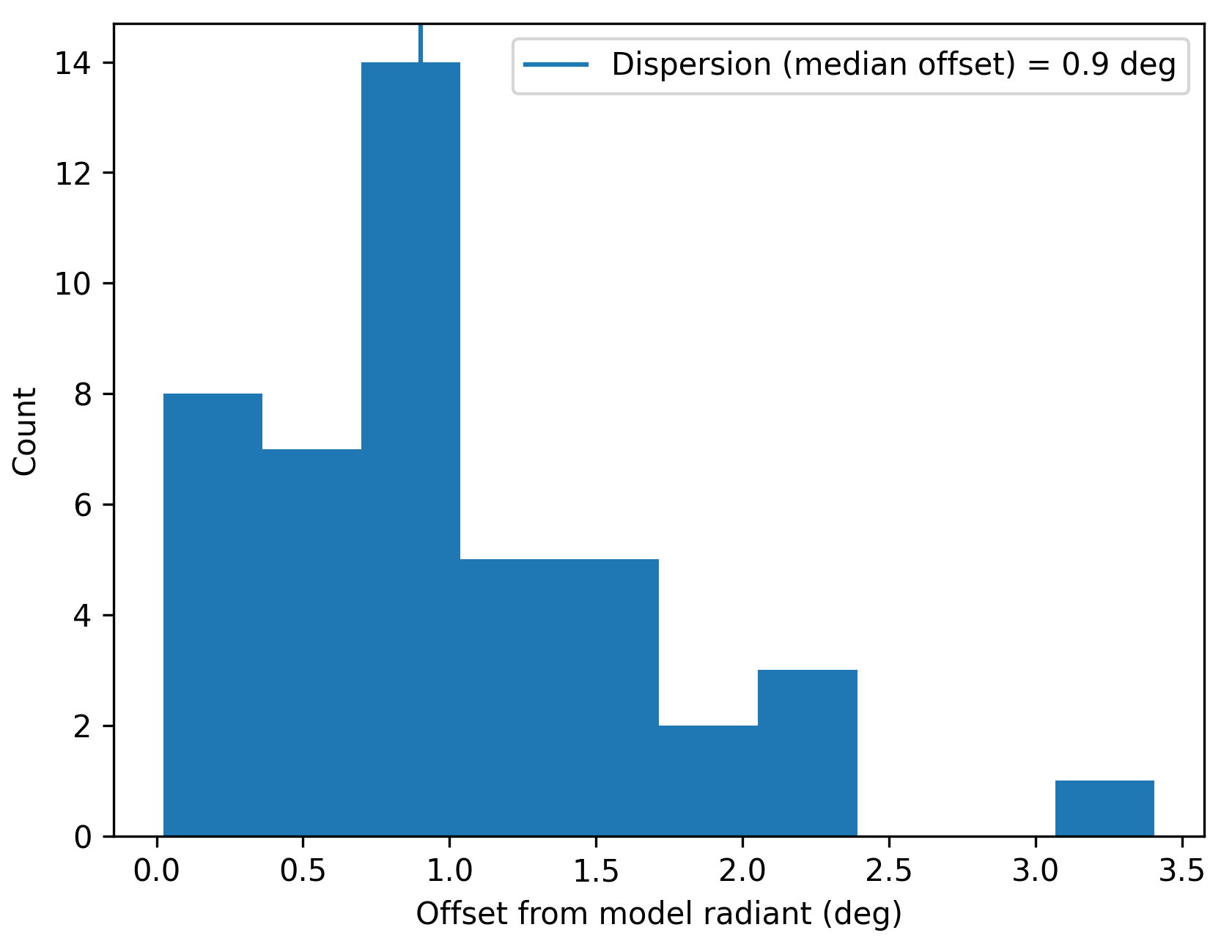
Figure 3 – Dispersion median offset on the radiant (2025).
The GMN shower association criteria assume that meteors within 1° in solar longitude, within 1.4° in radiant in this case, and within 10% in geocentric velocity of a shower reference location are members of that shower. Further details about the shower association are explained in Vida et al. (2021). Using the 2025 data, initially 45 possible shower members were selected and after removal of outliers, 32 members remained for final analysis. The 2026 data had 40 possible shower meteors and 32 after removal of outliers. 538 GMN-cameras in 28 countries (Austria, Bosnia Herzegovina, Belgium, Bulgaria, Canada, Croatia, Czech Republic, Denmark, France, Germany, Greece, Hungary, Ireland, Italy, Luxembourg, Netherlands, Poland, Portugal, Romania, Russia, Slovenia, Slovakia, South Korea, Spain, Switzerland, Ukraine, United Kingdom and the United States) contributed data for these datasets for the radiant and orbit based analyses. The shower parameters as obtained by the radiant method for 2025 and 2026 are listed in Table 1.
Figure 4 shows a scattered distribution of beta-Cepheid radiants which is due to the high declination and projection of the map.
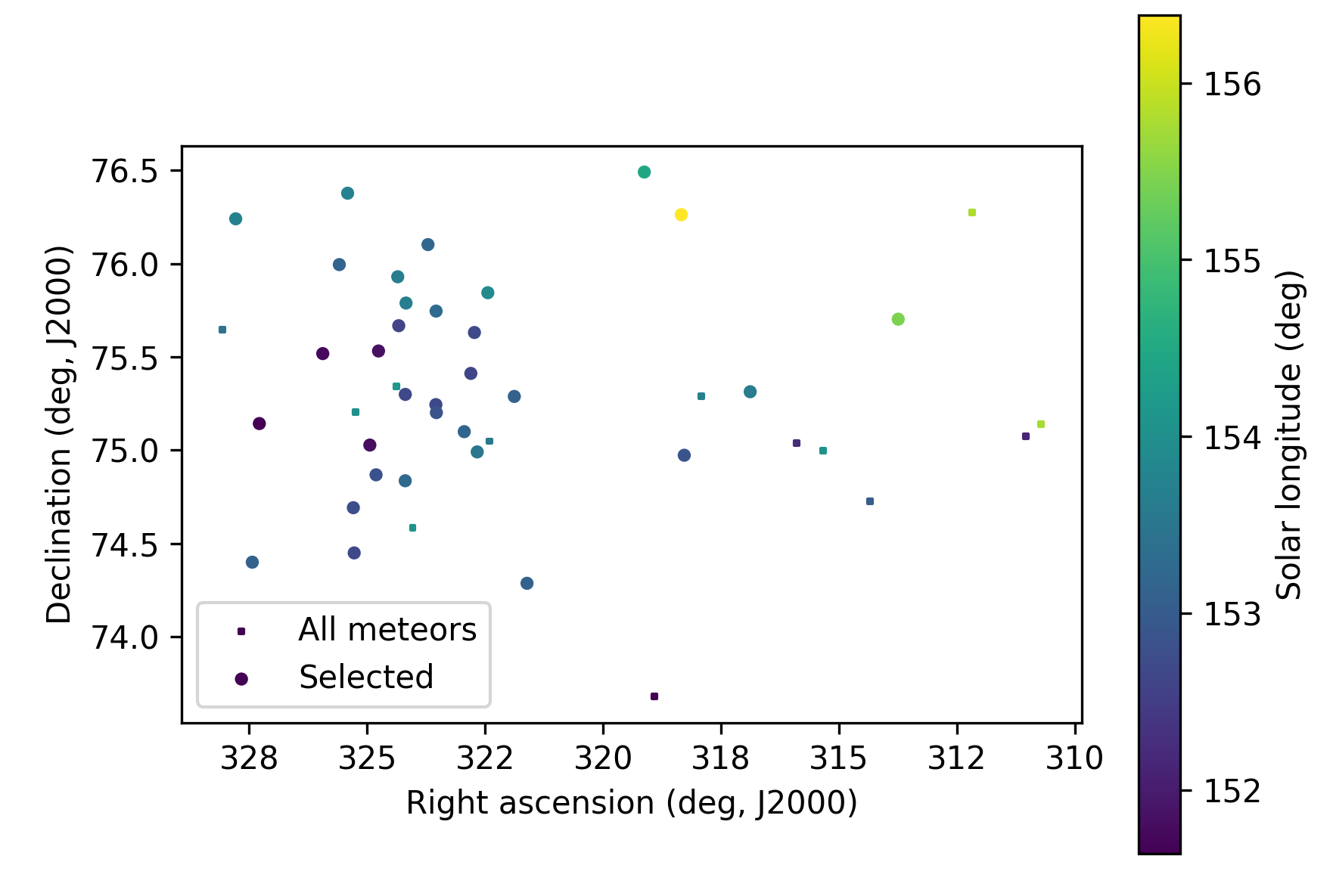
Figure 4 – The radiant distribution in 2025 during the solar-longitude interval 151.6° – 156.4° in equatorial coordinates.
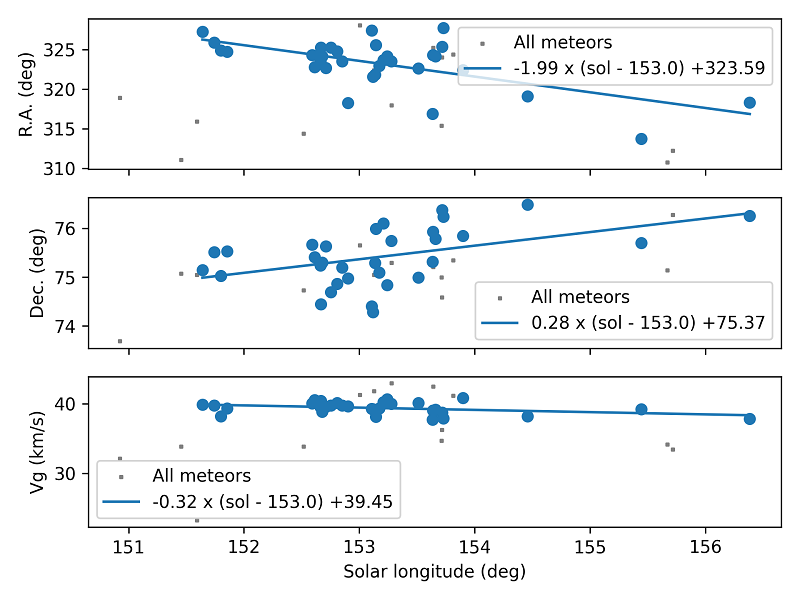
Figure 5 – The radiant drift in 2025.
3 Shower classification based on orbits
A complete independent meteoroid stream search has been applied to orbit data obtained between solar longitude 149° and 157° during the years 2019–2026. The method has been described in detail in a separate publication (Roggemans et al., 2026a). 78493 orbits were available within this time interval and a final mean orbit has been computed by the method of Jopek et al. (2006) for the thresholds DSH < 0.125 and DD < 0.05 and DJ < 0.125 (Southworth and Hawkins, 1963; Drummond, 1981; Jopek, 1993), based upon the Rayleigh fit in Figure 6. The resulting mean orbit based upon 242 meteors recorded from 2019 until 2026 is listed in Table 1.
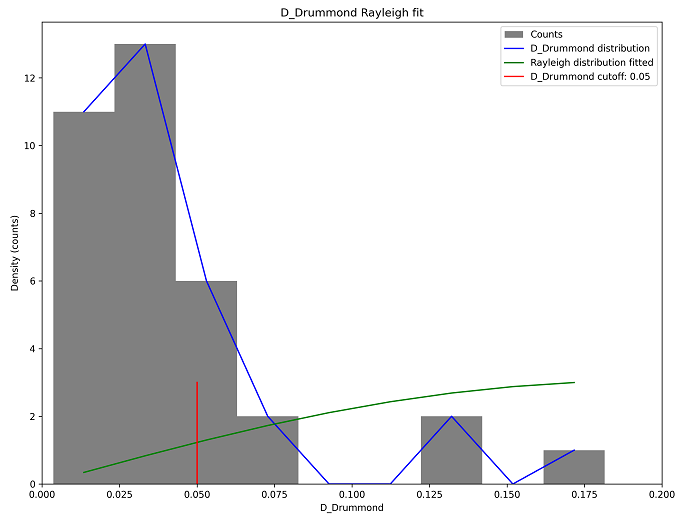
Figure 6 – Rayleigh fit on the Drummond criterion for beta-Cepheids. The 2026 data result in a cutoff value of DD = 0.05.
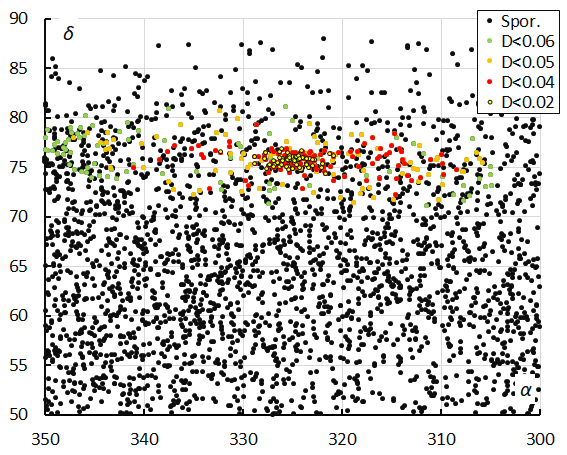
Figure 7 – The radiant distribution during the solar-longitude interval 149° – 157° in equatorial coordinates, color-coded for different threshold values of the combined similarity criteria.
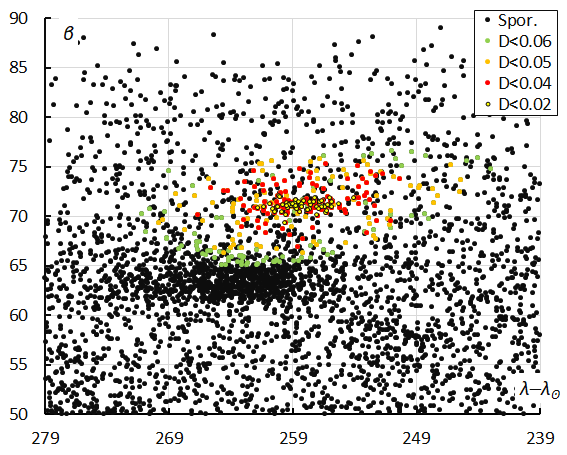
Figure 8 – The radiant distribution during the solar-longitude interval 149° – 157° in Sun-centered geocentric ecliptic coordinates, color-coded for different threshold values of the combined similarity criteria.
The radiant appears stretched in R.A. due to the high declination and map projection (Figure 7). The August gamma-Cepheids appear at the same declination east from the beta-Cepheids. The compactness of the radiant is more distinct in the geocentric Sun-centered ecliptic coordinates (Figure 8). The dark cluster just below from the beta-Cepheids are the August gamma-Cepheids, which have their maximum two days later. Orbits with thresholds DSH < 0.15 and DD < 0.06 and DJ < 0.15, marked in green in Figure 8, appear at the edge of the August gamma-Cepheids cluster, indicating that these threshold values are too tolerant to distinguish these meteors from the beta-Cepheids.
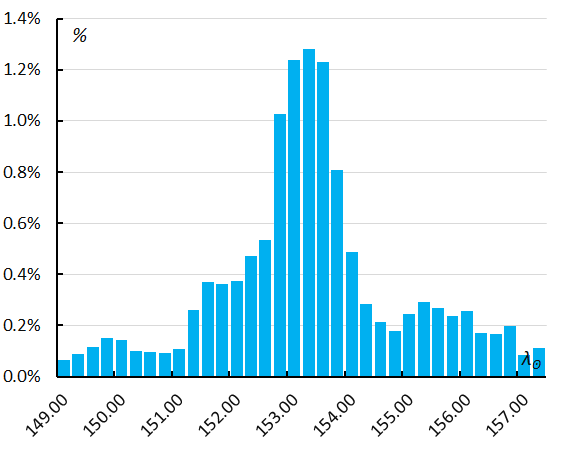
Figure 9 – The percentage of beta-Cepheid meteors relative to the total number of meteors recorded in 2019–2026.
The number of shower meteors as a percentage relative to the total number of meteors recorded in a 24 hours interval results in the profile plotted in Figure 9. Best rates occurred at λʘ = 153.25 ± 0.25° and the total activity duration spanned an 8 days interval from λʘ = 149.2° until λʘ = 357°. Other possible shower members outside this activity interval are most likely sporadic meteors that fit the similarity criteria by chance. The results obtained by the radiant based classification method for 2025 and 2026 and the orbit method for 2019–2026 are in good agreement.
4 Orbit and parent body
The diagram of the inclination i versus the longitude of perihelion Π shows a clear concentration (Figure 10). The dense cloud at 75° inclination are the August beta-Cepheids. The eccentricity e versus the longitude of perihelion Π appears dispersed in e versus Π (Figure 11) because of the sensitivity of the eccentricity for the uncertainty on the velocity measurement for high eccentricity values. The diagram e versus i (Figure 12) shows the spread too as well as the August gamma-Cepheids, which have a lower eccentricity and 10° higher inclination. The diagram with the perihelion distance q versus i (Figure 13) shows a dense concentration about 10° left from the August gamma-Cepheids with the same perihelion distance.
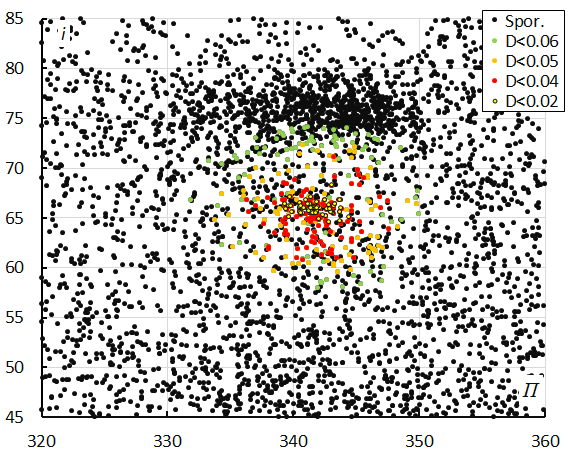
Figure 10 – Inclination i versus the longitude of perihelion Π color-coded for different classes of D-criteria thresholds, for λʘ between 149° – 157°. Spor. = sporadics.
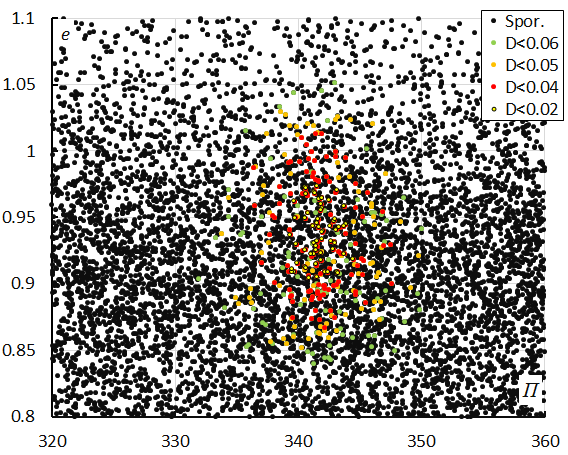
Figure 11 – Eccentricity e versus the longitude of perihelion Π color-coded for different classes of D-criteria thresholds, for λʘ between 149° – 157°. Spor. = sporadics.
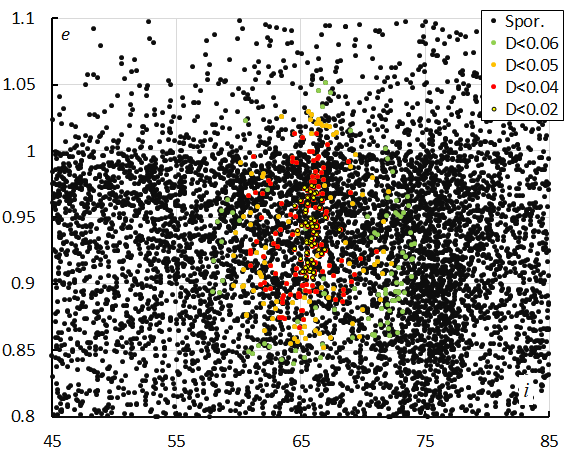
Figure 12 – Eccentricity e versus the inclination i color-coded for different classes of D-criteria thresholds, for λʘ between 149° – 157°. Spor. = sporadics.
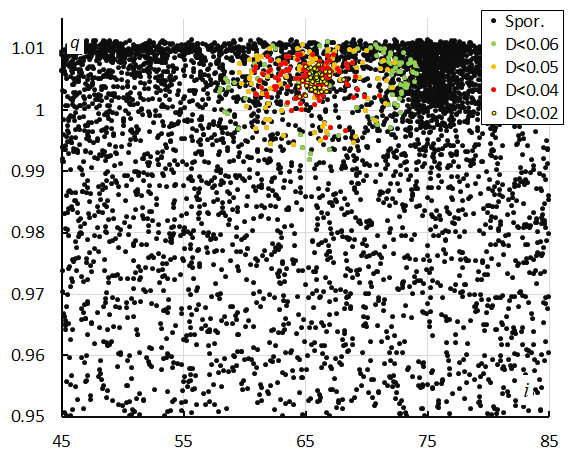
Figure 13 – Perihelion distance q versus the inclination i color-coded for different classes of D-criteria thresholds, for λʘ between 149° – 157°. Spor. = sporadics.
With a Tisserand value relative to Jupiter of 0.82, this is a Mellish-type shower. The ascending node is between the orbits of Uranus and Neptune (Figure 14). With an eccentricity close to the hyperbolic limit, the slightest observational or instrumental uncertainty on the velocity results in a huge difference in aphelion. The meteoroid stream encounters the Earth orbit at its descending node close to its perihelion (Figure 15).
A search for a possible parent body did not result in any positive match, the ten best results are listed in Table 2.
Table 1 – Comparing solutions derived by two different methods, GMN-method based on radiant positions for 2025 and 2026, and the orbit association method for DD < 0.05 for 2019–2026.
| Radiant
method 2025 |
Radiant
method 2026 |
Orbit method 2019–2026 DD < 0.05 | |
| λʘ (°) | 153.1 | 153.2 | 153.2 |
| λʘb (°) | 151.6 | 150.1 | 149.1 |
| λʘe (°) | 156.4 | 153.8 | 157.0 |
| αg (°) | 323.6 | 324.8 | 324.3 |
| δg (°) | 75.4 | +75.6 | +75.7 |
| Δαg (°) | –1.99 | –0.05 | +0.08 |
| Δδg (°) | +0.28 | +0.28 | +0.42 |
| vg (km/s) | 39.5 | 39.4 | 39.5 |
| Hb (km) | 104.4 | 104.1 | 104.3 |
| He (km) | 93.7 | 93.4 | 92.5 |
| Hp (km) | 97.6 | 98.0 | 96.9 |
| MagAp | –0.2 | +0.1 | –0.2 |
| λg (°) | 50.7 | 51.8 | 51.8 |
| λg – λʘ (°) | 257.6 | 258.6 | 258.6 |
| βg (°) | +71.3 | +71.0 | +71.1 |
| a (A.U.) | 16.1 | 12.0 | 14.7 |
| q (A.U.) | 1.004 | 1.005 | 1.003 |
| e | 0.938 | 0.916 | 0.932 |
| i (°) | 65.2 | 65.6 | 65.4 |
| ω (°) | 188.9 | 188.5 | 188.4 |
| Ω (°) | 153.2 | 152.7 | 153.3 |
| Π (°) | 342.0 | 341.2 | 341.8 |
| Tj | 0.84 | 0.94 | 0.86 |
| N | 32 | 32 | 242 |
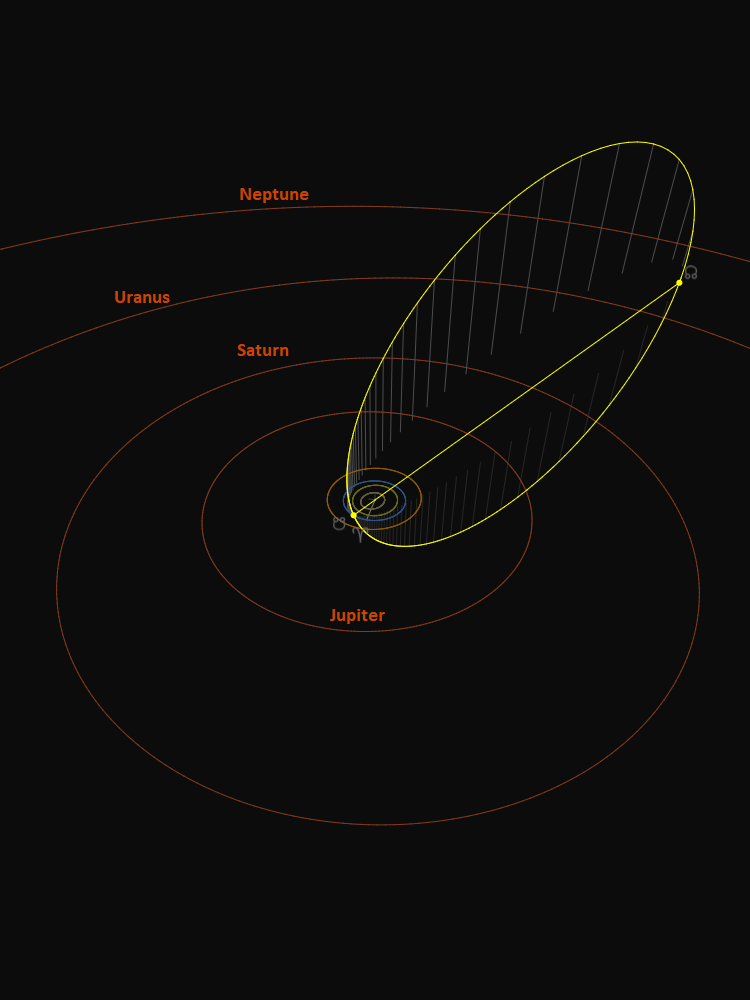
Figure 14 – The orbit determined solution for 2019–2026 (yellow). (Plotted with the Orbit visualization app provided by Pető Zsolt).
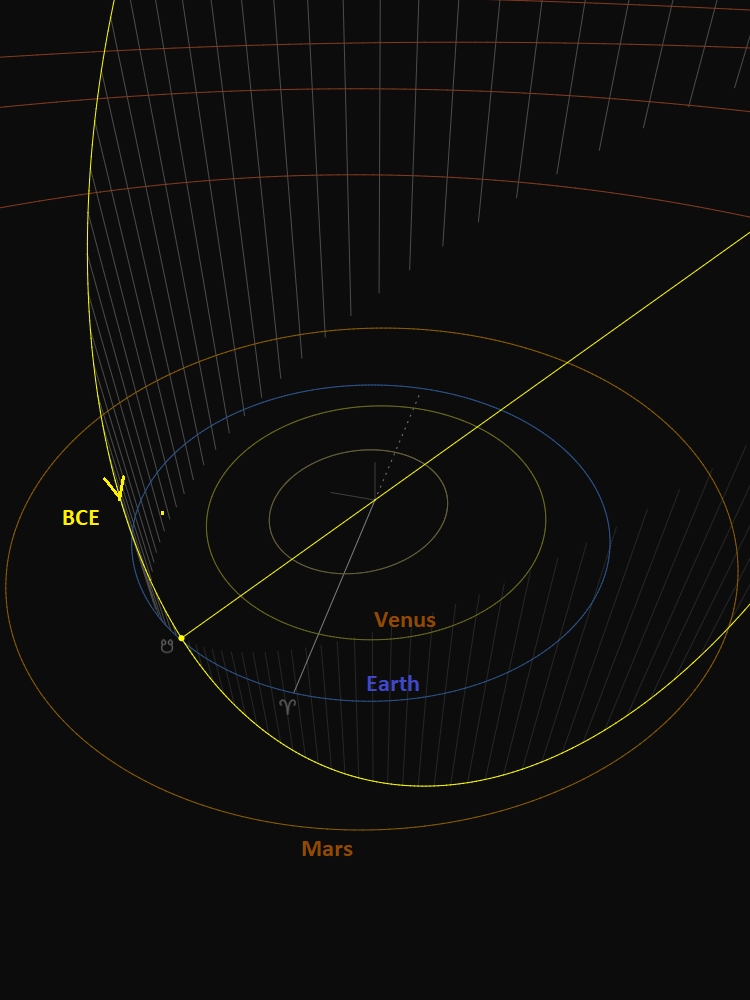
Figure 15 – Close-up in the inner Solar system with the orbit determined solution for 2019–2026 (yellow). (Plotted with the Orbit visualization app provided by Pető Zsolt).
Table 2 – Top ten matches of a search for possible parent bodies with DD < 0.30, based upon the mean orbit derived from the radiant classification method on 2025 data.
| Name | DD |
| C/1977 R1 (Kohler) | 0.214 |
| C/2013 G5 (Catalina) | 0.218 |
| C/1940 O1 (Whipple-Paraskevopoulos) | 0.232 |
| 2024 RK16 | 0.244 |
| 2020 HU6 | 0.247 |
| C/1919 Q2 (Metcalf) | 0.249 |
| 2017 NW5 | 0.254 |
| C/1965 S2 (Alcock) | 0.255 |
| (361861) 2008 ED69 | 0.257 |
| 2021 QA | 0.257 |
5 Conclusions
The existence and annual nature of the beta-Cepheids have been confirmed. This study provides some extra solutions to document this shower. The activity duration is between solar longitude 149° and 157° with best rates at λʘ = 153.2°. The shower is likely related to the nearby August gamma-Cepheids. No parent body could be identified but the ablation heights between 105 and 95km with a geocentric velocity of almost 40 km/s suggest that these particles consist of fragile cometary dust.
Acknowledgments
This report is based on the data of the Global Meteor Network (Vida et al., 2020a; 2020b; 2021) which is released under the CC BY 4.0 license. We thank all 927 participants in the Global Meteor Network project for their contribution and perseverance. A list with the names of the volunteers who contribute to GMN has been published in the 2025 annual report (Roggemans et al., 2026b). The following 538 cameras contributed to paired meteors used in this study:
AT0004, BA0002, BA0003, BA0004, BA0005, BE0002, BE0003, BE0005, BE0006, BE0007, BE0008, BE000A, BE000B, BE000C, BE000D, BE000G, BE000H, BE000J, BE000L, BE000M, BE000Q, BE000R, BE000S, BE000T, BE000U, BE000V, BE000X, BE000Z, BE0012, BE0015, BE0016, BE0018, BE0019, BE001A, BG0002, BG0003, BG000A, BG000B, BG000C, BG000H, BG000J, BG000L, CA0005, CA000D, CA000E, CA000L, CA000P, CA000Q, CA000U, CA000V, CA000W, CA000Y, CA0012, CA001A, CA001C, CA001G, CA001H, CA0021, CA0022, CA0026, CA0027, CA002F, CA002J, CA002K, CA002L, CA002R, CA002U, CA002V, CA0031, CA003E, CA003Y, CA003Z, CAC0A1, CAC0B1, CAC0B2, CH0002, CH0003, CH0004, CH0005, CZ0001, CZ0007, CZ000E, CZ000H, CZ000L, CZ000M, CZ000N, CZ000Y, DE0001, DE0004, DE0005, DE0006, DE0007, DE0008, DE000B, DE000J, DE000K, DE000Q, DE000S, DE000W, DE000X, DE0011, DE0013, DE0016, DE0017, DK0001, DK0003, DK0004, DK0007, DK000A, DK000B, DK000D, DK000F, DK000G, DK000L, DK000Q, DK000T, ES0001, ES0004, ES000N, ES000U, ES000W, ES000Z, ES0016, ES001A, ES001F, FR0003, FR0006, FR000A, FR000F, FR000G, FR000H, FR000K, FR000R, FR000V, FR000X, FR000Y, FR000Z, FR0011, FR0012, FR0013, FR0014, FR0015, GR0002, GR0003, GR0004, GR0007, GR0008, HR0001, HR0002, HR000D, HR000J, HR000K, HR000M, HR000P, HR000S, HR000T, HR000U, HR000W, HR0010, HR0017, HR0018, HR001A, HR001E, HR001M, HR001S, HR001Z, HR0024, HR0027, HR002D, HR002E, HR002J, HR002L, HR002M, HR002R, HR002W, HR002X, HR002Z, HU0001, HU0002, HU0003, HU0004, HU0006, HU0007, HU0008, HU0009, HU000B, HU000D, HU000E, HU000F, IE0004, IE000J, IT0001, IT0004, IT0007, KR0004, KR0005, KR000A, KR000D, KR000E, KR000F, KR000G, KR000R, KR000S, KR0011, KR0013, KR0014, KR0017, KR001C, KR001J, KR001Q, KR001S, KR001T, KR001U, KR001W, KR0020, KR0022, KR0023, KR0027, KR0028, KR002C, KR002D, KR002E, KR002J, KR002L, KR002N, KR002S, KR0038, KR003A, KR003K, KR003L, KR003M, KR003N, KR003Q, LU0001, NL0009, NL000B, NL000C, NL000D, NL000G, NL000K, NL000M, NL000P, NL000Q, NL000R, NL000S, NL000T, NL000U, NL000Z, NL0017, NL001A, NL001B, PL000D, PL000G, PL000L, PLM005, PT0002, RO0001, RO0002, RO0006, RO000T, RO0019, RU0001, RU0002, RU0003, RU0008, RU000F, RU000K, RU000L, RU000M, RU000N, RU000Q, RU0013, RU0014, RU0019, SI0001, SI0002, SK0003, SK0004, SK0005, SK0006, UA0001, UA0002, UK0001, UK0006, UK0008, UK0009, UK000C, UK000D, UK000F, UK000H, UK000S, UK000T, UK000U, UK000Y, UK001K, UK001L, UK001N, UK001P, UK001Q, UK001R, UK001S, UK001T, UK001U, UK001Z, UK0020, UK0022, UK0026, UK0027, UK0029, UK002C, UK002F, UK002G, UK002J, UK002K, UK002P, UK002Q, UK002T, UK002W, UK002X, UK002Z, UK0030, UK0031, UK0032, UK0033, UK0034, UK0035, UK003B, UK003C, UK003D, UK003E, UK003F, UK003G, UK003J, UK003L, UK003M, UK003N, UK003P, UK003U, UK003W, UK003X, UK003Z, UK0041, UK0045, UK0049, UK004B, UK004C, UK004D, UK004E, UK004F, UK004G, UK004J, UK004R, UK004V, UK0050, UK0051, UK0057, UK005F, UK005H, UK005L, UK005N, UK005P, UK005S, UK005V, UK0060, UK0067, UK006B, UK006C, UK006D, UK006E, UK006P, UK006S, UK006T, UK006V, UK006X, UK0070, UK0073, UK0074, UK0077, UK0079, UK007A, UK007B, UK007E, UK007G, UK007H, UK007J, UK007L, UK007N, UK007P, UK007Q, UK007R, UK007U, UK007V, UK007Y, UK007Z, UK0082, UK0083, UK0084, UK0085, UK0086, UK0087, UK0089, UK008B, UK008G, UK008H, UK008J, UK008Q, UK008R, UK008V, UK008W, UK008X, UK008Z, UK0092, UK0096, UK0098, UK0099, UK009A, UK009C, UK009D, UK009E, UK009G, UK009J, UK009K, UK009M, UK009P, UK009Q, UK009S, UK009T, UK009V, UK009W, UK00A0, UK00A1, UK00A3, UK00A4, UK00A5, UK00AB, UK00AE, UK00AG, UK00AK, UK00AL, UK00AN, UK00AP, UK00AT, UK00B0, UK00B1, UK00B2, UK00B5, UK00B6, UK00BH, UK00BK, UK00BW, UK00C1, UK00C2, UK00C6, UK00CC, UK00CE, UK00CJ, UK00CK, UK00CQ, UK00CT, UK00D6, UK00D7, US0001, US0002, US0004, US0005, US0006, US0007, US0008, US000A, US000C, US000D, US000E, US000G, US000H, US000J, US000L, US000P, US000U, US001P, US0020, US002N, US002Q, US002W, US002X, US002Y, US0035, US0037, US0039, US003N, US003Q, US004B, US004C, US004E, US004J, US004M, US004N, US004Q, US0050, US0054, US005E, US005P, US005X, US006A, USC0G1, USC0H3, USC0H4, USL001, USL002, USL003, USL005, USL006, USL007, USL008, USL00A, USL00B, USL00C, USL00D, USL00E, USL00F, USL00G, USL00H, USL00J, USL00K, USL00L, USL00M, USL00N, USL00P, USL00Q, USL00U, USL014, USL016, USL017, USL019, USL01A, USL01B, USL01D, USL01E and USV003.
References
Drummond J. D. (1981). “A test of comet and meteor shower associations”. Icarus, 45, 545–553.
Jenniskens P. (2023). Atlas of Earth’s meteor showers. Elsevier, Cambridge, United states. ISBN 978-0-443-23577-1. Page 307.
Jopek T. J. (1993). “Remarks on the meteor orbital similarity D-criterion”. Icarus, 106, 603–607.
Jopek T. J., Rudawska R. and Pretka-Ziomek H. (2006). “Calculation of the mean orbit of a meteoroid stream”. Monthly Notices of the Royal Astronomical Society, 371, 1367–1372.
Roggemans P., Vida D., Šegon D., Scott J.M. (2026a). “Meteoroid orbit shower identification”. eMetN Meteor Journal, 11, 189–204.
Roggemans P., Campbell-Burns P., Kalina M., McIntyre M., Scott J. M., Šegon D., Vida D. (2026b). “Global Meteor Network report 2025”. eMetN Meteor Journal, 11, 89–129.
Southworth R. B. and Hawkins G. S. (1963). “Statistics of meteor streams”. Smithsonian Contributions to Astrophysics, 7, 261–285.
Vida D., Gural P., Brown P., Campbell-Brown M., Wiegert P. (2020a). “Estimating trajectories of meteors: an observational Monte Carlo approach – I. Theory”. Monthly Notices of the Royal Astronomical Society, 491, 2688–2705.
Vida D., Gural P., Brown P., Campbell-Brown M., Wiegert P. (2020b). “Estimating trajectories of meteors: an observational Monte Carlo approach – II. Results”. Monthly Notices of the Royal Astronomical Society, 491, 3996–4011.
Vida D., Šegon D., Gural P. S., Brown P. G., McIntyre M. J. M., Dijkema T. J., Pavletić L., Kukić P., Mazur M. J., Eschman P., Roggemans P., Merlak A., Zubrović D. (2021). “The Global Meteor Network – Methodology and first results”. Monthly Notices of the Royal Astronomical Society, 506, 5046–5074.