By Milan Kalina, Denis Vida, Damir Šegon, Paul Roggemans, James M. Scott, Jeff Wood
Abstract: A new meteor shower from a Jupiter Family Comet type orbit (TJ = 2.7) was detected during July 14 – 16, 2026, by the Global Meteor Network. 43 meteors belonging to the new shower were observed between 111° < λʘ < 118° from a radiant at R.A. = 263.2° and Decl.= –44.6° in the constellation of Scorpion, with a geocentric velocity of 14.3 km/s. The new meteor shower has been listed in the IAU MDC Working List of Meteor Showers under the temporary name-designation: M2026-P1.
1 Introduction
The GMN radiant maps for July 14 – 16, 2026, showed a clear radiant concentration in the constellation of Scorpius. The activity lasted for about 3 days with the best activity at λʘ = 114.5° with the radiant visible on the radiant density maps (Figures 1). When the activity had completely ceased, 43 meteors of this new meteor shower had been registered by the Global Meteor Network low-light video cameras. The shower was independently observed by 114 cameras in Australia, Bosnia and Herzegovina, Brazil, Croatia and New Zealand.
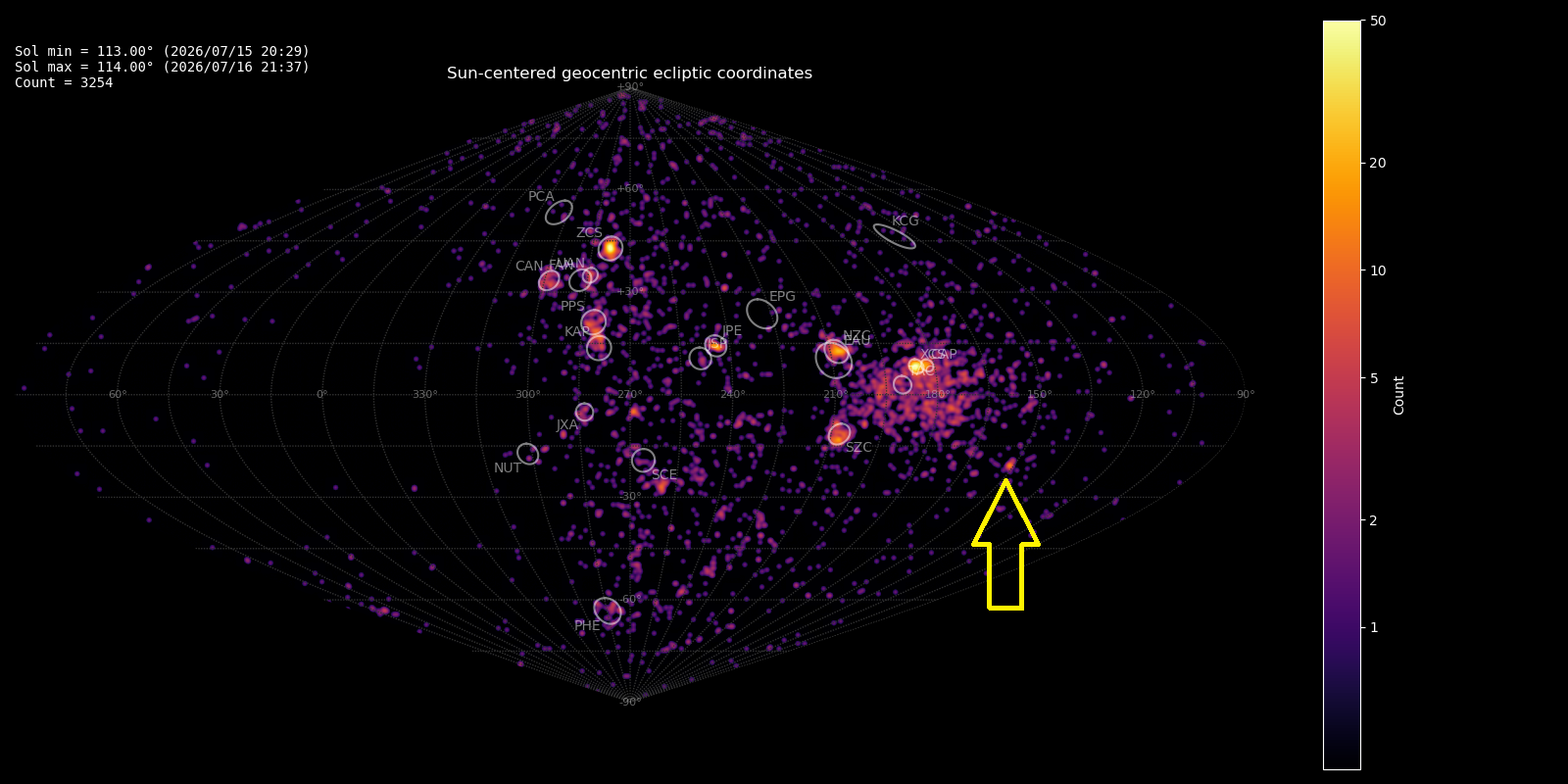
Figure 1 – Radiant density map in sinusoidal projection with 3254 radiants obtained by the Global Meteor Network during July 15 – 16, 2026. A distinct concentration is visible in Sun-centered geocentric ecliptic coordinates which was identified as a new meteor shower with the temporary identification M2026-P1. Activity from this new source was detected during several days.
2 Shower classification based on radiants
The GMN shower association criteria assume that meteors within 1° in solar longitude, within 1.5° in radiant in this case, and within 10% in geocentric velocity of a shower reference location are members of that shower. Further details about the shower association are explained in Moorhead et al. (2020). Initially 67 possible shower members were selected and after removal of outliers, 43 members remained for final analysis. The shower parameters as obtained by the GMN method are listed in Table 1.
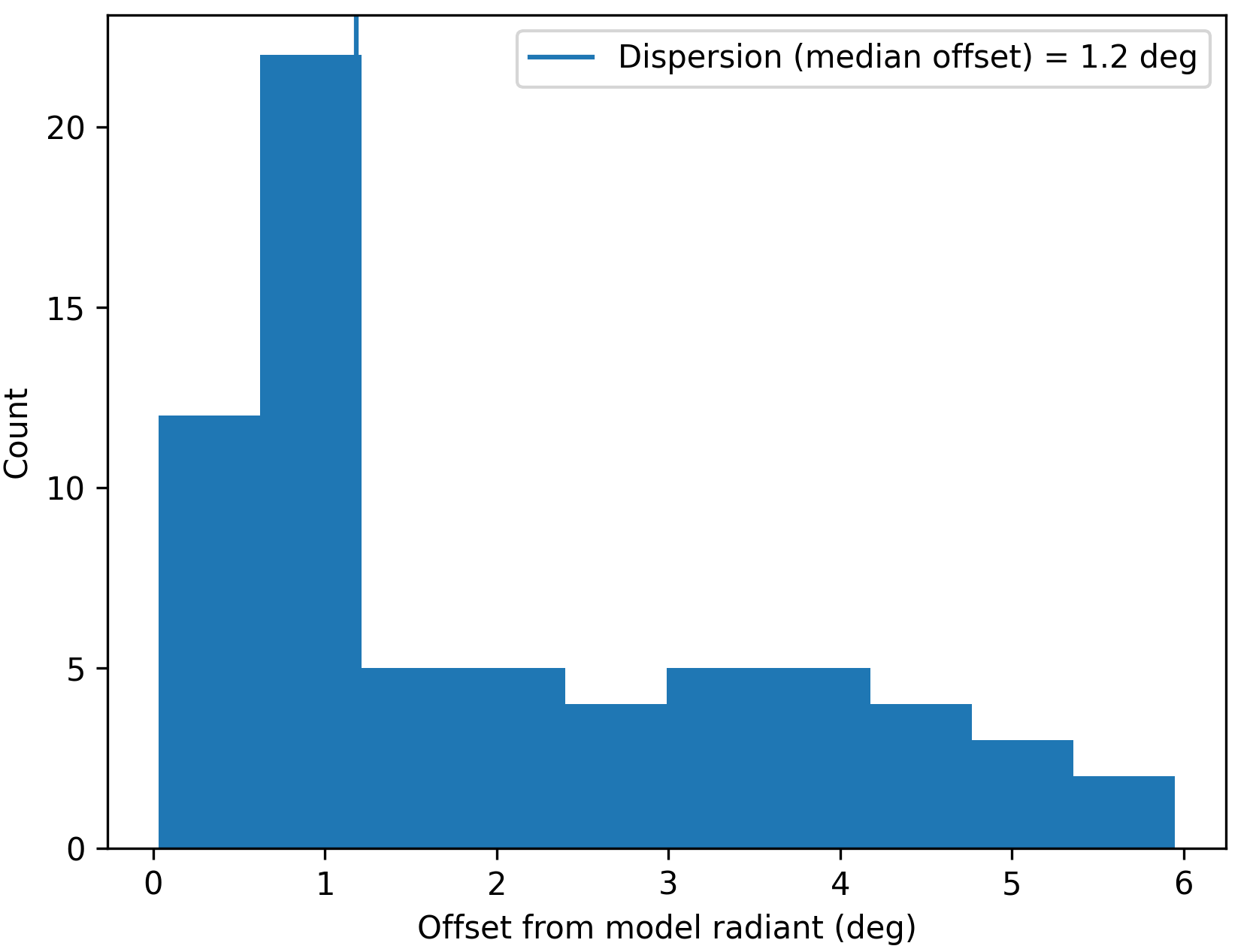
Figure 2 – Dispersion median offset on the radiant position.
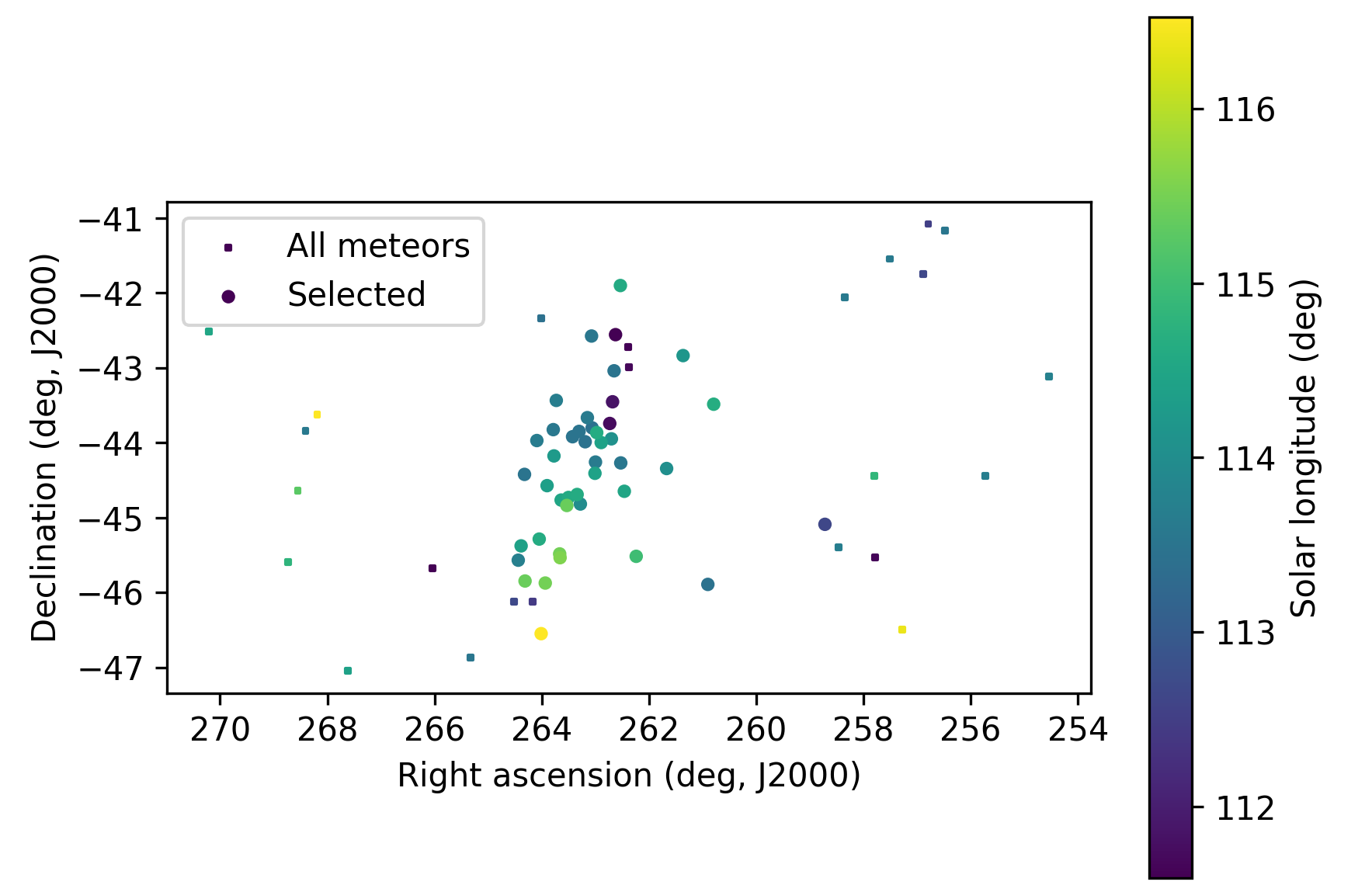
Figure 3 – The radiant distribution during the solar-longitude interval 111.5° – 116.5° in equatorial coordinates.
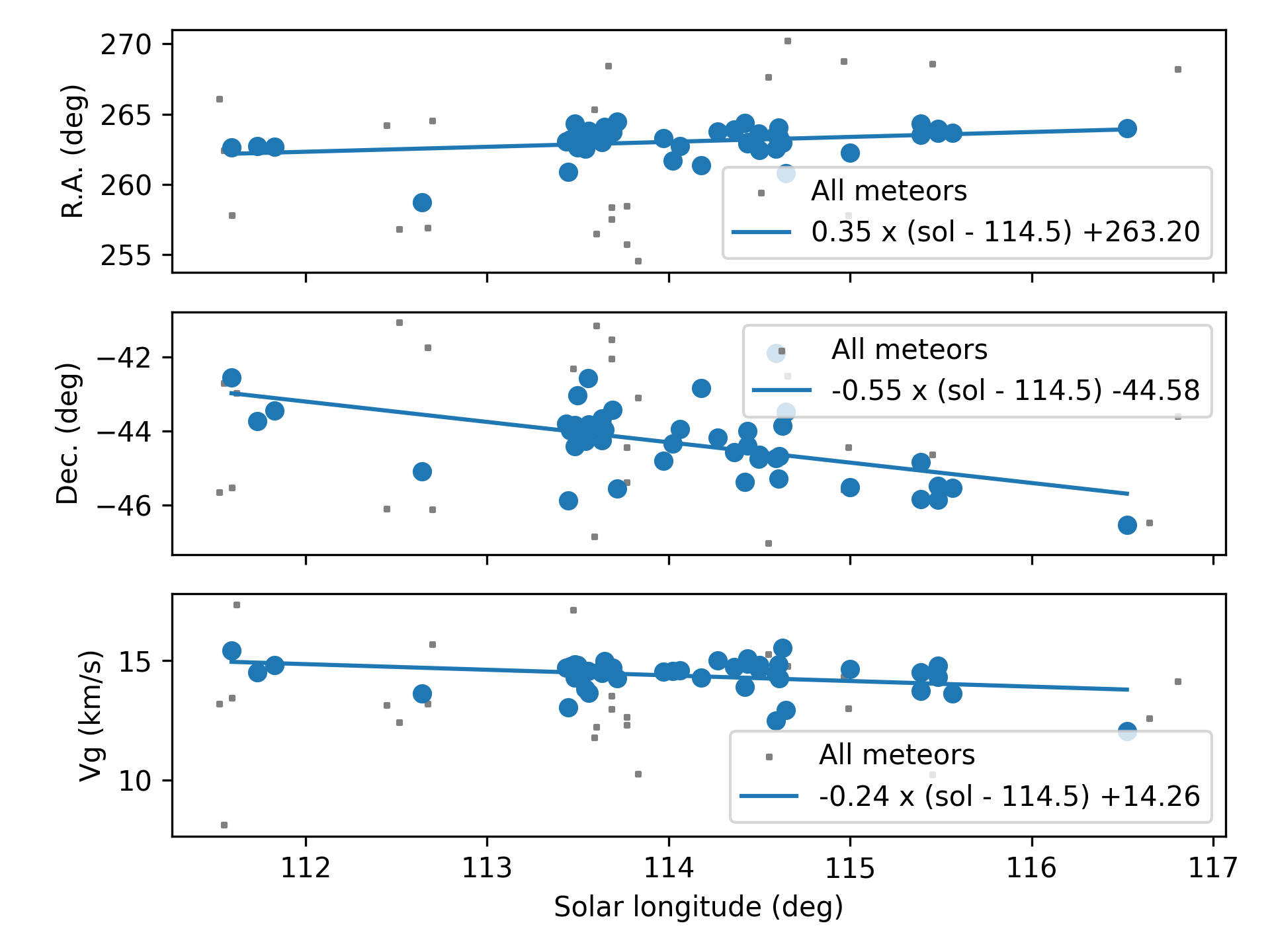
Figure 4 – The radiant drift.
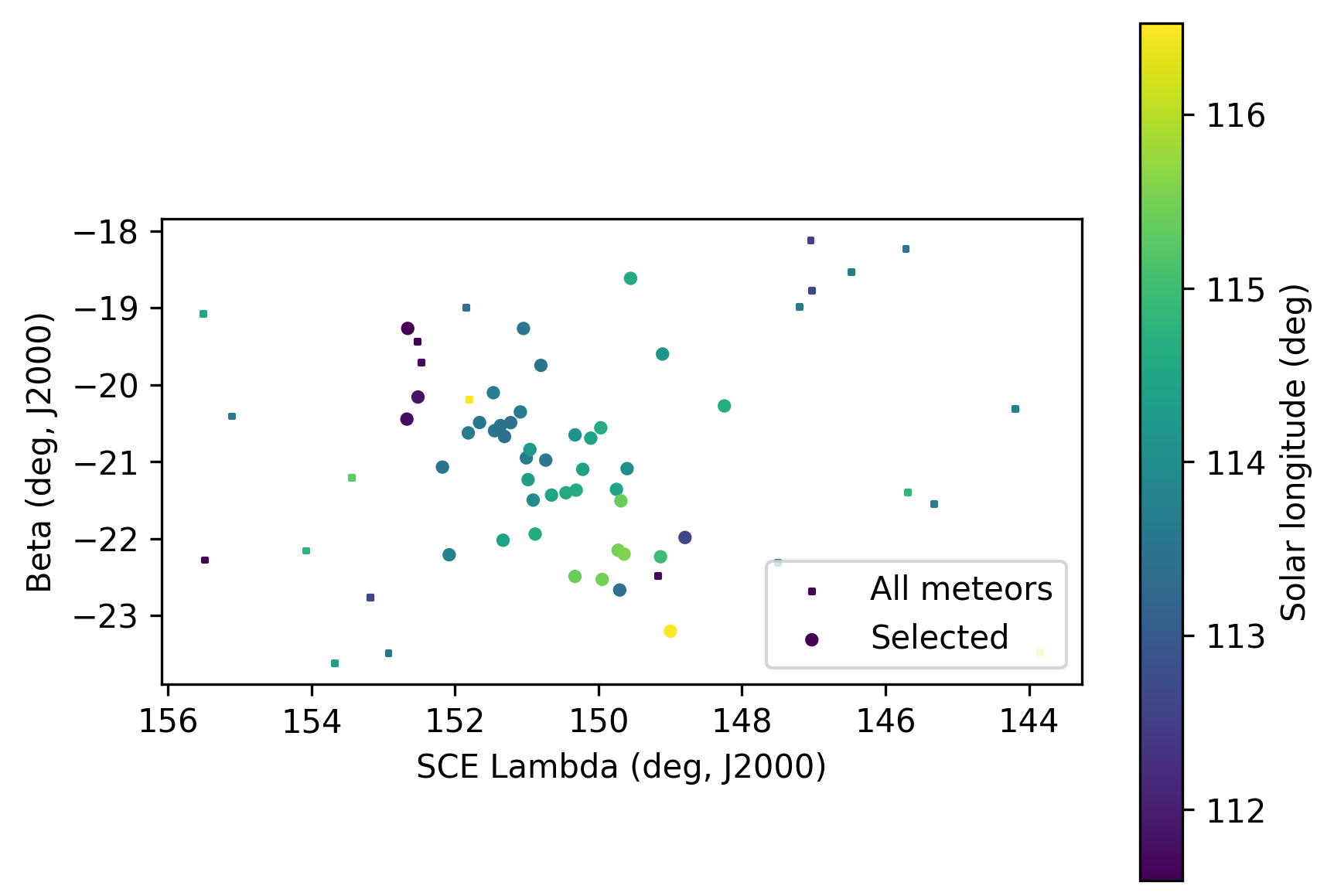
Figure 5 – The radiant distribution during the solar-longitude interval 111.5° – 116.5° in Sun centered geocentric ecliptic coordinates.
3 Shower classification based on orbits
A complete independent meteoroid stream search has been applied to orbit data obtained between Solar Longitude 111° and 116° during 2026. The method has been described in detail in a separate publication (Roggemans et al., 2026a). 20524 orbits were available within this time interval and a final mean orbit has been computed by the method of Jopek et al. (2006) for the thresholds DSH < 0.075 and DD < 0.03 and DJ < 0.075 (Southworth and Hawkins, 1963; Drummond, 1981; Jopek, 1993). The Rayleigh fit in Figure 6 indicates a larger cutoff value, but this type of low inclination short period orbits requires great care to exclude spurious associations. The resulting mean orbit based upon 38 meteors for 2026 is listed in Table 1.
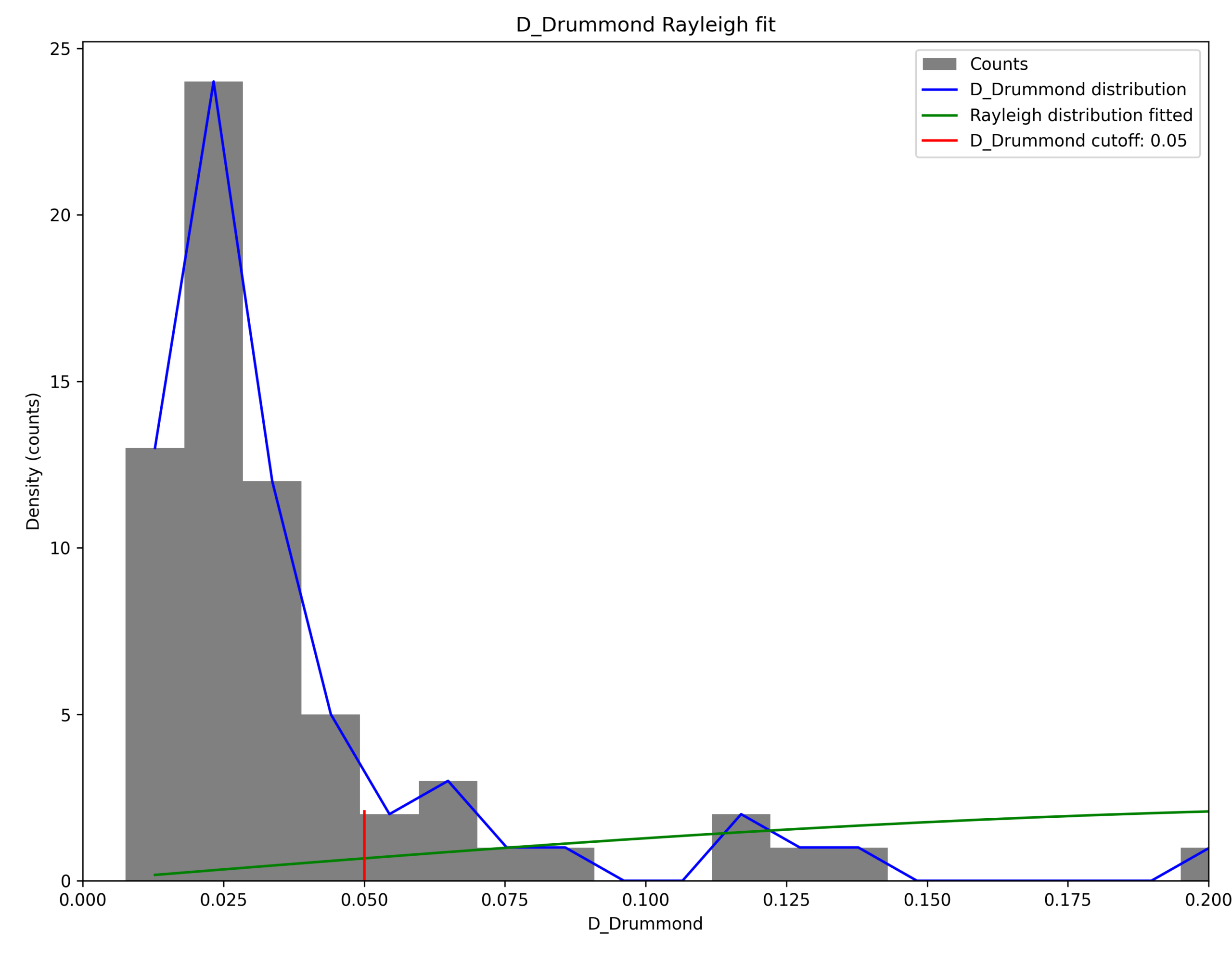
Figure 6 – Rayleigh fit on the Drummond criterion for the new shower, 2026 data results in a cutoff value od DD = 0.05.
The radiant is very compact in geocentric equatorial coordinates (Figure 7). Most higher threshold points appear as outliers among the sporadic background. The compactness of the radiant is also clear in the geocentric Sun-centered ecliptic coordinates (Figure 8). The number of shower meteors as a percentage relative to the total number of meteors recorded from camera stations south of 40° latitude results in the profile plotted in Figure 9. Best rates occurred at λʘ = 114.5 ± 0.5° and the total activity duration took about 3 days. Other possible shower members outside this activity interval are most likely sporadic meteors that fit the similarity criteria by chance. The results obtained by the radiant based classification method and the orbit method are in good agreement.
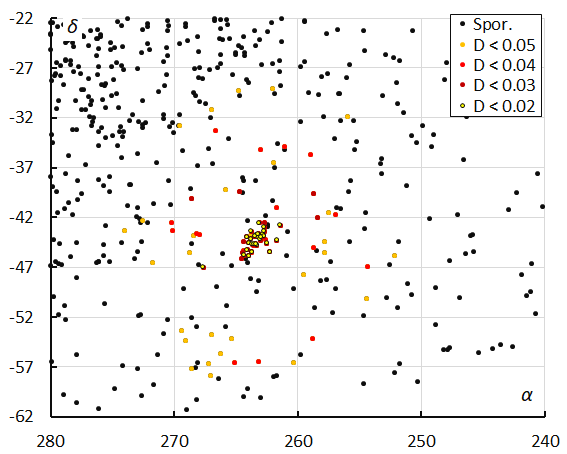
Figure 7 – The radiant distribution during the solar-longitude interval 111.5° – 116.5° in equatorial coordinates, color-coded for different threshold values of the combined similarity criteria.
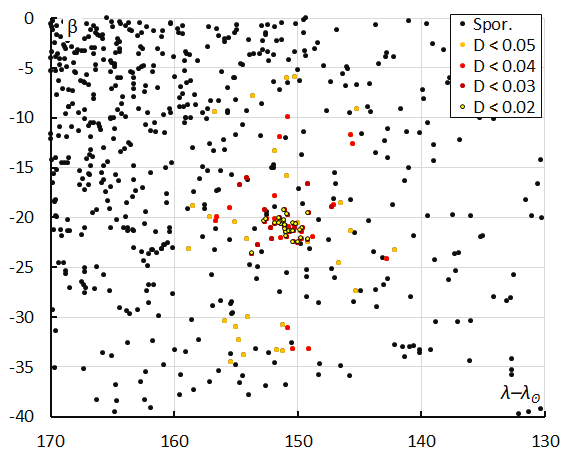
Figure 8 – The radiant distribution during the solar-longitude interval 111.5° – 116.5° in Sun-centered geocentric ecliptic coordinates, color-coded for different threshold values of the combined similarity criteria.
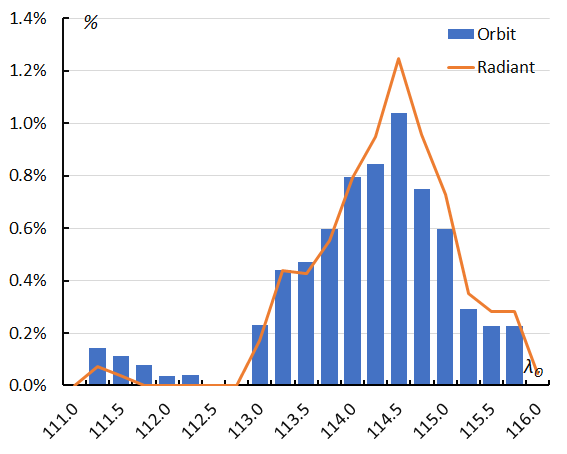
Figure 9 – The percentage of shower meteors relative to the total number of meteors recorded south of 40° latitude in 2026.
32 meteors were identified in common by the two methods, six were identified by the orbit method but failed for the radiant method. The radiant method associated 11 meteors that failed to fit the orbit similarity threshold with DSH < 0.075 and DD < 0.03 and DJ < 0.075. Both methods result in a slightly different solution which are both representative for the new meteor shower.
4 Orbit and parent body
The diagram of the inclination i versus the Longitude of Perihelion Π shows a clear concentration (Figure 10). The eccentricity e versus the Longitude of Perihelion Π also appears concentrated in e versus Π (Figure 11), e versus i (Figure 12) and q versus i (Figure 13). In Figure 12 we see a large concentration with inclination between 6° and 10° and eccentricity between 0.75 and 0.85. This is caused by the xi2-Capricornids (XCS#623) which are also visible in Figure 13 at a perihelion distance of 0.50 to 0.55 AU. Some of these meteors were identified as alpha-Capricornids (CAP#1).
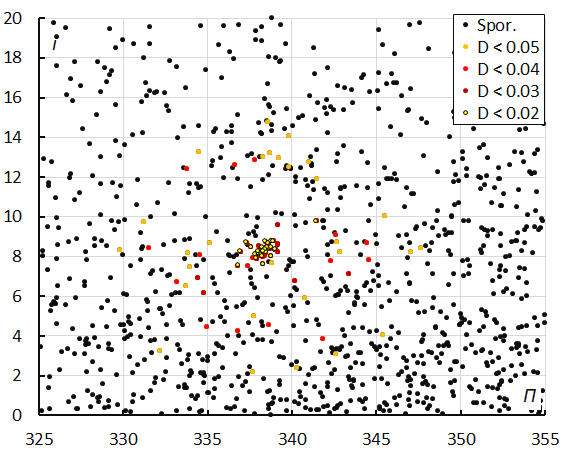
Figure 10 – Inclination i versus the Longitude of Perihelion Π color-coded for different classes of D-criteria thresholds, for λʘ between 111.5° – 116.5°. Spor. = sporadics.
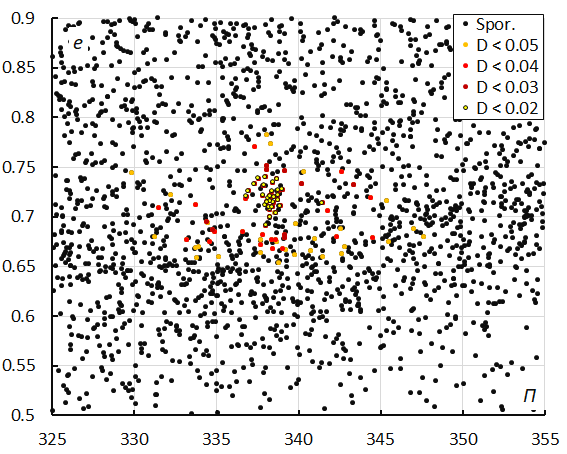
Figure 11 – Eccentricity e versus the Longitude of Perihelion Π color-coded for different classes of D-criteria thresholds, for λʘ between 111.5° – 116.5°. Spor. = sporadics.
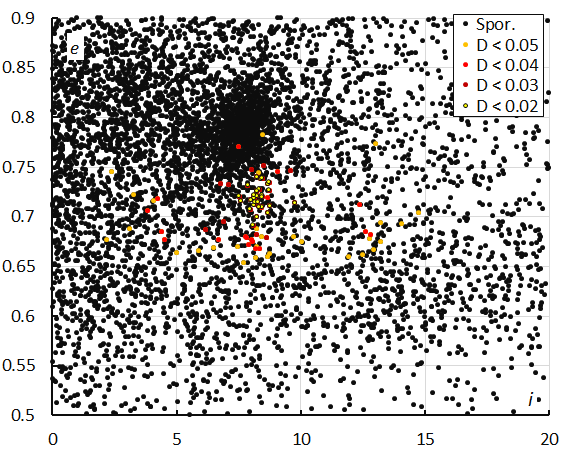
Figure 12 – Eccentricity e versus the inclination i color-coded for different classes of D-criteria thresholds, for λʘ between 111.5° – 116.5°. Spor. = sporadics.
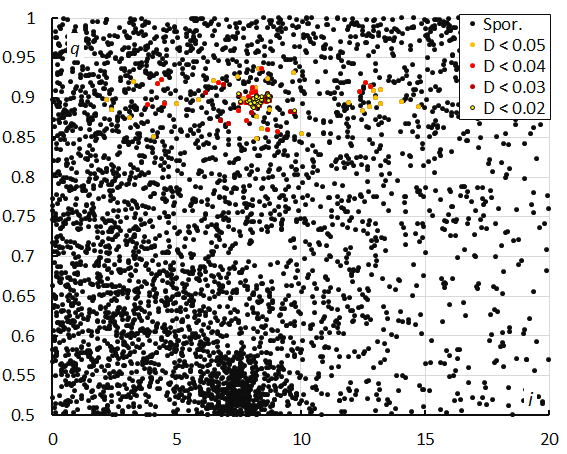
Figure 13 – Perihelion distance q versus the inclination i color-coded for different classes of D-criteria thresholds, for λʘ between 111.5° – 116.5°. Spor. = sporadics.
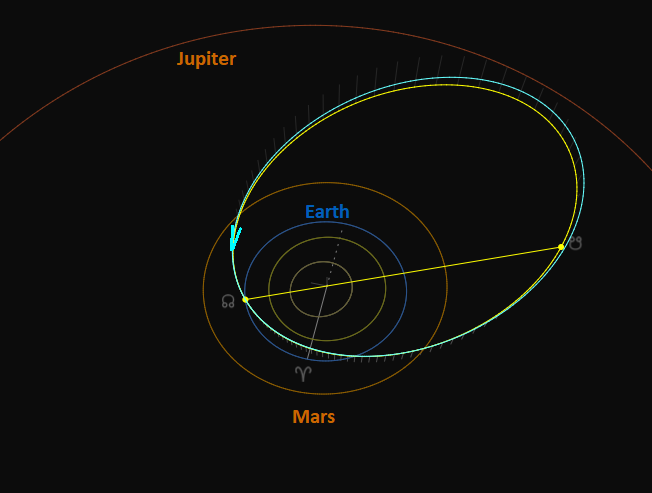
Figure 14 – Comparing the radiant determined new shower solution for 2026 (yellow) with the orbit determined solution for 2026 (blue). (Plotted with the Orbit visualization app provided by Pető Zsolt).
With a Tisserand value of about 2.7 relative to Jupiter, this is a typical Jupiter Family Comet orbit. A search for possible parent bodies yields one possible candidate 2023 VN9 (Table 2). The median ablation height of these meteors is rather deep in the atmosphere which is uncommon for fragile cometary particles and suggest a possible asteroidal origin.
Table 1 – Comparing solutions derived by two different methods, GMN-method based on radiant positions and orbit association for DD < 0.03 and DD < 0.02.
| Radiant
method |
DD < 0.03 | DD < 0.02 | |
| λʘ (°) | 114.5 | 114.5 | 114.1 |
| λʘb (°) | 111.1 | 111.6 | 111.7 |
| λʘe (°) | 117.8 | 115.5 | 115.5 |
| αg (°) | 263.2 | 263.3 | 263.3 |
| δg (°) | –44.6 | –44.1 | –44.2 |
| Δαg (°) | 0.35 | 0.40 | 0.34 |
| Δδg (°) | –0.55 | –0.95 | –0.75 |
| vg (km/s) | 14.3 | 14.7 | 14.7 |
| Hb (km) | 88.8 | 88.9 | 88.8 |
| He (km) | 76.0 | 75.9 | 75.8 |
| Hp (km) | 80.7 | 80.7 | 80.6 |
| MagAp | +0.8 | +0.8 | +0.7 |
| λg (°) | 264.8 | 264.9 | 264.8 |
| λg – λʘ (°) | 150.3 | 151.0 | 150.9 |
| βg (°) | –21.3 | –20.8 | –20.8 |
| a (A.U.) | 3.03 | 3.17 | 3.19 |
| q (A.U.) | 0.898 | 0.893 | 0.895 |
| e | 0.704 | 0.718 | 0.719 |
| i (°) | 8.2 | 8.2 | 8.3 |
| ω (°) | 44.1 | 44.6 | 44.3 |
| Ω (°) | 294.0 | 293.8 | 294.0 |
| Π (°) | 338.1 | 338.4 | 338.3 |
| Tj | 2.79 | 2.72 | 2.71 |
| N | 43 | 38 | 29 |
Table 2 – Top ten matches of a search for possible parent bodies with DD < 0.07, based upon the mean orbit derived from the radiant classification method.
| Name | DD |
| 2023 VN9 | 0.033 |
| 2016 KB1 | 0.057 |
| 2021 VW1 | 0.062 |
| 2024 TH11 | 0.062 |
| 2020 SP4 | 0.064 |
| 2017 UW5 | 0.065 |
| 2025 UW107 | 0.066 |
| 2016 LX48 | 0.067 |
| 2019 TJ5 | 0.069 |
| 2024 NN1 | 0.071 |
5 Past activity
There is extensive clustering of radiants between RA 260° and 280° and Dec –22° and –32° from mid to late July. It appears the first detection of the present “shower” was by R.A. MacIntosh (1935). Given the errors from plotting meteors MacIntosh’s shower #190 was the first positive detection. MacIntosh records an activity from 10 to 17 July with radiants at RA 273 , Dec –36° and RA 277.4 , Dec –37°.
The next recording of the shower is by Buhagiar who in his first list records a shower active from 10 July to 22 July with a maximum ZHR of 3 on 16 July and a dispersed radiant at RA 268 , Dec –38° in 1972–1978. Buhagiar later changed the radiant position in his second list (to RA 271 , Dec –34°, although he kept the activity period the same as his first list.
Both Clark 1972–1980 and WAMS /NAPOMS 1979–2000 did not detect the shower There were 2 to 3 radiants plotted in the general radiant area but the radiant density was such that a shower could not be positively identified from the sporadic radiants. John Morgan at Renwick New Zealand during the 1970’s did not detect the shower either. His skies were greatly affected by the winter weather. Darryl Skelsey at Colo NSW detected a radiant from RA 270°, Dec –39° on the evening of 16 July and at RA 268 , Dec –41° on the evening of 17 July 1971. Skelsey reported the rate on the first night reached 6 slow bright orange-yellow meteors per hour for two hours in the evening of 16 July 1971. Skelsey was out observing again at Colo on 15 July and 16 July 1972 but this time did not see any meteors from this source.
6 Conclusions
This GMN meteoroid orbit data case study documents a new activity source with a radiant in Scorpion and a Jupiter Family comet-type orbit. The best activity occurred around at λʘ = 114.5 ± 0.5°. Visual observations from the past suggest a possible periodic activity, being absent in most years. The new shower has been reported to the IAU-MDC and received the preliminary designation M2026-P1.
Acknowledgments
This report is based on the data of the Global Meteor Network (Vida et al., 2020a; 2020b; 2021) which is released under the CC BY 4.0 license. We thank all 927 participants in the Global Meteor Network project for their contribution and perseverance. A list with the names of the volunteers who contribute to GMN has been published in the 2025 annual report (Roggemans et al., 2026b). The following 114 cameras contributed to paired meteors used in this study: AU0006, AU000D, AU001B, AU001F, AU001S, AU001W, AU002A, AU002B, AU0030, BA0003, BA0005, BR000F, BR000J, BR000Q, BR000T, BR000Y, BR0013, BR002B, BR002C, HR000K, HR0024, HR002G, HR002H, HR002J, HR002M, HR002V, HR002X, NZ0004, NZ0007, NZ000H, NZ000P, NZ000R, NZ000S, NZ000X, NZ000Y, NZ000Z, NZ0012, NZ0017, NZ001E, NZ001G, NZ001J, NZ001L, NZ001N, NZ001P, NZ001Q, NZ001R, NZ001S, NZ001V, NZ0021, NZ0023, NZ002C, NZ002D, NZ002H, NZ002K, NZ002N, NZ002R, NZ002T, NZ002U, NZ002W, NZ002X, NZ002Y, NZ0030, NZ0032, NZ0033, NZ0036, NZ0037, NZ003A, NZ003C, NZ003E, NZ003F, NZ003H, NZ003K, NZ003R, NZ003S, NZ003U, NZ003W, NZ0040, NZ0041, NZ0042, NZ0044, NZ0046, NZ0049, NZ004A, NZ004F, NZ004H, NZ004J, NZ004R, NZ004T, NZ004Y, NZ0051, NZ0059, NZ005C, NZ005G, NZ005L, NZ005M, NZ005N, NZ005Q, NZ005R, NZ005S, NZ005T, NZ005U, NZ005Z, NZ0061, NZ0063, NZ0067, NZ0069, NZ006C, NZ006G, NZ006L, NZ006R, NZ006V, NZ007B, NZ007C and NZ007D.
References
Drummond J. D. (1981). “A test of comet and meteor shower associations”. Icarus, 45, 545–553.
Jopek T. J. (1993). “Remarks on the meteor orbital similarity D-criterion”. Icarus, 106, 603–607.
Jopek T. J., Rudawska R. and Pretka-Ziomek H. (2006). “Calculation of the mean orbit of a meteoroid stream”. Monthly Notices of the Royal Astronomical Society, 371, 1367–1372.
MacIntosh R.A. (1935). “An Index to Southern Meteor Showers”. Monthly Notices of the Royal Astronomical Society, 5, 709–718.
Moorhead A. V., Clements T. D., Vida D. (2020). “Realistic gravitational focusing of meteoroid streams”. Monthly Notices of the Royal Astronomical Society, 494, 2982–2994.
Roggemans P., Vida D., Šegon D., Scott J.M. (2026a). “Meteoroid orbit shower identification”. eMetN Meteor Journal, 11, 189–204.
Roggemans P., Campbell-Burns P., Kalina M., McIntyre M., Scott J. M., Šegon D., Vida D. (2026b). “Global Meteor Network report 2025”. eMetN Meteor Journal, 11, 89–129.
Southworth R. B. and Hawkins G. S. (1963). “Statistics of meteor streams”. Smithsonian Contributions to Astrophysics, 7, 261–285.
Vida D., Gural P., Brown P., Campbell-Brown M., Wiegert P. (2020a). “Estimating trajectories of meteors: an observational Monte Carlo approach – I. Theory”. Monthly Notices of the Royal Astronomical Society, 491, 2688–2705.
Vida D., Gural P., Brown P., Campbell-Brown M., Wiegert P. (2020b). “Estimating trajectories of meteors: an observational Monte Carlo approach – II. Results”. Monthly Notices of the Royal Astronomical Society, 491, 3996–4011.
Vida D., Šegon D., Gural P. S., Brown P. G., McIntyre M. J. M., Dijkema T. J., Pavletić L., Kukić P., Mazur M. J., Eschman P., Roggemans P., Merlak A., Zubrović D. (2021). “The Global Meteor Network – Methodology and first results”. Monthly Notices of the Royal Astronomical Society, 506, 5046–5074.