Lorenzo Barbieri (CARMELo and AAB, Associazione Astrofili Bolognesi)
Mariasole Maglione (CARMELo and GAV, Gruppo Astrofili Vicentini)
Alberto Latini (CARMELo, Sezione Meteore UAI and IMO)
William Rivato (CARMELo and MarSEC, Marana Space Exploration Center)
Introduction
In September, the meteor activity recorded by the CARMELo network was moderate and did not reveal any activity peaks from specific meteor showers.
Methods
The CARMELo network consists of SDR radio receivers. In them, a microprocessor (Raspberry) performs three functions simultaneously:
- By driving a dongle, it tunes the frequency on which the transmitter transmits and tunes like a radio, samples the radio signal and through the FFT (Fast Fourier Transform) measures frequency and received power.
- By analyzing the received data for each packet, it detects meteoric echoes and discards false positives and interference.
- It compiles a file containing the event log and sends it to a server.
The data are all generated by the same standard, and are therefore homogeneous and comparable. A single receiver can be assembled with a few devices whose total current cost is about 210 euros.
To participate in the network read the instructions on this page.
September data
In the plots that follow, all available at this page, the abscissae represent time, which is expressed in UT (Universal Time) or in solar longitude (Solar Long), and the ordinates represent the hourly rate, calculated as the total number of events recorded by the network in an hour divided by the number of operating receivers. The time resolution is 15 minutes.
In fig.1, the trend of signals detected by the receivers for the month of September.
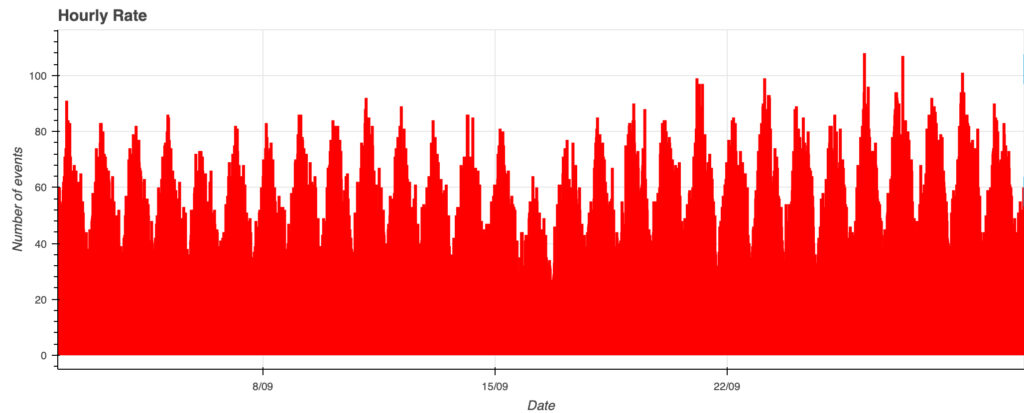
Fig. 1: September 2026 data trend.
The September Epsilon Perseus
The September Epsilon Perseids (208 SPE) are a meteor shower active during the first half of the month, with a peak that was predicted for September 10, 2026, at approximately 06:33 UT. The radiant is located in the constellation Perseus, with right ascension coordinates of 48.6° and declination of +39.6°.
In 2026, observation of the meteor shower was hampered by the position of the radiant, which, at Italian latitudes, set in the early morning hours, significantly reducing the number of detectable meteors.
This made it particularly difficult to verify the sudden increase in activity (outburst) reported by the Central Bureau for Astronomical Telegrams (CBAT) in Circular No. 5736 (1), since only the initial phase of the phenomenon was observable from our latitudes.
The data collected by the CARMELo network did not clearly identify this increase in activity. Even a separate analysis of the observations made by the network’s westernmost receiver did not yield any significant results.
The Daytimee Sextantids
The Daytime Sextantids (DSX) are a meteor shower active between September and October, with a radiant located in the constellation Sextans, near the Sun. They are therefore unobservable visually and can only be detected using radio techniques.
In 2026, analysis of the data collected by the CARMELo network did not reveal an activity profile clearly attributable to this meteor shower. Even when the analysis was limited to observations from the network’s westernmost receiver, no significant results emerged. It was therefore not possible to distinguish with sufficient certainty the contribution of the diurnal Sestantids from the background meteor activity.
The CARMELo network
The network currently consists of 18 receivers located in Italy, Spain, the UK, Switzerland and the USA. The European receivers are tuned to the Graves radar station frequency in France, which is 143.050 MHz. Participating in the network are:
- Lorenzo Barbieri, Budrio (BO) ITA
- Associazione Astrofili Bolognesi, Bologna ITA
- Associazione Astrofili Bolognesi, Medelana (BO) ITA
- Paolo Fontana, Castenaso (BO) ITA
- Associazione Astrofili Pisani, Orciatico (PI) ITA
- Gruppo Astrofili Persicetani, San Giovanni in Persiceto (BO) ITA
- Roberto Nesci, Foligno (PG) ITA
- MarSEC, Marana di Crespadoro (VI) ITA
- Gruppo Astrofili Vicentini, Arcugnano (VI) ITA
- Associazione Ravennate Astrofili Rheyta, Ravenna (RA) ITA
- Mike German a Hayfield, Derbyshire UK
- Mike Otte, Pearl City, Illinois USA
- Yuri Malagutti, Comano (TI) CH
- Leslie Fry, Trawscoed Ceredigion, Wales UK
- Brian Coleman, Redenham Observatory, Andover, England UK
- Radio club La Salle University, Barcellona ESP
- Alberto Latini, Carona (TI) CH
- AstroCampania, Agerola (NA) ITA
The authors’ hope is that the network can expand both quantitatively and geographically, thus allowing the production of better quality data.
References
(1) CBAT 5736