Roberto Gorelli points our attention at a recently published meteor related paper: Meteor clusters
Meteor clusters: tracing meteoroid fragmentation in near-Earth space
This article has been submitted for publication by P. Kotena, D. Čapek, J. Tóth, J. Vaubaillon, A. Ashimbekova, S. Anghel, J. Watanabe and T. Vörös.
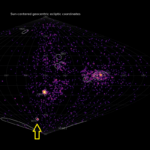
Abstract: Meteor clusters are typically defined as groups of meteors that appear close together in both space and time. To date, only a handful of such events have been recorded instrumentally and analysed in detail. In many documented cases, thermal stress has been identified as the most likely cause of meteoroid fragmentation near Earth. This paper documents two further cases and provides a summary of all currently known clusters. The two clusters that were recorded over Hawaii Island in 2023 and 2024 represent two distinct scenarios. The 2024 meteor cluster was characterised by a dominant mass body and, with the fragments arranged along the antisolar direction according to their mass. Such cases enable us to reliably determine the age of the cluster and identify the most likely formation scenario. This cluster was around three days old, and the thermal stress was the most likely mechanism of its formation. The 2023 cluster was not such a case. It does not contain a mass dominant body, nor are its fragments arranged by their mass. Therefore, it was only possible to estimate its age to be no more than four days. Furthermore, other potential formation mechanisms besides thermal stress cannot be ruled out. This fact was observed in all analysed clusters. All clusters known up to date were formed in close proximity to Earth. The volume of a cluster increases with its age. This means that older clusters, formed by the fragmentation far away from Earth may remain undetected, as their fragments are also dispersed too widely to be observed by local experiment. However, global networks can detect such dispersed clusters.
You can download this paper for free: https://arxiv.org/pdf/2604.07887 (13 pages).
Older meteor library news:
2026
- Multi-Sensor Trajectory Reconstruction of the 24 April 2025 Alaska Fireball and Implications for Planetary Defense. This article has been submitted for publication in the Journal of Geophysical Research: Planets by L. T. Scamfer, E. A. Silber, M.D. Fries, D. Vida, D. Šegon, P. Jenniskens, Y. Nishikawa, V. Sawal, T. A. Rector. (10 March 2026).
- Photometry of Fireballs using High Frame Rate Cameras. This article has been submitted for publication in the Publications of the Astronomical Society of Australia by D. Giancono, H. Devillepoix, R. Howie, D. Vida, D. Rollinson. (23 February 2026).
- Asteroidal activity amongst meteor datasets: Confirmed new “rock-comet” stream and search for a tidal disruption signature. This article has been submitted for publication by Patrick M. Shober. (18 February 2026).
- Deepest ever photographed Geminid with small but not negligible terminal mass. This article has been submitted for publication in Astronomy & Astrophysics by Pavel Spurný and Jiří Borovička. (19 February 2026).
- Meteor statistics I: The distribution of instrumental magnitudes. This article has been submitted for publication by Althea V. Moorhead, Peter G. Brown, Margaret D. Campbell-Brown, Michael J. Mazur, and Denis Vida. (18 February 2026).
- Achondrites in meteor data: Spectra, dynamics, and physical properties of candidate aubrite and eucrite impactors. This article has been submitted for publication in Astronomy & Astrophysics by P. Matlovič, A. Pisarčíková, V. Pazderová, T. Vörös, F. Hlobik, H.A.R. Devillepoix, J. Borovička2, M. Paprskárová, S. E. Deam, J. Tóth, L. Kornoš, T. Paulech, and P. Zigo. (2 February 2026).
- Distance-Independent Atmospheric Refraction Correction for Accurate Retrieval of Fireball Trajectories. This article has been submitted for publication This article has been submitted for publication by Jaakko Visuri, Maria Gritsevich, Janne Sievinen. (22 January 2026).
- Inferring Meteoroid Properties with Dynamic Nested Sampling: A Case Study of Orionid and Capricornid Shower Meteors. This article has been submitted for publication by Maximilian Vovk, Peter G. Brown, Denis Vida, Daeyoung Lee, Emma G. Harmos. (20 January 2026).
- Observation Timelines for the Potential Lunar Impact of Asteroid 2024 YR4. This article has been submitted for publication by Yifan He, Yixuan Wu, Yifei Jiao, Wen-Yue Dai, Xin Liu, Bin Cheng, and Hexi Baoyin. (15 January 2026).
- Detection of the 2021 Arid Meteor Shower on Maunakea, Hawaii. This article has been submitted for publication in Publications of the Astronomical Society of Japan by Ichi Tanaka, Hitoshi Hasegawa, Toyokazu Uda, Mikiya Sato, Jun-ichi Watanabe and Masanobu Higashiyama. (8 January 2026).
2025
- Geminids are initially cracked by atmospheric thermal stress. This article has been submitted for publication in Astronomy & Astrophysics by Tomáš Henych, Jiří Borovička, David Čapek, Vlastimil Vojáček, Pavel Spurný, Pavel Koten, and Lukáš Shrbený. (16 December 2025).
- From Flash to Crater: Morphological and Spectral Analysis of the Brightest Lunar Impact on 11 September 2013 using LRO Data. This article has been submitted and accepted for publication in MNRAS by J. L. Rizos, L. M. Lara, J. L. Ortiz, J. M. Madiedo. (15 November 2025).
- Spectroscopic analysis of hydrogen and silicon in bright f ireballs: New insights into meteoroid composition. This article has been submitted to Astronomy & Astrophysics by V. Vojáček, J. Borovička, and P. Spurný. (7 November 2025).
- The interstellar flux gap: From dust to kilometer-scale objects. This article has been submitted to Astronomy & Astrophysics by E. Peña-Asensio and D. Z. Seligman. (3 November 2025).
- Comparing the data reduction pipelines of FRIPON, DFN, WMPL, and AMOS: Geminids Case Study. This article has been submitted to Astronomy & Astrophysics by P.M. Shober, J. Vaubaillon, S. Anghel, H.A.R. Devillepoix, F. Hlobik, P. Matlovic, J. Tóth, D. Vida, E.K. Sansom, T. Jansen-Sturgeon, F. Colas, A. Malgoyre, L. Kornoš, F. Duriš, V. Pazderová, S. Bouley, B. Zanda, and P. Vernazza. (27 October 2025).
- Effect of a fine-scale layered structure of the atmosphere on infrasound signals from fragmenting meteoroids. This article has been submitted and published in Pure and Applied Geophysics by Igor P. Chunchuzov, Oleg E. Popov, Elizabeth A. Silber and Segey N. Kulichkov. (6 October 2025).
- Model Predictions for the 2025 October Draconid Outburst. This article has been submitted for publication by Auriane Egal, Paul Wiegert, Danielle E. Moser, Peter G. Brown, and Margaret Campbell-Brown. (30 September 2025).
- Space Mission Options for Reconnaissance and Mitigation of Asteroid 2024 YR4. This article has been submitted for publication by Brent W. Barbee, Matthew A. Vavrina, Rylie Bull, Adrienne Rudolph, Davide Farnocchia, Russell TerBeek, Justin Atchison, Joshua Lyzhoft, Jessie Dotson, Patrick King, Paul W. Chodas, Dawn Graninger, Ronald G. Mink, Kathryn M. Kumamoto, Jason M. Pearl, Mary Burkey, Isaiah Santistevan, Catherine S. Plesko, Wendy K. Caldwell, Megan Harwell. (15 September 2025).
- Error dependencies in the space-based CNEOS fireball database. This article has been submitted for publication by E. Peña-Asensio, H. Socas-Navarro, and D. Z. Seligman. (2 August 2025).
- Orbit dissimilarity criteria in meteor showers: a comparative review. This article has been submitted for publication by Ariane Courtot, Patrick Shober, Jérémie Vaubaillon. (25 July 2025).
- Lunar exosphere dynamics at the north pole following Perseid 2009 meteoroid impacts . This article has been submitted for publication by Alexey A. Berezhnoy, Maria Gritsevich, Ekaterina A. Feoktistova, Markku Nissinen, Yuri V. Pakhomov, and Vladislav V. Shevchenko. (24 July 2025).
- Investigation of lunar ejecta dynamics: Particles reaching the near-Earth space and their effect on Earth-based observation. This article has been submitted for publication by Kun Yang, Yu Jiang, Youpeng Liang, and Xiaodong Liu. (20 July 2025).
- BLADE: An Automated Framework for Classifying Light Curves from the Center for Near-Earth Object Studies (CNEOS) Fireball Database. This article has been submitted for publication by Elizabeth A. Silber, Vedant Sawal. (18 June 2025).
- The Potential Danger to Satellites due to Ejecta from a 2032 Lunar Impact by Asteroid 2024 YR4. This article has been submitted for publication by Paul Wiegert, Peter Brown, Jack Lopes and Martin Connors. (12 June 2025).
- A limit on the mass of the Taurid Resonant Swarm at sub-100 meter sizes. This article has been submitted for publication by Paul Wiegert, Denis Vida, David Clark, Auriane Egal, Richard Wainscoat and Robert Weryk. (3 June 2025).
- Exploring Seismic Signal Detection and Source Identification of Atmospheric Entries: The Hayabusa2 Sample Return Capsule as a Benchmark. This article has been submitted for publication by Iona Clemente, Eleanor K. Sansom, Hadrien A. R. Devillepoix, Taichi Kawamura, Benjamin A. Fernando, Raphael F. Garcia, Olivia Collet. (21 May 2025).
- Multi-parameter constraints on empirical infrasound period–yield relations for bolides and implications for planetary defense. This article has been submitted and accepted for publication in the Astronomical Journal by Elizabeth A. Silber, Josep M. Trigo-Rodríguez, Iyare Oseghae, Eloy Peña Asensio, Mark Boslough, Rodney Whitaker, Christoph Pilger, Philip Lubin, Vedant Sawal, Claus Hetzer, Randy Longenbaugh, Peter Jenniskens, Brin Bailey, Esther Mas Sanz, Patrick Hupe, Alexander N. Cohen, Thom R. Edwards, Sasha Egan, Reynold E. Silber, Summer Czarnowski, Miro Ronac Giannone. (4 May 2025).
- Meteoroid rotation and quasi-periodic brightness variation of meteor light curves. This article has been submitted for publication by Salvatore Mancuso, Dario Barghini and Daniele Gardiol. (2 May 2025).
- Inferring Fireball Velocity Profiles and Characteristic Parameters of Meteoroids from Incomplete Datasets. This article has been submitted by Eloy Peña-Asensio and Maria Gritsevich. (14 April 2025).
- Perihelion history and atmospheric survival as primary drivers of the Earth’s meteorite record. This article has been submitted by Patrick M. Shober, Hadrien A.R. Devillepoix, Jeremie Vaubaillon, Simon Anghel, Sophie E. Deam, Eleanor K. Sansom, Francois Colas, Brigitte Zanda, Pierre Vernazza, Phil Bland. (14 April 2025).
- Orbit, meteoroid size, and cosmic ray exposure history of the Aguas Zarcas CM2 breccia. This article has been submitted and accepted for publication in Meteoritics & Planetary Science by Peter Jenniskens, Gerardo J. Soto, Gabriel Gcalves Silva, Oscar Lücke, Pilar Madrigal, Tatiana Ballestero, Carolina Salas Matamoros, Paulo Ruiz Cubillo, Daniela Cardozo Mourao, Othon Cabo Winter, Rafael Sfair, Clemens E. Tillier, Jim Albers, Laurence A. J. Garvie, Karen Ziegler, Qing-Zhu Yin, Matthew E. Sanborn, Henner Busemann, My E. I. Riebe, Kees C. Welten, Marc W. Caffee, Matthias Laubenstein, Darrel K. Robertson, and David Nesvorny. (2 April 2025).
- An upper limit on the interstellar meteoroid flux at video sizes from the Global Meteor Network. This article has been submitted and accepted at the Astrophysical Journal by Paul Wiegert, Vanessa Tran, Cole Gregg, Denis Vida and Peter Brown. (24 March 2025).
- Towards a definition of a meteor cluster Detection of meteor clusters from meteor orbit databases. This article has been submitted to Astronomy & Astrophysics by A. Ashimbekova, J. Vaubaillon, and P. Koten. (21 March 2025).
- In Search of the Potentially Hazardous Asteroids in the Taurid Resonant Swarm. This article has been submitted by Jasmine Li, Quanzhi Ye (叶泉志), Denis Vida, David L. Clark, Eric C. Bellm, Richard Dekany, Matthew J. Graham, Frank J. Masci, Josiah Purdum, Benjamin Racine, and Avery Wold. (11 March 2025).
- Bolide infrasound signal morphology and yield estimates: A case study of two events detected by a dense acoustic sensor network. This article has been submitted and accepted for publication in Astronomical Journal by Trevor C. Wilson, Elizabeth A. Silber, Thomas A. Colston, Brian R. Elbing, Thom R. Edwards. (21 February 2025).
- The fall of asteroid 2024 XA1 and the location of possible meteorites. This article has been submitted by Francesco Gianotto, Albino Carbognani, Marco Fenucci, Maxime Devogèle, Pablo Ramirez-Moreta, Marco Micheli, Raffaele Salerno, Toni Santana-Ros, Juan Luis Cano, Luca Conversi, Charlie Drury, Laura Faggioli, Dora Föhring, Reiner Kresken, Selina Machnitzky, Richard Moissl, Francisco Ocaña, Dario Oliviero, Eduardo Alonso-Peleato, Margherita Revellino and Regina Rudawska. (13 February 2025).
- The structure of κ Cygnid and August Draconid meteoroid streams. This article has been submitted by J. Borovička, P. Spurný, L. Kotková, S. Molau, D. Tomko, and T. Weiland. (4 February 2025).
- Asteroid 2023 NT1: A Cautionary Tale. This article has been submitted by Brin Bailey, Alexander N. Cohen, Sasha Egan, Philip Lubin, Ruitao Xu, Mark Boslough, Darrel Robertson, Elizabeth A. Silber, Irina Sagert, Oleg Korobkin, and Glenn Sjoden. (16 January 2025).
- Decameter-sized Earth impactors– I: Orbital properties. This article has been submitted by Ian Chow, Peter G. Brown. (6 January 2025).
2024
- Telescope-to-Fireball Characterization of Earth Impactor 2022 WJ1. This article has been submitted by Theodore Kareta, Denis Vida, Marco Micheli, Nicholas Moskovitz, Paul Wiegert, Peter G. Brown, Phil J. A. McCausland, Hadrien A. R. Devillepoix, Barbara Malečić, Maja Telišman Prtenjak, Damir Šegon, Benjamin Shafransky, and Davide Farnocchia. (21 November 2024).
- Near-Earth Asteroids as the Parents of the δ-Cancrid Meteoroid Stream. This article has been submitted by G. I. Kokhirova, M. Zhang, X.-G. Li, A. I. Zhonmuhammadi and X. Liu. (29 October 2024).
- A survey of debris trails from short-period comets. This article has been submitted by William T. Reach, Michael S. Kelley and Mark V. Sykes. (29 October 2024).
- CAMO-S: A meteor-tracking spectrograph at the Canadian Automated Meteor Observatory. This article has been submitted by Michael J. Mazur, Margaret Campbell-Brown, Peter G. Brown, Denis Vida, Pete Gural, and Zhangqing Yang. (22 October 2024).
- How Meteor Showers Can Guide the Search for Long Period Comets. This article has been submitted by Samantha Hemmelgarn, Nicholas Moskovitz, Stuart Pilorz, and Peter Jenniskens. (8 October 2024).
- Delivery of DART Impact Ejecta to Mars and Earth: Opportunity for Meteor Observations. This article has been submitted by Eloy Peña-Asensio, Michael Küppers, Josep M. Trigo-Rodríguez and Albert Rimola. (30 August 2024).
- Properties of outer solar system pebbles during planetesimal formation from meteor observations . This article has been submitted submitted and accepted for publication in Icarus by Peter Jenniskens, Paul R. Estrada, Stuart Pilorz, Peter S. Gural, Dave Samuels, Steve Rau , Timothy M. C. Abbott, Jim Albers, Scott Austin, Dan Avner, Jack W. Baggaley, Tim Beck, Solvay Blomquist, Mustafa Boyukata, Martin Breukers, Walt Cooney, Tim Cooper, Marcelo De Cicco, Hadrien Devillepoix, Eric Egland, Elize Fahl, Megan Gialluca, Bryant Grigsby, Toni Hanke, Barbara Harris, Steve Heathcote, Samantha Hemmelgarn, Andy Howell, Emmanuel Jehin, Carl Johannink, Luke Juneau, Erika Kisvarsanyi, Philip Mey, Nick Moskovitz, Mohammad Odeh, Brian Rachford, David Rollinson, James M. Scott, Martin C. Towner, Ozan Unsalan, Rynault van Wyk, Jeff Wood, James D. Wray , C. Pavao, and Dante S. Lauretta. (24 July 2024).
- The 18 May 2024 superbolide over the Iberian Peninsula: USG space sensors and ground-based independent observations. This article has been submitted submitted to MNRAS for publication by E. Peña-Asensio, P. Grèbol-Tomàs, J. M. Trigo-Rodríguez, P. Ramírez-Moreta, and R. Kresken. (27 May 2024).
- A library of meteoroid environments encountered by spacecraft in the inner solar system. This article has been submitted submitted to Advances in Space Research for publication by Althea V. Moorhead, Katie Milbrandt, Aaron Kingery. (14 May 2024).
- Comparing the dynamics of Jupiter-family Comets and comet-like fireballs. This article has been submitted for publication in Astronomy & Astrophysics by P.M. Shober, G. Tancredi, J. Vaubaillon, H.A.R. Devillepoix, S. Deam, S. Anghel, E.K. Sansom, F. Colas, and S. Martino. (13 May 2024).
- Determining the population of Large Meteoroids in Major Meteor Showers. This article has been submitted for publication by K. S. Wisniewski, P. G. Brown, D. E. Moser, R. Longenbaugh. (9 May 2024).
- The Fireball of November 24, 1970, as the Most Probable Source of the Ischgl Meteorite. This article has been submitted for publication by Maria Gritsevich, Jarmo Moilanen, Jaakko Visuri, Matthias M. M. Meier, Colin Maden, Jürgen Oberst, Dieter Heinlein, Joachim Flohrer, Alberto J. Castro-Tirado, Jorge Delgado-García, Christian Koeberl, Ludovic Ferrière, Franz Brandstätter, Pavel P. Povinec, Ivan Sýkora, Florian Schweidler. (19 April 2024).
- A generalizable method for estimating meteor shower false positives. This article has been submitted for publication in Astronomy & Astrophysics by P.M. Shober and J. Vaubaillon. (12 April 2024).
- Quantifying the bulk density of southern delta aquariid meteoroids:
insights from the Canadian automated meteor observatory. This article has been submitted for publication in Monthly Notices of the Royal Astronomical Society by Arazi Pinhas, Zbyszek Krzeminski, Denis Vida, and Peter Brown. (21 March 2024). - Atmospheric entry and fragmentation of small asteroid 2024 BX1: Bolide trajectory, orbit, dynamics, light curve, and spectrum. This article has been submitted for publication in Astronomy & Astrophysics by P. Spurný, J. Borovicka, L. Shrbený, M. Hankey, and R. Neubert. (1 March 2024).
- New evidence on the lost giant Chinguetti meteorite. This article has been submitted for publication by Robert Warren, Stephen Warren, and Ekaterini Protopapa. (21 February 2024).
- Observations of the new meteor shower from comet 46P/Wirtanen. This article has been submitted for publication in Astronomy & Astrophysics by D. Vida, J. M. Scott, A. Egal, J. Vaubaillon, Q.-Z. Ye, D. Rollinson, M. Sato, and D. E. Moser. (12 February 2024).
- Age of Geminids Derived from the Statistics of Meteoroid Orbits. This article has been submitted for publication by D. V. Milanov, V. S. Shaidulin, A. S. Rusakov, A. V. Veselova. (8 February 2024).
- A Physical Survey of Meteoroid Streams: Comparing Cometary Reservoirs. This article has been submitted for publication by N. Buccongello, P. G. Brow, D. Vida, A. Pinhas. (19 January 2024).
- Properties, age, and origin of a huge meteor cluster observed over Scandinavia on 30 October 2022. This article has been submitted for publication in Astronomy & Astrophysics by This article has been submitted for publication in Astronomy & Astrophysics by P. Koten, D. Capek, S. Midtskogen, L. Shrbený, P. Spurný, and M. Hankey. (9 January 2024).
- Dynamical study of Geminid formation assuming a rotational instability scenario. This article has been submitted for publication in Astronomy & Astrophysics by Hangbin Jo and Masateru Ishiguro. (8 January 2024).
2023
- A new meteor shower from comet 46P/Wirtanen expected in December 2023. This article has been submitted for publication in Astronomy & Astrophysics by J. Vaubaillon, Q.-Z. Ye, A. Egal, M. Sato, and D. E. Moser. (5 December 2023).
- A Physical Survey of Meteoroid Streams: Comparing Cometary Reservoirs. This article has been submitted for publicationby N. Buccongello, P. G. Brown, D. Vida, A. Pinhas. (1 December 2023).
- Oort cloud perturbations as a source of hyperbolic
Earth impactors. This article has been submitted for publication in Icarus by Eloy Peña-Asensio, Jaakko Visuri, Josep M. Trigo-Rodríguez, Hector Socas-Navarro, Maria Gritsevich, Markku Siljama, Albert Rimola. (25 October 2023). - Mean-motion resonances in the Quadrantid meteoroid stream and dynamic evolution of dust trail of asteroid (196256) 2003 EH1. This article has been submitted for publication in Russian Physics Journal by G. E. Sambarov, A. P. Kartashova, and T. Yu. Galushina. (12 October 2023).
- Search for shower’s duplicates at the IAU MDC. Methods and general results. This article has been submitted for publication by T.J. Jopek, L. Neslušan, R. Rudawska, and M. Hajduková. (8 September 2023).
- AI-Enhanced Data Processing and Discovery Crowd Sourcing for Meteor Shower Mapping. This article has been submitted for publication by Siddha Ganju, Amartya Hatua, Peter Jenniskens, Sahyadri Krishna, Chicheng Ren, Surya Ambardar. (2 August 2023).
- The First Instrumentally Documented Fall of an Iron Meteorite: Orbit and Possible Origin. This article has been published in The Astrophysical Journal, Volume 953, Number 1, by Ihor Kyrylenko, Oleksiy Golubov, Ivan Slyusarev, Jaakko Visuri, Maria Gritsevich, Yurij N. Krugly, Irina Belskaya, and Vasilij G. Shevchenko. (28 July 2023).
- Computation of a possible Tunguska’s strewn field. This article has been submitted for publication by Albino Carbognani, Mario Di Martino, and Giovanna Stirpe. (26 July 2023).
- Could a Bolide Listed in the CNEOS Database have Originated from 1I/’Oumuamua?. This article has been submitted for publication by Adam Hibberd. (18 July 2023).
- On the Proposed Interstellar Origin of the USG 20140108 Fireball. This article has been submitted for publication by Peter G. Brown and Jiří Borovička. (25 June 2023).
- Characterisation of chaos and mean-motion resonances in meteoroid streams Application to the Draconids and Leonids. This article has been submitted to Astronomy & Astrophysics by Ariane Courtot, Melaine Saillenfest, Jérémie Vaubaillon, and Marc Fouchard. (23 June 2023).
- Formation, Structure, and Detectability of the Geminids Meteoroid Stream. This article has been submitted by W. Z. Cukier and J. R. Szalay. (19 June 2023).
- Near-Earth Asteroids of Cometary Origin Associated with the Virginid Complex. This article has been submitted to Planetary and Space Science by G.I. Kokhirova, A.I. Zhonmuhammadi, U.H. Khamroev, T.J. Jopek. (26 May 2023).
- τ Herculid meteor shower on night 30/31 May, 2022, and properties of the meteoroids. This article has been submitted for publication in Astronomy & Astrophysics by P. Koten, L. Shrbený, P. Spurný, J. Borovička, R. Štork, T. Henych, V. Vojáček and Jan Mánek. (23 May 2023).
- Prediction of the collisions of meteoroids originating in comet 21P/Giacobini-Zinner with the Mercury, Venus, and Mars. This article has been submitted for publication by D. Tomko, L. Neslušan (24 April 2023).
- Showers with both northern and southern solutions. This article has been submitted for publication by L. Neslušan, T. J. Jopek, R. Rudawska, M. Hajduková and G. Kokhirova (21 April 2023).
- Characterisation of chaos in meteoroid streams.
Application to the Geminids.. This article has been submitted for publication by Ariane Courtot, Jérémie Vaubaillon, and Marc Fouchard (7 April 2023). - Preatmospheric detection of a meter-sized Earth impactor. This article has been submitted for publication by David L. Clark, Paul A. Wiegert, Peter G. Brown, Denis Vida, Aren Heinze, and Larry Denneau (5 April 2023).
- Expected Fragment Distribution from the First Interstellar Meteor CNEOS 2014-01-08. This article has been submitted for publication by Amory Tillinghast-Raby, Abraham Loeb and Amir Siraj (31 March 2023).
- Computation of a possible Tunguska’s strewn field. This article has been submitted for publication by Albino Carbognani, Mario Di Martino, and Giovanna Stirpe. (31 March 2023).
- Sodium Brightening of (3200) Phaethon Near Perihelion. This article has been submitted for publication by Qicheng Zhang, Karl Battams, Quanzhi Ye (叶泉志), Matthew M. Knight, and Carl A. Schmidt. (30 March 2023).
- The Winchcombe Fireball—that Lucky Survivor. This article has been submitted for publication by Sarah McMullan, Denis Vida, Hadrien A. R. Devillepoix, Jim Rowe, Luke Daly, Ashley J. King, Martin Cupák, Robert M. Howie, Eleanor K. Sansom, Patrick Shober, Martin C. Towner , Seamus Anderson, Luke McFadden, Jana Horák, Andrew R. D. Smedley, Katherine H. Joy, Alan Shuttleworth, Francois Colas, Brigitte Zanda, Aine C. O’Brien, Ian McMullan, Clive Shaw, Adam Suttle, Martin D. Suttle, John S. Young, Peter Campbell-Burns, Richard Kacerek, Richard Bassom, Steve Bosley, Richard Fleet, Dave Jones, Mark McIntyre, Nick James, Derek Robson, Paul Dickinson, Philip A. Bland, and Gareth S. Collins. (21 March 2023).
- Localizing The First Interstellar Meteor With Seismometer Data. This article has been submitted for publication by Amir Siraj and Abraham Loeb. (15 March 2023).
- Computation of a possible Tunguska’s strewn field. This article has been submitted for publication by Albino Carbognani, Mario Di Martino, and Giovanna Stirpe. (27 February 2023).
- Modification of the Shower Database of the IAU Meteor Data Center. This article has been submitted for publication by Mária Hajduková, Regina Rudawska, Tadeusz J. Jopek, Masahiro Koseki, Gulchehra Kokhirova, Luboš Neslušan. (24 February 2023).
- Modelling the 2022 τ -Herculid outburst. This article has been submitted for publication by Auriane Egal, Paul A. Wiegert , Peter G. Brown and Denis Vida. (6 February 2023).
- Identifying meteorite droppers among the population of bright ’sporadic’ bolides imaged by the Spanish Fireball Network during the spring of 2022. This article has been submitted for publication in MNRAS by E. Peña-Asensio, J. M. Trigo-Rodríguez, A. Rimola, M. Corretgé-Gilart, and D. Koschny. (9 January 2023).
2022
- Expected Fragment Distribution from the First Interstellar Meteor CNEOS 2014-01-08. This article has been submitted for publication by Amory Tillinghast-Raby, Abraham Loeb, and Amir Siraj. (5 December 2022).
- The Winchcombe meteorite, a unique and pristine witness from the outer solar system. This article has been published by Ashley J. King, Luke Daly, James Rowe, Katherine H. Joy, Richard C. Greenwood, Hadrien A. R. Devillepoix, Martin D. Suttle, Queenie H. S. Chan, Sara S. Russell, Rob Wilcock + 114 authors. (16 November 2022).
- New Nomenclature Rules for Meteor Showers Adopted. This article has been submitted for publication by Mária Hajduková, Regina Rudawska, Tadeusz J. Jopek, Masahiro Koseki, Gulchehra Kokhirova, Luboš Neslušan. (2 November 2022).
- Data on 824 fireballs observed by the digital cameras of the European Fireball Network in 2017–2018 II. Analysis of orbital and physical properties of centimeter-sized meteoroids. This article has been submitted for publication by J. Borovička, P. Spurný and L. Shrbený. (26 September 2022).
- Comets and meteor showers. This article has been submitted for publication by Quanzhi Ye and Peter Jenniskens. (21 September 2022).
- New Constraints on Macroscopic Dark Matter Using Radar Meteor Detectors. This article has been submitted for publication by Pawan Dhakal, Steven Prohira, Christopher V. Cappiello, John F. Beacom, Scott Palo, and John Marino. (16 September 2022).
- Exoatmospheric detection of a meter-sized Earth impactor. This article has been submitted for publication by David L. Clark, Paul A. Wiegert, Peter G. Brown, Denis Vida, Aren Heinze, and Larry Denneau. (13 September 2022).
- Identifying interstellar object impact craters. This article has been submitted for publication by Samuel H. C. Cabot and Gregory Laughlin. (31 July 2022).
- An Ocean Expedition by the Galileo Project to Retrieve Fragments of the First Large Interstellar Meteor CNEOS 2014-01-08. This article has been submitted for publication by Amir Siraj, Abraham Loeb, and Tim Gallaudet. (29 July 2022).
- Ejection velocities, age, and formation process of SPE meteoroid cluster. This article has been submitted for publication to Astronomy & Astrophysics, by David Capek, Pavel Koten, Pavel Spurný and Lukáš Shrbený. (28 July 2022).
- Computing optical meteor flux using Global Meteor Network data. This article has been accepted for publication in Monthly Notices of the Royal Astronomical Society, submitted by Denis Vida, Rhiannon C. Blaauw Erskine, Peter G. Brown, Jonathon Kambulow, Margaret Campbell-Brown, Michael J. Mazur. (22 June 2022).
- Orbital characterization of superbolides observed from space: dynamical association with near-Earth objects, meteoroid streams and identification of hyperbolic projectiles. This article has been accepted for publication in The Astronomical Journal, submitted by Eloy Peña-Asensio, Josep M. Trigo-Rodríguez, and Albert Rimola. (3 June 2022).
- Evolution of the dust trail of comet 17P/Holmes. This article has been accepted for publication in the Monthly Notices of the Royal Astronomical Society, submitted by Maria Gritsevich, Markku Nissinen, Arto Oksanen, Jari Suomela and Elizabeth A. Silber. (20 March 2022).
- The 2022 Encounter of the Outburst Material from Comet 73P/Schwassmann–Wachmann 3. This article has been submitted by Quanzhi Ye (叶泉志), Jerémie Vaubaillon, and Josselin Desmars. (25 May 2022).
- Status of the IAU Meteor Data Center. This article has been submitted by Regina Rudawska, Mária Hajduková, Tadeusz J. Jopek, Luboš Neslušan, Marián Jakubík, Ján Svoren. (26 March 2022).
- PyNAPLE: Lunar Surface Impact Crater Detection. This article has been submitted by D. Sheward, C. Avdellidou, A. Cook, E. Sefton-Nash, M. Delbo, B. Cantarella, and L. Zanatta. (26 April 2022).
- Discovery of a Meteor of Interstellar Origin. This article has been submitted by Amir Siraj and Abraham Loeb. (18 April 2022).
- Trajectory, recovery, and orbital history of the Madura Cave meteorite. This article has been submitted by Hadrien A. R. Devillepoix, Eleanor K. Sansom, Patrick Shober, Seamus L. Anderson, Martin C. Towner, Anthony Lagain, Martin Cupak, Philip A. Bland , Robert M. Howie, Trent Jansen-Sturgeon, Benjamin A. D. Hartig, Marcin Sokolowski, Gretchen Benedix, and Lucy Forman. (15 February 2022).
- An observational synthesis of the Taurid meteor complex. This article has been submitted by A. Egal, P. G. Brown, P. Wiegert and Y. Kipreos. (10 February 2022).
2021
- Terminal Planetary Defense. This article has been submitted by Philip Lubin. (10 December 2021).
- Lunar-like silicate material forms the Earth quasi-satellite (469219) 2016 HO3 Kamòoalewa. This article has been submitted by Benjamin N.L. Sharkey, Vishnu Reddy, Renu Malhotra, Audrey Thirouin, Olga Kuhn, Albert Conrad, Barry Rothberg, Juan A. Sanchez, David Thompson, Christian Veillet. (12 November 2021).
- Search for pairs and groups in the 2006 Geminid meteor shower. This article has been submitted to Astronomy & Astrophysics by P. Koten, D. Čapek, P. Spurný, R. Štork, V. Vojáček, and J. Bednář. (4 October 2021).
- Eduard Heis, an early pioneer in meteor research. This article has been published in Hist. Geo Space. Sci., 12, 163–170, 2021, by Ulrich Sperberg. (23 September 2021).
- Learning about comets from the study of mass distributions and fluxes of meteoroid streams. This article has been submitted by Josep M. Trigo-Rodríguez, and Jürgen Blum. (29 September 2021).
- Iron Rain: measuring the occurrence rate and origin of small iron meteoroids at Earth. This article has been submitted by Tristan Mills, P. G. Brown, M. J. Mazur, D. Vida, Peter S. Gural and Althea V. Moorhead. (21 September 2021).
- Using fireball networks to track more frequent reentries: Falcon 9 upper stage orbit determination from video recordings. This article has been submitted by Eloy Peña-Asensio, Josep M. Trigo-Rodríguez, Marco Langbroek, Albert Rimola, and Antonio J. Robles. (2 September 2021).
- Taurid stream #628: a reservoir of large cometary impactors. This article has been submitted by Hadrien A. R. Devillepoix, Peter Jenniskens, Philip A. Bland, Eleanor K. Sansom, Martin C. Towner, Patrick Shober, Martin Cupak, Robert M. Howie, Benjamin A. D. Hartig, Seamus Anderson, Trent Jansen-Sturgeon, and Jim Albers. (19 August 2021).
- Probable identification of the impact craters associated with two luminous historical lunar flashes. This article has been submitted by William Bruckman and Abraham Ruiz (19 August 2021).
- Triple-frequency meteor radar full wave scattering Measurements and comparison to theory. This article has been submitted for publication by G. Stober, P. Brown, M. Campbell-Brown, and R. J. Weryk (18 August 2021).
- Darkflight estimates of meteorite fall positions: issues and a case study using the Murrili meteorite fall . This article has been submitted for publication by M.C. Towner, T. Jansen-Sturgeon, M. Cupak, E.K. Sansom, H.A.R. Devillepoix, P.A. Bland, R.M Howie, J.P. Paxman, G.K. Benedix, B.A.D. Hartig (13 August 2021).
- A dynamical analysis of the Taurid Complex: evidence for past
orbital convergences. This article has been accepted for publication in the Monthly Notices of the Royal Astronomical Society submitted by A. Egal, P. Wiegert, P. G. Brown, P. Spurný, J. Borovička
and G. B. Valsecchi (30 July 2021). - Radar observations of Draconid outbursts. This article has been accepted for publication in the Monthly Notices of the Royal Astronomical Society submitted by M. D. Campbell-Brown, G. Stober, C. Jacobi, J. Kero, A. Kozlovsky and M. Lester (28 July 2021).
- The Global Meteor Network – Methodology and First Results. This article has been accepted for publication in the Monthly Notices of the Royal Astronomical Society submitted by Denis Vida, Damir Šegon, Peter S. Gural, Peter G. Brown, Mark J.M. McIntyre, Tammo Jan Dijkema, Lovro Pavletić, Patrik Kukić, Michael J. Mazur, Peter Eschman, Paul Roggemans, Aleksandar Merlak and Dario Zubović (26 July 2021).
- Fragmentation model and strewn field estimation for meteoroids entry. This article has been published by Limonta S., Trisolini M., Frey S., Colombo C. (10 June 2021).
- A Numerical Approach to Study Ablation of Large Bolides: Application to Chelyabinsk. This article has been published in Advances in Astronomy by Josep M. Trigo-Rodríguez, Joan Dergham, Maria Gritsevich, Esko Lyytinen, Elizabeth A. Silber, and Iwan P. Williams. (27 March 2021).
- Accurate 3D fireball trajectory and orbit calculation using the 3D-FireTOC automatic Python code, this article has been published in the Monthly Notices of the Royal Astronomical Society by Eloy Peña-Asensio, Josep Maria Trigo-Rodríguez, Maria Gritsevich, Albert Rimola. (10 April 2021).
- The manifold of variations: impact location of short-term impactors, this article has been submitted for publication by Alessio del Vigna, Linda Dimare, and Davide Bracalli Cioci. (24 April 2021).
- Asteroid that hit Botswana in 2018 likely came from Vesta, this article appeared online on the SETI institute website. (22 April 2021).
- Effect of ice sheet thickness on formation of the Hiawatha impact crater, by Elizabeth A. Silber, Brandon C. Johnson, Evan Bjonnes, Joseph A. MacGregor, Nicolaj K. Larsen, Sean E. Wiggins. (20 April 2021).
- Determination of strewn fields for meteorite falls, by Jarmo Moilanen, Maria Gritsevich and Esko Lyytinen. (1 March 2021).
- Observation of the α Carinid meteor shower 2020 unexpected outburst, by Juan Sebastian Bruzzone, Robert J. Weryk, Diego Janches, Carsten Baumann, Gunter Stober, and Jose Luis Hormaechea. (25 February 2021).
- Fireball characteristics derivable from acoustic data, by Luke McFadden, Peter Brown, Denis Vida and Pavel Spurný. (15 February 2021).
- Detection of a bolide in Jupiter’s atmosphere with Juno UVS, by Rohini S. Giles, Thomas K. Greathouse, Joshua A. Kammer, G. Randall, Gladstone, Bertrand Bonfond, Vincent Hue, Denis C. Grodent, Jean-Claude Gérard, Maarten H. Versteeg, Scott J. Bolton, John E. P. Connerney and Steven M. Levin. (8 February 2021).
- The Sariçiçek howardite fall in Turkey: Source crater of HED meteorites on Vesta and impact risk of Vestoids, by Ozan Unsalan, Peter Jenniskens, Qing-Zhu Yin, Ersin Kaygisiz, Jim Albers, David L. Clark, Mikael Granvik, Iskender Demirkol, Ibrahim Y. Erdogan, Aydin S. Bengu, Mehmet E. Özel, Zahide Terzioglu, Nayeob Gi, Peter Brown, Esref Yalcinkaya, Tuğba Temel, Dinesh K. Prabhu, Darrel K. Robertson, Mark Boslough, Daniel R. Ostrowski, Jamie Kimberley, Selman Er, Douglas J. Rowlands, Kathryn L. Bryson, Cisem Altunayarunsalan, Bogdan Ranguelov, Alexander Karamanov, Dragomir Tatchev, Özlem Kocahan, Michael I. Oshtrakh, Alevtina A. Maksimova, Maxim S. Karabanalov, Kenneth L. Verosub, Emily Levin, Ibrahim Uysal, Viktor Hoffmann, Takahiro Hiroi, Vishnu Reddy, Gulce O. Ildiz, Olcay Bolukbasi, Michael E. Zolensky, Rupert Hochleitner, Melanie Kaliwoda, Sinan Öngen, Rui Fausto, Bernardo A. Nogueira, Andrey V. Chukin, Daniela Karashanova, Vladimir A. Semionkin, Mehmet Yesiltas, Timothy Glotch, Ayberk Yilmaz, Jon M. Friedrich, Matthew E. Sanborn, Magdalena Huyskens, Karen Ziegler, Curtis D. Williams, Maria Schönbächler, Kerstin Bauer, Matthias M. M. Meier, Colin Maden, Henner Busemann, Kees C. Welten, Marc W. Caffee, Matthias Laubenstein, Qin Zhou, Qiu-Li LI, XianHua LI, Yu Liu, Guo-Qiang Tang, Derek W. G. Sears, Hannah L. Mclain, Jason P. Dworkin, Jamie E. Elsila, Daniel P. Glavin, Philippe Schmitt-Kopplin, Alexander Ruf, Lucille Le Corre, & Nico Schmedemann. (6 February 2021).
- Relationship between Radar Cross Section and Optical Magnitude based on Radar
and Optical Simultaneous Observations of Faint Meteors, by Ryou Ohsawa, Akira Hirota, Kohei Morita, Shinsuke Abe, Daniel Kastinen, Johan Kero, Csilla Szasz, Yasunori Fujiwara, Takuji Nakamura, Koji Nishimura, Shigeyuki Sako, Jun-ichi Watanabe, Tsutomu Aoki, Noriaki Arima, Ko Arimatsu, Mamoru Doi, Makoto Ichiki, Shiro Ikeda, Yoshifusa Ita, Toshihiro Kasuga, Naoto Kobayashi, Mitsuru Kokubo, Masahiro Konishi, Hiroyuki Maehara, Takashi Miyata, Yuki Mori, Mikio Morii, Tomoki Morokuma, Kentaro Motohara, Yoshikazu Nakada, Shin-ichiro Okumura, Yuki Sarugaku, Mikiya Sato, Toshikazu Shigeyama, Takao Soyano, Hidenori Takahashi, Masaomi Tanaka, Ken’ichi Tarusawa, Nozomu Tominaga, Seitaro Urakawa, Fumihiko Usui, Takuya Yamashita, Makoto Yoshikawa. (6 February 2021). - Ejby—A new H5/6 ordinary chondrite fall in Copenhagen, Denmark, by by H. Haack, A. N. Sørensen, A. Bischoff, M. Patzek, J.-A. Barrat, S. Midtskogen, E. Stempels, M. Laubenstein, R. Greenwood, P. Schmittkopplin, H. Busemann, C. Maden, K. Bauer, P. Morina, M. Schönbächler, P. Voss and T. Dahl-Jensen. (2 February 2021).
- The Great Chinese Fireball of December 22, 2020, by Albino Carbognani. (7 January 2021).
- Trajectory and orbit of the unique carbonaceous meteorite Flensburg, by Jiří Borovička, Felix Bettonvil, Gerd Baumgarten, Jörg Strunk, Mike Hankey, Pavel Spurný, and Dieter Heinlein. (7 January 2021).
- Remarks on generating realistic synthetic meteoroid orbits, by T. J. Jopek. (6 January 2021).
2020
- FRIPON: A worldwide network to track incoming meteoroids, by F. Colas, B. Zanda, S. Bouley, S. Jeanne, A. Malgoyre, M. Birlan, C. Blanpain, J. Gattacceca, L. Jorda, J. Lecubin, C. Marmo, J.L. Rault, J. Vaubaillon, P. Vernazza, C. Yohia, D. Gardiol, A. Nedelcu, B. Poppe, J. Rowe, M. Forcier, D. Koschny, J.M. Trigo-Rodriguez, H. Lamy, R. Behrend, L. Ferrière, D. Barghini, A. Buzzoni, A. Carbognani, M. Di Carlo, M. Di Martino, C. Knapic, E. Londero, G. Pratesi, S. Rasetti, W. Riva, G.M. Stirpe, G.B. Valsecchi, C.A. Volpicelli, S. Zorba, D. Coward, E. Drolshagen, G. Drolshagen, O. Hernandez, E. Jehin, M. Jobin, A. King, C. Nitschelm, T. Ott, A. Sanchez-Lavega, A. Toni, P. Abraham, F. Affaticati, M. Albani, A. Andreis, T. Andrieu, S. Anghel, E. Antaluca, K. Antier, T. Appéré, A. Armand, G. Ascione, Y. Audureau, G. Auxepaules, T. Avoscan, D. Baba Aissa, P. Bacci, O. Badescu, R. Baldini, R. Baldo58, Balestrero, D. Baratoux, E. Barbotin, M. Bardy, S. Basso, O. Bautista, L. D. Bayle, P. Beck, R. Bellitto, R. Belluso, C. Benna, M. Benammi, E. Beneteau, Z. Benkhaldoun, P. Bergamini, F. Bernardi, M.E. Bertaina, P. Bessin, L. Betti, F. Bettonvil, D. Bihel, C. Birnbaum, O. Blagoi, E. Blouri, I. Boaca, R. Boata, B. Bobiet, R. Bonino, K. Boros, E. Bouchet, V. Borgeot, E. Bouchez, D. Boust, V. Boudon, T. Bouman, P. Bourget, S. Brandenburg, Ph. Bramond, E. Braun, A. Bussi, P. Cacault, B. Caillier, A. Calegaro, J. Camargo, S. Caminade, A.P.C. Campana, P. Campbell-Burns, R. Canal-Domingo, O. Carell, S. Carreau, E. Cascone, C. Cattaneo, P. Cauhape, P. Cavier, S. Celestin, A. Cellino, M. Champenois, H. Chennaoui Aoudjehane, S. Chevrier, P. Cholvy, L. Chomier, A. Christou, D. Cricchio, P. Coadou, J.Y. Cocaign, F. Cochard, S. Cointin, E.. Colombi, J. P. Colque Saavedra, L. Corp, M. Costa, F. Costard, M. Cottier, P. Cournoyer, E. Coustal, G. Cremonese, O. Cristea, J.C. Cuzon, G. D’Agostino, k. Daiffallah, C. Danescu, A. Dardon, T. Dasse, C. Davadan, V. Debs, J.P. Defaix, F. Deleflie, M. D’Elia, P. De Luca, P. De Maria, P. Deverchère, H. Devillepoix, A. Dias, A. Di Dato, R. Di Luca, F.M. Dominici, A. Drouard, J.L. Dumont, P. Dupouy, L. Duvignac, A. Egal, N. Erasmus, N. Esseiva, A. Ebel, B. Eisengarten, F. Federici, S. Feral, G. Ferrant, E. Ferreol, P. Finitzer, A. Foucault, P. Francois, M. Frîncu, J.L. Froger, F. Gaborit, V. Gagliarducci, J. Galard, A. Gardavot, M. Garmier, M. Garnung, B. Gautier, B. Gendre, D. Gerard, A. Gerardi, J.P. Godet, A. Grandchamps, B. Grouiez, S. Groult, D. Guidetti, G. Giuli, Y. Hello, X. Henry, G. Herbreteau, M. Herpin, P. Hewins, J.J. Hillairet, J. Horak, R. Hueso, E. Huet, S. Huet, F. Hyaumé, G. Interrante, Y. Isselin, Y. Jeangeorges, P. Janeux, P. Jeanneret, K. Jobse, S. Jouin, J.M. Jouvard, K. Joy, J.F. Julien, R. Kacerek, M. Kaire, M. Kempf, D. Koschny, C. Krier, M.K. Kwon, L. Lacassagne, D. Lachat, A. Lagain, E. Laisné, V. Lanchares, J. Laskar, M. Lazzarin, M. Leblanc, J.P. Lebreton, J. Lecomte, P. Le Dû, F. Lelong, S. Lera, J.F. Leoni, A. Le-Pichon, P. Le-Poupon, A. Leroy, G. Leto, A. Levansuu, E. Lewin, A. Lienard, D. Licchelli, H. Locatelli, S. Loehle, D. Loizeau, L. Luciani, M. Maignan, F. Manca, S. Mancuso, E. Mandon, N. Mangold, F. Mannucci, L. Maquet, D. Marant, Y. Marchal, J.L. Marin, J.C. Martin-Brisset, D. Martin, D. Mathieu, A. Maury, N. Mespoulet, F. Meyer, J.Y. Meyer, E. Meza, V. Moggi Cecchi, J.J. Moiroud, M. Millan, M. Montesarchio, A. Misiano, E. Molinari, S. Molau, J.Monari, B. Monflier, A. Monkos, M. Montemaggi, G. Monti, R. Moreau, J. Morin, R. Mourgues, O. Mousis, C. Nablanc, A. Nastasi, L., Niacsu, P. Notez, M. Ory, E. Pace, M.A. Paganelli, A. Pagola, M. Pajuelo, J.F. Palacián, G. Pallier, P. Paraschiv, R. Pardini, M. Pavone, G. Pavy, G. Payen, A. Pegoraro, E. Peña-Asensio, L. Perez, S. Pérez-Hoyos, V. Perlerin, A. Peyrot, F. Peth, V. Pic, S. Pietronave, C. Pilger, M. Piquel, T. Pisanu, M. Poppe, L. Portois, J.F. Prezeau, N. Pugno, C. Quantin, G. Quitté, N. Rambaux, E. Ravier, U. Repetti, S. Ribas, C. Richard, D. Richard, M. Rigoni, J.P. Rivet, N. Rizzi, S. Rochain, J.F. Rojas, M. Romeo, M. Rotaru, M. Rotger, P. Rougier, P. Rousselot, J. Rousset, D. Rousseu, O. Rubiera, R. Rudawska, J. Rudelle, J.P. Ruguet, P. Russo, S. Sales, O. Sauzereau, F. Salvati, M. Schieffer, D. Schreiner, Y. Scribano, D. Selvestrel, R. Serra, L. Shengold, A. Shuttleworth, R. Smareglia, S. Sohy, M. Soldi, R. Stanga, A. Steinhausser, F. Strafella, S. Sylla Mbaye, A.R.D. Smedley, M. Tagger, P. Tanga, C. Taricco, J.P. Teng, J.O. Tercu, O. Thizy, J.P. Thomas, M. Tombelli, R. Trangosi, B. Tregon, P. Trivero, A. Tukkers, V. Turcu, G. Umbriaco, E. Unda-Sanzana, R. Vairetti, M. Valenzuela, G. Valente, G. Varennes, S. Vauclair, J. Vergne, M. Verlinden, M. Vidal-Alaiz, R. Vieira-Martins, A. Viel, D.C. Vîntdevara, V. Vinogradoff, P. Volpini, M. Wendling, P. Wilhelm, K. Wohlgemuth, P. Yanguas, R. Zagarella, and A. Zollo.. (2 December 2020).
- Taurid complex smoking gun: detection of cometary activity, by Ignacio Ferrín, Vincenzo Orofino. (30 November 2020).
- Velocity distribution of larger meteoroids and small asteroids impacting Earth, by Esther Drolshagen, Theresa Ott, Detlef Koschny, Gerhard Drolshagen, Anna Kristiane Schmidt, and Björn Poppe. (14 November 2020).
- Satellite observation of the dust trail of a major bolide event over the Bering Sea on December 18, 2018, by J. Borovička, M. Setvák, H. Roesli, and J. K. Kerkmann. (26 October 2020).
- Effect of the surface shape of a large space body on its fragmentation in a planetary atmosphere, by Daniil E. Khrennikov, Andrei K. Titov, Alexander E. Ershov, Andrei B. Klyuchantsev, Vladimir I. Pariev, and Sergei V. Karpov. (5 October 2020).
- On the possibility of through passage of asteroid bodies across the Earth’s atmosphere, by Daniil E. Khrennikov, Andrei K. Titov, Alexander E. Ershov, Vladimir I. Pariev, and Sergei V. Karpov. (1 October 2020).
- Machine Learning for Semi-Automated Meteorite Recovery, by Seamus Anderson, Martin Towner, Phil Bland, Christopher Haikings, William Volante, Eleanor Sansom, Hadrien Devillepoix, Patrick Shober, Benjamin Hartig, Martin Cupak, Trent Jansen Sturgeon, Robert Howie, Gretchen Benedix, Geoff Deacon. (30 September 2020).
- Murrili Meteorite’s fall and recovery from Kati Thanda, by Eleanor K. Sansom, Philip A. Bland, Martin C. Towner, Hadrien A. R. Devillepoix, Martin Cupak, Robert M. Howie, Trent Jansen-Sturgeon, Morgan A. Cox, Benjamin A. D. Hartig, Jonathan P. Paxman, Gretchen Benedix, and Lucy Forman. (22 September 2020).
- Modeling the past and future activity of the Halleyids meteor showers, by A. Egal, P. Wiegert, P. G. Brown, M. Campbell-Brown, and D. Vida. (8 August 2020).
- Analysis of the dynamical evolution of the Quadrantid meteoroid stream, by G.E. Sambarov, T.Yu. Galushina and O.M. Syusina. (12 August 2020).
- 138175 (2000 EE104) and the Source of Interplanetary Field Enhancements, by David Jewitt. (14 July 2020).
- Comparing the reflectivity of ungrouped carbonaceous chondrites with that of short period comets like 2P/Encke, by Safoura Tanbakouei, Josep M. Trigo-Rodríguez, Jürgen blum, Iwan Williams and Jordi Llorca. (13 July 2020).
- Coordinated Optical and Radar measurements of Low Velocity Meteors, by Peter Brown and Robert J. Weryk. (8 July 2020).
- Meteors – light from comets and asteroids, by Pavol Matlovič and Juraj Tóth. (8 July 2020).
- Forbidden mass ranges for shower meteoroids, by Althea V. Moorhead. (26 June 2020).
- Frequency shifts of head echos in meteoroid trail formation, by Hans Wilschut. (30 June 2020).
- Precision measurements of radar transverse scattering speeds from meteor phase characteristics, by Michael Mazur, Petr Pokorný, Peter Brown, Robert J. Weryk, Denis Vida, Carsten Schult, Gunter Stober, Anamika Agrawal. (25 June 2020).
- Testing the Radiation Pattern of Meteor Radio Afterglow, by S. S. Varghese, K. S. Obenberger, G. B. Taylor and J. Dowell. (25 June 2020).
- The dynamical evolution and the force model for asteroid (196256) 2003 EH1, by T.Yu. Galushina, G.E. Sambarov. (24 June 2020).
- A Global Fireball Observatory, by H. A. R. Devillepoix, M. Cupák, P. A. Bland, E. K. Sansom, M. C. Towner, R. M. Howie, B. A. D. Hartig, T. Jansen-Sturgeon, P. M. Shober, S. L. Anderson, G. K. Benedix, D. Busan, R. Sayers, P. Jenniskens, J. Albers, C. D. K. Herd, P. J. A. Hill, P. G. Brown, Z. Krzeminski, G. R. Osinski, H. Chennaoui Aoudjehane, Z. Benkhaldoun, A. Jabiri, M. Guennoun, A. Barka, H. Darhmaouij, L. Daly, G. S. Collins, S. McMullan, M. D. Suttle, T. Ireland, G. Bonning, L. Baeza, T. Y. Alrefay, J. Horner, T. D. Swindle, C. W. Hergenrother, M. D. Fries, A. Tomkins, A. Langendam, T. Rushmer, C. O’Neill, D. Janches, J. L. Hormaechea, C. Shaw, J. S. Young, M. Alexander, A. D. Mardon and J. R. Tate. (12 June 2020).
- Activity of the Eta-Aquariid and Orionid meteor showers, by A. Egal, P. G. Brown, J. Rendtel, M. Campbell-Brown, and P. Wiegert (16 June 2020).
- Dynamics of spherical space debris of different sizes falling to Earth, by Judit Slíz-Balogh, Dániel Horváth, Róbert Szabó and Gábor Horváth (3 June 2020).
- Near-infrared observations of active asteroid (3200) Phaethon reveal no evidence for hydration, by Driss Takir, Theodore Kareta, Joshua P. Emery, Josef Hanuš , Vishnu Reddy, Ellen S. Howell, Andrew S. Rivkin & Tomoko Arai (1 May 2020).
- Measuring Fluxes of Meteor Showers with the NASA All-Sky Fireball Network, by Steven Ehlert and Rhiannon Blaauw Erskine (20 April 2020).
- Where did they come from, where did they go. Grazing fireballs, by P. M. Shober, T. Jansen-Sturgeon, E. K. Sansom, H.A.R. Devillepoix, M.C. Towner, P.A. Bland, M. Cupák, R.M. Howie, and B.A.D. Hartig (12 April 2020).
- The Quadrantids and December alpha Draconids 2012-2019 – Multi-year Meteor Videography, by Alex Pratt (9 April 2020).
- Characterization of the June epsilon Ophiuchids meteoroid stream and the comet 300P/Catalina, by Pavol Matlovič, Leonard Kornoš, Martina Kováčová, Juraj Tóth and Javier Licandro (7 April 2020).
- The hazard from fragmenting comets, by W.M. Napier (7 April 2020).
- A Real-Time Search for Interstellar Impacts on the Moon, by Amir Siraj and Abraham Loeb (7 April 2020).
- A Global Fireball Observatory, by H. A. R. Devillepoix, M. Cupák, , P. A. Bland, , E. K. Sansom, M. C. Towner, R. M. Howie, B. A. D. Hartig, T. Jansen-Sturgeon, P. M. Shober, S. L. Anderson, G. K. Benedix, D. Busan, R. Sayers, P. Jenniskens, J. Albers, C. D. K. Herd, P. Carlson, P. J. A. Hill, P. G. Brown, Z. Krzeminski, G. R. Osinski, H. Chennaoui Aoudjehane, T. Shisseh, Z. Benkhaldoun, A. Jabiri, M. Guennouni, A. Barka, H. Darhmaoui, L. Daly, G. S. Collins, S. McMullan, M. D. Suttle, C. Shaw, J. S. Younga, M. Alexander, A. D. Mardon, T. Ireland, G. Bonning, L. Baeza, T. Y. Alrefay, J. Horner, T. D. Swindle, C. W. Hergenrother, M. D. Fries, A. Tomkins, A. Langendam, T. A. Rushmer, C. O’Neill, D. Janches and J. L. Hormaechea (3 April 2020).
- Realistic gravitational focusing of meteoroid streams, by Althea V. Moorhead, Tiffany D. Clements, and Denis Vida (14 March 2020).
- On the delivery of DART-ejected material from asteroid (65803) Didymos to Earth, by Paul Wiegert (5 March 2020).
- Physically based alternative to the PE criterion for meteoroids, by Manuel Moreno-Ibáñez, Maria Gritsevich, Josep M. Trigo-Rodríguez, Elizabeth A. Silber. (3 March 2020).
- Hemolithin: a Meteoritic Protein containing Iron and Lithium, by Malcolm. W. McGeoch, Sergei Dikler and Julie E. M. McGeoch (28 February 2020).
- Orbital dynamics of highly probable but rare Orionid outbursts possibly observed by the ancient Maya, by J. H. Kinsman and D. J. Asher (22 February 2020).
- A new method for measuring the meteor mass index: application to the 2018 Draconid meteor shower outburst, by D. Vida, M. Campbell-Brown, P. G. Brown, A. Egal, and M. J. Mazur (11 February 2020).
- A Two Year Survey for VLF Emission from Fireballs, by C. Y. Sung, P. Brown and R. Marshall (11 February 2020).
- Observational Signatures of Sub-Relativistic Meteors, by Amir Siraj and Abraham Loeb (6 February 2020).
- Supercatastrophic disruption of asteroids in the context of SOHO comet, fireball and meteor observations, by Paul Wiegert, Peter Brown, Petr Pokorny, Quanzhi Ye, Cole Gregg, Karina Lenartowicz, Zbigniew Krzeminski and David Clark. (28 January 2020).
- Physical properties of Taurid meteoroids of various sizes, by Jiří Borovička and Pavel Spurný. (27 January 2020).
- The orbital clusters among the near Earth asteroids, by Tadeusz J. Jopek. (27 January 2020).
2019
- Parker Solar Probe Observations of a Dust Trail in the Orbit of (3200) Phaethon, by Karl Battams, Matthew M. Knight, Michael S.P. Kelley, Brendan M. Gallagher, Russell A. Howard, and Guillermo Stenborg. (22 December 2019).
- Meteoroid Stream Formation Due to the Extraction of Space Resources from Asteroids, by Logan Fladeland, Aaron C. Boley, and Michael Byers. (2 December 2019).
- Estimating trajectories of meteors: an observational Monte Carlo approach – II. Results, by Denis Vida, Peter G. Brown, Margaret Campbell-Brown, Paul Wiegert and Peter S. Gural. (27 November 2019).
- Estimating trajectories of meteors: an observational Monte Carlo approach – I. Theory, by Denis Vida, Peter S. Gural, Peter G. Brown, Margaret Campbell-Brown and Paul Wiegert. (11 November 2019).
- Meteor shower activity profiles and the use of orbital dissimilarity (D) criteria, by Althea V. Moorhead. (25 October 2019).
- A fireball and potentially hazardous binary near-Earth asteroid (164121) 2003 YT1, by Toshihiro Kasuga, Mikiya Sato, Masayoshi Ueda, Yasunori Fujiwara, Chie Tsuchiya, and Jun-ichi Watanabe. (18 October 2019).
- Spectral and orbital survey of medium-sized meteoroids, by Pavol Matlovic, Juraj Tóth, Regina Rudawska, Leonard Kornoš and Adriana Pisarcíková. (7 August 2019).
- Rising from Ashes or Dying Flash? Mega Outburst of Small Comet 289P/Blanpain in 2013, by Quanzhi Ye (叶泉志) and David L. Clark. (19 June 2019).
- Discovery of a Meteor of Interstellar Origin, by Amir Siraj and Abraham Loeb. (10 June 2019).
- A Mathematical Model for Simulating Meteor Showers, by M. Cardinot and A. Namen. (4 June 2019).
- The 2019 Taurid resonant swarm: prospects for ground detection of small NEOs, by David Clark, Paul Wiegert and Peter G. Brown. (28 May 2019).
- Analysis of the June 2, 2016 bolide event over Arizona, by Csaba Palotai, Ramanakumar Sankar, Dwayne L. Free, J. Andreas Howell, Elena Botella and Daniel Batcheldor. (25 May 2019).
- Identifying Interstellar Objects Trapped in the Solar System through Their Orbital Parameters, by Amir Siraj and Abraham Loeb. (5 May 2019).
- Meteor Shower Modeling: Past and Future Draconid Outbursts, by A. Egal, P. Wiegert, P. G. Brown, D. E. Moser, M. Campbell-Brown, A. Moorhead, S. Ehlert and N. Moticska. (1 May 2019).
- Meteoroid structure and fragmentation, by M. D. Campbell-Brown. (24 March 2019).
- Solar cycle variation in radar meteor rates, by M. D. Campbell-Brown. (26 February 2019).
- A New Meteoroid Model, by Valeri V. Dikarev, Eberhard Grün, William J. Baggaley, David P. Galligan, Markus Landgraf, Rüdiger Jehn. (12 February 2019).
- Lunar impacts, by Costantino Sigismondi. (12 February 2019).
- Lunar impact flashes, by C. Avdellidou and J. Vaubaillon. (10 February 2019).
- The Geminid parent body: (3200) Phaethon, by Patrick A. Taylor, Edgard G. Rivera-Valentín, Lance A.M. Benner, Sean E. Marshall, Anne K. Virkki, Flaviane C.F. Venditti, Luisa F. Zambrano-Marin, Sriram S. Bhiravarasu, Betzaida Aponte-Hernandez, Carolina Rodriguez Sanchez-Vahamonde and Jon D. Giorgini. (10 February 2019).
- Sun approaching asteroids and meteor streams, by Quanzhi Ye and Mikael Granvik. (10 February 2019).
2018
- Waiting to make an impact: A probable excess of near-Earth asteroids in 2018 LA-like orbits, by C. de la Fuente Marcos and R. de la Fuente Marcos. (18 December 2018).
- What mechanisms dominate the activity of Geminid Parent (3200) Phaethon?, by LiangLiang Yu, Wing-Huen Ip and Tilman Spohn. (6 November 2018).
- The Draconid meteoroid stream 2018: prospects for satellite impact detection, by Auriane Egal, Paul Wiegert, Peter G. Brown, Danielle E. Moser, Althea V. Moorhead and William J. Cooke (21 September 2018).
- Modeling the measurement accuracy of pre-atmosphere velocities of meteoroids, by Denis Vida, Peter G. Brown and Margaret Campbell-Brown (15 July 2018).
2017
- The Mayas and Eta Aquariids in AD 250-909, by J.H. Kinsman and D.J. Asher (31 July 2017).