Prologue
After the first Perseids were spotted in July [1], I had to wait for the full moon on July 29th to pass. Back in January, my partner Lizzie and I had booked a holiday from August 9th to 21st at the Lenikos Resort near Agia Galini. We had visited this location before, in 2017; back then, the Cretan sky offered exceptionally clear conditions, thanks to the dry and strong Meltemi winds.
The plan was to enjoy a holiday but also to do some meteorgazing—attempting to gather data on every clear night. I always find it fascinating to see how a meteor shower evolves over time. This makes not only the peak interesting, but also the increasing and decreasing activity—something you can see changing night after night.
However, things got a bit tense as the holiday approached. In late July, three major wildfires were raging on Crete, two of which were just 5 and 10 kilometers away from Agia Galini. Fortunately, they were extinguished around August 4th. We drove through that area on August 10th: what a desolate sight. A valley where vast stretches of land were charred black—mostly grassland, but many olive trees had burned as well.
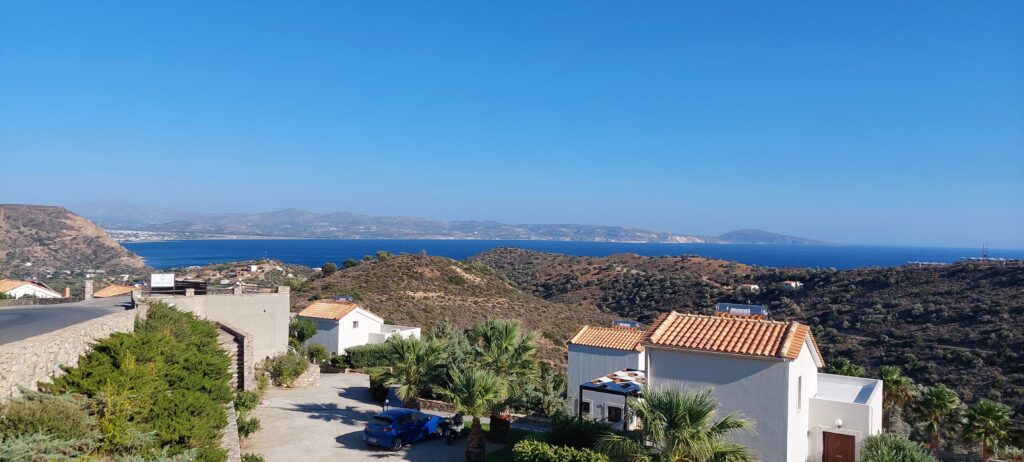
Figure 1. Part of the Lenikos Resort near Agia Galini on Crete, viewed towards the east-southeast. The observation site was located more than 200 meters west of this small complex.
The observations
The first clear night following the full moon of July 29 was:
August 5/6, 2026
A brief observing session in Ermelo under a sky with good transparency. This was due to the moon rising around 21:20 UT. Observations took place between 21:00 and 22:00 UT. A total of 12 meteors were counted, 3 of which were Perseids. The finest meteor was a fast, orange, magnitude -3 sporadic meteor in Boötes, leaving a persistent train lasting 2 seconds and captured with the all sky camera (EN908).
On the afternoon of August 8th, we set off for the CitizenM hotel at Amsterdam Schiphol Airport, as we had an early flight the next day. We arrived in Heraklion on August 9th, quickly sorted out our rental car, and began the 70 km drive to Agia Galini—heading for the coast of southern Crete to escape the busy, mass-tourism north. We stayed at the Lenikos Resort, a small-scale, luxury holiday complex featuring about twenty cottages and apartments. Everything was equipped with good Wi-Fi (essential for managing CAMS at home at Ermelo!) and air conditioning, and there were four swimming pools that we made great use of. They also served fantastic, extensive Greek breakfasts—a must for the hungry visual observer :-).
The resort itself was well-lit, though most of the lights were switched off later in the night. My routine for the evening and night usually went like this: I would go to bed early in the evening, then get up around 1:00 AM local time, walk about 200 meters to my observing spot, and observe for three hours. The only exceptions were the Perseid peak nights of August 11/12 and 12/13, when I observed for about 5 hours. After that, I’d get a few more hours of sleep before breakfast was ready. This made the observing schedule sustainable without leaving me feeling groggy during the day. During the day—whenever holiday activities allowed—I would simply transcribe the data. I saved the tasks of creating tables and uploading them to the IMO website for after I got home. A stockpile of all-sky recordings and CAMS data processing awaited me there, too…
I was able to start observing the very first night after our arrival; that night, I set up my observing spot just 100 meters away from the resort. It was the same location where I had conducted observations in 2017. Although nighttime temperatures on Crete remain well above 20 degrees in august, I wore long trousers, socks, and a long-sleeved T-shirt while observing. I also used mosquito repellent—all necessary measures to ward off attacks by the pesky mosquitoes. Fortunately, this worked very well.
Over the course of several nights, Norwegian observer Kai Gaarder was also active on Crete near the village of Chora Sfakion, located about 60 km west of Agia Galini. We were in regular contact via Messenger to share our findings.
August 9/10, 2026
When I arrive at the observing site, a strong northerly Meltemi wind is blowing (Beaufort 4). The wind gradually subsides after two hours of observing. Even so, the sky clarity isn’t “top-notch.” It is somewhat hazy, especially below an altitude of 10 degrees; consequently, the night lack the exceptional clarity and high transparency of 2017. SQM readings range between 21.23 and 21.39. The limiting magnitude is between 6.4 and 6.5. Nevertheless, the starry sky is quite beautiful, featuring a mottled Milky Way stretching from northeast to southwest. Observations take place between 22:25 and 02:00 UT (01:25 and 05:00 local time), focusing on the southern sky. A hill and some bushes partially obstruct my favorite viewing direction—the northeast—as well as the small amount of lightpollution coming from the resort.
The Perseids are already clearly active, with hourly rates reaching up to 18 meteors, while the Southern Delta Aquariids also contribute 1 to 4 meteors per hour. A total of 107 meteors are spotted over 3.52 hours of actual observing time. See Table 1 for the complete overview. The brightest meteor observed is a magnitude -2 Perseid.
Although the sky isn’t perfectly clear, it is evident that light pollution low in the east has increased. While I could see the zodiacal light reasonably well in 2017, that is no longer the case. However, this also depends, of course, on the amount of moisture and dust in the air. Fortunately, the rest of the sky is nice and dark.
August 10/11, 2026
Once again, a somewhat hazy night at lower altitude. A total of 3.58 hours of effective observation time was logged between 22:45 and 02:20 UT. Quite a few bright Perseids were spotted, reminding me of 1980 and 2008, when many bright Perseids were also seen during the August 10–15 period. I had started observing at 22:45 UT, and eight minutes later, I caught my first Perseid fireball: a magnitude -4 meteor shooting through the “Great Square” of Pegasus. Later that night, at 02:00 and 02:11 UT, two more Perseids—magnitudes -4 and -3, respectively—were observed.
The highlight of the session, however, was an sporadic Earth-grazing fireball that appeared at 00:33 UT. It was a stroke of luck that I saw the fireball almost from the very beginning. I had just spotted a magnitude +2 Perseid and was verifying the radiant’s position, so I was looking toward Perseus. The fireball emerged from behind the hill in the northeast, leaving a long trail that passed Capella and cut through Perseus and Andromeda before fading out near the three stars Beta, Eta, and Mu Pegasi (see Figure 1). The fireball illuminated the surroundings significantly; I estimated its brightness at a minimum of magnitude -6. Its brightest section lay between Alpha Persei and Gamma Andromedae. A broad, long, white-blue persistent train of magnitude 1 lingered, though it rapidly shortened. A segment within Perseus remained visible for longer and clearly drifted in an east-southeast direction. I was able to track it for about 150 seconds! Figure 2 provides an approximate indication of the length of the persistent train after 1 and 5 seconds. The section between Alpha and Theta Persei remained visible for 150 seconds. WOW, what a spectacular event. Kai Gaarder saw the fireball appear low in the east and also estimated it at magnitude -6, with a persistent train lasting nearly 2 minutes.
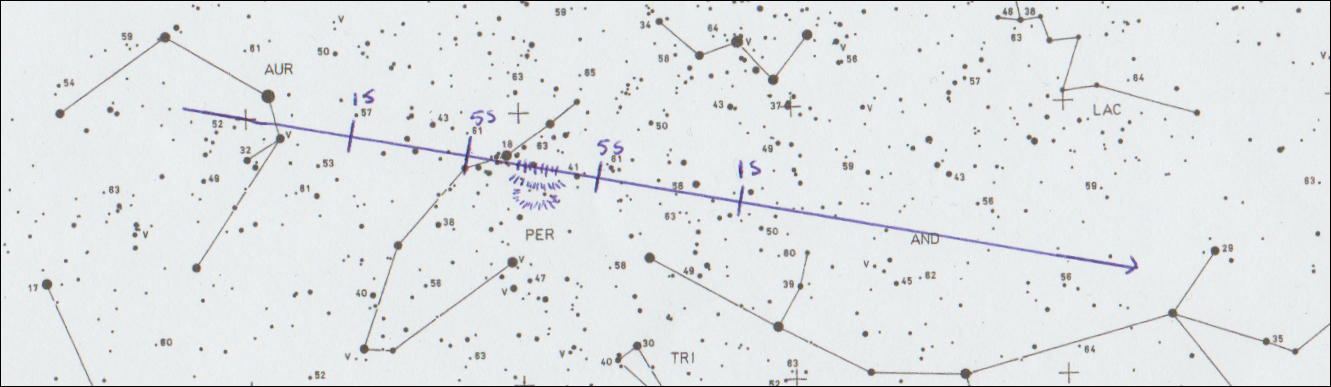
Figure 2. The bright Earth-Grazing Fireball of August 11, 2026, at 00:33 UT. The labels “1 s” and “5 s” indicate the length of the persistent trail after 1 and 5 seconds, respectively. The drawing was made after the session, but it is reasonably accurate thanks to a trajectory passing near bright stars and easily identifiable reference points.
A total of 173 meteors were counted over 3.58 hours; see Table 1. SQM values ranged from 21.30 to 21.39. The limiting magnitude increased from 6.4 to 6.5.
August 11/12, 2026: low activity but a relatively high number of bright meteors
Once again, a somewhat hazy night, though conditions improved—especially at lower altitudes. The limiting magnitude ranged from 6.4 to 6.6. SQM readings fluctuated between 21.08 and 21.41, with a single peak at 21.52. A Beaufort 4 Meltemi was blowing when I started, but it went down after an hour. The low-altitude haze dissipated as the night progressed; this made stars such as Tiaki and Al Nair in the constellation Grus (the Crane)—low in the southern sky—more clearly visible than in previous nights.
Hourly Perseid counts ranged from 20 to 50. This seemed a bit meager for August 11/12. However, this was more than compensated for by a good number of bright Perseids. In addition to nearly 40 meteors with magnitudes between -2 and +1, several fireballs were also observed:
- 22:55 UT: -3 Perseid in Delphinus with a 5-second persistent train.
- 23:36 UT: -5 Perseid moving from Aries to Pisces with a 15-second persistent train.
- 00:56 UT: -4 sporadic fireball in Aquarius with a 1-second persistent train.
- 00:57 UT: -5 Perseid low in the west in Aquila; 12-second persistent train.
- 01:01 UT: -4 Perseid in Perseus/Auriga with a 4-second persistent train.
- 01:35 UT: -3 Perseid in Cetus; 4-second persistent train. 01:48 UT: -4 Perseid in Piscis Austrinus with an 8-second persistent train
- 02:00 UT: Flash! Wow… A very bright -7 to -8 magnitude Perseid lit up almost the entire sky. It moved from Perseus toward Cassiopeia. The persistent train remained visible for 25 seconds.
- 02:08 UT: -3 Perseid in Pegasus with a 2-second persistent train.
All in all, a distinctive observation session: somewhat lower activity, yet a relatively high number of bright meteors.
Incidentally, I’ve decided to look for a different observation site after tonight. This spot was easily accessible in 2017, but perhaps due to heavy rainfall, the ground has become quite loose and covered in small stones. I took a nasty fall while leaving the site, resulting in two scraped knees and a torn pair of trousers.
August 12/13, 2026: filament active?
During the day, I walked along the path again to find a better observation spot. Overall, the path had deteriorated significantly since 2017. On the positive side, however, the two houses that were previously occupied—complete with free-roaming, barking dogs back in 2017—were now abandoned. This allowed me to walk further along the path undisturbed. Unfortunately, a lot of trash gets dumped along roadsides in Greece; a bit further along, for instance, a tub of leftover concrete had been tipped out next to the path. Fortunately, the surface had been smoothed over. It was an ideal spot to set up a sleeping mat and observe. Given the poor condition of the path, I didn’t expect any traffic.
I decided to look towards the south from this location, though I noticed the view to the northeast wasn’t bad either. That night, I brought along my Sony Alpha A7 SII with the Sigma 20mm f/1.4 super-wide-angle lens. Although the camera didn’t run flawlessly, it still managed to capture 42 meteors.
When I started at 20:55 UT (just before midnight local time), the sky background was still somewhat bright, but it improved quickly. The SQM reading rose from 21.10 to 21.45, and the limiting magnitude improved from 6.4 to nearly 6.6. The first hour revealed a number of bright Perseids: magnitudes -2, -3, and a -5. The last one appeared in Aquarius at 21:26 UT and left a persistent train visible for 15 seconds. After that, the rate of bright Perseids dropped off noticeably, although overall activity remained good, with numbers trending upwards. Quarter-hourly counts ranged from 9 to 16 Perseids. Activity dipped slightly after 00:00 UT but then increased sharply and quite rapidly after 00:30 UT. I noticed this while in the field, but upon processing the data, it became clear that the numbers were higher than I had anticipated. Quarter-hourly counts were between 20 and 25. The number of bright meteors also increased, though there were no fireballs; most fell within the -3 to +1 magnitude range. This surge in activity aligns with Peter Jennisken’s prediction regarding the filament expected to pass Earth on August 13 around 01:00 UT (± 5 hours) [2]. Ofcourse this must be confirmed by data from other European observers. Incidentally, I changed my viewing direction after 01:08 UT, shifting to the north-northeast. That remained the case for all the nights that followed.
While walking the 200 meters back to our rented apartment around 00:40 UT, I saw a bright flash, even though the sky was already beginning to brighten (Lm ~4.0). It was possibly a bright fireball. I immediately scanned the sky for a persistent train but found none. I also checked for thunderstorms on the weatherapp, but there was no active storm activity within a radius of at least 200 km.
All in all, it was a fantastic observing session! A total of 363 meteors were counted.
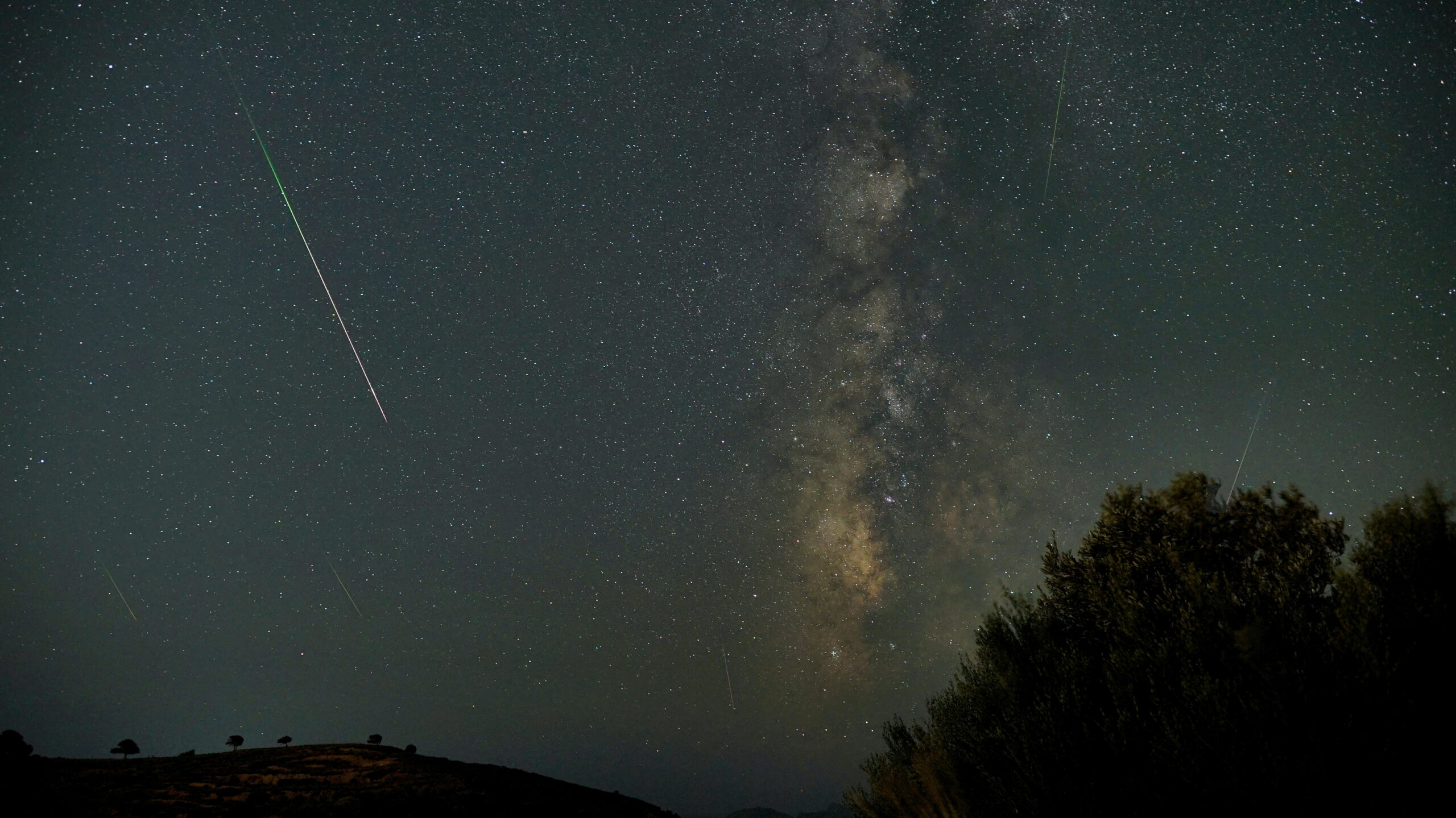
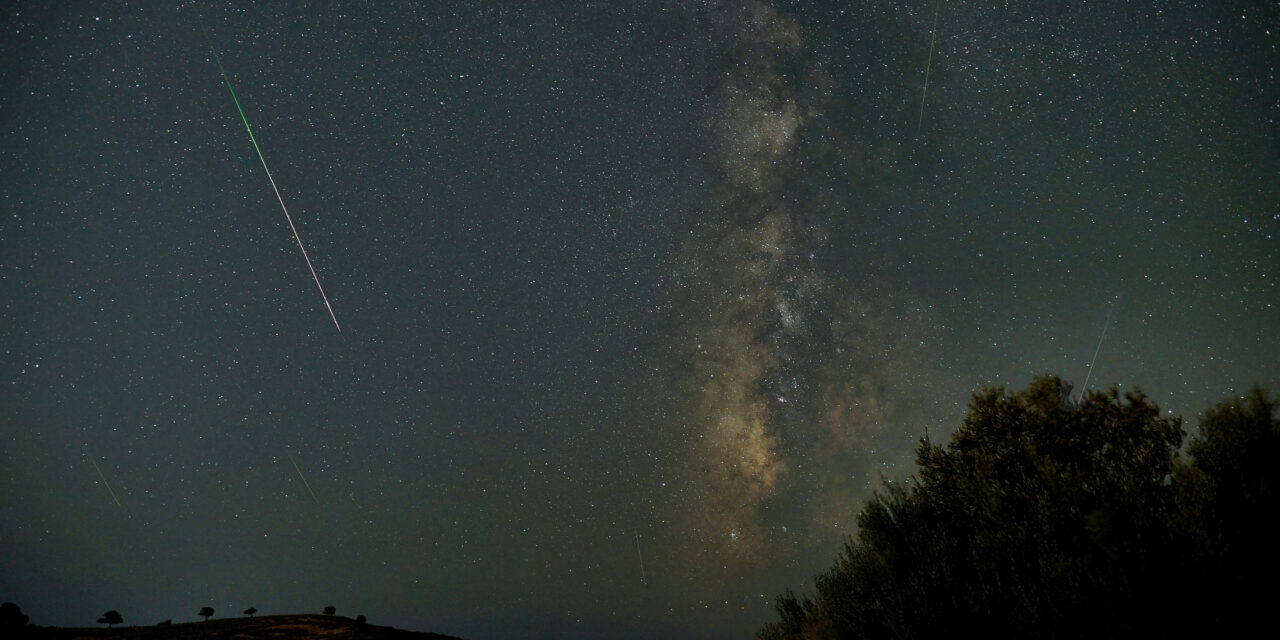
Figure 3. 12 August 2026, around 22:00 UT. Composite image of multiple Perseids near the southern Milky Way. The effect of the anti-radiant is clearly visible.
Camera: Sony Alpha A7 with a Sigma 20mm f/1.4 wide-angle lens. Camera settings: ISO 1600, f/1.8, and 20-second exposure.
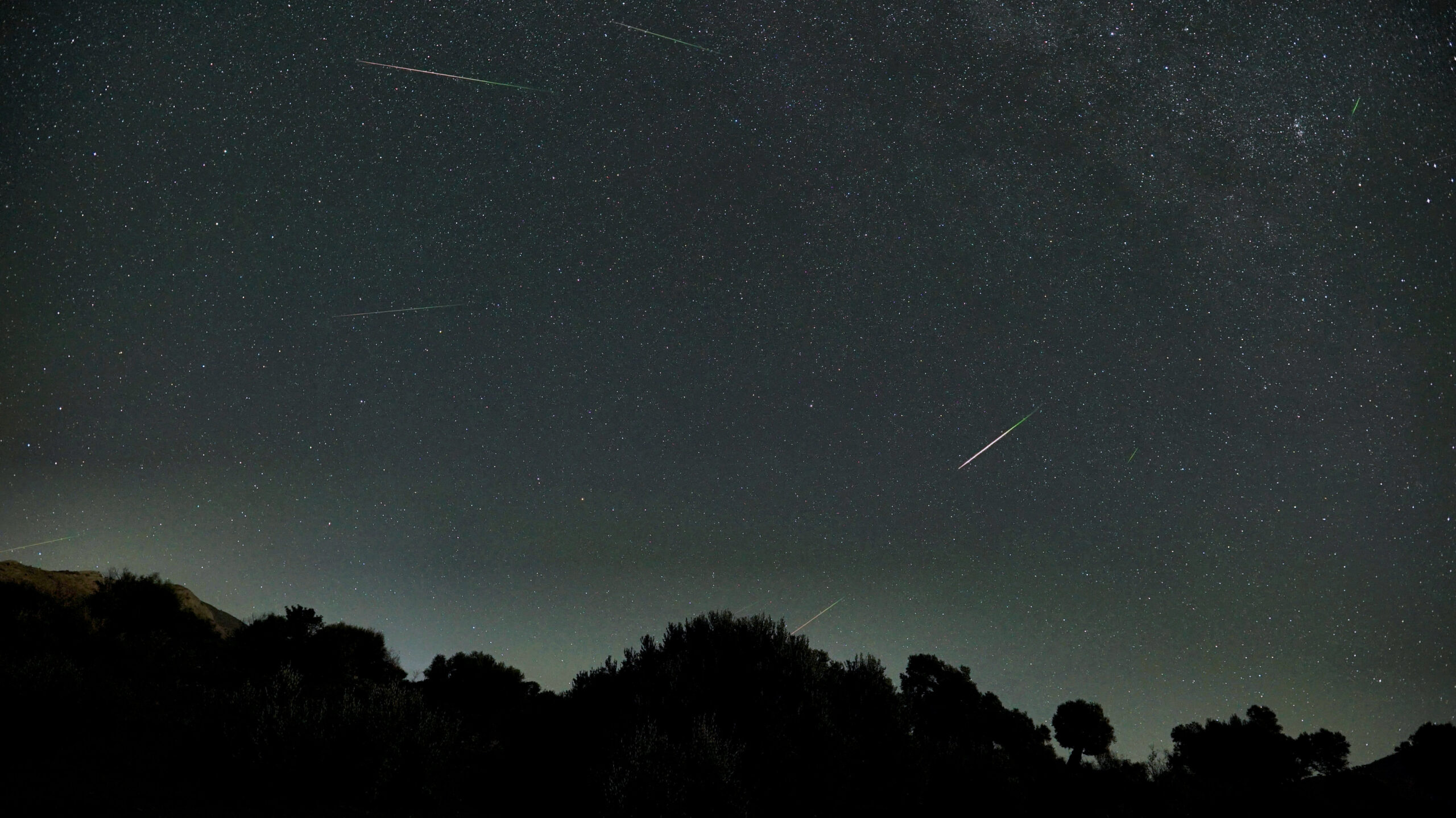
Figure 4. 13 August 2026, around 01:00 UT. Composite image of 8 Perseids, the brightest of which was estimated at magnitude -3.
Camera: Sony Alpha A7 with a Sigma 20mm f/1.4 wide-angle lens. Camera settings: ISO 1600, f/1.8, and a 20-second exposure.
August 13/14, 2026
A strong south-westerly wind picked up during the day. Haze increased significantly, and later, cumulus clouds drifted inland. Cloud cover increased further towards the evening. I set an alarm anyway, recalling the 2018–2022 period when the Perseids displayed (sometimes major) outbursts on this night. However, when the alarm went off, it was still largely cloudy. By morning, the sky had cleared, and the haze had vanished.
August 14/15, 2026
Starting tonight, I returned to shorter sessions following the nights of peak activity. I started with a strong north-westerly Meltemi wind, estimated at Force 5. The transparency of the starry sky was excellent, though the limiting magnitude lagged slightly behind. SQM readings also peaked at only 21.42. The sky background was somewhat light, suggesting the presence of a moist layer somewhere. As expected, Perseid activity was on the decline, with hourly counts ranging from 12 to 24 meteors. There were few bright meteors—unlike in 1980 and 2008—with only one Perseid of magnitude -3 observed.
I logged 3.68 hours of effective observation time, yielding 136 meteors, 73 of which were Perseids. The Capricornids were barely active by this point; I spotted just one. The Kappa Cygnids showed little activity as well—we are in a quiet year. The SDAs, however, remained active, with 5 meteors observed.
August 15/16, 2026
This night also started with a strong Meltemi wind: starting at Bf 5, but it quickly intensifies to Bf 7 or 8. It is blowing so hard that I strap the backpack containing my observing gear to my arm to prevent it from blowing down into the valley. After an hour, things gradually calm down, and by the end of the session, only a light breeze remains. The temperature is also lower than on previous nights, settling at 20 degrees Celsius by the end.
The sky background is now truly dark, resembling the dark skies of 2017 for the first time. Limiting magnitudes range between 6.6 and 6.7, and SQM readings are higher than on previous nights, between 21.45 and 21.55. Occasionally, tiny clouds form, only to be blown away and dissipate quickly.
I observe for just over three hours, counting 107 meteors. The Perseids show hourly rates of between 12 and 18. The SDAs are somewhat more prominent now, with eight of them spotted. The brightest meteors are two Perseids with magnitudes of -2 and -4. At 01:45 UT, I see a bright satellite moving past the bright stars Castor and Pollux. I suspect it is the ISS, though it appears slightly fainter than usual. A quick check in Stellarium afterwarts reveals it to be the Chinese Tiangong space station. It is great to have seen that.
August 16/17, 2026
This turned out to be the clearest night—along with the following one. Limiting magnitude reached 6.7 and SQM readings up to 21.55. Over three hours of observing yielded 88 meteors, 37 of which were Perseids. Hourly Perseid counts ranged from 9 to 15. During this night, I also spotted my last Capricornid of the year—and what a spectacular one it was! A beautiful magnitude 0 meteor traced a long path from Sagitta toward Draco, moving almost parallel to the horizon and showing slight fragmentation. I also caught a glimpse of a magnitude -4 Perseid out of the corner of my eye near the eastern horizon. I initially thought it was a Perseid, but that turned out to be incorrect; the persistent train pointed toward Capella, so I reclassified it as a sporadic meteor. The first Aurigid of the season was also spotted that night. At 02:10 UT, another bright satellite appeared; this time, it was indeed the ISS.
August 17/18, 2026
This night observations were conducted for exactly three hours under excellent sky conditions once again. A notable feature was a persistent, light NW breeze throughout the night that carried the smell of smoke; indeed, the wind was blowing from the area affected by wildfires. Interestingly, there was no smell of smoke during stronger NW winds, but it was present when the wind was slow. The three-hour session yielded 78 meteors, including 29 Perseids, with hourly counts of 12, 6, and 11 meteors respectively. A greenish, late-appearing magnitude -2 SDA was the finest meteor of the night.
August 18/19, 2026
Weather conditions mirrored those of August 13/14. In the evening, the sky became very hazy and very humid, so no observations were made. The next day the sky was clear again with no haze.
August 19/20, 2026
Another three-hour session resulted in 67 meteors, 20 of which were Perseids. The brightest meteor was a magnitude -2 Perseid. Once again, there was a gentle NW breeze carrying the same smell of smoke. Another interesting fact from this night: it marked the 1400th night of visual observations since April 1980…
August 20/21, 2026
The final night from Agia Galini! Observations were again carried out for three hours, resulting in 50 meteors, 16 of which were Perseids. There were almost no spectacular meteors, with the exception of a very fine magnitude -3 sporadic meteor. This fast-moving meteor displayed rapid, very short successive flares and left a persistent train lasting 5 seconds. Despite SQM readings of 21.50, the limiting magnitude lagged slightly at 6.6.
August 23/24, 2026
For the first few nights after returning home, the moon did not yet interfere observations at night. This allowed for three hours of observation during the night August 23/24. A chance to get used to the light-polluted Dutch sky and to catch the last of the Perseids. Sky transparency was very good, though the conditions were very humid. The temperature dropped from 9 to 5 degrees Celsius. The maximum SQM reading was 20.32, and the limiting magnitude was 6.3. A total of 36 meteors were spotted, including 5 Perseids.
August 24/25, 2026
The final night of August, and thus the last Perseids of 2026. Once again, transparency was good. Over two hours of effective observation, 20 meteors were seen, including (the final) three Perseids. Table 1. Overview of the authors observations
Summary
All in all, a highly successful campaign: a total of over 42 hours of observation took place in August, yielding 1,490 meteors. Notable highlights included the sporadic fireball on August 11 at 00:33 UT; the somewhat low Perseid activity on the night of August 11/12, combined with a high number of bright Perseids; and the sudden burst of activity on August 13 after 00:32 UT. This last event might have been caused by the Perseid filament—or was it perhaps the annual peak? Analysis of data from other observers may provide the answer.
References
[1] Koen Miskotte, July observations: the first Perseids, eMN
[2] Peter Jenniskens, Meteor Showers and their Parent Comets, Cambridge University Press, 2006