By Paul Roggemans, Denis Vida, Damir Šegon, Milan Kalina, James M. Scott, Jeff Wood
Abstract: A distinct concentration of radiants detected by GMN occurred on 3rd – 4th March 2026 from a source at R.A. 217° and decl. +25° with a geocentric velocity of 49.5 km/s. The activity has been identified as the 26-Bootids (TSB#571), a long-period comet type meteoroid stream. This shower has been recorded by GMN in the previous years and this case study confirms that this annual meteor shower fulfils the criteria in order to be nominated for established status by the IAU-MDC.
1 Introduction
The radiant density map for the 3rd and 4th March 2025 showed a bright spot caused by the 26-Bootids (Figure 1). The activity lasted from λʘ = 340° until λʘ = 345°. The shower is listed in the GMN meteor shower reference list and has been recently nominated to be established in the IAU-MDC Working List of Meteor Showers. The shower was discovered by Andreić et al. (2014) and later confirmed by Shiba (2023) and (Jenniskens, 2023). The activity has been well observed by the Global Meteor Network and justified a dedicated case study. The best coverage by GMN for this shower occurred in 2025 and 2026.
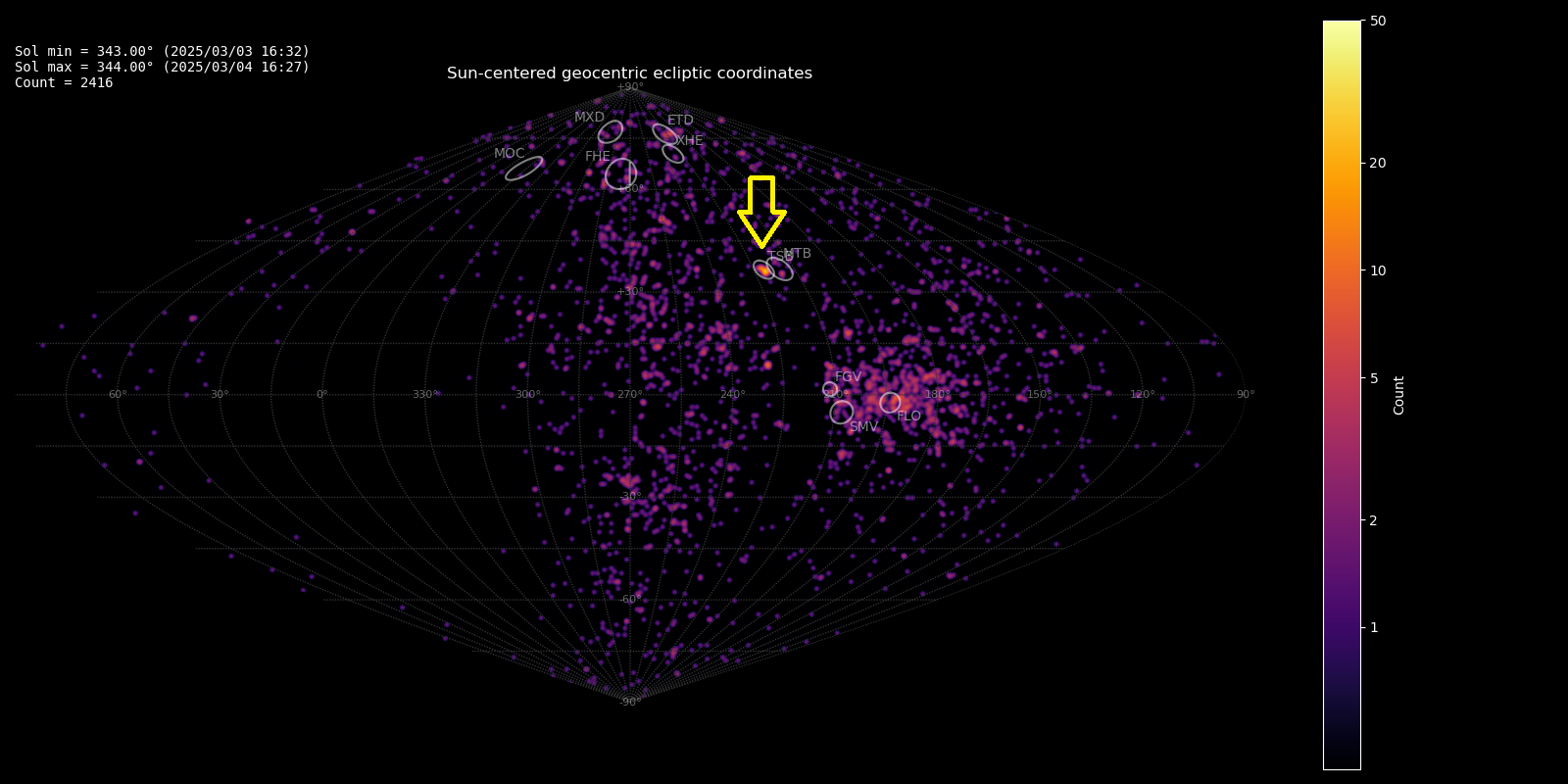
Figure 1 – Radiant density map with 2416 radiants obtained by the Global Meteor Network during the 3rd – 4th March, 2025. The position of the 26-Bootids in Sun-centered geocentric ecliptic coordinates is marked with a yellow arrow.
2 Shower classification based on radiants
The GMN shower association criteria assume that meteors within 1° in solar longitude, within 1.8° in radiant in this case, and within 10% in geocentric velocity of a shower reference location are members of that shower. Further details about the shower association are explained in Moorhead et al. (2020). Using the 2025 data, initially 102 possible shower members were selected and after removal of outliers, 72 members remained for final analysis. 169 GMN-cameras in 23 countries (Austria, Australia, Belgium, Bulgaria, Brazil, Canada, Croatia, Czech Republic, Finland, France, Germany, Hungary, Ireland, Italy, Netherlands, New Zealand, Poland, Romania, Russia, Slovenia, Slovakia, United Kingdom and the United States) contributed data for this dataset in 2025. The shower parameters as obtained by the radiant method for 2025 are listed in Table 1 and compared to the results for 2026.
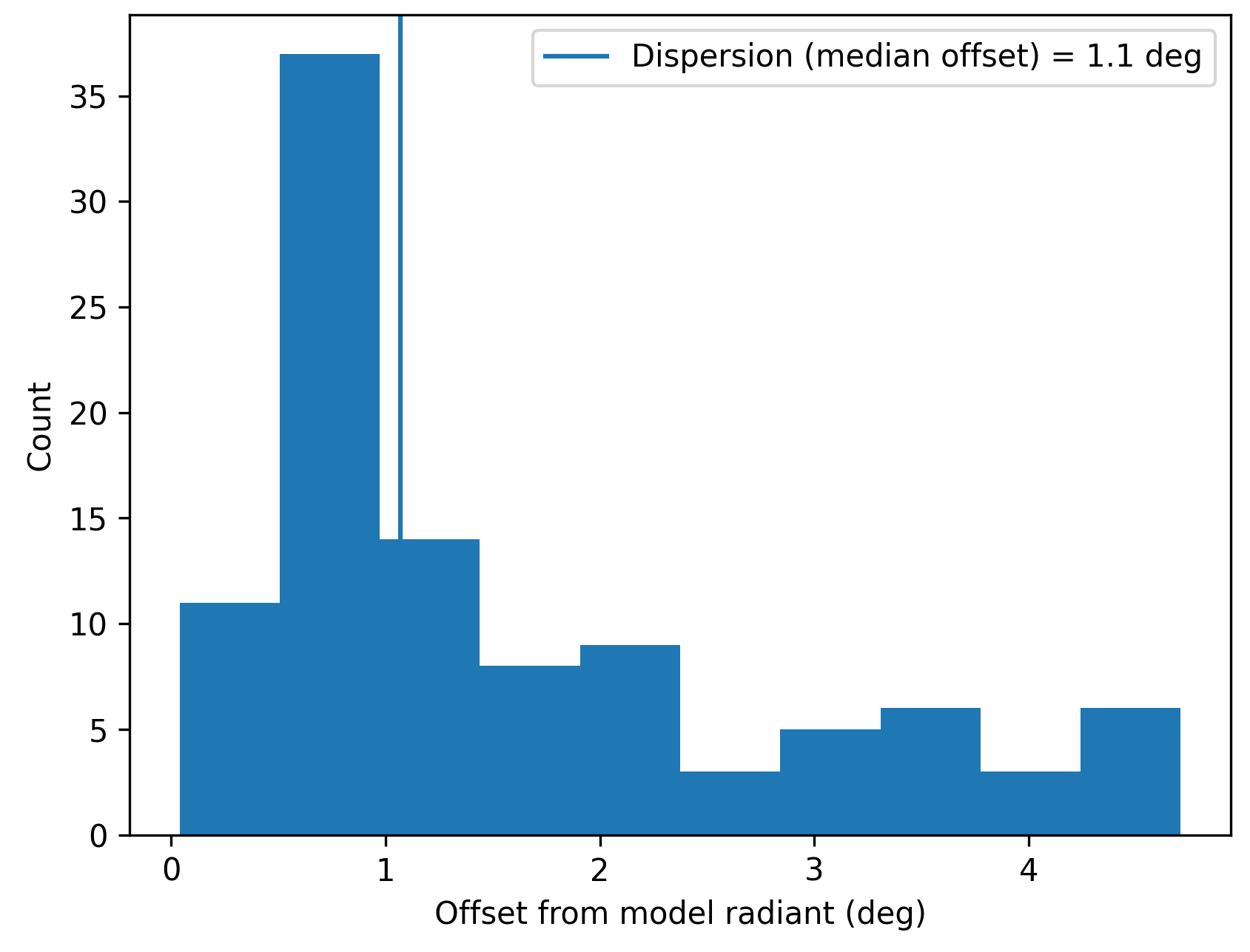
Figure 2 – Dispersion median offset on the radiant position.
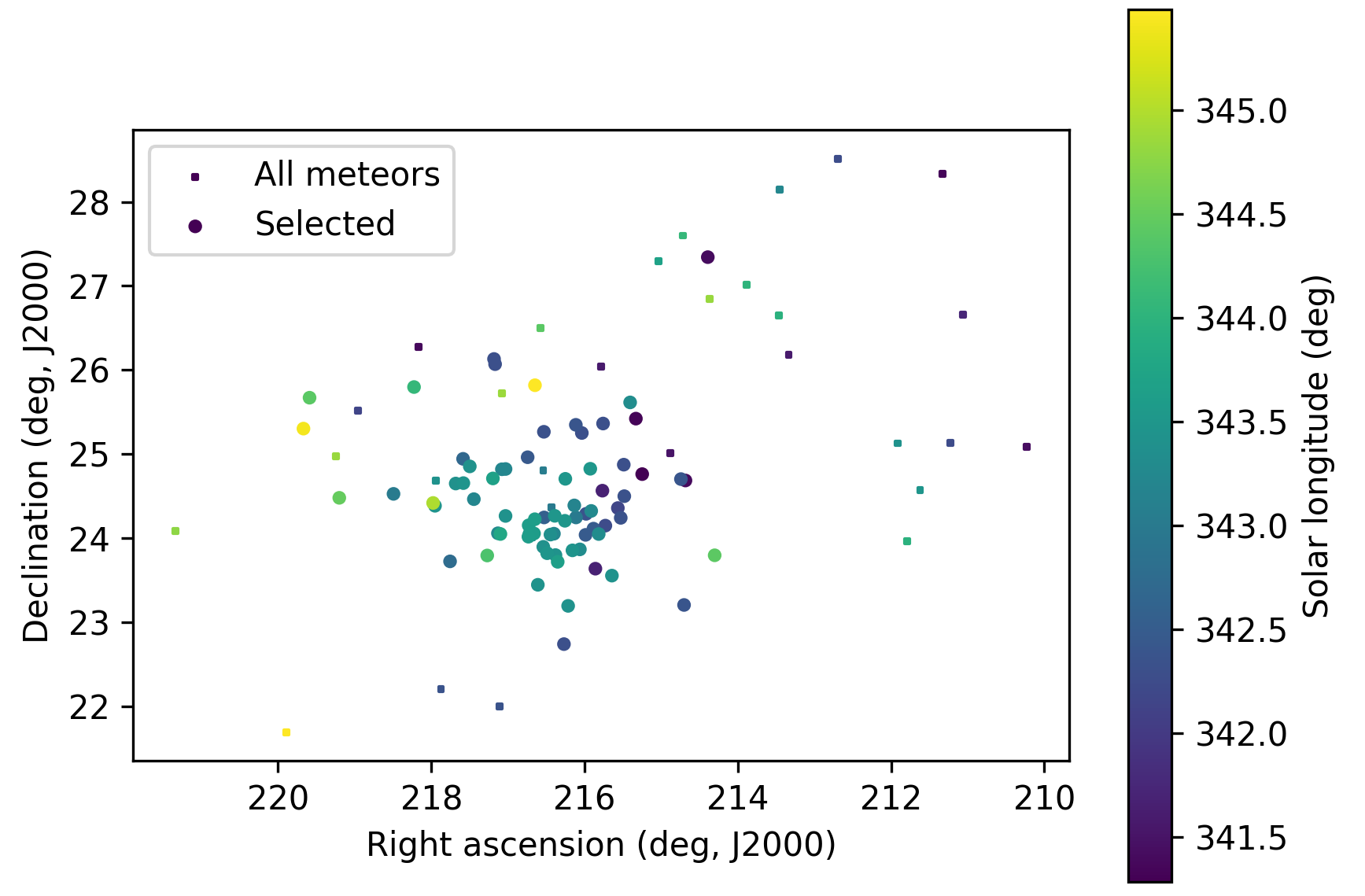
Figure 3 – The radiant distribution in 2025 during the solar-longitude interval 341.2° – 345.5° in equatorial coordinates.
Figure 3 shows a distinct concentration of 26-Bootid radiants. This can also be illustrated when the shower meteors are plotted as grey diamonds and the sporadic background appears randomly distributed in Figure 5, compared to the shower meteors plotted as a cluster with the sporadics as grey diamonds in the background (Figure 6). In geocentric Sun-centered ecliptic coordinates the compactness of the radiant is even more striking (Figure 7). It should be noted that the radiant shower association method results in a short activity interval in solar longitude between 341.2° and 346.5° with best activity around λʘ = 343.3°. This activity duration is shorter than given by other researchers (Shiba, 2023; Jenniskens, 2023).
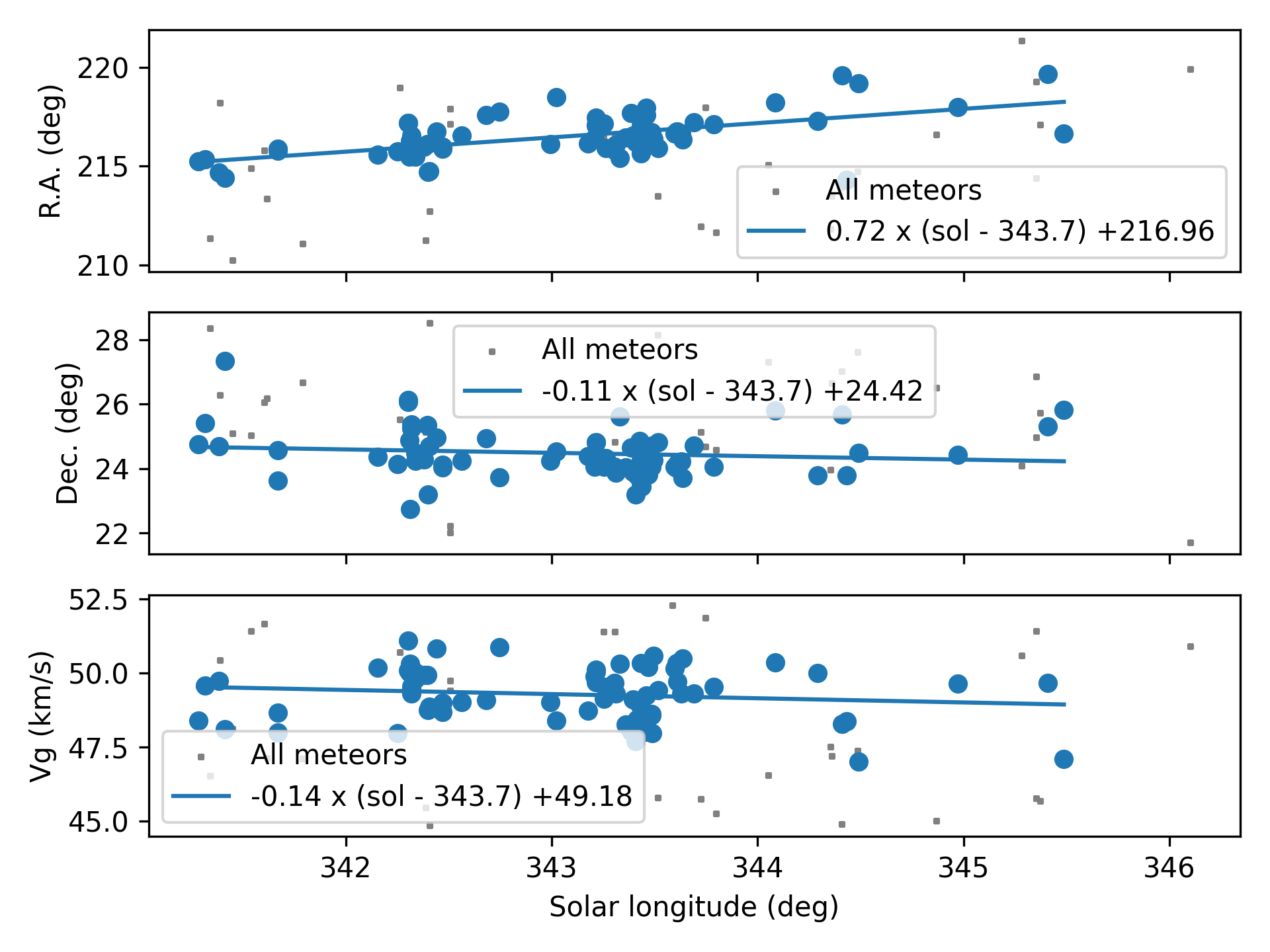
Figure 4 – The radiant drift.
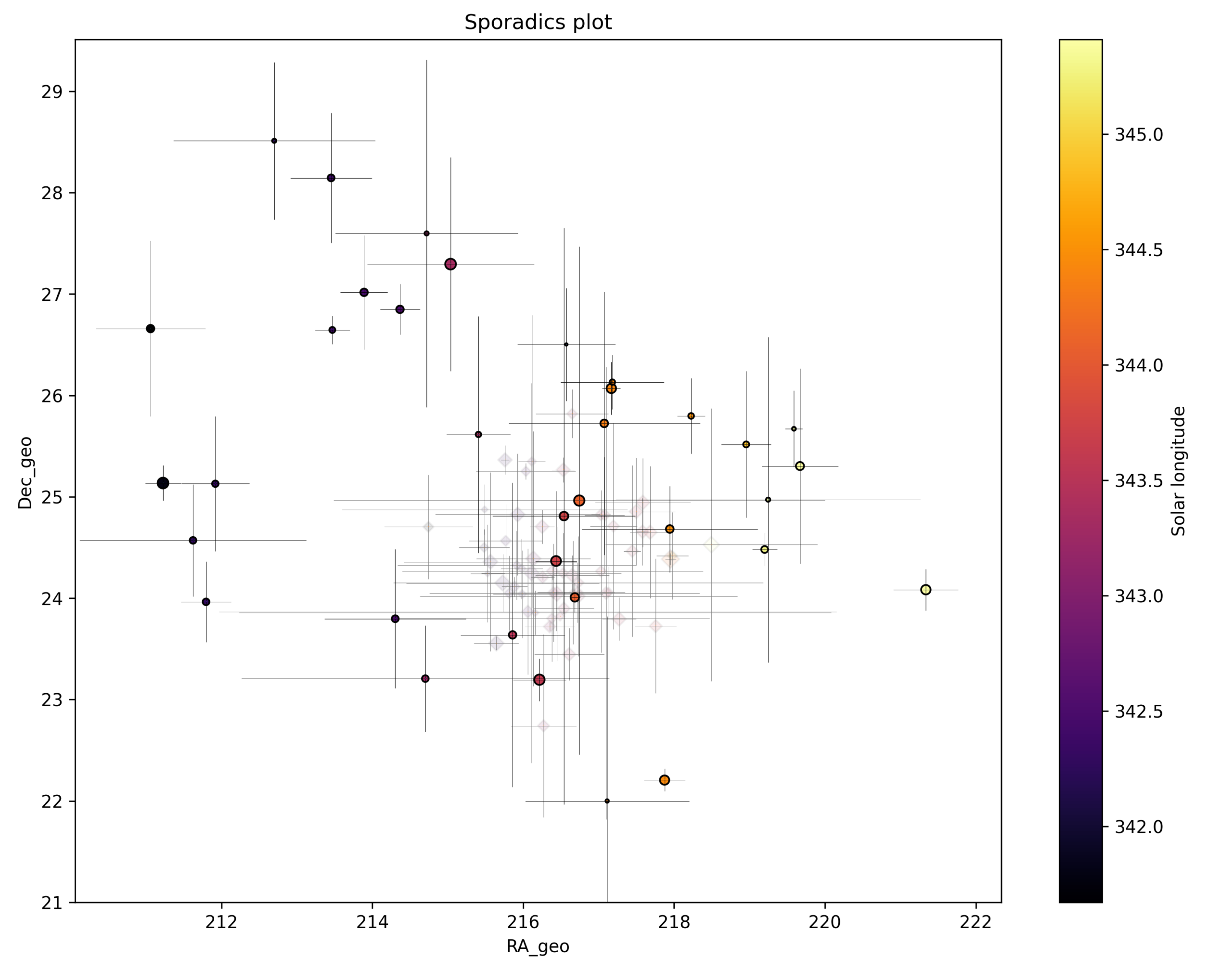
Figure 5 – The sporadic radiant distribution in 2025 during the solar-longitude interval 341.2° – 345.5° in equatorial coordinates with the 26-Booitds as grey diamonds.
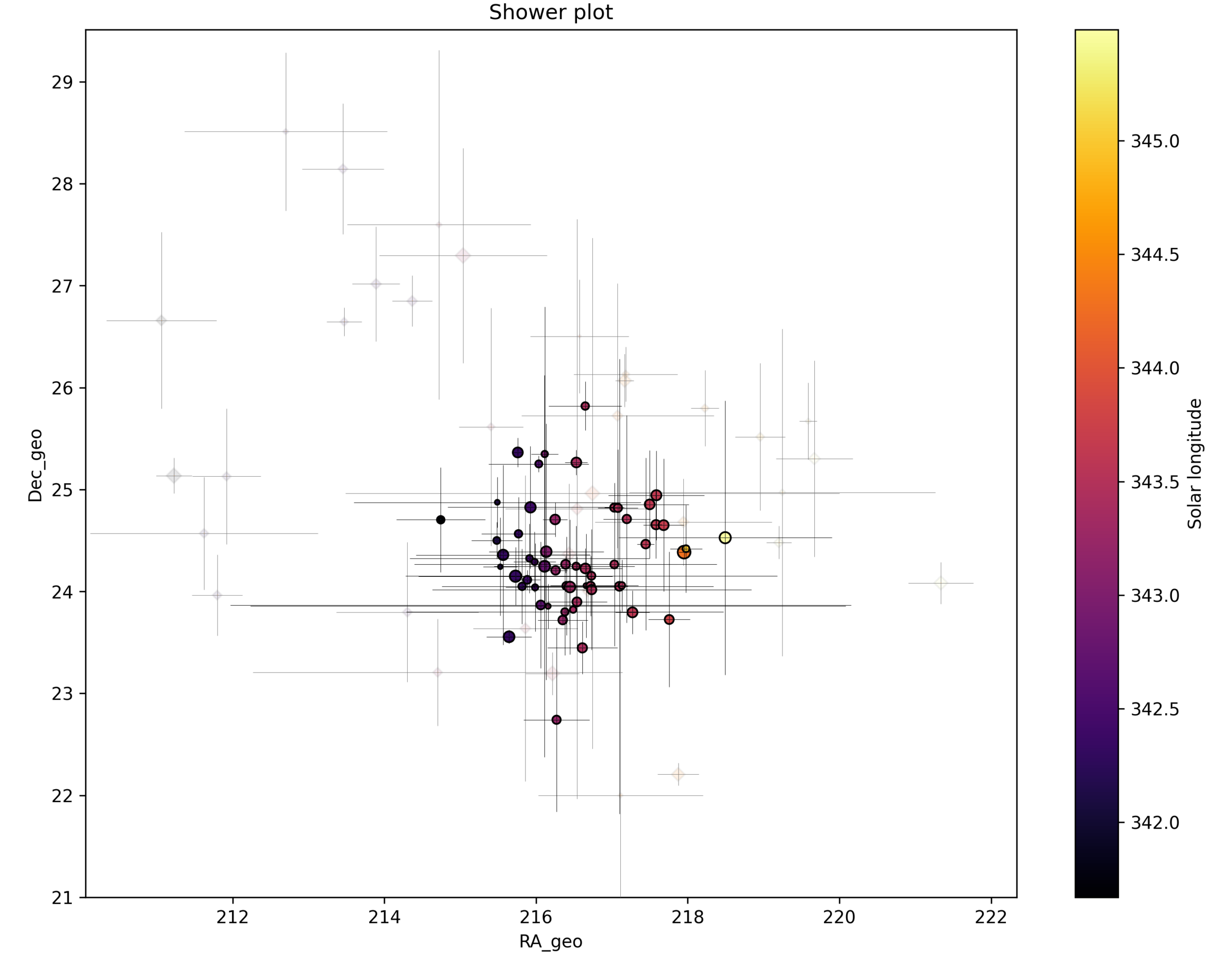
Figure 6 – The 26-Bootids radiant distribution in 2025 during the solar-longitude interval 341.2° – 345.5° in equatorial coordinates with the sporadic background as grey diamonds.
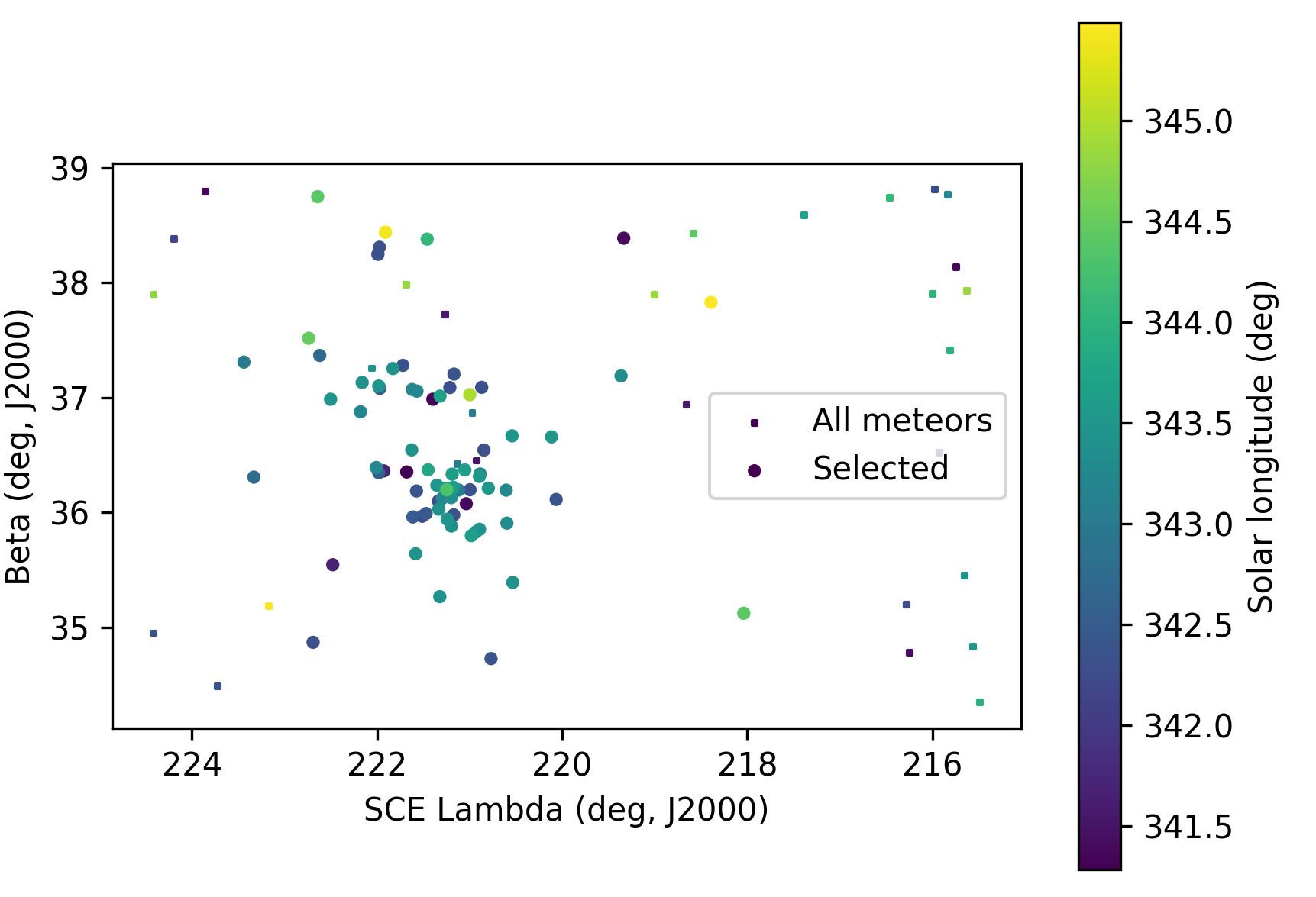
Figure 7 – The radiant distribution during the solar-longitude interval 341.2° – 345.5° in Sun centered geocentric ecliptic coordinates.
3 Shower classification based on orbits
A complete independent meteoroid stream search has been applied to orbit data obtained between solar longitude 337° and 348° during the years 2019–2026. The method has been described in detail in a separate publication (Roggemans et al., 2026a). 74549 orbits were available within this time interval and a final mean orbit has been computed by the method of Jopek et al. (2006) for the thresholds DSH < 0.125 and DD < 0.05 and DJ < 0.125 (Southworth and Hawkins, 1963; Drummond, 1981; Jopek, 1993), based upon the Rayleigh fit in Figure 8. The resulting mean orbit based upon 207 meteors recorded from 2019 until 2026 is listed in Table 1.
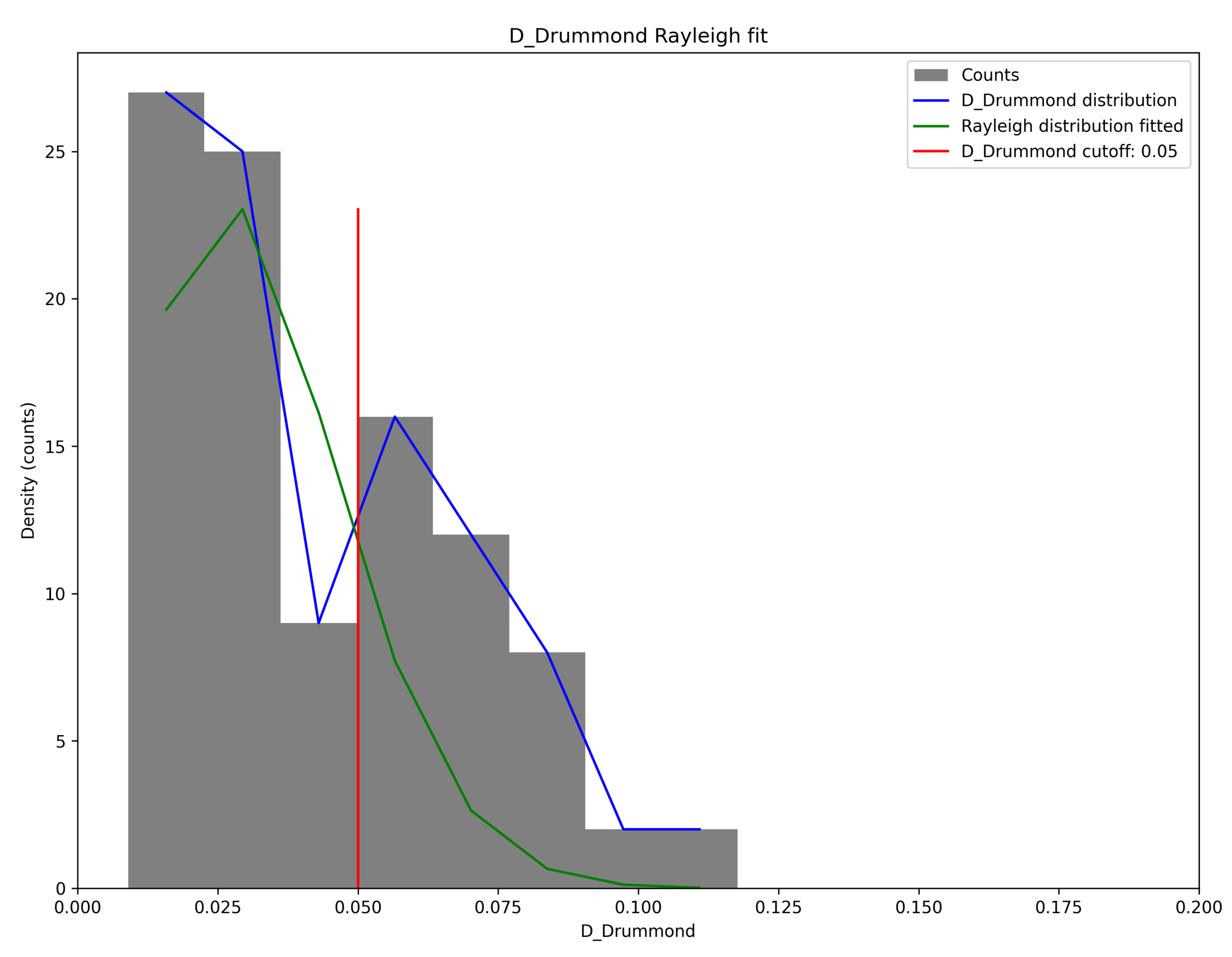
Figure 8 – Rayleigh fit on the Drummond criterion for 26-Bootids. The 2025 data result in a cutoff value of DD = 0.05.
The radiant is very compact in geocentric equatorial coordinates (Figure 9). The more dispersed cloud of sporadics at slightly higher declination right of the 26-Bootids are the March 12-Bootids (MTB#859). The compactness of the radiant is very distinct in the geocentric Sun-centered ecliptic coordinates (Figure 10). The dark cluster just right from the 26-Bootids are the March 12-Bootids which have their maximum a couple of days later than the 26-Bootids and have a similar orbit apart from a 10° lower inclination. Both showers are very likely related.
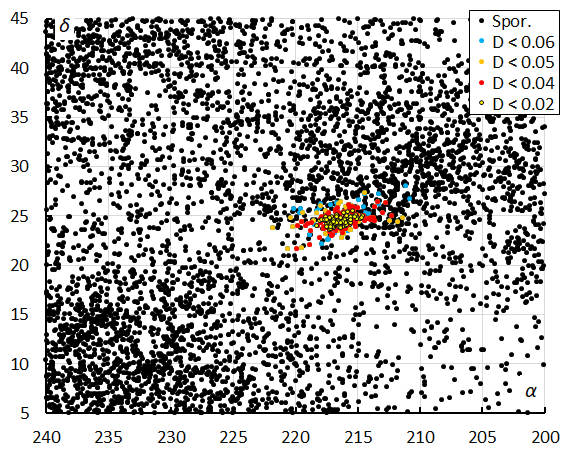
Figure 9 – The radiant distribution during the solar-longitude interval 337° – 348° in equatorial coordinates, color-coded for different threshold values of the combined similarity criteria.
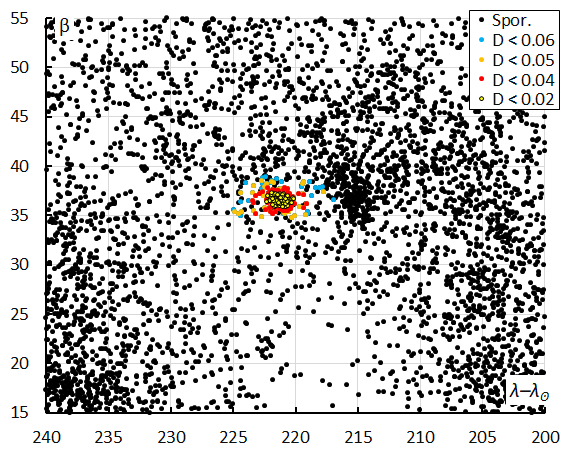
Figure 10 – The radiant distribution during the solar-longitude interval 337° – 348° in Sun-centered geocentric ecliptic coordinates, color-coded for different threshold values of the combined similarity criteria.
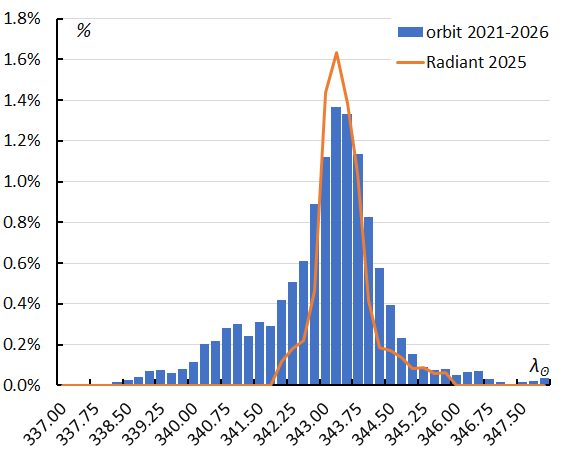
Figure 11 – The percentage of shower meteors relative to the total number of meteors recorded in 2019–2026.
The number of shower meteors as a percentage relative to the total number of meteors recorded in a 24 hours interval results in the profile plotted in Figure 11. Best rates occurred at λʘ = 343.25 ± 0.5° and the total activity duration spanned a 5 days interval from λʘ = 340° until λʘ = 345°. This is very well visible in the radiant density maps (Figure 12) where almost no 26-Bootids activity is visible after λʘ = 344° when the March 12-Bootids (MTB in Figure 12) becomes stronger. Other possible shower members outside this activity interval are most likely sporadic meteors that fit the similarity criteria by chance. The results obtained by the radiant based classification method for 2025 and 2026 and the orbit method for 2019–2026 are in good agreement.
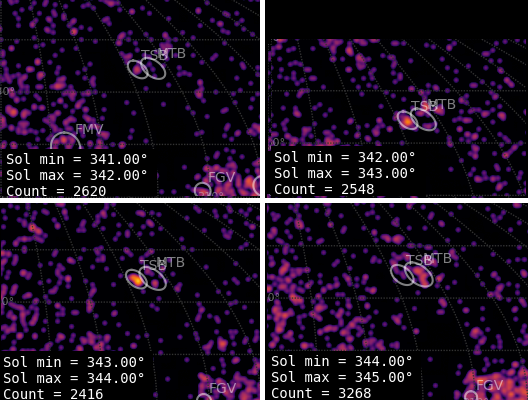
Figure 12 – The radiant density maps show clear activity of the 26-Bootids for a few nights.
4 Orbit and parent body
The diagram of the inclination i versus the longitude of perihelion Π shows a clear concentration (Figure 13). The diffuse cloud at 72° inclination are the March 12-Bootids. The eccentricity e versus the longitude of perihelion Π also appears concentrated in e versus Π (Figure 14), e versus i (Figure 15), q versus i (Figure 16) and q versus e
(Figure 17). Note that the March 12-Bootids only differ about 10° in inclination, best visible in Figure 16 as the other orbital elements overlap for both showers with the March 12-Bootids being more scattered.
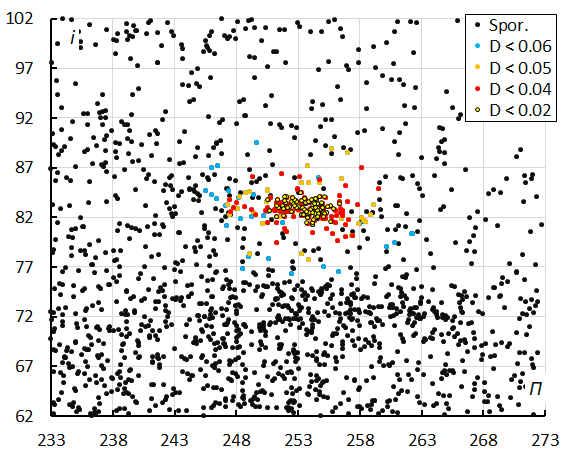
Figure 13 – Inclination i versus the longitude of perihelion Π color-coded for different classes of D-criteria thresholds, for λʘ between 337° – 348°. Spor. = sporadics.
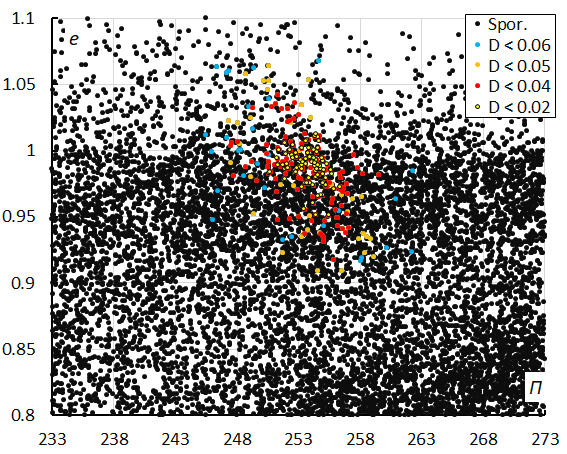
Figure 14 – Eccentricity e versus the longitude of perihelion Π color-coded for different classes of D-criteria thresholds, for λʘ between 337° – 348°. Spor. = sporadics.
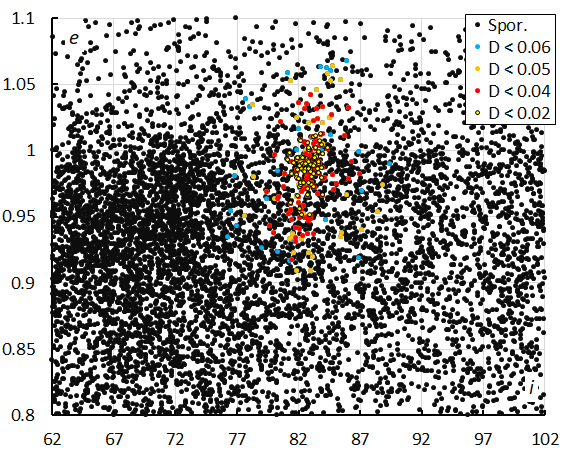
Figure 15 – Eccentricity e versus the inclination i color-coded for different classes of D-criteria thresholds, for λʘ between 337° – 348°. Spor. = sporadics.
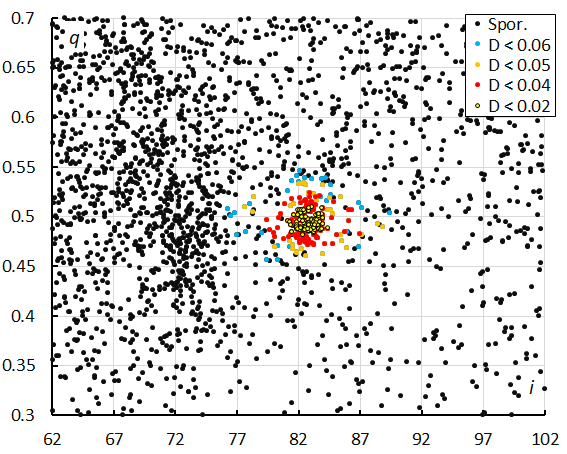
Figure 16 – Perihelion distance q versus the inclination i color-coded for different classes of D-criteria thresholds, for λʘ between 337° – 348°. Spor. = sporadics.
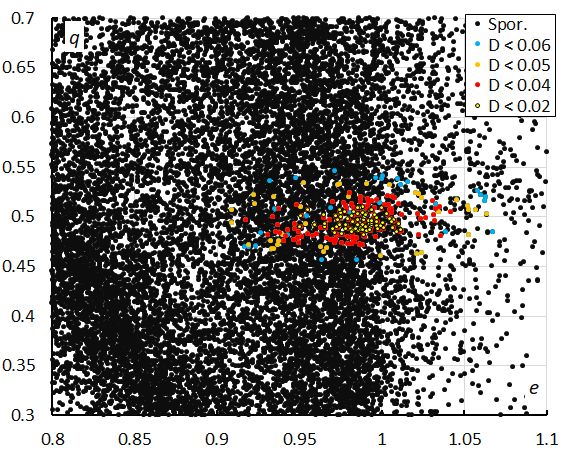
Figure 17 – Perihelion distance q versus the eccentricity e color-coded for different classes of D-criteria thresholds, for λʘ between 337° – 348°. Spor. = sporadics.
Table 1 – Comparing solutions derived by two different methods, GMN-method based on radiant positions for 2025 and 2026, and the orbit association method for DD < 0.05 for 2019–2026.
| Radiant method 2025 | Radiant method 2026 | Orbit method 2019–2026 DD < 0.05 | |
| λʘ (°) | 343.3 | 343.5 | 343.3 |
| λʘb (°) | 341.2 | 341.1 | 338.7 |
| λʘe (°) | 345.5 | 345.2 | 348.0 |
| αg (°) | 217.0 | 216.7 | 216.4 |
| δg (°) | +24.4 | +24.5 | +24.5 |
| Δαg (°) | 0.72 | 0.67 | 0.85 |
| Δδg (°) | –0.11 | –0.31 | –0.26 |
| vg (km/s) | 49.2 | 49.5 | 49.7 |
| Hb (km) | 106.3 | 105.9 | 106.7 |
| He (km) | 92.6 | 90.6 | 91.3 |
| Hp (km) | 98.2 | 96.3 | 97.2 |
| MagAp | –0.8 | –1.0 | –0.8 |
| λg (°) | 204.5 | 204.6 | 204.5 |
| λg – λʘ (°) | 221.2 | 221.1 | 221.2 |
| βg (°) | +36.7 | +36.7 | +36.4 |
| a (A.U.) | 16.1 | 24.7 | 28.6 |
| q (A.U.) | 0.493 | 0.496 | 0.494 |
| e | 0.969 | 0.980 | 0.983 |
| i (°) | 82.4 | 82.4 | 82.9 |
| ω (°) | 271.2 | 270.5 | 270.6 |
| Ω (°) | 343.1 | 343.4 | 343.0 |
| Π (°) | 254.3 | 253.9 | 253.6 |
| Tj | 0.44 | 0.33 | 0.29 |
| N | 72 | 44 | 207 |
With a Tisserand value relative to Jupiter of 0.30, this shower has a long period comet type orbit. The inclination of ~83° is almost perpendicular to the ecliptic plane
(Figure 18). With an eccentricity close to the hyperbolic limit, the slightest observational or instrumental uncertainty on the velocity results in a huge difference in aphelion, which reaches far beyond the distance of Neptune to the Sun.
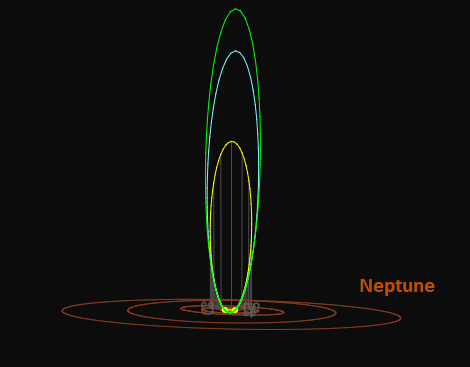
Figure 18 – Comparing the radiant determined 26-Bootids solution for 2025 (yellow), for 2026 (blue) and the orbit determined solution for 2019–2026 (green). (Plotted with the Orbit visualization app provided by Pető Zsolt).
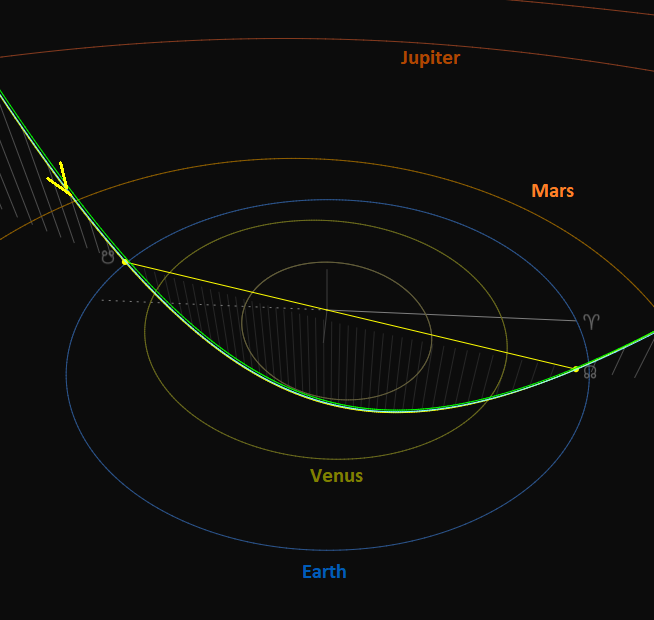
Figure 19 – Close-up in the inner Solar system with the solutions for 2025 (yellow), 2026 (blue) and the orbit determined solution for 2019–2026 (green). (Plotted with the Orbit visualization app provided by Pető Zsolt).
Looking at the orbit solutions within the inner Solar system (Figure 19), no difference can be seen in the plotted version of the three solutions. The 26-Bootids encounter the Earth at the descending node. Its ascending node is within the Earth orbit and relatively close to the Earth orbit. In principle this could produce another meteor shower and the orbit shower classification method can detect such orbits. Using the 26-Bootids orbit as a reference we find such orbits between 6 and 8 September from a radiant near
R.A. = 116° and Decl. = –15°. There is no such shower known in the IAU-MDC Working List of Meteor Showers.
A search for candidate parent bodies did not yield any convincing similarity in orbit. Jenniskens (2023) suggests C/868 B1 as a vague resemblance but that orbit is uncertain due to poor observations. Our search results in two other slightly better resembling orbits but even here the Drummond criterion with DD = 0.15 is too poor to associate both orbits. The shower may be related to a long period comet that hasn’t yet been discovered.
Table 2 – Top ten matches of a search for possible parent bodies with DD < 0.30, based upon the mean orbit derived from the radiant classification method.
| Name | DD |
| C/-146 P1 | 0.15 |
| C/1914 S1 (Campbell) | 0.20 |
| C/868 B1 | 0.20 |
| 2020 QH4 | 0.23 |
| 2005 BW1 | 0.26 |
| 2020 CY1 | 0.26 |
| C/2000 S5 | 0.27 |
| C/1952 W1 (Mrkos) | 0.27 |
| C/2012 F6 (Lemmon) | 0.27 |
| (858130) 2012 US136 | 0.29 |
5 Conclusions
The existence and annual nature of the 26-Bootids have been confirmed. Meanwhile the shower has been nominated for established status and this study provides some extra solutions to document this shower. The activity duration corresponds best to the initial discovery by the Croatian Meteor Network (Andreić et al., 2014) between solar longitude 341° and 345°. The orbit shower identification method found similar orbits between solar longitudes 338.7° and 348° but the numbers of orbits before 340° and after 345° are statistically insignificant and may concern spurious associations. The activity period given by Shiba (2023) from 330.5° to 358.96° could not be confirmed from the GMN data.
Acknowledgments
This report is based on the data of the Global Meteor Network (Vida et al., 2020a; 2020b; 2021) which is released under the CC BY 4.0 license. We thank all 927 participants in the Global Meteor Network project for their contribution and perseverance. A list with the names of the volunteers who contribute to GMN has been published in the 2025 annual report (Roggemans et al., 2026b). The following 454 cameras contributed to paired meteors used in this study:
AU0002, AU0003, AT0004, AU0006, AU000B, AU000F, AU000G, AU000J, AU000T, AU000X, AU000Z, AU0011, AU001A, AU001L, AU001N, AU001Q, AU001S, AU001V, AU001W, AU001X, AU001Z, AU002B, AU0030, AU0038, AU003G, AU003J, BE0001, BE0002, BE0005, BE0006, BE0007, BE000A, BE000B, BE000C, BE000D, BE000E, BE000G, BE000H, BE000K, BE000P, BE000U, BE000V, BE0010, BE0015, BE0016, BE0019, BG0004, BG000C, BG000K, BR000G, BR001Q, BR001R, CA0005, CA000D, CA000F, CA000S, CA000Z, CA0015, CA0021, CA002R, CA0031, CH0005, CZ0002, CZ0003, CZ0004, CZ0007, CZ0009, CZ000B, CZ000E, CZ000F, CZ000G, CZ000J, CZ000K, CZ000M, CZ000N, CZ000P, CZ000Q, DE0001, DE0004, DE0005, DE0006, DE0007, DE000B, DE000H, DE000Q, DE000R, DE000S, DE000W, DE000Y, DE0013, DK0002, DK0004, DK0007, DK0008, DK0009, DK000A, DK000F, DK000G, DK000J, DK000K, DK000M, DK000N, DK000R, DK000S, DK000T, ES000D, ES000E, ES000L, ES000Q, ES000Z, ES0013, ES0016, FI0002, FI0004, FR0006, FR000A, FR000G, FR000R, FR000U, FR000X, FR000Z, FR0011, FR0013, FR0014, FR0017, GR0006, GR0009, HR0007, HR000K, HR000M, HR000P, HR000S, HR001G, HR001H, HR001Z, HR0024, HR0025, HR0027, HR002F, HR002H, HR002J, HR002K, HR002M, HR002X, HU0001, HU0002, HU0004, HU0005, HU0008, HU000A, IE0005, IE000G, IT0001, IT0004, KR0002, KR0004, KR0009, KR000G, KR000H, KR000K, KR000M, KR000P, KR000R, KR0019, KR001C, KR001J, KR0023, KR0024, KR002F, KR002G, KR002S, KR0036, KR0037, KR003P, KR003Q, KR003W, LU0001, MX0006, MX000A, NL0001, NL0003, NL0009, NL000C, NL000M, NL000P, NL000Q, NL000R, NL000S, NL0010, NZ0001, NZ000D, NZ000G, NZ000M, NZ000V, NZ000W, NZ000X, NZ0015, NZ001Q, NZ001Z, NZ0024, NZ0026, NZ002E, NZ002M, NZ002S, NZ002Z, NZ0046, NZ004E, NZ004Y, NZ005J, NZ0061, NZ0063, NZ007D, PL0005, PL0006, PL0009, PL000B, PT0002, RO0002, RO000B, RO000R, RU0004, RU0007, RU0008, RU0009, RU000M, RU0016, RU0018, SI0002, SI0005, SK0002, SK0004, UK0004, UK0006, UK000D, UK000F, UK000H, UK000R, UK000S, UK000Z, UK001L, UK001M, UK001R, UK001S, UK001Z, UK0021, UK0024, UK0026, UK002F, UK002J, UK002K, UK002L, UK002Y, UK0030, UK0031, UK0034, UK0035, UK003C, UK003D, UK003E, UK003F, UK003N, UK003W, UK003X, UK003Y, UK003Z, UK0041, UK0042, UK0045, UK0049, UK004C, UK004E, UK004F, UK004G, UK004H, UK004M, UK004R, UK0050, UK0057, UK005E, UK005G, UK005J, UK005M, UK005P, UK005S, UK005U, UK0060, UK0062, UK0066, UK0067, UK006D, UK006E, UK006G, UK006H, UK006P, UK006S, UK0070, UK0079, UK007A, UK007B, UK007E, UK007H, UK007P, UK007Q, UK007U, UK007V, UK007Y, UK007Z, UK0083, UK0084, UK008A, UK008C, UK008D, UK008F, UK008J, UK008Q, UK008S, UK008T, UK008U, UK008W, UK008X, UK0092, UK0098, UK0099, UK009A, UK009B, UK009D, UK009G, UK009J, UK009K, UK009L, UK009M, UK009P, UK009S, UK009T, UK009U, UK009W, UK009X, UK00A0, UK00A1, UK00A2, UK00A5, UK00AB, UK00AE, UK00AF, UK00AG, UK00AK, UK00AL, UK00AN, UK00AP, UK00AT, UK00AU, UK00B0, UK00B1, UK00B2, UK00B5, UK00B6, UK00B7, UK00BA, UK00BF, UK00BH, UK00BJ, UK00BK, UK00BL, UK00BW, UK00C1, UK00C2, UK00C9, UK00CC, UK00CE, UK00CJ, UK00CQ, UK00CZ, UK00DH, UK00DL, UK00DN, US0001, US0002, US0003, US0004, US0005, US0006, US0008, US0009, US000A, US000D, US000E, US000G, US000H, US000J, US000L, US000M, US000N, US000R, US000S, US000U, US001G, US001P, US001Q, US001R, US001U, US001V, US0020, US0021, US0023, US0027, US002A, US0030, US0031, US0039, US003G, US003N, US003S, US004B, US004J, US004N, US004P, US004U, US0051, US005A, US005B, US005C, US005D, US005Y, US0062, USL002, USL003, USL004, USL005, USL006, USL007, USL008, USL009, USL00A, USL00D, USL00F, USL00G, USL00J, USL00L, USL00M, USL00Q, USL00V, USL00X, USL00Y, USL011, USL012, USL014, USL015, USL016, USL01A, USL01B, USL01C, USL01D, USL01E and USV002.
References
Andreić Ž., Gural P., Šegon D., Skokić I., Korlević K., Vida D., Novoselnik F., Gostinski D. (2014). “Results of CMN 2013 search for new showers across CMN and SonotaCo databases I-0.5mm”. WGN, Journal of the International Meteor Organization, 42, 90–97.
Drummond J. D. (1981). “A test of comet and meteor shower associations”. Icarus, 45, 545–553.
Jenniskens P. (2023). Atlas of Earth’s meteor showers. Elsevier, Cambridge, United states. ISBN 978-0-443-23577-1. Page 135.
Jopek T. J. (1993). “Remarks on the meteor orbital similarity D-criterion”. Icarus, 106, 603–607.
Jopek T. J., Rudawska R. and Pretka-Ziomek H. (2006). “Calculation of the mean orbit of a meteoroid stream”. Monthly Notices of the Royal Astronomical Society, 371, 1367–1372.
Moorhead A. V., Clements T. D., Vida D. (2020). “Realistic gravitational focusing of meteoroid streams”. Monthly Notices of the Royal Astronomical Society, 494, 2982–2994.
Roggemans P., Vida D., Šegon D., Scott J.M. (2026a). “Meteoroid orbit shower identification”. eMetN Meteor Journal, 11, 189–204.
Roggemans P., Campbell-Burns P., Kalina M., McIntyre M., Scott J. M., Šegon D., Vida D. (2026b). “Global Meteor Network report 2025”. eMetN Meteor Journal, 11, 89–129.
Shiba Y. (2023). “Halley Type and Long Period Meteor Shower Luminous Altitude Characteristics”. WGN, Journal of the International Meteor Organization, 51, 93–108.
Southworth R. B. and Hawkins G. S. (1963). “Statistics of meteor streams”. Smithsonian Contributions to Astrophysics, 7, 261–285.
Vida D., Gural P., Brown P., Campbell-Brown M., Wiegert P. (2020a). “Estimating trajectories of meteors: an observational Monte Carlo approach – I. Theory”. Monthly Notices of the Royal Astronomical Society, 491, 2688–2705.
Vida D., Gural P., Brown P., Campbell-Brown M., Wiegert P. (2020b). “Estimating trajectories of meteors: an observational Monte Carlo approach – II. Results”. Monthly Notices of the Royal Astronomical Society, 491, 3996–4011.
Vida D., Šegon D., Gural P. S., Brown P. G., McIntyre M. J. M., Dijkema T. J., Pavletić L., Kukić P., Mazur M. J., Eschman P., Roggemans P., Merlak A., Zubrović D. (2021). “The Global Meteor Network – Methodology and first results”. Monthly Notices of the Royal Astronomical Society, 506, 5046–5074.