Koen Miskotte & Pierre Martin
Introduction
On Thursday, September 10, 2026, a brief outburst of the September ε Perseids (SPE) was observed from North America. Canadian observer Pierre Martin reported the following:
“I believe I have seen a small outburst of SPEs last night near this predicted time (see table 1). There was definitely a surge in especially bright meteors for several minutes (perhaps briefly reaching a ZHR around 30), then the rates quickly lowered to a weak level.
At 0610 for a few minutes, my sky had an unexpected patch of cloud, and unfortunately had to wait for it to pass. By 0620 when it cleared again I think that was near the maximum with a lot of SPEs before the rates rapidly wound down. I’ll decode my data after some needed sleep”.
Pierre conducted observations between 05:00 and 08:15 UT. He spotted a total of 45 meteors, 29 of which were SPEs. Never before had Pierre seen so many SPEs during a single observing session. Later that night, observer Paul Jones was also active from Florida; he, too, observed a fair number of SPEs.
|
Ejection |
Earth Encounter 2026 |
Author and remarks |
|
|
Year |
UT |
λꙨ |
|
|
1583 |
06:09 |
167,199 |
Sato; 450 yr orbital period |
|
1085 |
06:10 |
167,200 |
Sato; 950 yr orbital period |
|
1848 |
06:13 |
167,200 |
Vaubaillon |
Table 1. Overview of the expected peak times according to Mikiya Sato and Jeremy Vaubaillon [1].
The assumed ejection years differ between the calculations, but all three modelling runs yield a possible encounter on 2026 September 10 near 06:10 UT [1].
Population index r
Table 2 presents the magnitude distribution obtained by Pierre—an unusual distribution featuring many meteors of magnitude +2 and brighter.
|
-2 |
-1 |
0 |
1 |
2 |
3 |
4 |
5 |
Lm |
|
1 |
2 |
3 |
4 |
10 |
1 |
3 |
5 |
6,28 |
Table 2: Magnitude distribution September Perseïds
This yielded the following population index r[-2;5] 2.01 ± 0.46 (see also Table 2). A population index r of 2.00 was used for the ZHR calculation. Normally, the population index r of the SPE is 2.50. Thus, the SPE were, on average, much brighter during the outburst.
|
± |
n SPE |
||
|
r[-2;5] |
2,01 |
0,46 |
29 |
|
r[-1;5] |
2,1 |
0,47 |
28 |
|
r[-1;4] |
1,53 |
0,53 |
23 |
|
r[ 0;4] |
1,51 |
0,56 |
21 |
|
r[ 0;5] |
2,33 |
0,5 |
26 |
|
r[ 1;5] |
2,75 |
0,53 |
23 |
Table 2: Populatie index r
ZHR
Subsequently, the ZHR was calculated based on data from both observers. For the most part, overlapping 12-minute counts were used. 6-minute counts were used during the peak, while 0.3 or 0.4-hour counts were used at the start and the end of the session of Pierre Martin. Paul Jones data is derived from overlapping 20 minute counts. Figures 1 and 2 shows the results.
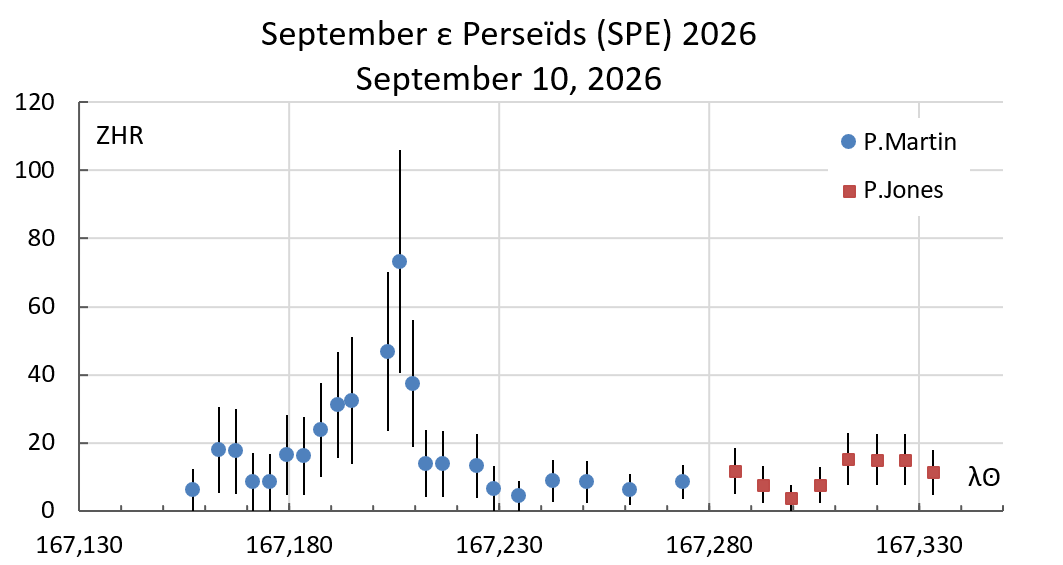
Figure 2. Graph showing the ZHR of the September Epsilon Perseids versus solar longitude (λꙨ).
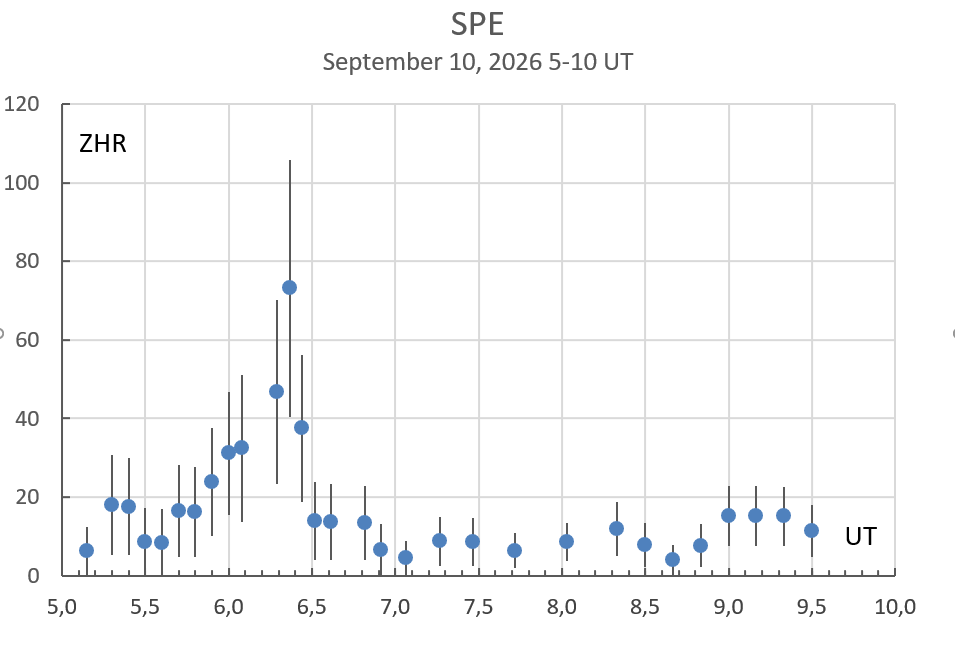
Figure 2. Graph showing the ZHR of the September Epsilon Perseids (in UT)
Due to the relatively low radiant elevation (25 degrees at the start of Pierre’s session) and the low number of meteors, the error bars are quite large—an important point to note. A difference of just one meteor during such a counting interval can lead to significant changes in the calculated ZHR values. Nevertheless, it is clearly evident that the activity rises more slowly than it declines. The peak, with a ZHR of 73 ± 32.7, lasted a few minutes, while the event as a whole spanned roughly 1.5 hours. The maximum occurred near λꙨ=167.206—specifically on September 10, 2026, at 06:22 UT. This suggests that the predictions made by both Sato and Vaubaillon in [1] were accurate (see Figure 3), with Vaubaillon’s timing coming closest to the observed result. Pierre Martin’s observation now appears to be confirmed by radio observations indicating a maximum at 06:30 UT (website: H. Sugimoto).
https://mro.chips.jp/Flash/2026/SPE/index-e.htm
The annual maximum occurred on September 9, 2026, at 18:00 UT (peak ZHR of 8), meaning the outburst took place 12.5 hours after this maximum.
On September 12, the Global Meteor Network reported via CBET 5736 that the outburst had been recorded by network system as well. The GMN determined a peak time of 06:33 UT (±2 hours). This timing aligns closely with the times derived from visual and radio observations. The peak ZHR recorded by the GMN network was 9.4 (±0.4). In a “normal” year, GMN records an average ZHR of 4.5 (±0.1).
September Epsilon meteor outburst September 9/10 2026
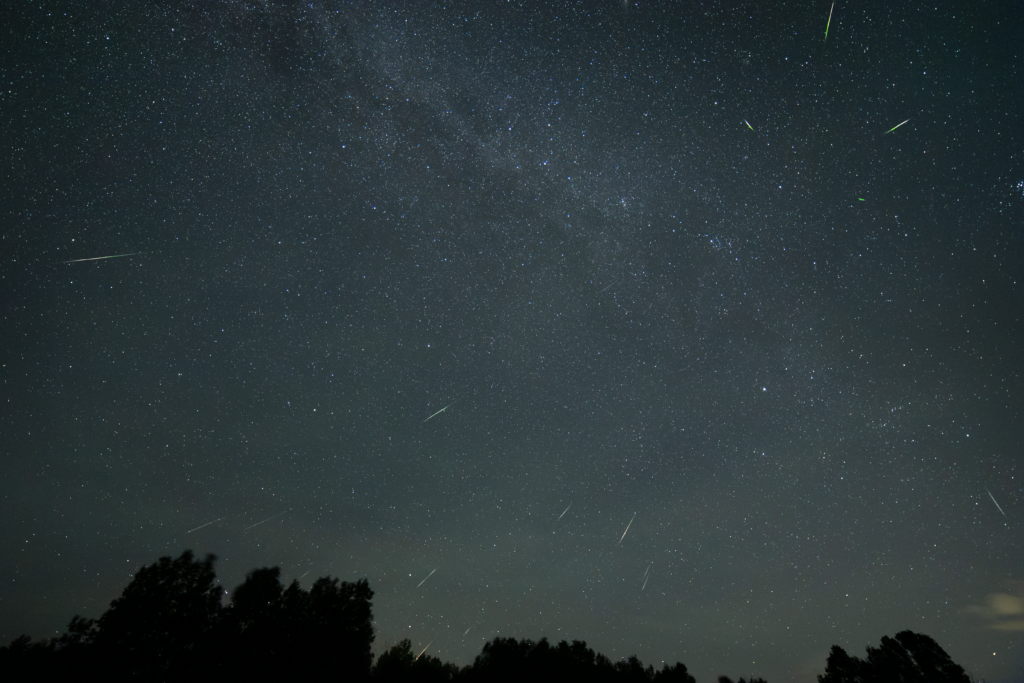
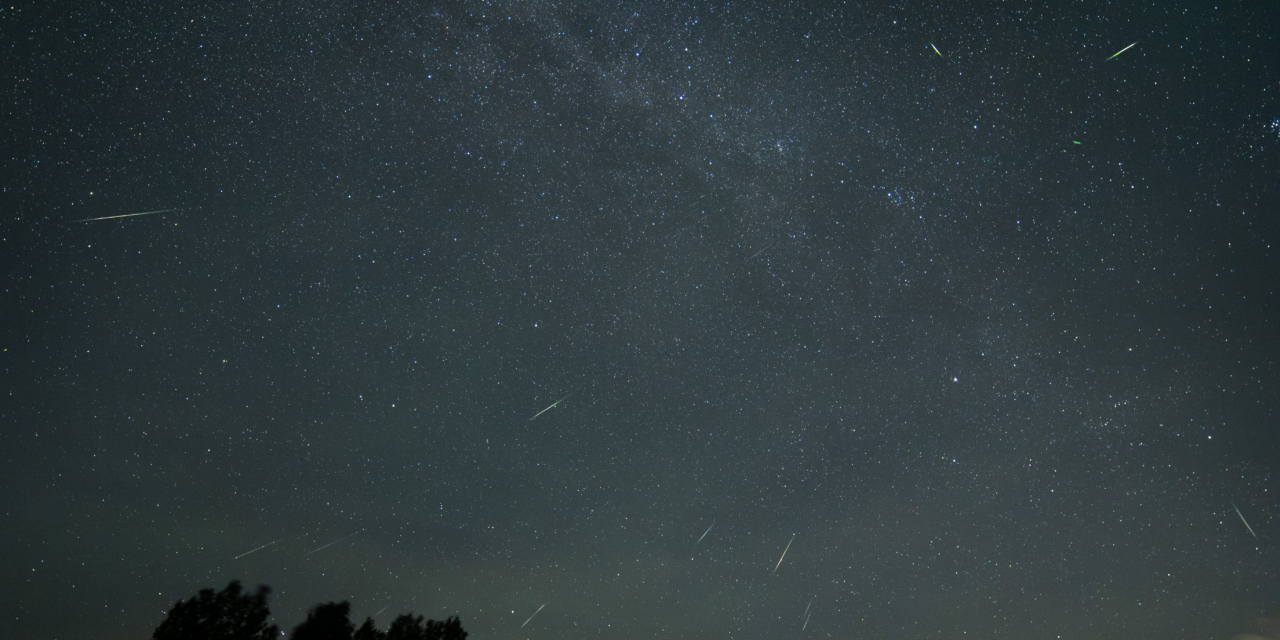
Figure 3. Composite image of Sept Epsilon Perseids meteor outburst Sept 9/10 2026 from Stewartville, Ontario. Canon 6D with a 14mm f/2.8 lens, ISO 3200. It is made from a series of continues 20 second exposures taken between 05UT-08UT. Many of the meteors in the photo occurred between 06-07UT. Image by Pierre Martin>
Full resolution image: September Epsilon meteor outburst September 9/10 2… – 2026/09/10 September Epsilon Perseids – pmartin
Reference
[1] Rendtel J. et all, 2026 Meteor shower Calendar, International Meteor Organisation