During this period the moon will reach its last quarter phase on Tuesday December 1. At that time the moon will rise near 23:00 local standard time (LST) on the previous evening. The bright waning gibbous moon will hinder meteor observations this weekend, but as the days progress the moon will become less of a nuisance as the phase wanes and it rises later in the morning.
This week evening observers can expect total hourly rates of four from mid-northern latitudes (45°N) and near three from tropical southern locations (25°S). Morning observers may see rates near ten from mid-northern latitudes and near seven from tropical southern locations. Morning rates are reduced due to moonlight.
The actual rates observed will also depend on factors such as personal light and motion perception, local weather conditions, alertness, and experience in watching meteor activity. Note that the hourly rates listed below are estimates based on observations from dark-sky sites away from urban light sources. Observers viewing from urban areas will see less activity, as only the brighter meteors will be visible from such locations.
The radiant (the area of the sky from which meteors appear to originate) positions and rates listed below are exact for Saturday night/Sunday morning, November 28/29. These positions do not change greatly from day to day, so the listed coordinates may be used throughout this entire period. Most star atlases (available online, in bookstores, and at planetariums) include maps with celestial coordinate grids that can help you locate these positions in the sky.
I have also included charts of the sky that display the radiant positions for evening, midnight, and morning. The center of each chart represents the sky directly overhead at the corresponding hour. These charts are oriented towards facing south but can be used for any direction by rotating them accordingly. A planisphere or planetarium app is also useful for showing the sky at any time of night on any date of the year.
Activity from each radiant is best seen when it is positioned highest in the sky (culmination), either due north or south along the meridian, depending on your latitude. Radiants that rise after midnight will not reach their highest point until daylight; therefore, it is best to view them during the last few hours of the night.
It must be remembered that meteor activity is rarely seen directly at the radiant position. Rather, meteors shoot outward from the radiant, so it is best to center your field of view so that the radiant lies near the edge rather than the center. Viewing in this way allows you to trace the path of each meteor back to the radiant (if it belongs to a shower) or in another direction if it is sporadic. Meteor activity is not visible from radiants located far below the horizon.
The positions below are listed in west-to-east order by right ascension (celestial longitude). The positions listed first are located farther west and are therefore accessible earlier in the night, while those listed farther down the list rise later.
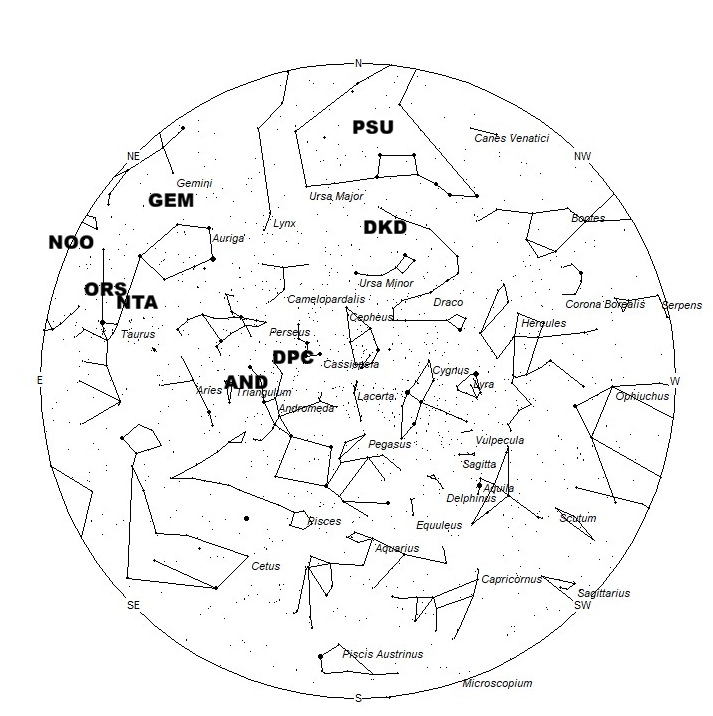
Radiant Positions at 18:00 Local Standard Time
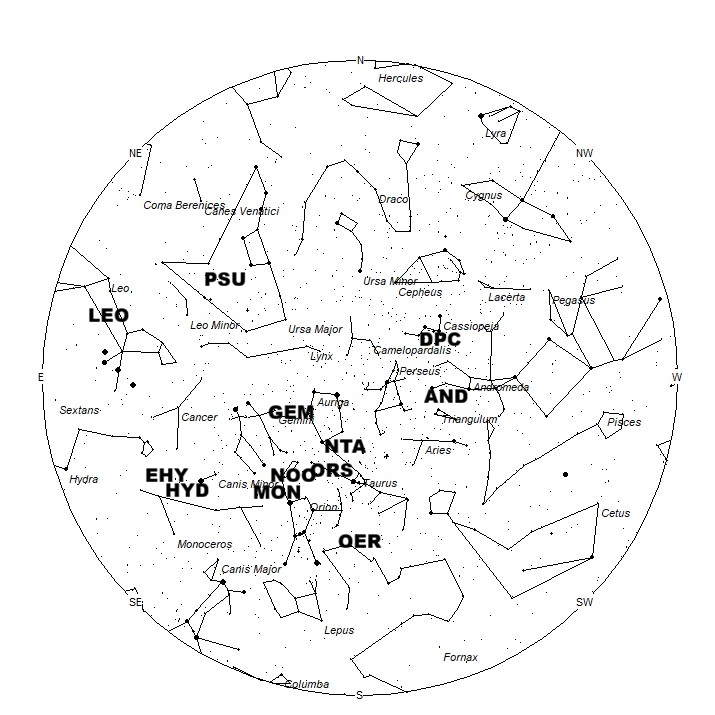
Radiant Positions at Midnight Local Standard Time
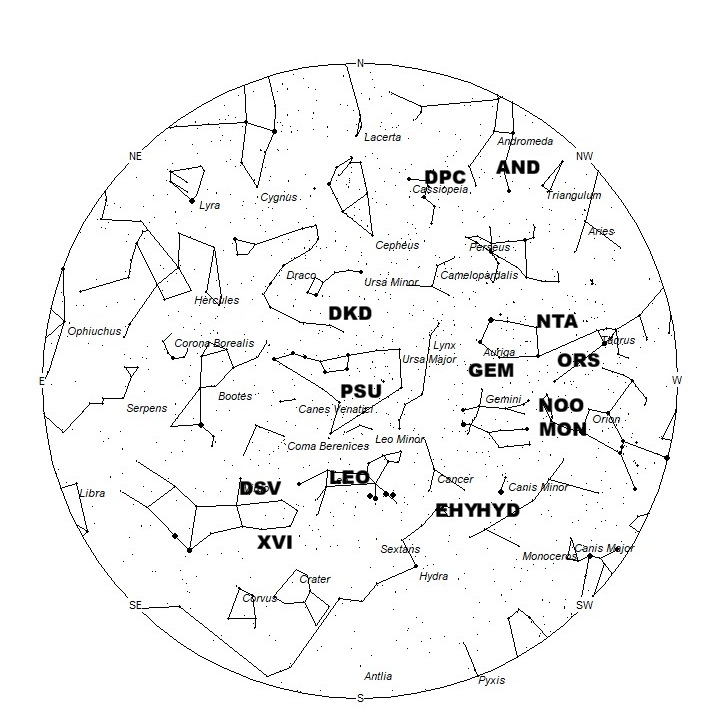
Radiant Positions at 06:00 Local Standard Time
The following sources of meteoric activity are expected to be active this week.
The December phi Cassiopeiids (DPC) are the periodic debris encountered from the remains of comet 3D/Biela. These meteors were responsible for the great meteor storms of the 19th century as those meteors are in a slightly different orbit than the annual Andromedids. The meteors are rarely seen between November 28 and December 10, with maximum activity occurring near December 4. The radiant currently is located near 00:56 (014) +56. This position lies in southern Cassiopeia, two degrees southeast of the second magnitude star known as Schedar (alpha Cassiopeiae). This part of the sky is best placed near 21:00 LST, when the radiant lies highest above the northern horizon. Current hourly rates would most likely be less than one no matter your location. With an entry velocity of 17 km/sec., the average DPC meteor would be of slow velocity. Due to the high northern location, these meteors are not well seen in the Southern Hemisphere
The Andromedids (AND) are the annual debris encountered from the remains of comet 3D/Biela. These meteors should not be mistaken for the great meteor storms of the 19th century as those meteors are in a slightly different orbit and irregularly encountered in early December. They are known as the December phi Cassiopeiids (DPC). It is interesting that during November, this radiant moves northward toward the area of the DPC’s but ends before reaching the DPC radiant. The radiant currently is located near 01:44 (026) +42. This position lies in eastern Andromeda, one degree northeast of the fourth magnitude star known as Titawin (upsilon Andromedae). This part of the sky is best placed near 22:00 local standard time (LST), when the radiant lies nearly overhead. Current hourly rates would most likely be less than one no matter your location. With an entry velocity of 14 km/sec., the average Andromedid meteor would be of slow velocity.
The last of the omicron Eridanids (OER) are expected this week from a radiant located at 04:36 (069) -03, which is located in northeastern Eridanus, one degree northeast of the fourth magnitude star known as nu Eridani. This radiant is best placed near midnight LST, when it lies on the meridian and is located highest in the southern sky. Rates at this time should be less than 1 per hour no matter your location. With an entry velocity of 26 km/sec., the average OER meteor would be of medium-slow velocity.
The Northern Taurids (NTA) should be active from a wide radiant located at 04:44 (071) +25. This area of the sky lies in northern Taurus, two degrees northeast of the fourth magnitude star known as Gaja (tau Tauri). To best see these meteors, observers should face southward near midnight LST. Rates at this time should be near one per hour as seen from the Northern Hemisphere and less than one as seen from south of the equator. With an entry velocity of 25 km/sec, the average NTA meteor would be of medium-slow velocity.
The Southern chi Orionids (ORS) are active from November 14 through December 16, with maximum activity occurring on November 28. The radiant is currently located at 05:04 (076) +18, which lies in central Taurus, six degrees northeast of the 1st magnitude star known as Aldebaran (alpha Tauri). This radiant is best placed in the southern sky near midnight LST, when it lies on the meridian and is located highest in the sky. Rates at this time should be less than 1 per hour no matter your location. With an entry velocity of 27 km/sec., the average ORS meteor would be of medium-slow velocity.
The November Orionids (NOO) are active from November 13 through December 12, with maximum activity occurring on November 28. The radiant is currently located at 06:00 (090) +16. This area of the sky lies in northeastern Orion, 8 degrees north of the first magnitude star known as Betelgeuse (alpha Orionis). This radiant is best placed in the southern sky near 0200 LST, when it lies highest above the horizon. Rates should be near one per hour no matter your location. With an entry velocity of 43 km/sec., most activity from this radiant would be of medium speed.
The Monocerotids (MON) are active from November 23 through December 24, with maximum activity occurring on December 10. The radiant is currently located at 06:08 (092) +10. This area of the sky lies in northeastern Orion, two degrees northeast of the bright orange variable star known as Betelgeuse (alpha Orionis). This radiant is best placed in the southern sky near 0200 LST, when it lies highest above the northern horizon. Hourly rates should be near 1 no matter your location. With an entry velocity of 44 km/sec., most activity from this radiant would be of medium speed.
The Geminids (GEM) are active from December 1st through December 24th, with maximum activity occurring on December 13. The radiant is currently located at 06:28 (097) +35. This area of the sky lies in eastern Auriga, four degrees west of the fourth magnitude star known as theta Geminorum. This radiant is best placed in the southern sky near 0200 LST, when it lies highest above the northern horizon. Hourly rates should be less than 1 no matter your location. With an entry velocity of 32 km/sec., most activity from this radiant would be of medium -slow speed.
The sigma Hydrids (HYD) are active from November 22 through December 31, with maximum activity occurring on December 7. The radiant is currently located at 07:48 (117) +05. This area of the sky lies on central Canis Minor, two degrees southeast of the zero-magnitude star known as Procyon (alpha Canis Minoris A). This radiant is best placed near 0300 LST, when it lies highest above the southern horizon. Rates should be less than one no matter your location. With an entry velocity of 60 km/sec., most activity from this radiant would be of appear swift.
The eta Hydrids (EHY) are active from November 22 through December 31, with maximum activity occurring on December 8. The radiant is currently located at 08:16 (124) +04. This area of the sky lies on western Hydra, five degrees southwest of the fourth magnitude star known as delta Hydrae. This radiant is best placed near 0400 LST, when it lies highest above the southern horizon. Rates should be less than one no matter your location. With an entry velocity of 62 km/sec., most activity from this radiant would be of appear swift.
The Puppid-Velid Complex (PUP) are a vast complex of weak radiants located in the constellations of Puppis and Vela. Visual plots and photographic studies have revealed many radiants in this area during November and December. The combined strength of these radiants can produce a ZHR of ten at maximum. Actual hourly rates will be much less unless you happen to be observing from the deep Southern Hemisphere. Activity from this source begins around November 22. The center of this activity is currently located at 08:32 (128) -47. This position lies in western Vela, three degrees east of the second magnitude star known as gamma Velorum. Peak rates occur near December 8. These meteors are best seen near 0400 LST when the radiant lies highest in the southern sky. Observers located in the Southern Hemisphere have an advantage viewing this shower as the radiant will rise higher into their sky allowing more activity to be seen. Since the radiant lies low in the south for most Northern Hemisphere observers, meteors seen from north of the equator tend to be long in length and long-lasting. At 42 km/sec. the Puppid-Velids produce meteors of average velocity. Note: these are also listed as the “e Velids” from several sources.
The Leonids (LEO) are active from October 27 to December 7 with maximum activity occurring on November 18. The radiant is currently located at 10:40 (160) +18. This position lies in central Leo, four degrees southeast of the third magnitude star known as Algeiba (gamma Leonis). The Leonid radiant is best placed in the southern sky during the last hour before morning twilight when the radiant lies highest in a dark sky. Leonids may be seen from the Southern Hemisphere, but the viewing conditions are not quite as favorable as those north of the equator. Current rates are expected to be less than one per hour no matter your location. With an entry velocity of 71 km/sec., most activity from this radiant would be of swift speed with numerous persistent trains on the brighter meteors.
The psi Ursa Majorids (PSU) were discovered by observers in Japan using data from SonotaCo. This shower is active from November 29-December 11 with maximum activity occurring on December 4th. The radiant is currently located at 10:48 (162) +48. This position lies in southwestern Ursa Major, four degrees northwest of the third magnitude star known as psi Ursae Majoris. This area of the sky is best placed during the last hour before dawn, when it lies nearly overhead. Current hourly rates would most likely be less than one regardless of your location. At 60km/sec., the average psi Ursa Majorid meteor would be medium-swift.
The December kappa Draconids (DKD) were discovered by SonotaCo during studies of new radiants in 2008-09. This shower is active from November 28 through December 7 with maximum activity occurring on December 2. The radiant is currently located at 11:48 (177) +73. This position lies in extreme western Draco, four degrees northwest of the fourth magnitude star known as lambda Draconis. While the radiant lies above the horizon all night for most of the Northern Hemisphere, it is best placed during the last hour before dawn, when it lies highest above the northern horizon in a dark sky. Hourly rates are expected to be less than one. Due to the high northerly declination of the radiant these meteors are not visible from most of the Southern Hemisphere. At 43km/sec., the average December kappa Draconid meteor would be of medium velocity.
The December chi Virginids (XVI) were discovered in Japan by observers using data from SonotaCo. This source is active from November 26 through December 30 with maximum occurring on December 15. The radiant is currently located at 12:00 (180) -04, which places it in southwestern Virgo, 5 degrees southwest of the 4th magnitude star known as Zaniah (eta Virginis). Hourly rates should be less than one no matter your location. These meteors are best seen during the last dark hour before dawn, when the radiant lies highest above the eastern horizon in a dark sky. At 68 km/sec. the December chi Virginids would produce mostly swift meteors.
The December sigma Virginids (DSV) is a source of long duration discovered by John Greaves using the data from SonotaCo. This source is active from November 26 through January 24 with peak rates occur near December 23rd. The current radiant location is at 12:28 (187) +10, which places it in northern Virgo, two degrees west of the faint star known as rho Virginis. Current hourly rates would be less than one no matter your location. These meteors are best seen during the last dark hour before dawn, when the radiant lies highest above the eastern horizon in a dark sky. At 66 km/sec. the December Sigma Virginids would produce mostly swift meteors.
Sporadic meteors are those meteors that cannot be associated with any known meteor shower. All meteor showers are evolving and disperse over time to the point where they are no longer recognizable. Away from the peaks of the major annual showers, these sporadic meteors make up the bulk of the activity seen each night.
As seen from the mid-Northern Hemisphere (45N), one would expect to see during this period approximately eight sporadic meteors per hour during the last hour before dawn as seen from rural observing sites. Evening rates would be near three per hour. As seen from the tropical southern latitudes (25S), morning rates would be near six per hour as seen from rural observing sites and two per hour during the evening hours. Morning rates are reduced by moonlight.
The list below provides information in tabular form on active showers within reach of the visual observer. Hourly rates are often less than one, so these sources are rarely listed as visual targets in most meteor shower catalogs. If you wish to associate as many meteors as possible with known sources, you will appreciate these listings.
Before claiming to have observed meteors from these Class IV showers, determine whether they truly belong to them and are not chance alignments of sporadic meteors. Note parameters such as duration, length, radiant distance, and elevation to help compute the probability of shower association.
It should be remembered that slow meteors can appear in fast showers, but fast meteors cannot be produced by slow showers. Slower showers have velocities less than 35 km/sec. Slow meteors from fast showers usually occur close to the radiant or low in the sky.
Recognizing meteors from obscure showers is not for beginning observers—it takes many hours of practice to develop an instinct for what you are seeing. It is our hope that you will move beyond simply watching meteors as a celestial fireworks display and help expand our knowledge by classifying each meteor you observe.
Rates and positions on the table are exact for Saturday night/Sunday morning November 28/29
| SHOWER | DATE OF MAXIMUM | CELESTIAL POSITION | ENTRY VELOCITY | CULMINATION | HOURLY RATE | CLASS |
| ACTIVITY | RA (RA in Deg.) DEC | Km/Sec | Local Standard Time | North-South | ||
| December phi Cassiopeiids (DPC) | Dec 04 | 00:56 (014) +56 | 17 | 21:00 | <1 – <1 | III |
| Andromedids (AND) | Nov 07 | 01:44 (026) +42 | 14 | 22:00 | <1 – <1 | IV |
| omicron Eridanids (OER) | Nov 05 | 04:36 (069) -03 | 26 | 00:00 | <1 – <1 | IV |
| Northern Taurids (NTA) | Nov 09 | 04:44 (071) +25 | 25 | 00:00 | 1 – <1 | II |
| Southern chi Orionids (ORS) | Nov 28 | 05:04 (076) +18 | 27 | 01:00 | <1 – <1 | IV |
| November Orionids (NOO) | Nov 28 | 05:44 (086) +16 | 43 | 02:00 | 1 – 1 | II |
| Monocerotids (MON) | Dec 10 | 06:08 (092) +10 | 44 | 02:00 | <1 – <1 | II |
| Geminids (GEM) | Dec 14 | 06:28 (097) +35 | 32 | 02:00 | <1 – <1 | I |
| sigma Hydrids (HYD) | Dec 07 | 07:48 (117) +05 | 60 | 03:00 | <1 – <1 | II |
| eta Hydrids (EHY) | Dec 08 | 08:16 (124) +04 | 62 | 04:00 | <1 – <1 | IV |
| Puppid-Velids (PUP) | Dec 08 | 08:32 (128) -47 | 42 | 04:00 | <1 – <1 | II |
| Leonids (LEO) | Nov 18 | 10:40 (160) +18 | 71 | 06:00 | <1 – <1 | I |
| psi Ursa Majorids (PSU) | Dec 04 | 10:48 (162) +48 | 60 | 06:00 | <1 – <1 | IV |
| December kappa Draconids (DKD) | Dec 03 | 11:48 (177) +73 | 43 | 07:00 | <1 – <1 | IV |
| December chi Virginids (XVI) | Dec 15 | 12:00 (180) -04 | 68 | 07:00 | <1 – <1 | IV |
| December sigma Virginids (DSV) | Dec 23 | 12:28 (187) +10 | 66 | 08:00 | <1 – <1 | IV |
You can keep track of the activity of these meteor showers as well as those beyond the limits of visual observing by visiting the NASA Meteor Shower Portal. You can move the sky globe to see different areas of the sky. Colored dots indicate shower meteors while white dots indicate sporadic (random) activity. The large orange disk indicates the position of the sun so little activity will be seen in that area of the sky.
Class Explanation: A scale to group meteor showers by their intensity:
- Class I: the strongest annual showers with Zenith Hourly Rates normally ten or better.
- Class II: reliable minor showers with ZHR’s normally two to ten.
- Class III: showers that do not provide annual activity. These showers are rarely active yet have the potential to produce a major display on occasion.
- Class IV: weak minor showers with ZHR’s rarely exceeding two. The study of these showers is best left to experienced observers who use plotting and angular velocity estimates to determine shower association. These weak showers are also good targets for video and photographic work. Observers with less experience are urged to limit their shower associations to showers with a rating of I to III.