By Paul Roggemans, Denis Vida, Damir Šegon, James M. Scott, Jeff Wood
Abstract: An activity source identified as the iota-Lupids has been detected between the 17th and 21st of December 2025 from a radiant at R.A. = 214.1° and Decl.= –42.2°, with a geocentric velocity of 41.5 km/s. This case study confirms the existence of this annual meteor shower and the shower fulfils the criteria to be nominated for established status by the IAU-MDC.
1 Introduction
A small but distinct group of radiants appeared on the Global Meteor Network radiant density maps between the 17th and 21st of December 2025 (Figure 1). A first preliminary analysis failed to identify this activity source with any known meteor shower in the IAU-MDC Working List of Meteor Shower. This activity was initially monitored as a possible new meteor shower.
Before reporting this source to the IAU-MDC as a possible new meteor shower another checkup was done based upon the orbit data and that resulted in a positive match although rather weak correlation with similarity criteria DSH ~0.15 and DD ~0.1. The shower is known as the iota-Lupids (ILU#783) which was discovered by Pokorný et al. (2017) during a meteoroid stream search on data of the Southern Argentina Agile MEteor Radar (SAAMER) between 2012–2015.
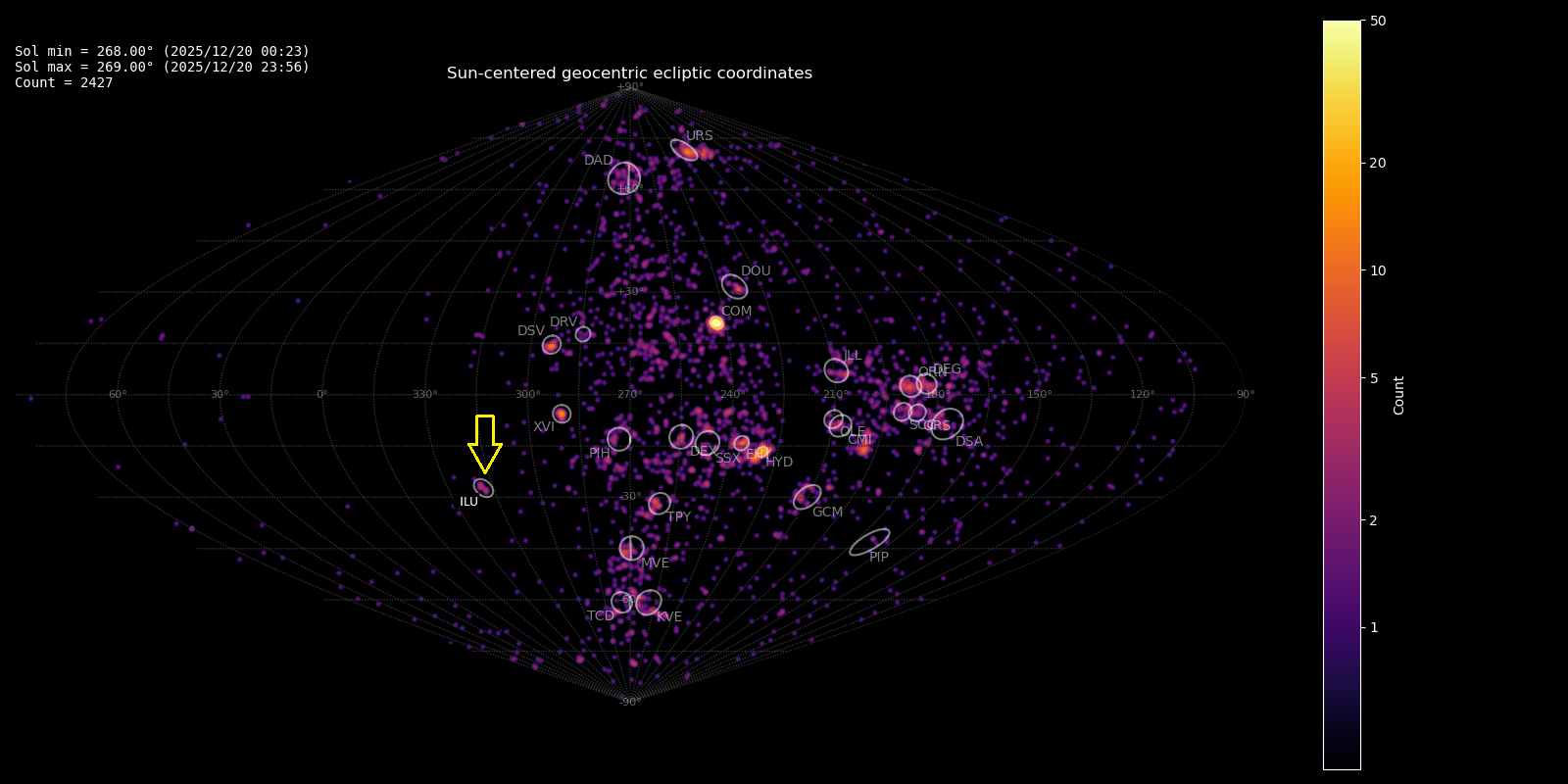
Figure 1 – Radiant density map with 2427 radiants obtained by the Global Meteor Network during 20–21 December, 2025. The position of the iota-Lupids in Sun-centered geocentric ecliptic coordinates is marked with a yellow arrow.
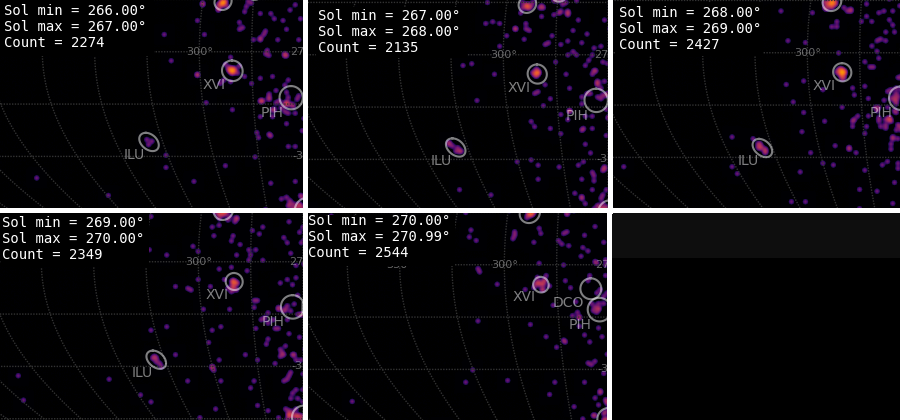
Figure 2 – Changes in the radiant appearance during the activity period.
2 Shower classification based on radiants
The GMN shower association criteria assume that meteors within 1° in solar longitude, within 2.5° in radiant in this case, and within 10% in geocentric velocity of a shower reference location are members of that shower. Further details about the shower association are explained in Moorhead et al. (2020). Using these meteor shower selection criteria, 23 orbits have been identified as iota-Lupids by 80 GMN cameras installed in Australia, New Zealand and the United States. The final results have been listed in Table 1.
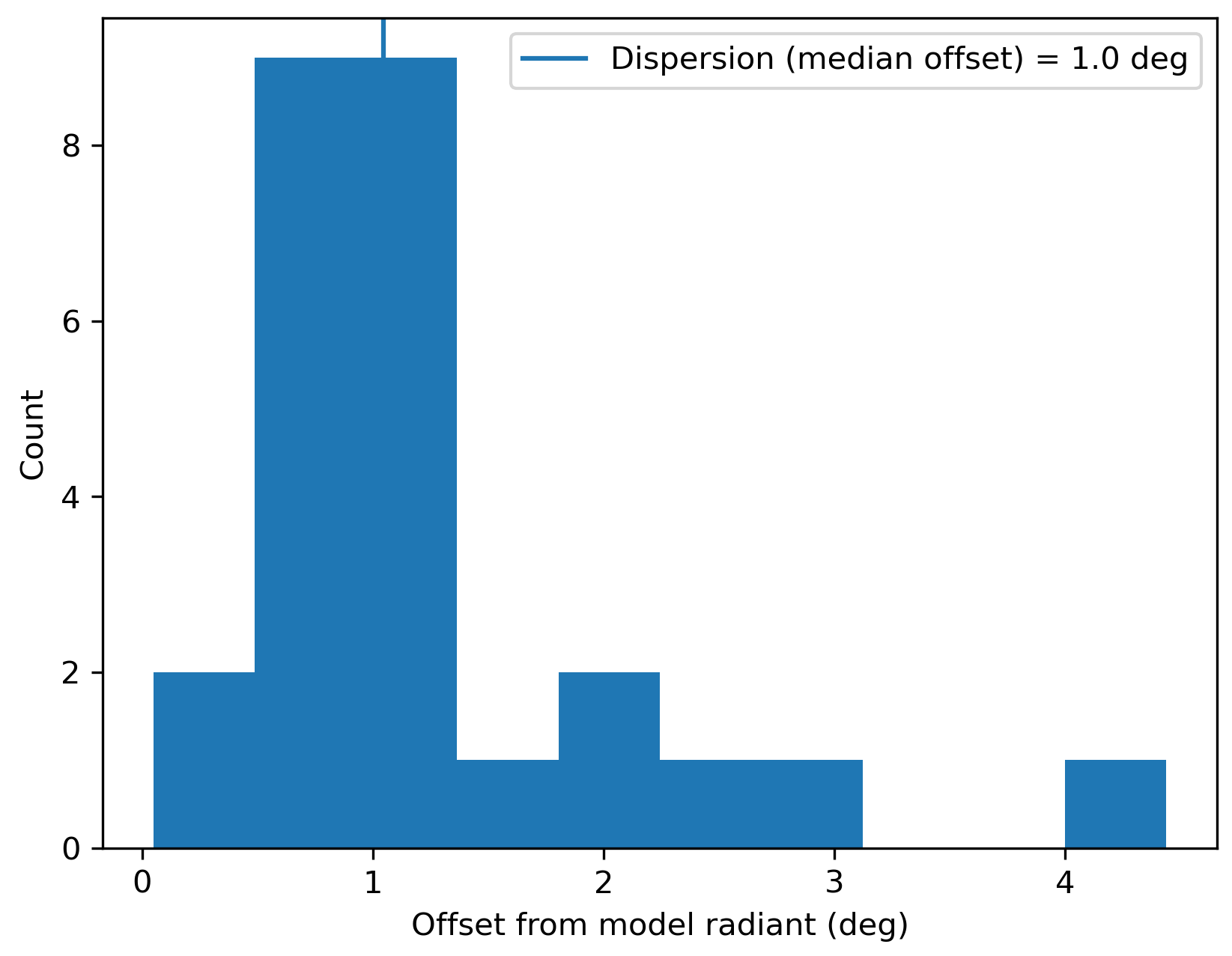
Figure 3 – Dispersion median offset on the radiant position.
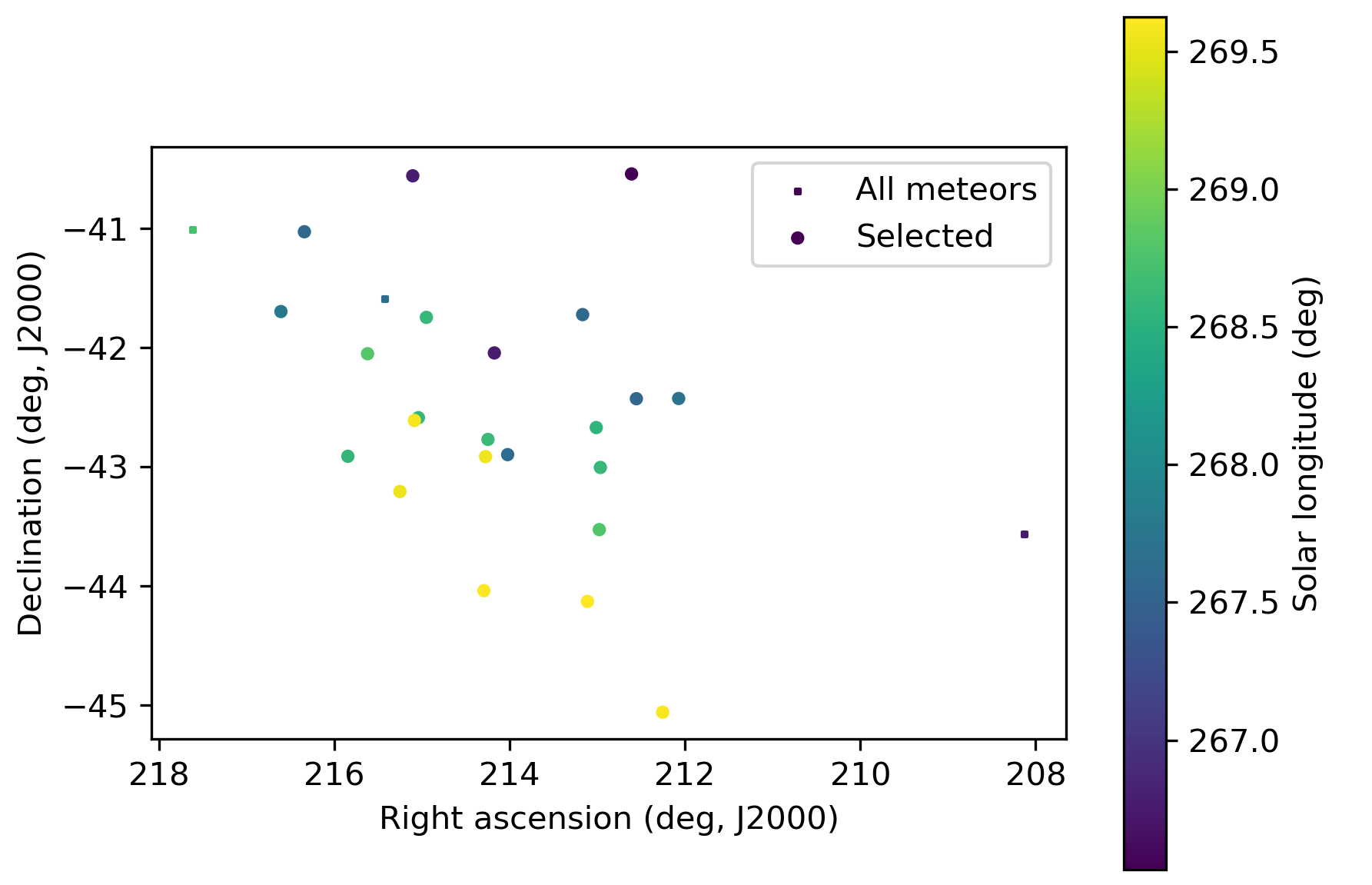
Figure 4 – The radiant distribution during the solar-longitude interval 266.5° – 269.5° in equatorial coordinates.
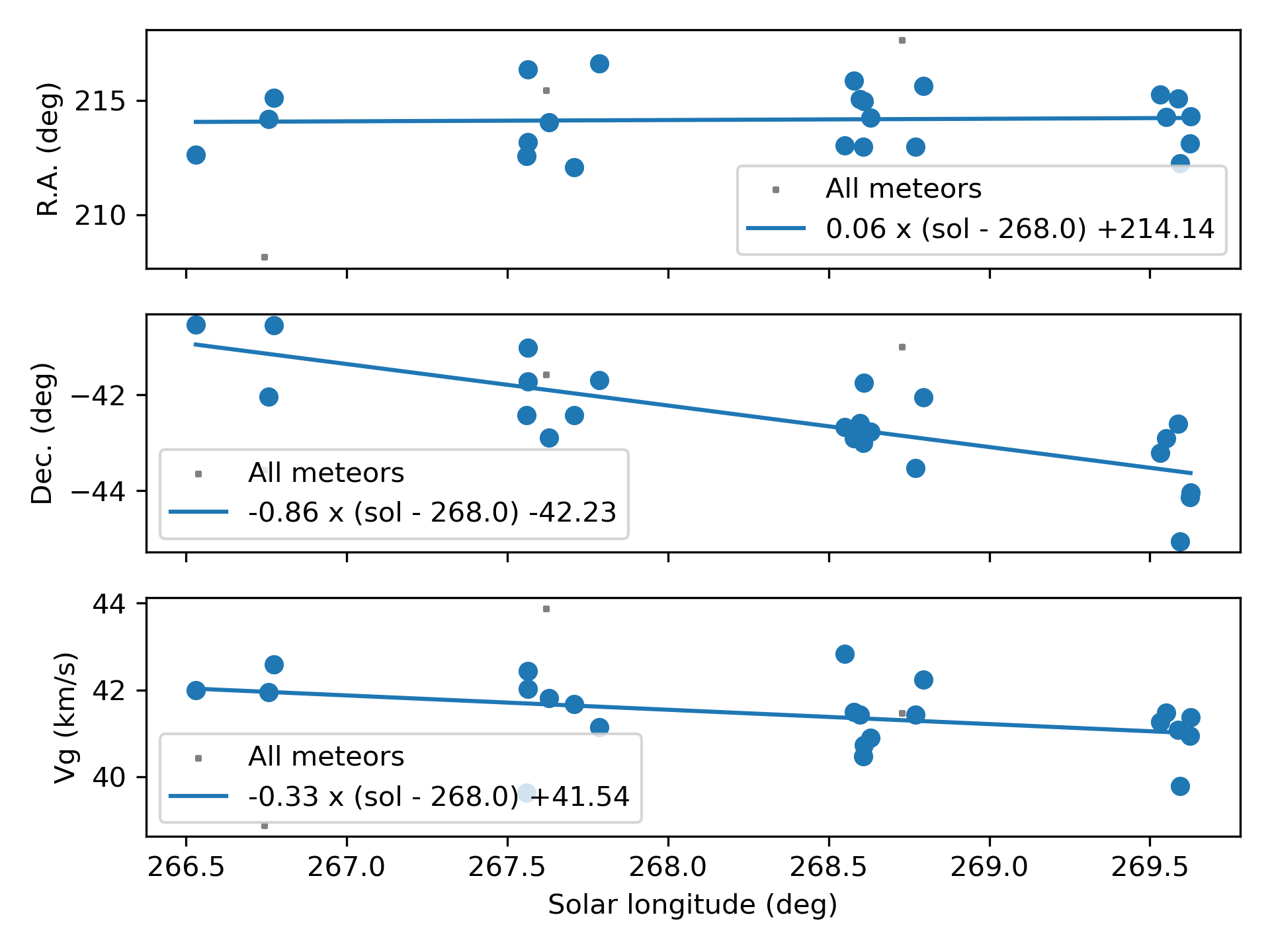
Figure 5 – The radiant drift.
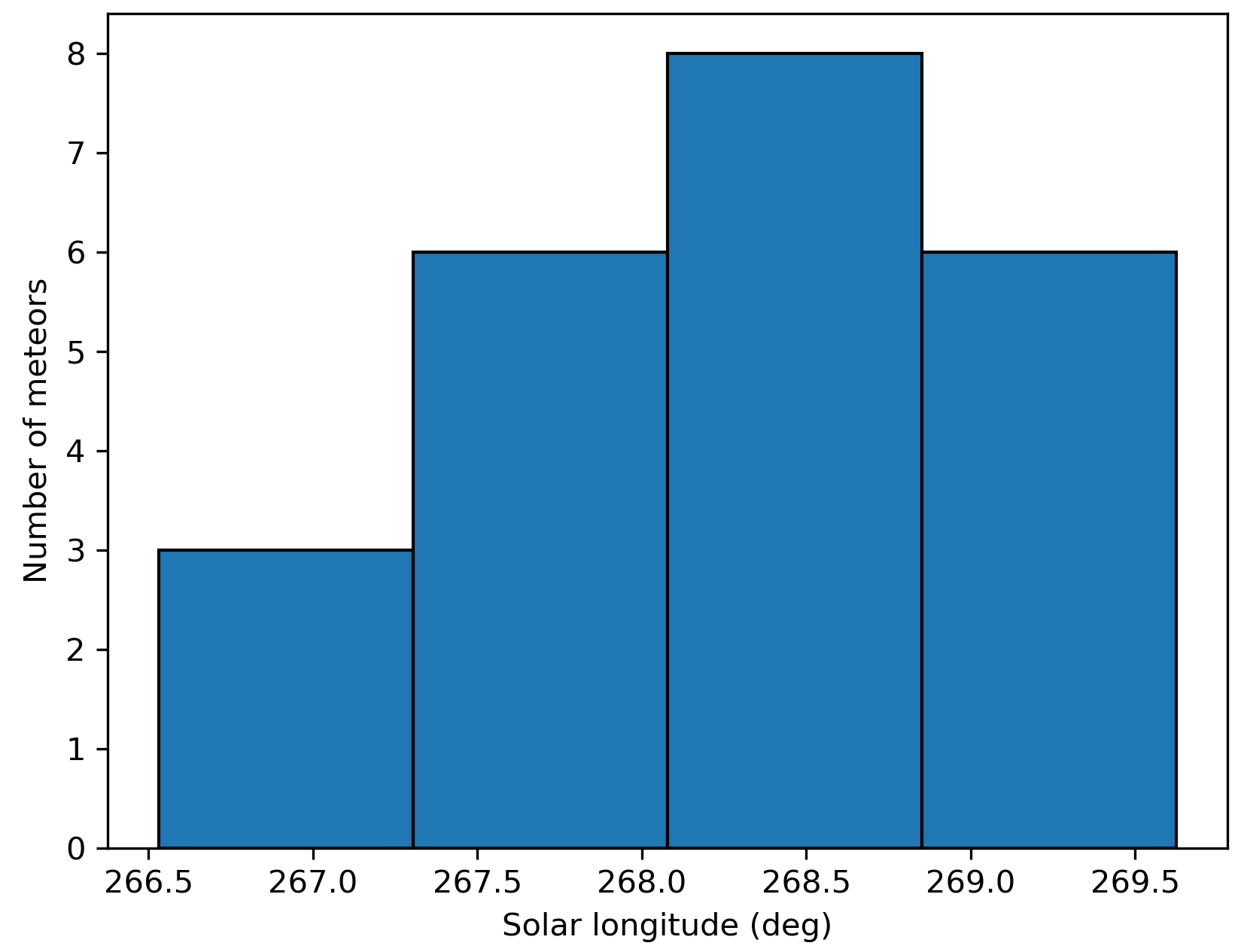
Figure 6 – The uncorrected number of shower meteors recorded per degree in solar longitude.
3 Shower classification based on orbits
A complete independent meteoroid stream search has been applied based upon orbit data for confirmation. This method has been described in a separate publication (Roggemans and Vida, 2026). The mean orbit was computed by the method of Jopek et al. (2006) for all orbits that fit the thresholds DSH < 0.15 & DD < 0.06 & DJ < 0.15 (Southworth and Hawkins, 1963; Drummond, 1981; Jopek, 1993). The results have been listed in Table 1.
Twenty iota-Lupids were identified in common by both methods, three were found by the radiant identification method but not confirmed by the orbit method and four were identified by the orbit identification but not detected by the radiant method.
The radiant plots in equatorial coordinates (Figure 7) and in Sun-centered ecliptic coordinates (Figure 8) show a distinct concentration in a generally sparse distributed sporadic background. The radiant drift listed in Table 1 is rather uncertain due to the small number of shower meteors.
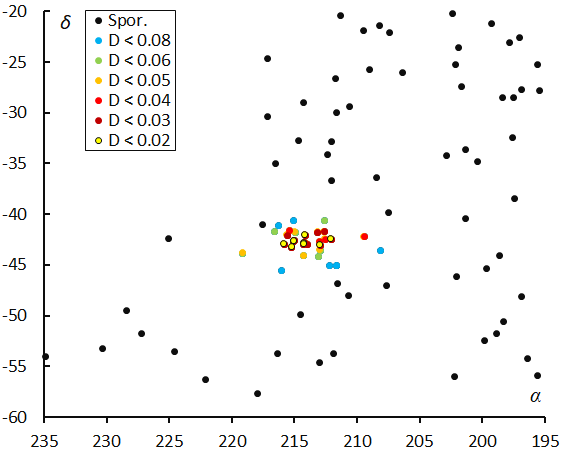
Figure 7 – The radiant distribution during the solar-longitude interval 265° – 273° in equatorial coordinates, color-coded for different threshold values of the DD orbit similarity criterion.
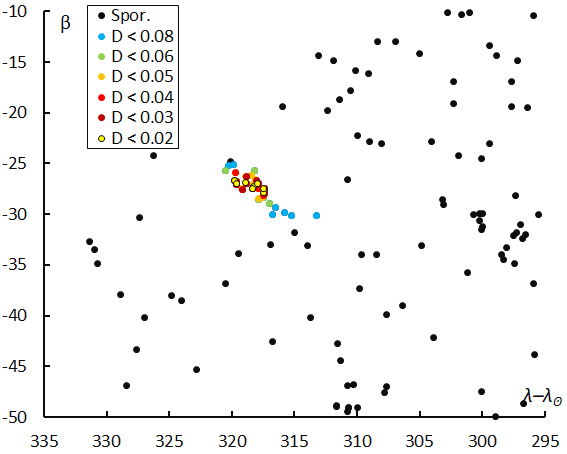
Figure 8 – The radiant distribution during the solar-longitude interval 265° – 273° in Sun-centered geocentric ecliptic coordinates, color-coded for different threshold values of the DD orbit similarity criterion.
4 Orbit and parent body
The only previously known record for the iota-Lupids orbit has been obtained from radar observations (Pokorný et al., 2017) and the orbital parameters differ mainly because of the significant lower geocentric velocity measured by radar. The radar results are included in Table 1 for comparison. Radar meteor observations cover another population in meteoroid streams than low-light optical cameras. It is not clear if the difference in velocity and consequent shorter orbit observed by radar is due to the fact that the radar detects mainly fainter meteors and thus much smaller particles, or if the difference is instrumental.
Table 1 – Comparing solutions derived by two different methods, radiant based method and orbit based menthod for DD < 0.06, both compared to Pokorný (2017).
| Radiant method | Orbit method DD < 0.06 | Pokorný (2017) | |
| λʘ (°) | 268.6 | 268.6 | 271.0 |
| λʘb (°) | 266.0 | 265.4 | 267.0 |
| λʘe (°) | 270.0 | 272.9 | 272.0 |
| αg (°) | 214.1 | 214.2 | 213.0 |
| δg (°) | –42.2 | –42.6 | –46.1 |
| Δαg (°) | +0.06 | +0.86 | +1.58 |
| Δδg (°) | –0.86 | –0.39 | –0.36 |
| vg (km/s) | 41.5 | 41.4 | 37.0 |
| Hb (km) | 97.4 | 97.4 | – |
| He (km) | 85.9 | 86.2 | – |
| Hp (km) | 89.3 | 90.1 | – |
| MagAp | –0.5 | –0.3 | – |
| λg (°) | 226.62 | 226.9 | 227.4 |
| λg – λʘ (°) | 318.62 | 318.2 | 316.4 |
| βg (°) | –26.83 | –27.2 | –30.7 |
| a (A.U.) | 1.337 | 1.339 | 1.05 |
| q (A.U.) | 0.233 | 0.234 | 0.268 |
| e | 0.826 | 0.826 | 0.744 |
| i (°) | 72.9 | 72.9 | 66.2 |
| ω (°) | 226.7 | 226.8 | 225.1 |
| Ω (°) | 88.4 | 88.3 | 91.0 |
| Π (°) | 315.0 | 315.1 | 316.1 |
| Tj | 4.06 | 4.06 | 5.21 |
| N | 23 | 24 | 185 |
Looking at the diagram of inclination versus longitude of perihelion, we found a concentration amid a scarce populated space (Figure 9). It appears there are very few meteoroids in this range of inclination and longitude of perihelion, with mainly iota-Lupid meteoroids in this diagram.
The distribution of the perihelion distance versus the inclination (Figure 10) shows a concentration near what looks like the edge for short perihelion distances.
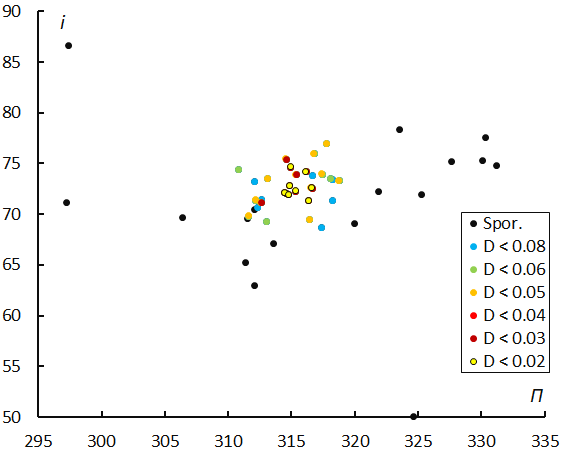
Figure 9 – The diagram of the inclination i against the longitude of perihelion Π color-coded for different classes of D criteria thresholds, for λʘ between 265° and 273°.
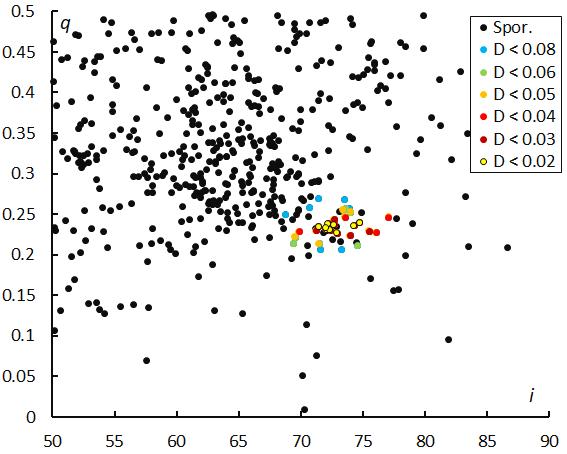
Figure 10 – The diagram of the perihelion distance q against the inclination i color-coded for different classes of D criteria thresholds, for λʘ between 265° and 273°.
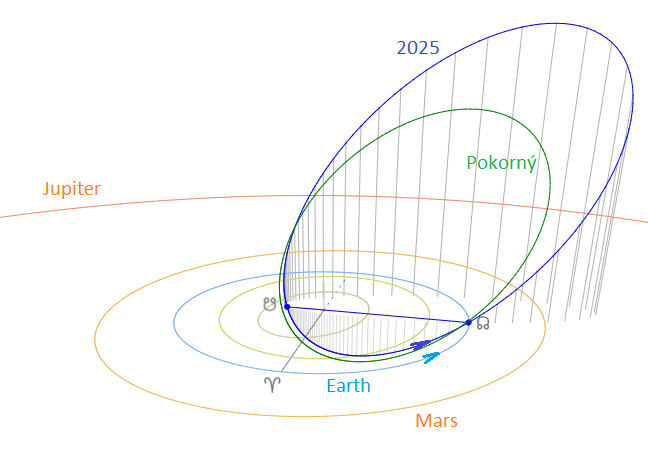
Figure 11 – Comparing the mean orbits for the solutions for the iota-Lupids based on the radiant shower identification (blue), to the radar orbit (green) published by Pokorný et al. (2017), close-up at the inner Solar System. (Plotted with the Orbit visualization app provided by Pető Zsolt).
The iota-Lupids encounter the Earth at their ascending node (Figure 11). The position of the descending node is far inside the orbit of planet Mercury, which means that the meteoroids are exposed to extreme thermal stress due to intense Solar radiation. The orbit determined by radar observations is plotted in green and represents mainly smaller particles far inside the orbit (blue) determined by the low-light cameras of the Global Meteor Network.
The Tisserand relative to Jupiter, with TJ = 4.06, indicates an asteroidal orbit type and close approaches to the Sun with perihelion distance far inside the orbit of planet Mercury explains why this meteoroid stream can be called a Sun-skirter.
The original discovery of this meteoroid stream mentioned 2012MS4 as possible parent object. However, this object does not appear in the top-10 of best fitting orbits of minor bodies, all of which have poor similarity far above the minimal threshold of DD < 0.105 (Table 2). The parent body, if still preserved, is therefore unknown.
Table 2 – Top ten matches of a search for possible parent bodies with DD < 0.35
| Name | DD |
| C/1905 X1 (Giacobini) | 0.249 |
| (620071) 2011 WN15 | 0.293 |
| 2019 UU13 | 0.306 |
| 2004 WK1 | 0.312 |
| C/2002 X5 (Kudo-Fujikawa) | 0.315 |
| (177651) 2004 XM14 | 0.323 |
| 2022 YN7 | 0.331 |
| 2019 WM3 | 0.334 |
| C/2019 Y4-D (ATLAS) | 0.336 |
| C/1844 Y1 (Great comet) | 0.337 |
5 Past activity
Searching previous years of Global Meteor Network data, twelve iota-Lupids orbits were found in 2024, fourteen in 2023, four in 2022 and one in 2020, none in 2021 or 2019. The expansion of GMN at the Southern Hemisphere in recent years explains the increase in detected orbits from this shower in recent years. The SonotaCo Net and EDMOND meteoroid orbit datasets had zero iota-Lupids, as these networks cover mainly the Northern Hemisphere. The CAMS dataset covers 2010–2016 and had one iota-Lupid in 2015 and two in 2016.
Verification of visual records from the past did not result in any findings and it appears there has never been a potential detection by anyone until Pokorný and his team in 2017. The iota-Lupids appear to be an annual minor shower and its observations depend upon the detection capacity at the Southern Hemisphere.
Acknowledgments
This report is based on the data of the Global Meteor Network (Vida et al., 2020a; 2020b; 2021) which is released under the CC BY 4.0 license. We thank all 927 participants in the Global Meteor Network project for their contribution and perseverance. A list with the names of the volunteers who contribute to GMN has been published in the 2025 annual report (Roggemans et al., 2026). The following 80 cameras recorded iota-Lupids that have been used in this study:
AU0002, AU000U, AU000V, AU001A, AU001B, AU001E, AU001Q, AU001R, AU001S, AU001U, AU001V, AU001W, AU002B, AU002E, AU0030, AU003E, AU0046, NZ000B, NZ000D, NZ000G, NZ000T, NZ0011, NZ0014, NZ0016, NZ0017, NZ001A, NZ001N, NZ001P, NZ001R, NZ0022, NZ0025, NZ0026, NZ0028, NZ0029, NZ002C, NZ002D, NZ002G, NZ002H, NZ002K, NZ002N, NZ002R, NZ002V, NZ002X, NZ0030, NZ0033, NZ0034, NZ0035, NZ0037, NZ0038, NZ003A, NZ003C, NZ003K, NZ0040, NZ0043, NZ0044, NZ0048, NZ004A, NZ004C, NZ004N, NZ004U, NZ0059, NZ005B, NZ005C, NZ005D, NZ005E, NZ005F, NZ005H, NZ005J, NZ005N, NZ005Q, NZ005R, NZ005T, NZ005U, NZ005Z, NZ0061, NZ0063, NZ0067, NZ0068, US003G, US005W.
References
Drummond J. D. (1981). “A test of comet and meteor shower associations”. Icarus, 45, 545–553.
Jopek T. J. (1993). “Remarks on the meteor orbital similarity D-criterion”. Icarus, 106, 603–607.
Jopek T. J., Rudawska R. and Pretka-Ziomek H. (2006). “Calculation of the mean orbit of a meteoroid stream”. Monthly Notices of the Royal Astronomical Society, 371, 1367–1372.
Moorhead A. V., Clements T. D., Vida D. (2020). “Realistic gravitational focusing of meteoroid streams”. Monthly Notices of the Royal Astronomical Society, 494, 2982–2994.
Pokorný P., Janches D., Brown P. G., Hormaechea J. L. (2017). “An orbital meteoroid stream survey using the Southern Argentina Agile MEteor Radar (SAAMER) based on a wavelet approach”. Icarus, 290, 162–182.
Roggemans P., Vida D. (2026). “Meteoroid orbit shower identification”. eMetN Meteor Journal, 11, In Press.
Roggemans P., Campbell-Burns P., Kalina M., McIntyre M., Scott J. M., Šegon D., Vida D. (2026). “Global Meteor Network report 2025”. eMetN Meteor Journal, 11, In press.
Southworth R. B. and Hawkins G. S. (1963). “Statistics of meteor streams”. Smithsonian Contributions to Astrophysics, 7, 261–285.
Vida D., Gural P., Brown P., Campbell-Brown M., Wiegert P. (2020a). “Estimating trajectories of meteors: an observational Monte Carlo approach – I. Theory”. Monthly Notices of the Royal Astronomical Society, 491, 2688–2705.
Vida D., Gural P., Brown P., Campbell-Brown M., Wiegert P. (2020b). “Estimating trajectories of meteors: an observational Monte Carlo approach – II. Results”. Monthly Notices of the Royal Astronomical Society, 491, 3996–4011.
Vida D., Šegon D., Gural P. S., Brown P. G., McIntyre M. J. M., Dijkema T. J., Pavletić L., Kukić P., Mazur M. J., Eschman P., Roggemans P., Merlak A., Zubrović D. (2021). “The Global Meteor Network – Methodology and first results”. Monthly Notices of the Royal Astronomical Society, 506, 5046–5074.