Mariasole Maglione (Rete CARMELo e GAV, Gruppo Astrofili Vicentini)
Lorenzo Barbieri (Rete CARMELo e AAB, Associazione Astrofili Bolognesi)
Introduction
April is the first spring month to feature prominent meteor showers, particularly the Lyrids (LYR). However, activity was fairly moderate. On April 23, however, a fireball was observed across much of Europe, an event of great significance and impact.
Methods
The CARMELO network consists of SDR radio receivers. In them, a microprocessor (Raspberry) performs three functions simultaneously:
- By driving a dongle, it tunes the frequency on which the transmitter transmits and tunes like a radio, samples the radio signal and through the FFT (Fast Fourier Transform) measures frequency and received power.
- By analyzing the received data for each packet, it detects meteoric echoes and discards false positives and interference.
- It compiles a file containing the event log and sends it to a server.
The data are all generated by the same standard, and are therefore homogeneous and comparable. A single receiver can be assembled with a few devices whose total current cost is about 210 euros.
To participate in the network read the instructions on this page.
April data
In the plots that follow, all available at this page, the abscissae represent time, which is expressed in UT (Universal Time) or in solar longitude (Solar Long), and the ordinates represent the hourly rate, calculated as the total number of events recorded by the network in an hour divided by the number of operating receivers. The time resolution is 15 minutes.
In fig.1, the trend of signals detected by the receivers for the month of April.
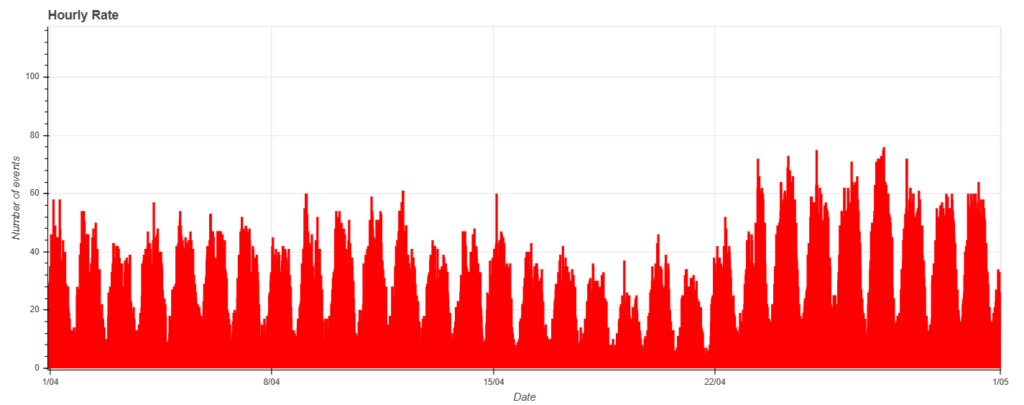
Fig. 1: April 2026 data trend.
Lyrids
The Lyrids are a meteor shower that occurs every year in April, with a peak usually around the 22nd of the month. It is one of the oldest meteor showers ever observed and the one with the longest continuous historical record, with observations dating back to at least 687 B.C. (1).
The parent body was identified in the 19th century as Comet C/1861 G1 (Thatcher), which takes approximately 415 years to complete an orbit around the Sun. The meteors of this shower have their radiant in the constellation Lyra, near the bright star Vega. The Lyrids are distinguished by their speed (about 49 km/s) and their ability to produce bright, persistent trails in the sky.
Typically, about 15–20 meteors per hour can be seen, but much higher peaks have occasionally been recorded, which were believed to be associated with the parent comet’s proximity to Earth. However, studies conducted at the end of the 20th century have refuted this direct correlation and suggest that the outbursts may instead be linked to dynamical resonances or dense regions of material within the comet’s tail (1).
One of the most intense events was the 1803 outburst, with an estimated hourly rate of about 860, which attracted considerable astronomical interest. A more recent one occurred in 1982, when up to 90 meteors per hour were recorded (2).
In 2026, the meteor shower’s activity was fairly moderate, with no real visible peak. This can be seen in the CARMELo network graph in fig. 1, but it was also noted in the CMOR data. Video observations from the Global Meteor Network show that the peak was fairly low this year (3). Activity was also not intense last year (4).
Fireball on 23/4
A fireball is a particularly bright meteor. These are small rocky fragments (meteoroids) that enter Earth’s atmosphere at extremely high speeds. Friction with the air heats them up until they glow intensely, creating very bright trails and, in the most energetic cases, trails that are even colored or persist for a few seconds.
The fireball observed on the evening of April 23, 2026, at 22:45:53 UT (00:45:53 in Italy) was one such spectacular event. It was seen across much of Europe, from Germany to Italy, with approximately 350 reports collected by the International Meteor Organization (5). Many witnesses described a luminous trail lasting about 3–4 seconds, silent but with very vivid, greenish colors (see fig. 2). In some areas, such as Liguria, the glow was so intense that it lit up the landscape almost as if it were daytime.
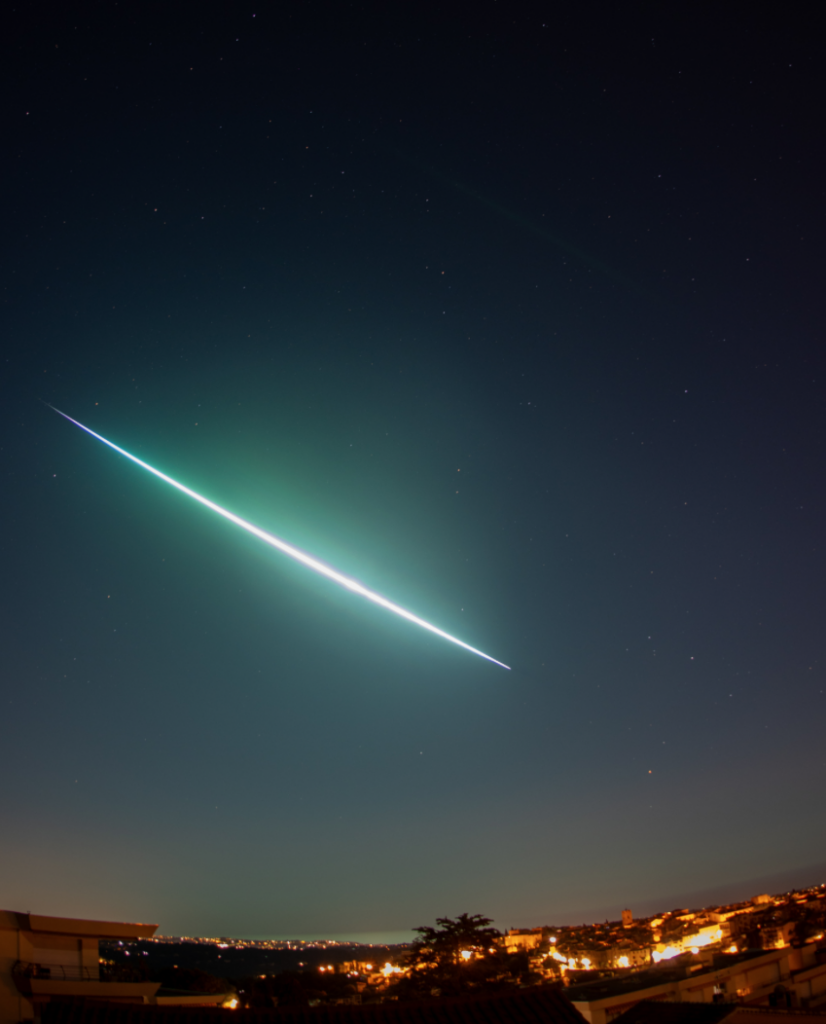
Fig. 2: The fireball of April 23, 2026, as seen from Vence, France. Credits: Sylvain R./IMO
Despite the magnitude of the event, not all observation networks were able to record it in its entirety. The Global Meteor Network and the PRISMA network of the National Institute of Astrophysics did not provide data useful for accurately reconstructing its trajectory. It was, however, observed by 12 cameras of the Fripon network (6) over the Tyrrhenian Sea: its trail lit up at an altitude of about 87 km and faded at about 48 km. It reached an absolute magnitude of -13 at an altitude of about 68 km. Its speed was approximately 29 km/s. The reconstruction of its orbit describes a body with a moderate inclination and an aphelion just beyond Mars’ orbit, with a semi-major axis of less than 3 AU (Astronomical Units). It was therefore not a Lyrid.
The CARMELo network also did not directly detect the fireball’s passage at the exact moment of the event. This can happen: to observe a meteor using the radio method, a specific alignment between the transmitter, the ionized trail, and the receiver is required. If this alignment is not favorable, the echo is not recorded, even if the phenomenon is very bright.
In the 15 seconds following the fireball, however, the CARMELo network recorded as many as 21 radio echoes of varying intensity. How can this be explained?
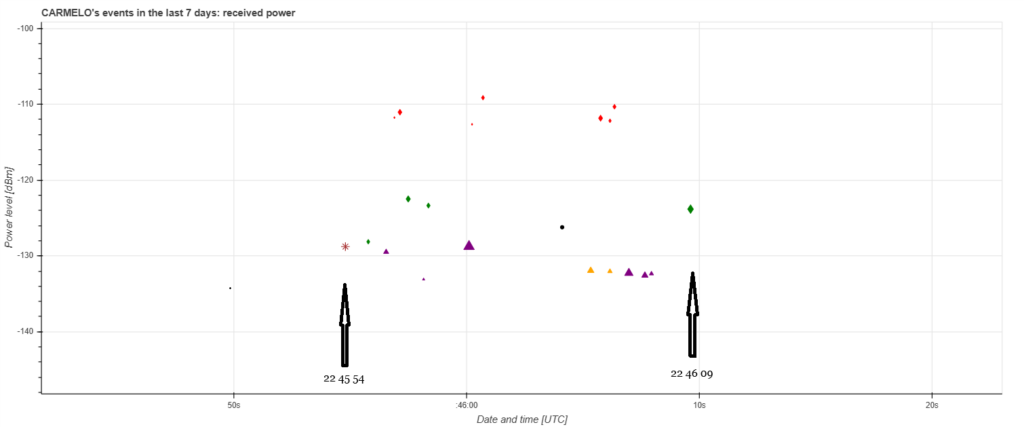
Fig. 2: Radio echoes detected by the CARMELo network between 22:45:54 UT and 22:46:09 UT on April 23, 2026.
Let’s assume that such a powerful event created a very extensive and “dense” ionization trail, which consequently dissipated through reionization over a much longer period than that of a meteor of ordinary size. In the seconds that followed, winds in the upper atmosphere may have distorted and broken this trail into several pieces. Some of these “fragments” then found themselves, even if only for brief moments, in the right position to reflect the radio signal toward our receivers.
In this way, even without a main echo, the fireball left a clearly recognizable radio trail that extended over time. This is an interesting phenomenon, suggesting a particularly energetic and complex event.
The CARMELo network
The network currently consists of 16 receivers located in Italy, Spain, the UK, Switzerland and the USA. The European receivers are tuned to the Graves radar station frequency in France, which is 143.050 MHz. Participating in the network are:
- Lorenzo Barbieri, Budrio (BO) ITA
- Associazione Astrofili Bolognesi, Bologna ITA
- Associazione Astrofili Bolognesi, Medelana (BO) ITA
- Paolo Fontana, Castenaso (BO) ITA
- Associazione Astrofili Pisani, Orciatico (PI) ITA
- Gruppo Astrofili Persicetani, San Giovanni in Persiceto (BO) ITA
- Roberto Nesci, Foligno (PG) ITA
- MarSEC, Marana di Crespadoro (VI) ITA
- Gruppo Astrofili Vicentini, Arcugnano (VI) ITA
- Associazione Ravennate Astrofili Rheyta, Ravenna (RA) ITA
- Mike German a Hayfield, Derbyshire UK
- Mike Otte, Pearl City, Illinois USA
- Yuri Malagutti, Comano (TI) CH
- Leslie Fry, Trawscoed Ceredigion, Wales UK
- Brian Coleman, Redenham Observatory, Andover, England UK
- Radio club La Salle University, Barcellona ESP
The authors’ hope is that the network can expand both quantitatively and geographically, thus allowing the production of better quality data.
References
(1) M.J. Martínez Usó et al. (2023): The Lyrids meteor shower: A historical perspective, Planetary and Space Science, Vol. 238
(2) Porubcan, V. & Cevolani, G. (1985): Unusual Display of the Lyrid Meteor Shower in 1982, Contributions of the Astronomical Observatory Skalnate Pleso, Vol.13, p.247
(3) Global Meteor Network – Lyrids 2026.
(4) M. Maglione, L. Barbieri (2025): April 2025 CARMELo report, eMetN Meteor Journal, Vol. 10, Issue 4, p.234
(5) International Meteor Organization – Fireball 23/4.