Mariasole Maglione (GAV, Gruppo Astrofili Vicentini)
Lorenzo Barbieri (CARMELO network and AAB, Associazione Astrofili Bolognesi)
William Rivato (MarSEC, Marana Space Explorer Center)
Introduction
In the first half of July, meteor activity was moderate, mainly dominated by the Psi Cassiopeids meteor shower (187 PCA).
Methods
The CARMELO network consists of SDR radio receivers. In them, a microprocessor (Raspberry) performs three functions simultaneously:
- By driving a dongle, it tunes the frequency on which the transmitter transmits and tunes like a radio, samples the radio signal and through the FFT (Fast Fourier Transform) measures frequency and received power.
- By analyzing the received data for each packet, it detects meteoric echoes and discards false positives and interference.
- It compiles a file containing the event log and sends it to a server.
The data are all generated by the same standard, and are therefore homogeneous and comparable. A single receiver can be assembled with a few devices whose total current cost is about 210 euros.
To participate in the network read the instructions on this page.
July data
In the plots that follow, all available at this page, the abscissae represent time, which is expressed in UT (Universal Time) or in solar longitude (Solar Long), and the ordinates represent the hourly rate, calculated as the total number of events recorded by the network in an hour divided by the number of operating receivers.
In fig.1, the trend of signals detected by the receivers for the month of July.
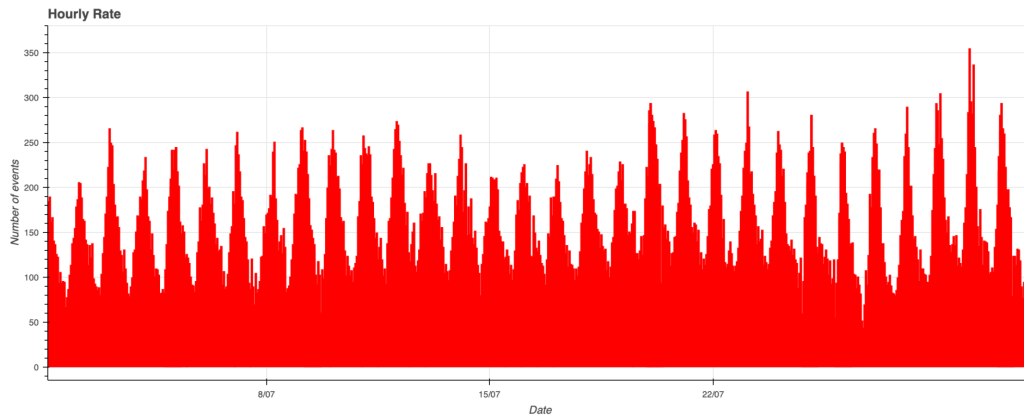
July 2025 data trend.
Psi Cassiopeiids
Psi Cassiopeids (187 PCA) are a meteor shower active during the first half of July, with a peak around mid-month. It is a minor shower, not easily visible to the naked eye but detectable through radio observation systems, thanks to the speed and frequency of the meteors, especially during twilight hours. It is not associated with any known parent body (1).
The radiant of the shower is located in the Cassiopeia constellation, near the star Psi Cassiopeiae, from which it takes its name. The Psi Cassiopeids are fast meteors, entering Earth’s atmosphere at about 58 km/s, and they produce short, intense radio echoes.
In 2025, the Psi Cassiopeids showed increasing activity in the first half of July, and the CARMELO network recorded an hourly rate consistent with the shower’s tracking (fig. 2).
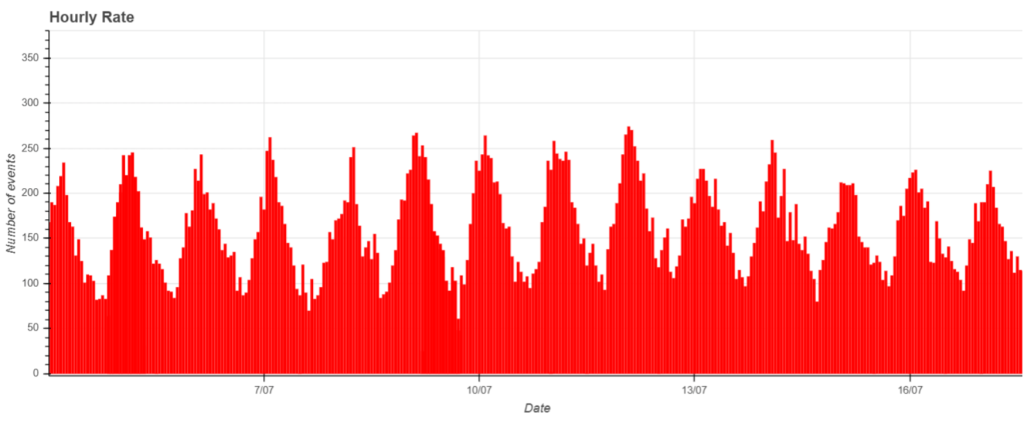
Hourly rate between July 4 and 18, 2025, showing activity consistent with the tracking of the Psi Cassiopeids meteor shower.
The CARMELO network
The network currently consists of 14 receivers, 13 of which are operational, located in Italy, the UK, Croatia and the USA. The European receivers are tuned to the Graves radar station frequency in France, which is 143.050 MHz. Participating in the network are:
- Lorenzo Barbieri, Budrio (BO) ITA
- Associazione Astrofili Bolognesi, Bologna ITA
- Associazione Astrofili Bolognesi, Medelana (BO) ITA
- Paolo Fontana, Castenaso (BO) ITA
- Paolo Fontana, Belluno (BL) ITA
- Associazione Astrofili Pisani, Orciatico (PI) ITA
- Gruppo Astrofili Persicetani, San Giovanni in Persiceto (BO) ITA
- Roberto Nesci, Foligno (PG) ITA
- MarSEC, Marana di Crespadoro (VI) ITA
- Gruppo Astrofili Vicentini, Arcugnano (VI) ITA
- Associazione Ravennate Astrofili Theyta, Ravenna (RA) ITA
- Akademsko Astronomsko Društvo, Rijeka CRO
- Mike German a Hayfield, Derbyshire UK
- Mike Otte, Pearl City, Illinois USA
The authors’ hope is that the network can expand both quantitatively and geographically, thus allowing the production of better quality data.
References
(1) Peter Jenniskens et al. (2006): Meteor showers and their parent comets, Cambridge University Press