By Paul Roggemans, Denis Vida, Damir Šegon, Milan Kalina, James M. Scott, Jeff Wood
Abstract: A short duration meteor activity lasting about 24 hours has been detected by GMN on 21st – 22nd March 2026 from a radiant at R.A. 279.8° and decl. –70.6° with a geocentric velocity of 55.7 km/s. The activity has been identified as the zeta-Pavonids (ZPA#853), a long-period comet type meteor stream. This case study confirms the existence of this annual meteor shower that fulfils the criteria in order to be nominated for established status by the IAU-MDC.
1 Introduction
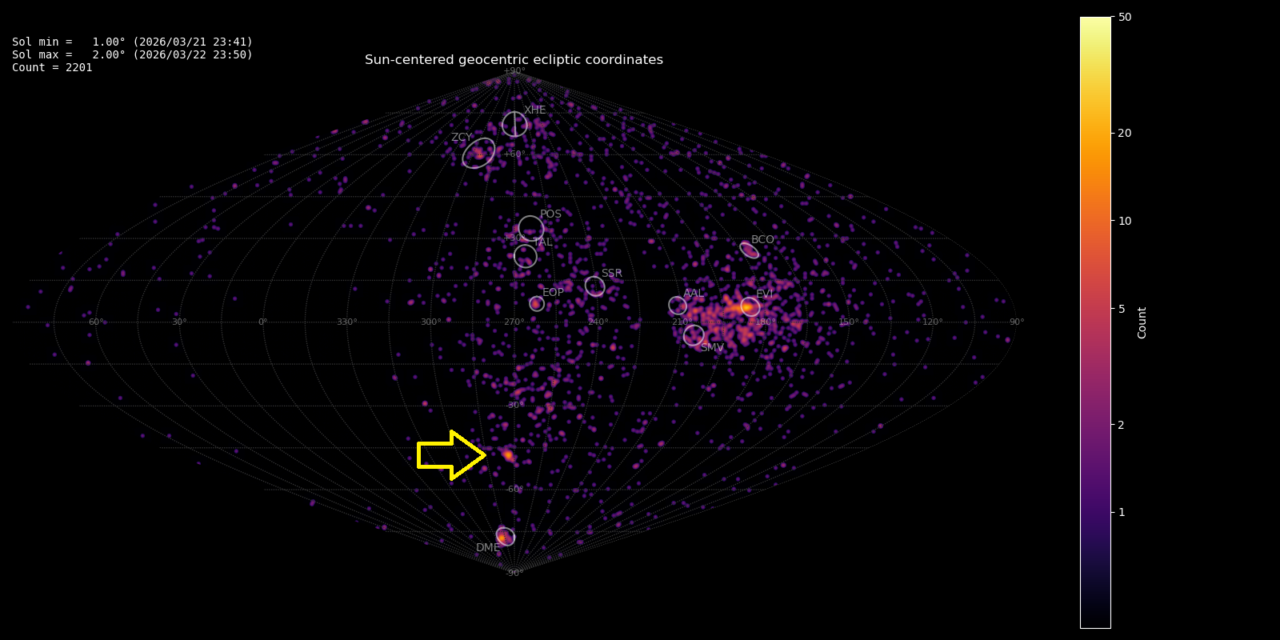
The radiant density map for the 21st and 22nd March 2026 showed a bright spot caused by a short duration meteor shower (Figure 1). The activity lasted about 24 hours and no trace was recorded the day before or the day after this event. The shower was not listed in the GMN meteor shower reference list but is identified as the zeta-Pavonids (ZPA#853) in the IAU-MDC Working List of Meteor Showers. The shower was detected from a group of five triangulated meteors by CAMS in 2016 (Jenniskens et al., 2018). More zeta-Pavonids were observed in 2020 and 2021 with an unusually short duration (Jenniskens, 2021; 2023).
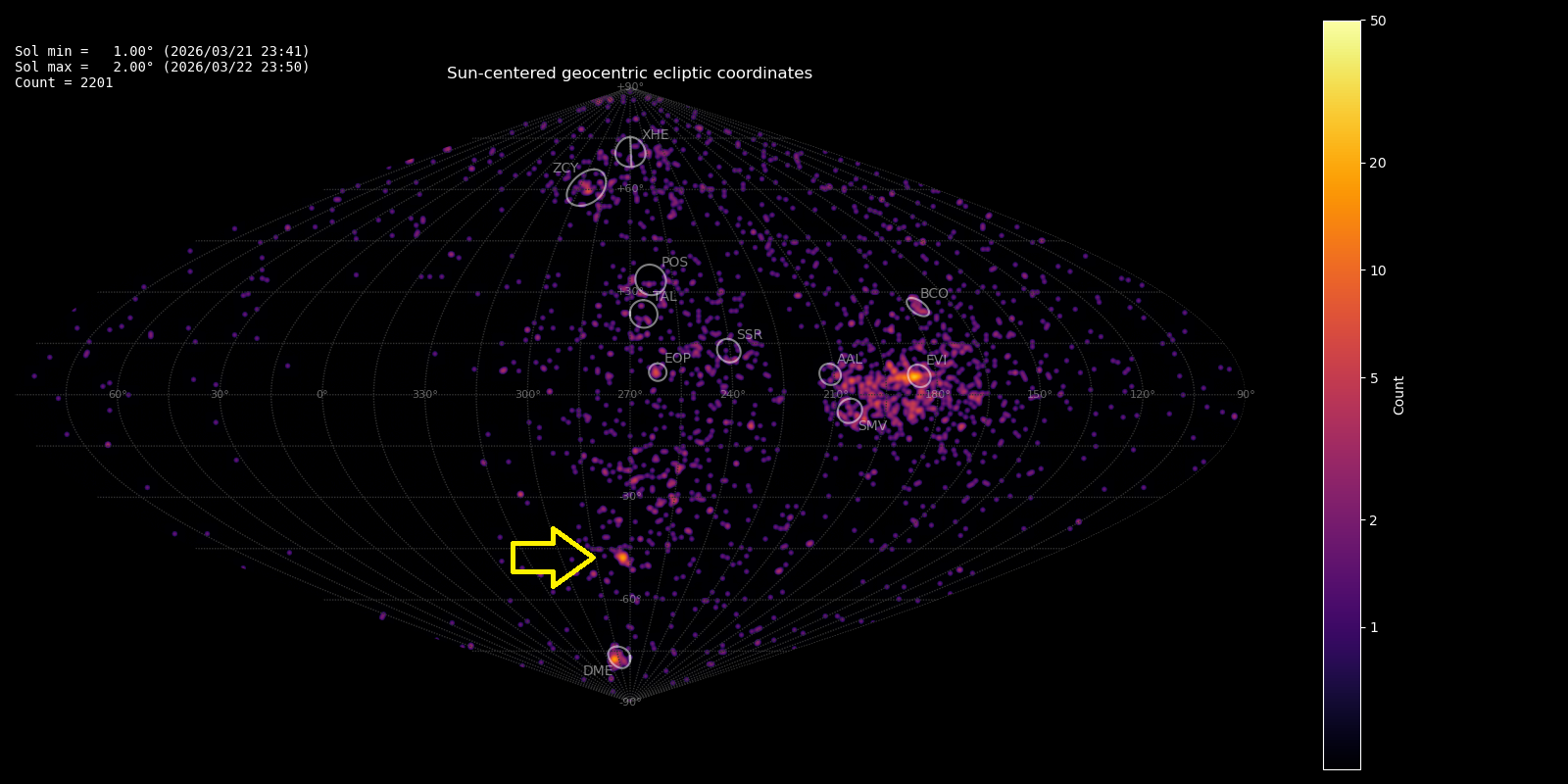
Figure 1 – Radiant density map with 2201 radiants obtained by the Global Meteor Network during the 21st – 22nd March, 2026. The position of the zeta-Pavonids in Sun-centered geocentric ecliptic coordinates is marked with a yellow arrow.
2 2026 zeta-Pavonids
The GMN shower association criteria assume that meteors within 1° in solar longitude, within 1.6° in radiant in this case (Figure 2), and within 10% in geocentric velocity of a shower reference location are members of that shower. Further details about the shower association are explained in Moorhead et al. (2020). Using these meteor shower selection criteria, 36 orbits have been identified as zeta-Pavonids recorded in 2026 by 88 GMN cameras installed in Australia, New Zealand and South Africa, with the cameras listed at the end of this document. The final results have been listed in Table 2. The radiant size appears to be very compact in equatorial (Figure 3) and in ecliptic coordinates (Figure 5). The radiant drift is uncertain due to the short activity interval (Figure 4).
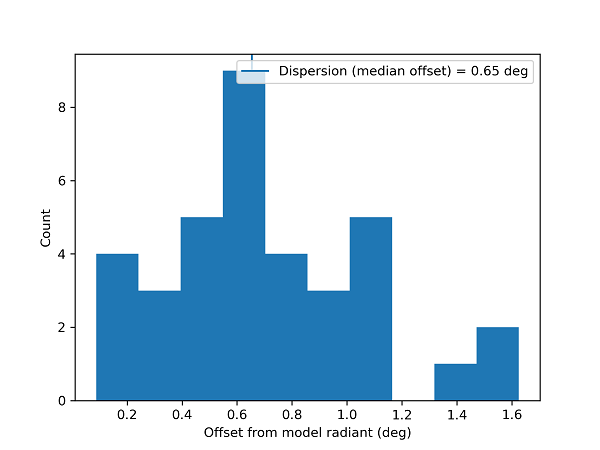
Figure 2 – Dispersion median offset on the radiant position.
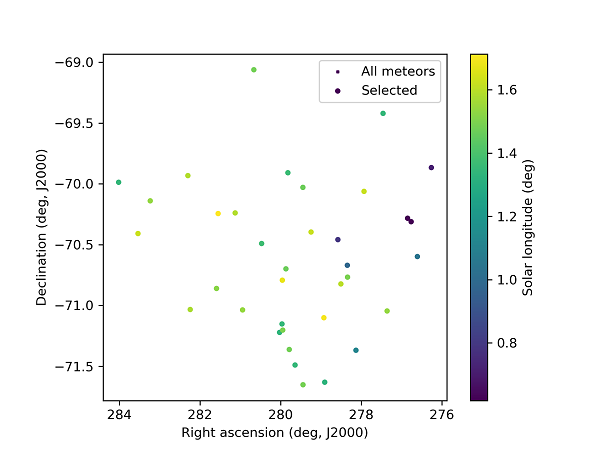
Figure 3 – The radiant distribution during the solar-longitude interval 0.62° – 1.71° in equatorial coordinates.
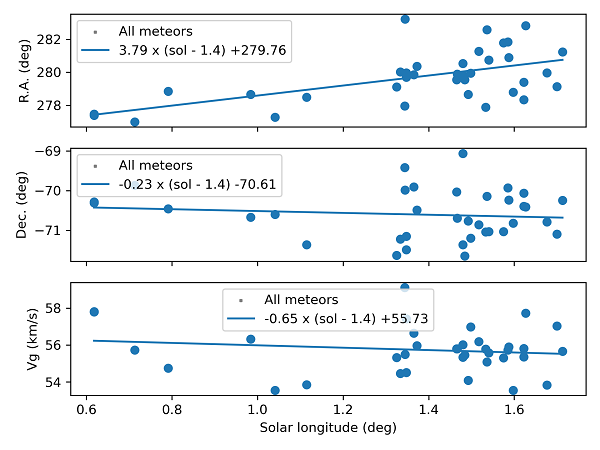
Figure 4 – The radiant drift.
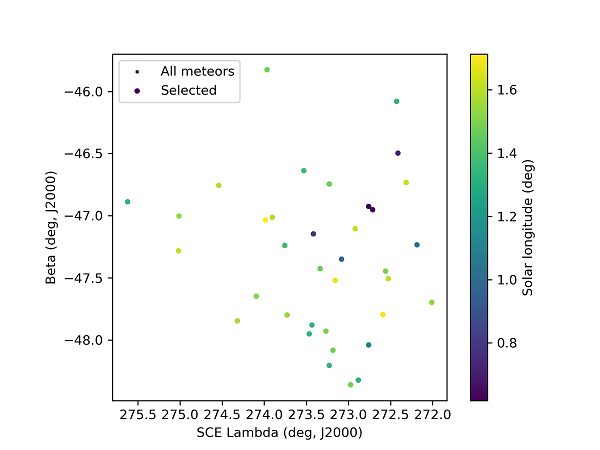
Figure 5 – The radiant distribution during the solar-longitude interval 0.62° – 1.71° in Sun centered geocentric ecliptic coordinates.
3 Shower classification based on orbits
A complete independent meteoroid stream search has been applied to orbit data obtained between Solar Longitude 0° and 2° during the years 2019 to 2026. The method has been described in detail in a separate publication (Roggemans et al., 2026a). 15463 orbits were available within this time interval and a final mean orbit has been computed by the method of Jopek et al. (2006) for the thresholds according to the Rayleigh fit in Figure 6, with as cutoff value DSH < 0.125 and DD < 0.05 and DJ < 0.125 (Southworth and Hawkins, 1963; Drummond, 1981; Jopek, 1993). The results and mean orbit based upon 90 meteors for 2022–2026 are listed in Table 2.
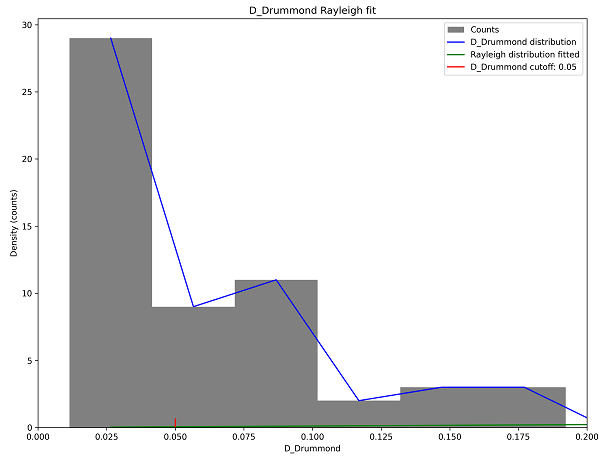
Figure 6 – Rayleigh fit on the Drummond criterion for zeta-Pavonids, 2026 data results in a cutoff value od DD = 0.05.
The radiant is very compact in geocentric equatorial coordinates (Figure 7). The spread in Right Ascension is due to the proximity of the Southern Pole. The compactness of the radiant becomes clearer in the geocentric Sun-centered ecliptic coordinates (Figure 8). Meteors associated with the zeta-Pavonids with more tolerant D-criteria of DSH < 0.2 and DD < 0.08 and DJ < 0.2, do not deviate much from the main radiant and are most likely outliers of the same meteor shower. The number of zeta-Pavonid meteors as a percentage relative to the total number of meteors recorded at the Southern hemisphere results in the profile plotted in Figure 9. Best rates occurred at λʘ = 1.3 ± 0.1° and the total activity duration took about 24 hours.
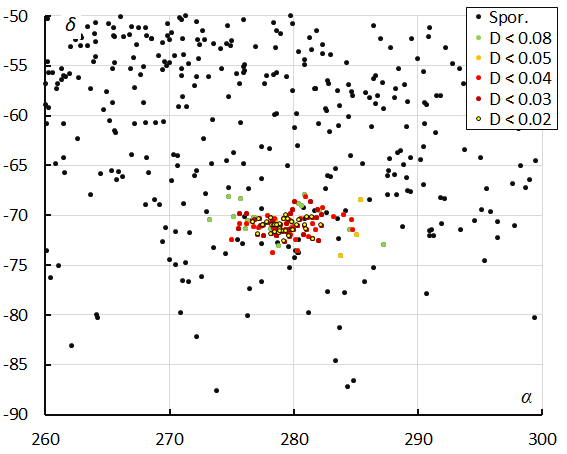
Figure 7 – The radiant distribution during the solar-longitude interval 0° – 2° in equatorial coordinates, color-coded for different threshold values of the combined similarity criteria.
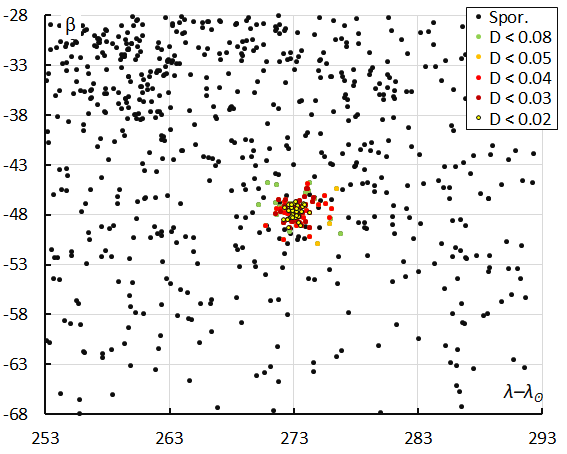
Figure 8 – The radiant distribution during the solar-longitude interval 0° – 2° in Sun-centered geocentric ecliptic coordinates, color-coded for different threshold values of the combined similarity criteria.
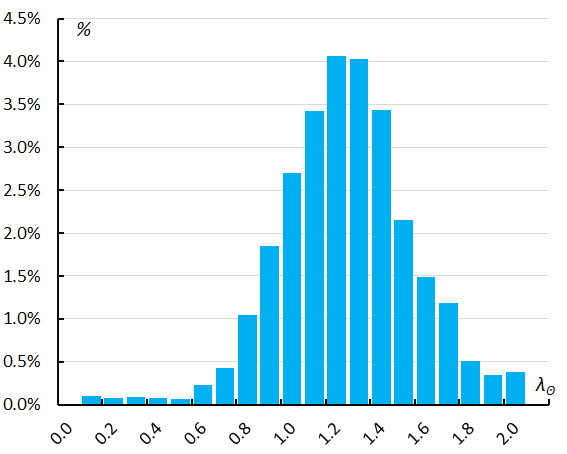
Figure 9 – The percentage of zeta-Pavonids relative to the total number of meteors, for the orbit classification method 2022–2026.
Table 1 – Number of zeta-Pavonid orbits detected by GMN per year.
| Year | Radiant method |
| 2022 | 3 |
| 2023 | 8 |
| 2024 | 28 |
| 2025 | 22 |
| 2026 | 29 |
The number of zeta-Pavonids identified per year reflects the expansion of GMN at the Southern hemisphere (Table 1). The shower displays annual activity and there is no indication for any periodicity or outbursts.
4 Orbit and parent body
The diagram of the inclination i versus the Longitude of Perihelion Π shows a clear concentration (Figure 10). The eccentricity e versus the Longitude of Perihelion Π appears scattered in e due to the large uncertainties in e (Figure 11).
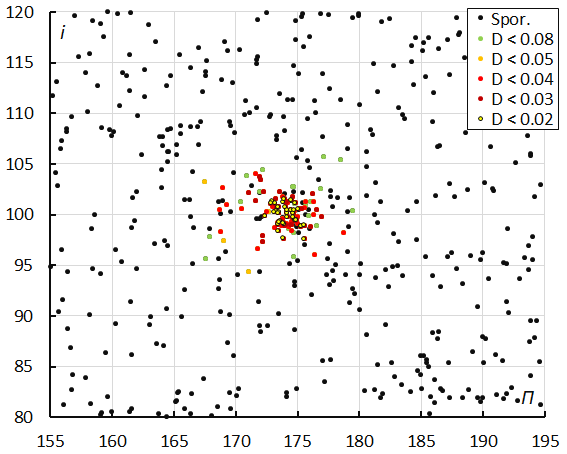
Figure 10 – Inclination i versus the Longitude of Perihelion Π color-coded for different classes of D-criteria thresholds, for λʘ between 0° and 2°. Spor. = sporadics.
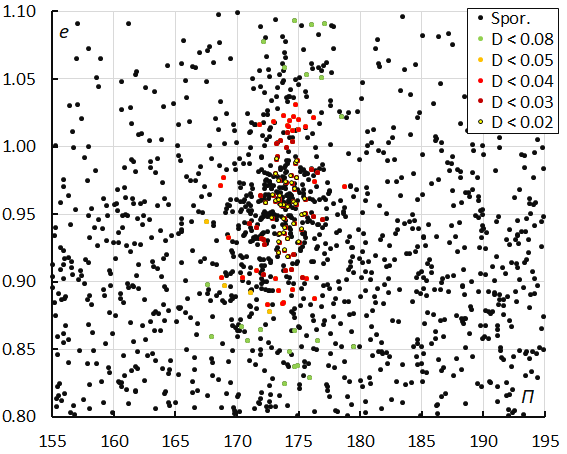
Figure 11 – Eccentricity e versus the Longitude of Perihelion Π color-coded for different classes of D-criteria thresholds, for λʘ between 0° and 2°. Spor. = sporadics.
There is another concentration in the e versus Π diagram intermixed with the zeta-Pavonids. These orbits correspond to the delta-Mensids (DME#0130), an unconfirmed meteor shower associated with comet C/1804 E1 (Pons). The delta-Mensids have the same eccentricity and the same longitude of perihelion as the zeta-Pavonids.
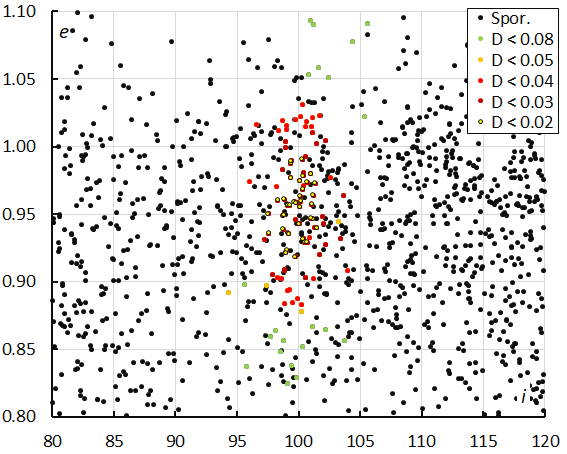
Figure 12 – Eccentricity e versus the inclination i color-coded for different classes of D-criteria thresholds, for λʘ between 0° and 2°. Spor. = sporadics.
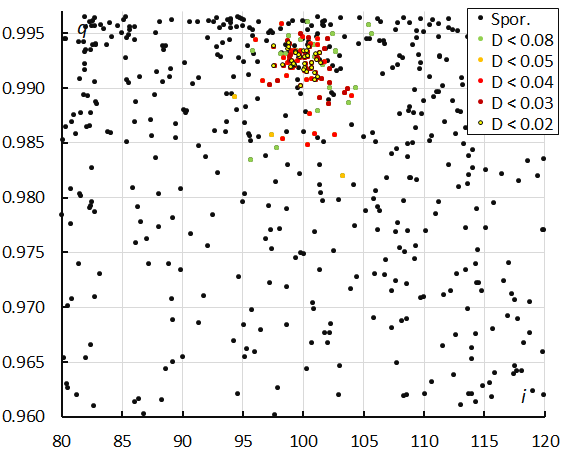
Figure 13 – Perihelion distance q versus the inclination i color-coded for different classes of D-criteria thresholds, for λʘ between 0° and 2°. Spor. = sporadics.
Looking at the diagram eccentricity e versus inclination i, we see the same spread in eccentricity due to the large uncertainty near the parabolic limit of e = 1 (Figure 12). The zeta-Pavonid orbits show a clear concentration in perihelion distance q versus inclination i (Figure 13).
The Tisserand value relative to Jupiter with TJ = 0.03 is typical for a long-period cometary orbit (Figure 14). The meteoroid stream crosses the ecliptic and Earth’s orbit on a retrograde orbit (i > 90°) at its ascending node (Figure 15). The descending node is situated far beyond the orbit of Neptune. A search for parent bodies did not reveal any good match based upon the Drummond D-criterion. Note that also the parent body of the delta-Mensids, C/1804 E1 (Pons), appears in the list (Table 3).
Table 2 – Comparing solutions obtained by the radiant method for 2026, the orbit method 2022–2026 for DD < 0.05, compared to the solution by Jenniskens (2023).
|
|
Radiant 2026 |
Orbit method
DD < 0.05 |
Jenniskens (2023) |
| λʘ (°) | 1.48 | 1.20 | 1.4 |
| λʘb (°) | 0.61 | 0.21 | 1.0 |
| λʘe (°) | 1.71 | 1.84 | 2.0 |
| αg (°) | 279.8 | 279.4 | 279.5 |
| δg (°) | –70.6 | –71.0 | –71.1 |
| Δαg (°) | +3.79 | +2.72 | +1.27 |
| Δδg (°) | –0.23 | +0.54 | +0.11 |
| vg (km/s) | 55.7 | 55.4 | 56.3 |
| Hb (km) | 112.5 | 112.1 | 113.4 |
| He (km) | 100.2 | 99.5 | 99.4 |
| Hp (km) | 105.1 | 104.2 | 104.7 |
| MagAp | –1.1 | –1.3 | +0.71 |
| λg (°) | 274.8 | 274.5 | 274.3 |
| λg – λʘ (°) | 273.3 | 273.3 | 272.9 |
| βg (°) | –47.3 | –47.7 | –48.1 |
| a (A.U.) | 28.7 | 21.6 | 999 |
| q (A.U.) | 0.991 | 0.991 | 0.993 |
| e | 0.965 | 0.954 | 1.0 |
| i (°) | 100.8 | 100.0 | 99.6 |
| ω (°) | 352.52 | 352.48 | 353.6 |
| Ω (°) | 181.38 | 181.25 | 181.4 |
| Π (°) | 173.9 | 173.7 | 174.8 |
| Tj | –0.05 | 0.03 | –0.21 |
| N | 36 | 90 |
45 |
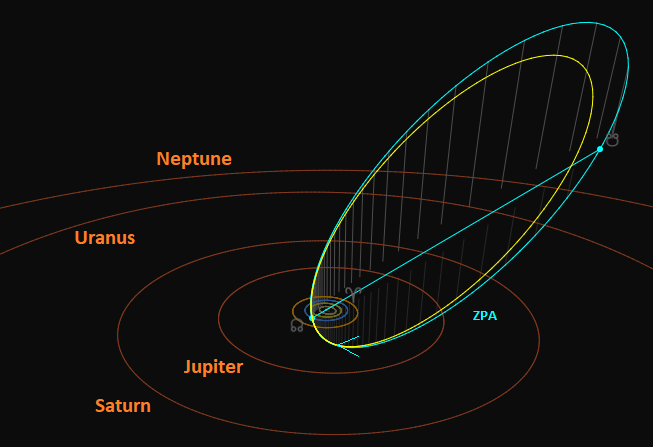
Figure 14 – Comparing the radiant determined zeta-Pavonids solution for 2026 (blue) with the orbit determined solution for 2022–2026 (yellow). (Plotted with the Orbit visualization app provided by Pető Zsolt).
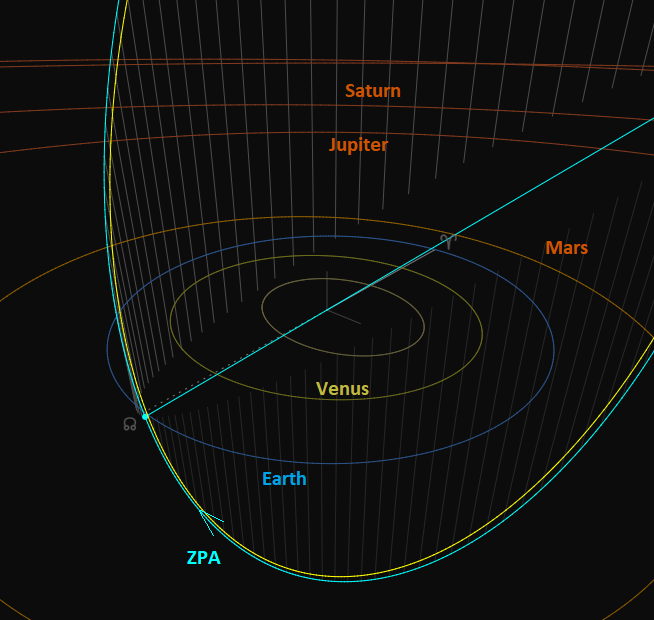
Figure 15 – Comparing the radiant determined zeta-Pavonids solution for 2026 (blue) with the orbit determined solution 2022–2026 (yellow), close-up at the inner Solar System. (Plotted with the Orbit visualization app provided by Pető Zsolt).
Table 3– Top ten matches of a search for possible parent bodies with DD < 0.3, based upon the mean orbit derived from the radiant classification method.
| Name | DD |
| C/1999 T1 (McNaught-Hartley) | 0.151 |
| C/1907 G1 (Grigg-Mellish) | 0.174 |
| C/1893 U1 (Brooks) | 0.192 |
| C/1742 C1 | 0.219 |
| C/2001 Q4 (NEAT) | 0.223 |
| C/1894 G1 (Gale) | 0.254 |
| (466130) 2012 FZ23 | 0.268 |
| C/1930 D1 (Peltier-Schwassmann-Wachmann) | 0.274 |
| C/2016 E2 (Kowalski) | 0.284 |
| C/1804 E1 (Pons) | 0.284 |
5 Conclusion
This GMN meteoroid orbit data case study confirms the existence of the zeta-Pavonids. The GMN results are in very good agreement with the earlier reported parameters obtained by CAMS (Jenniskens, 2023). Our independent solution has been reported to the IAU-MDC, and the shower now fulfils the criteria for being upgraded to be nominated for established status.
Acknowledgment
This report is based on the data of the Global Meteor Network (Vida et al., 2020a; 2020b; 2021) which is released under the CC BY 4.0 license. We thank all 927 participants in the Global Meteor Network project for their contribution and perseverance. A list with the names of the volunteers who contribute to GMN has been published in the 2025 annual report (Roggemans et al., 2026b). The following 181 cameras contributed to paired meteors used in this study: AU0001, AU0002, AU0003, AU0004, AU0006, AU0007, AU0009, AU000A, AU000B, AU000D, AU000E, AU000F, AU000G, AU000R, AU000S, AU000U, AU000V, AU000X, AU000Y, AU0010, AU001A, AU001B, AU001C, AU001D, AU001E, AU001F, AU001L, AU001N, AU001P, AU001S, AU001U, AU001V, AU001W, AU001X, AU0028, AU002B, AU002E, AU002F, AU0030, AU0035, AU0036, AU0038, AU003J, AU0042, AU0044, AU0048, BR000F, BR000Q, NZ0001, NZ0002, NZ0004, NZ0008, NZ000A, NZ000D, NZ000G, NZ000H, NZ000M, NZ000N, NZ000Q, NZ000R, NZ000S, NZ000V, NZ000W, NZ000X, NZ000Y, NZ000Z, NZ0010, NZ0011, NZ0012, NZ0015, NZ0016, NZ0017, NZ0018, NZ001A, NZ001C, NZ001E, NZ001G, NZ001H, NZ001J, NZ001L, NZ001N, NZ001P, NZ001Q, NZ001R, NZ001S, NZ001V, NZ001W, NZ001X, NZ001Y, NZ0020, NZ0022, NZ0024, NZ0025, NZ0026, NZ0027, NZ0029, NZ002C, NZ002D, NZ002F, NZ002H, NZ002J, NZ002K, NZ002L, NZ002N, NZ002P, NZ002Q, NZ002R, NZ002S, NZ002V, NZ002W, NZ002X, NZ002Y, NZ002Z, NZ0030, NZ0032, NZ0033, NZ0034, NZ0035, NZ0036, NZ0037, NZ0038, NZ003A, NZ003C, NZ003E, NZ003G, NZ003H, NZ003N, NZ003Q, NZ003R, NZ003S, NZ003V, NZ003W, NZ003X, NZ003Y, NZ003Z, NZ0041, NZ0042, NZ0045, NZ0046, NZ0049, NZ004A, NZ004B, NZ004C, NZ004E, NZ004H, NZ004J, NZ004L, NZ004M, NZ004N, NZ004S, NZ004U, NZ004W, NZ004X, NZ004Y, NZ004Z, NZ0051, NZ0059, NZ005G, NZ005J, NZ005K, NZ005L, NZ005M, NZ005Q, NZ005R, NZ005S, NZ005T, NZ005U, NZ006J, NZ006M, NZ006N, NZ006P, NZ006Q, NZ007B, NZ007E, NZ007F, ZA0001, ZA0002, ZA0007, ZA000A, ZA000C and ZA000D.
References
Drummond J. D. (1981). “A test of comet and meteor shower associations”. Icarus, 45, 545–553.
Jenniskens P., Baggaley J., Crumpton I., Aldous P., Pokorny P., Janches D., Gural P. S., Samuels D., Albers J., Howell A., Johannink C., Breukers M., Odeh M., Moskovitz N., Collison J., Ganju S. (2018). “A survey of southern hemisphere meteor showers”. Planetary and Space Science, 154, 21–29.
Jenniskens P. (2021). “Narrow shower of zeta Pavonids (ZPA, #853)3. eMetN Meteor Journal, 6, 332–333.
Jenniskens P. (2023). Atlas of Earth’s meteor showers. Elsevier, Cambridge, United states. ISBN 978-0-443-23577-1. Page 135.
Jopek T. J. (1993). “Remarks on the meteor orbital similarity D-criterion”. Icarus, 106, 603–607.
Jopek T. J., Rudawska R. and Pretka-Ziomek H. (2006). “Calculation of the mean orbit of a meteoroid stream”. Monthly Notices of the Royal Astronomical Society, 371, 1367–1372.
Moorhead A. V., Clements T. D., Vida D. (2020). “Realistic gravitational focusing of meteoroid streams”. Monthly Notices of the Royal Astronomical Society, 494, 2982–2994.
Roggemans P., Vida D., Šegon D., Scott J.M. (2026a). “Meteoroid orbit shower identification”. eMetN Meteor Journal, 11, 189–204.
Roggemans P., Campbell-Burns P., Kalina M., McIntyre M., Scott J. M., Šegon D., Vida D. (2026b). “Global Meteor Network report 2025”. eMetN Meteor Journal, 11, 89–129.
Southworth R. B. and Hawkins G. S. (1963). “Statistics of meteor streams”. Smithsonian Contributions to Astrophysics, 7, 261–285.
Vida D., Gural P., Brown P., Campbell-Brown M., Wiegert P. (2020a). “Estimating trajectories of meteors: an observational Monte Carlo approach – I. Theory”. Monthly Notices of the Royal Astronomical Society, 491, 2688–2705.
Vida D., Gural P., Brown P., Campbell-Brown M., Wiegert P. (2020b). “Estimating trajectories of meteors: an observational Monte Carlo approach – II. Results”. Monthly Notices of the Royal Astronomical Society, 491, 3996–4011.
Vida D., Šegon D., Gural P. S., Brown P. G., McIntyre M. J. M., Dijkema T. J., Pavletić L., Kukić P., Mazur M. J., Eschman P., Roggemans P., Merlak A., Zubrović D. (2021). “The Global Meteor Network – Methodology and first results”. Monthly Notices of the Royal Astronomical Society, 506, 5046–5074.