By Damir Šegon, Denis Vida, Paul Roggemans, James M. Scott, Jeff Wood
Abstract: A new meteor shower from a Jupiter Family Comet type orbit (TJ = 2.87) was detected during October 19 – 27, 2025 by the Global Meteor Network. 124 meteors belonging to the new shower were observed between 206° < λʘ < 214° from a radiant at R.A. = 359.7° and Decl.= +12.2° in the constellation of Pegasus, with a geocentric velocity of 14.0 km/s. The new meteor shower has been listed in the IAU MDC Working List of Meteor Showers under the temporary name-designation: M2025-U1.
1 Introduction
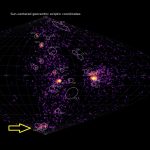
The GMN radiant maps for October 19 – 27, 2025, showed a clear concentration of related radiants in the constellation of Pegasus. The activity lasted one week with an almost constant level of activity with the radiant well visible on the radiant density maps see Figures 1 and 2. When the activity had completely ceased, 124 meteors of this new meteor shower had been registered by the Global Meteor Network low-light video cameras. The shower was independently observed by 311 cameras in Australia, Bosnia and Herzegovina, Belgium, Bulgaria, Brazil, Canada, Chile, Czechia, Denmark, Germany, France, Hungary, the Netherlands, New Zealand, Poland, Romania, Russia, Slovakia, South Korea, Spain, Ukraine, United Kingdom and the United States.
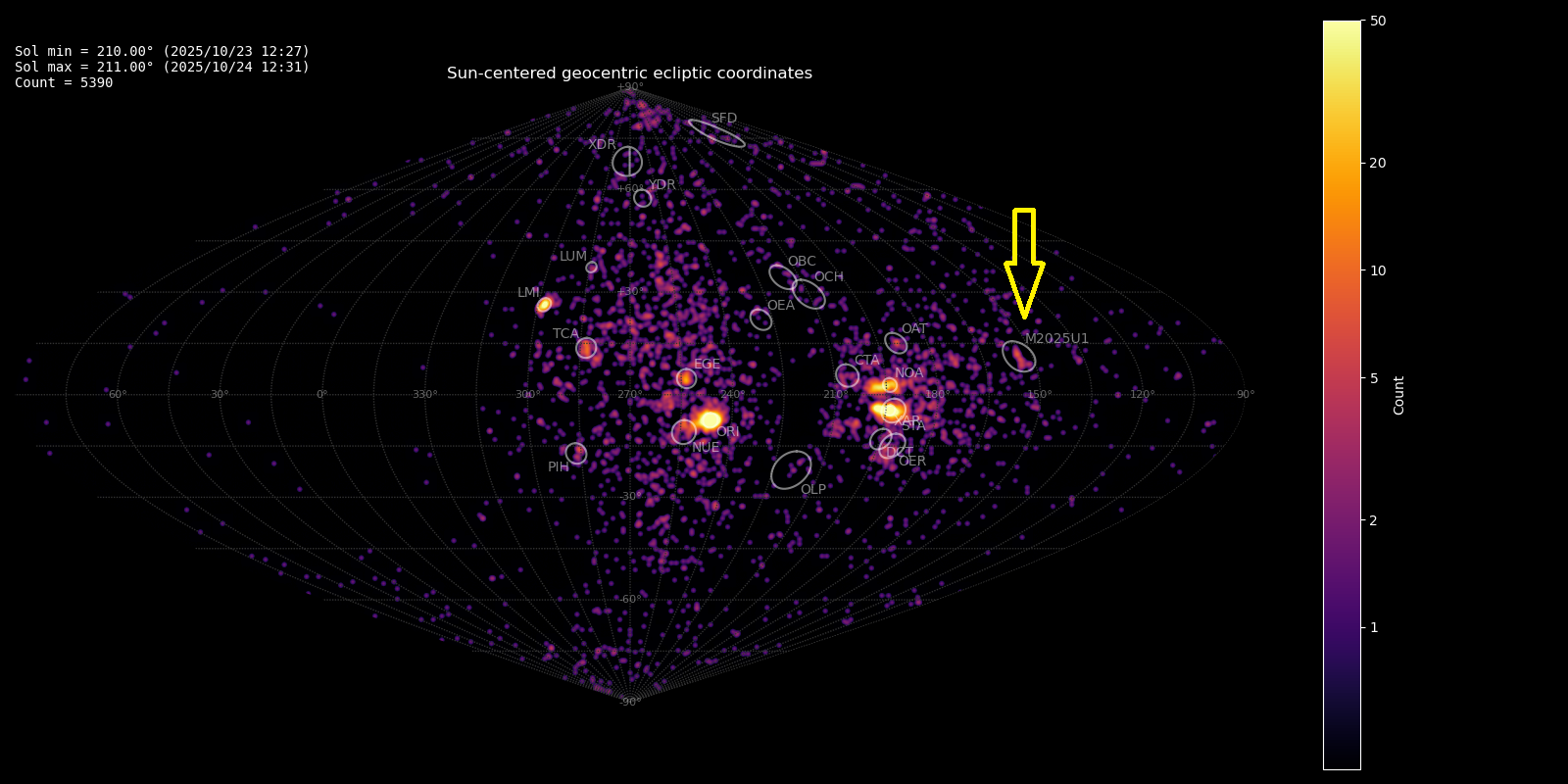
Figure 1 – Radiant density map in sinusoidal projection with 5390 radiants obtained by the Global Meteor Network during October 23 – 24, 2025. A distinct concentration is visible in Sun-centered geocentric ecliptic coordinates which was identified as a new meteor shower with the temporary identification M2025-U1. Activity from this new source was detected during an entire week.
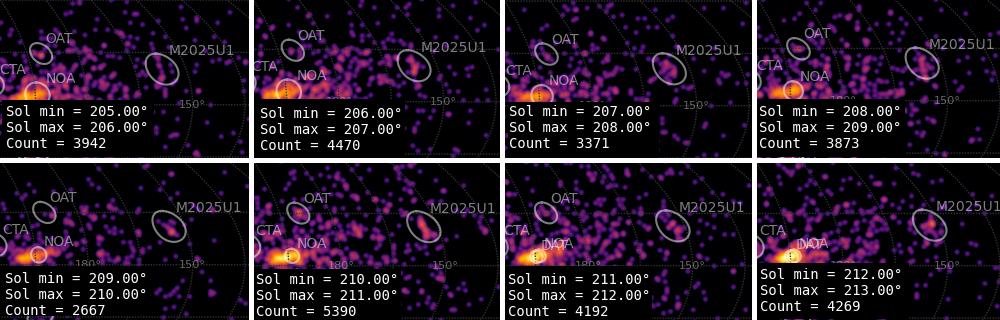
Figure 2 – The appearance of the M2025-U1 radiant during the activity period.
2 Shower classification based on radiants
The GMN shower association criteria assume that meteors within 1° in solar longitude, within 4.2° in radiant in this case, and within 10% in geocentric velocity of a shower reference location are members of that shower. Further details about the shower association are explained in Moorhead et al. (2020).
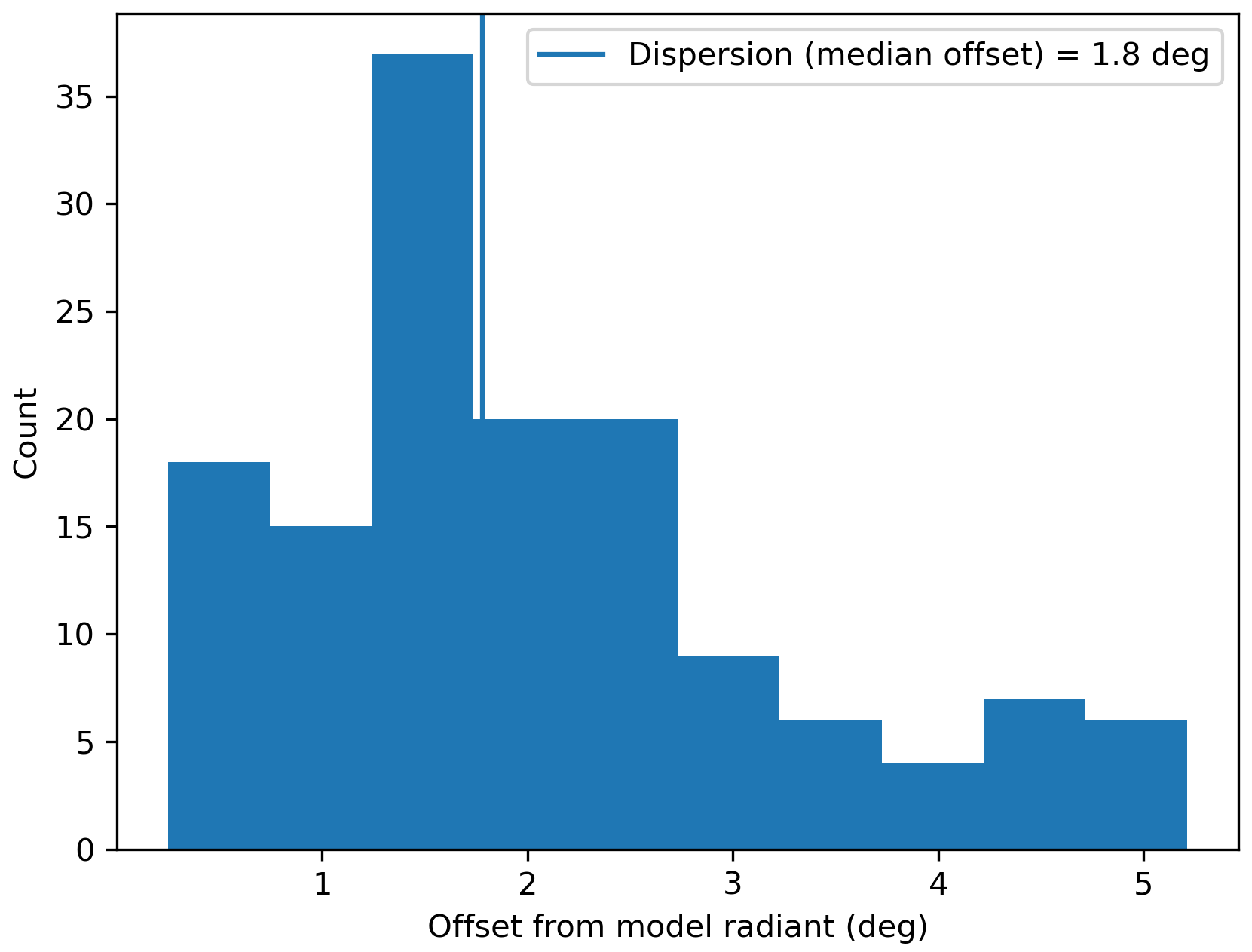
Figure 3 – Dispersion median offset on the radiant position.
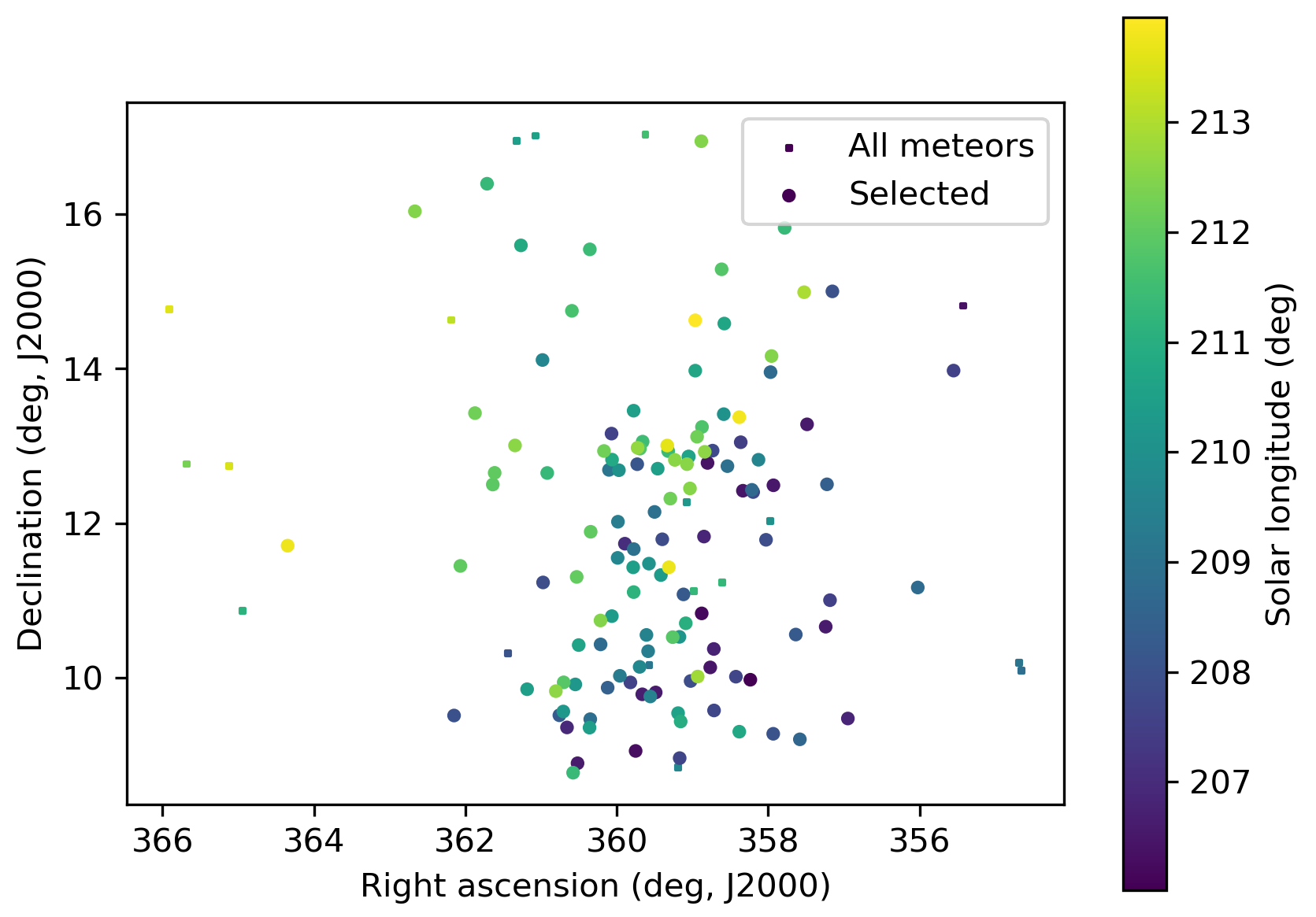
Figure 4 – The radiant distribution during the solar-longitude interval 206° – 214° in equatorial coordinates.
The shower had a median geocentric radiant with coordinates R.A. = 359.7°, Decl. = +12.2°, within a circle with a standard deviation of ±1.7° (equinox J2000.0). The radiant drift in R.A. is +0.22° on the sky per degree of solar longitude and +0.34° in Dec., both referenced to λʘ = 211.0° (Figures 4 and 5). The uncorrected raw numbers of shower meteors per degree in solar longitude show a constant activity level (Figure 6). Figures 7 and 8 show that the new activity source appeared on top of the sporadic background noise. The median Sun-centered ecliptic coordinates were λ – λʘ = 153.6°, β = +11.3° (Figure 9). The geocentric velocity was 14.0 ± 0.1 km/s. The shower parameters as obtained by the GMN method are listed in Table 1.
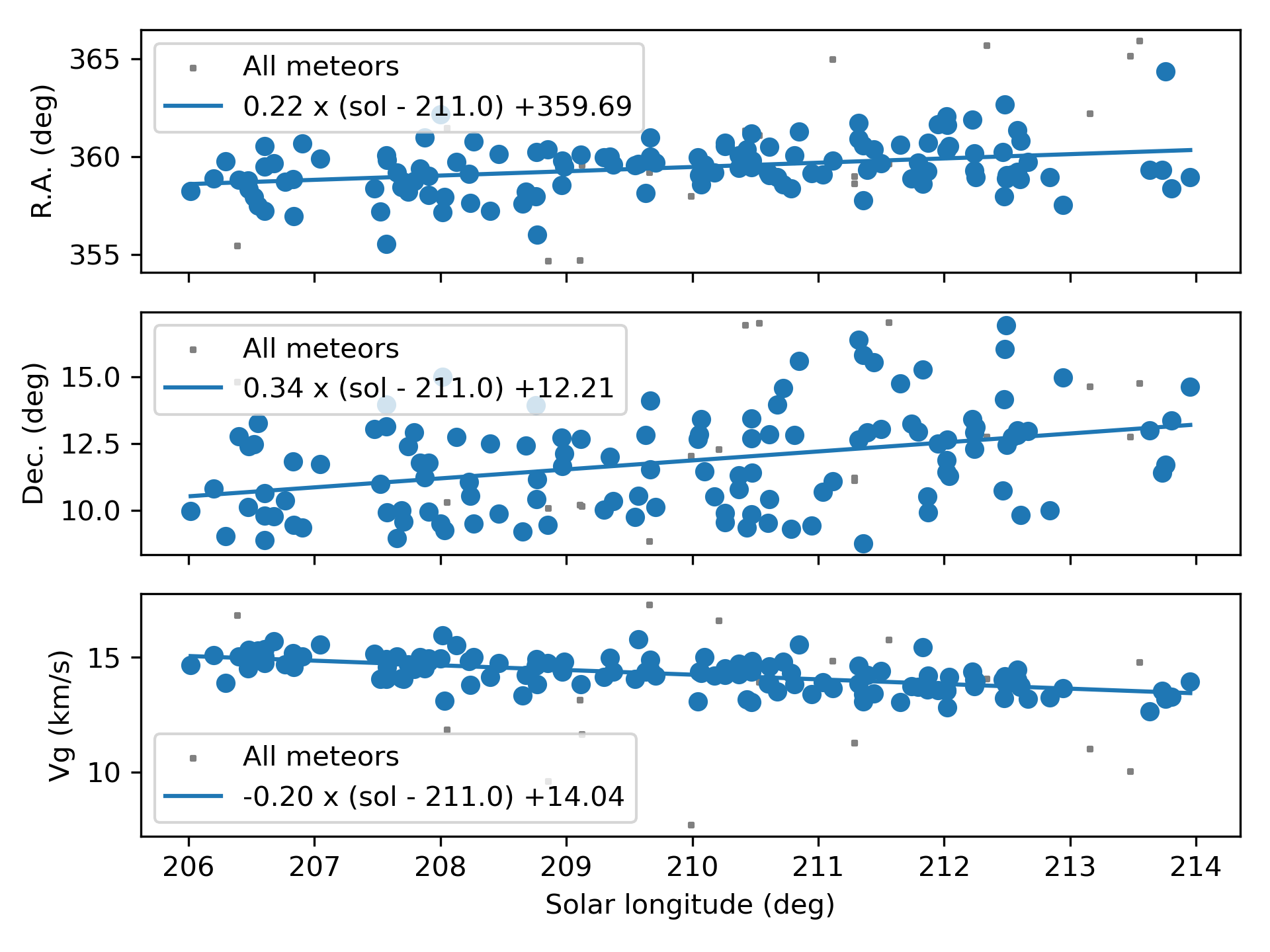
Figure 5 – The radiant drift.
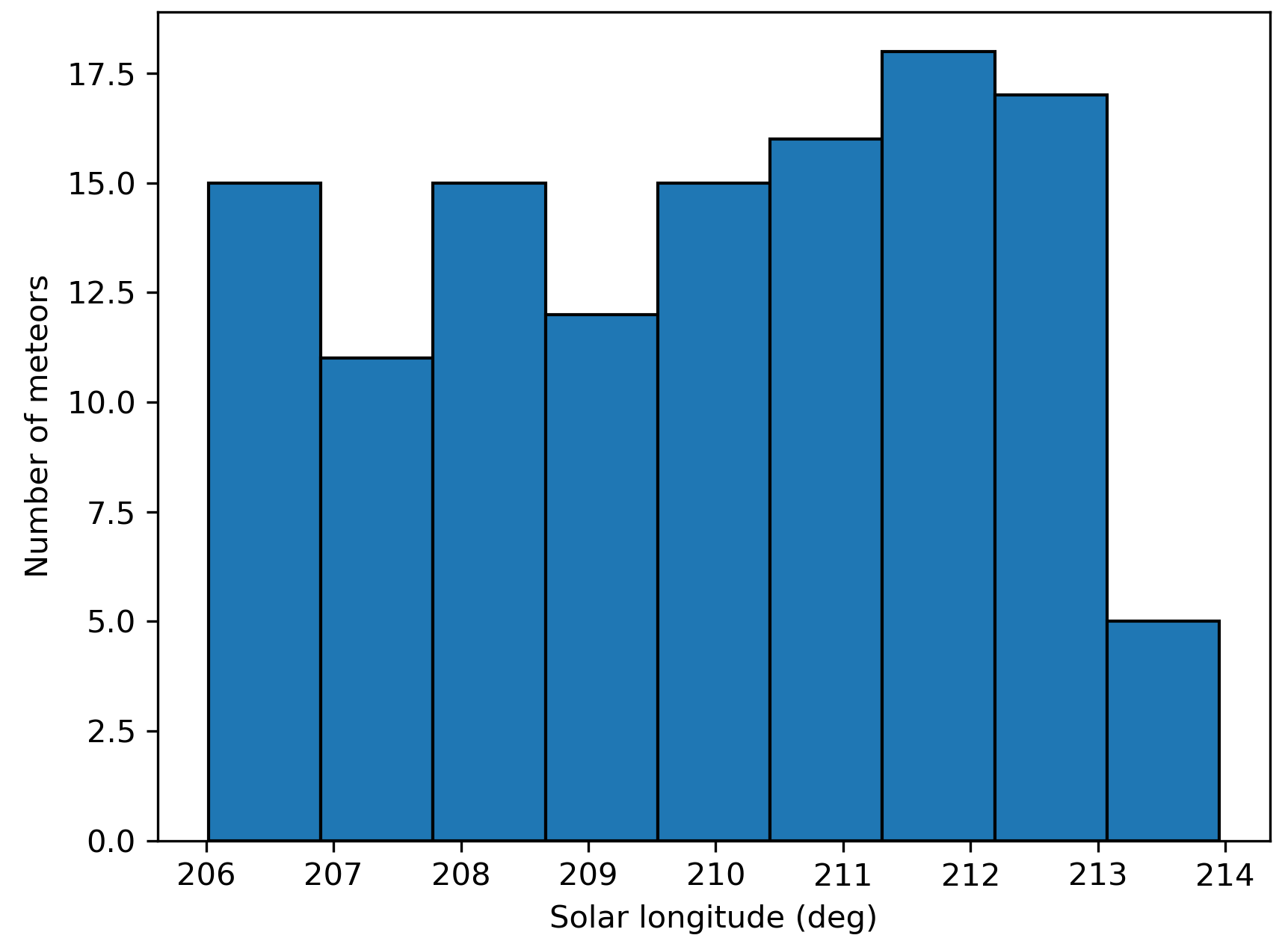
Figure 6 – The uncorrected number of shower meteors recorded per degree in solar longitude.
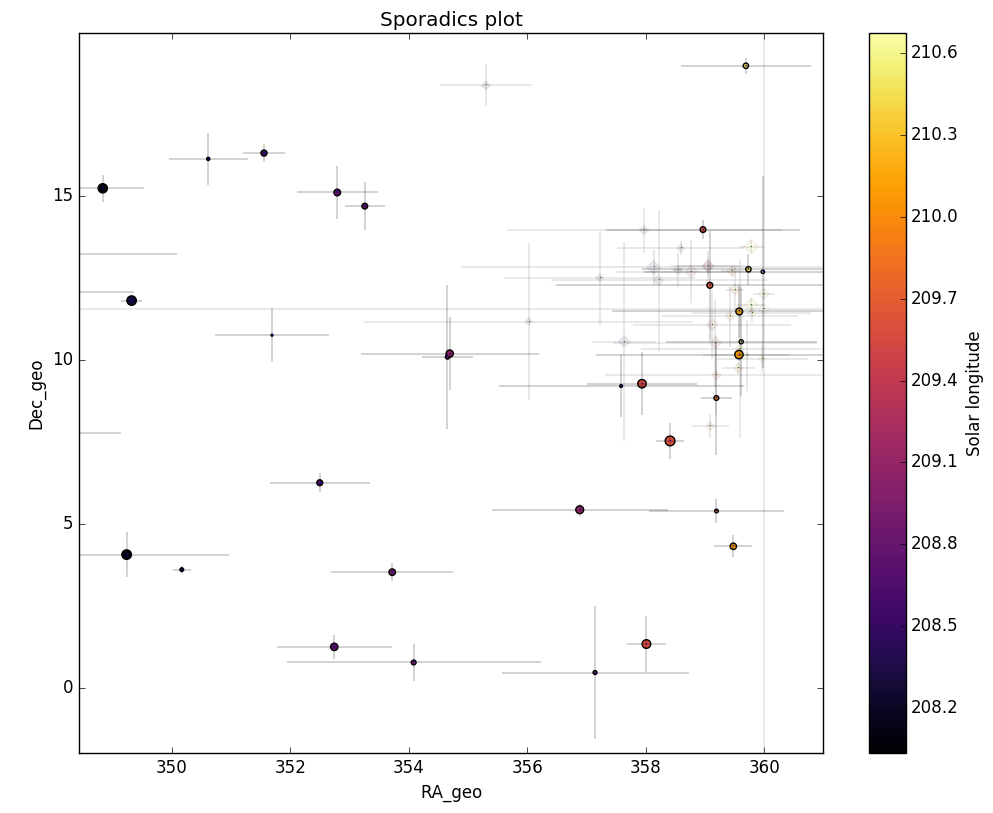
Figure 7 – All non-shower meteor radiants in geocentric equatorial coordinates during the shower activity. The pale diamonds represent the shower radiants plots, error bars represent two sigma values in both coordinates.
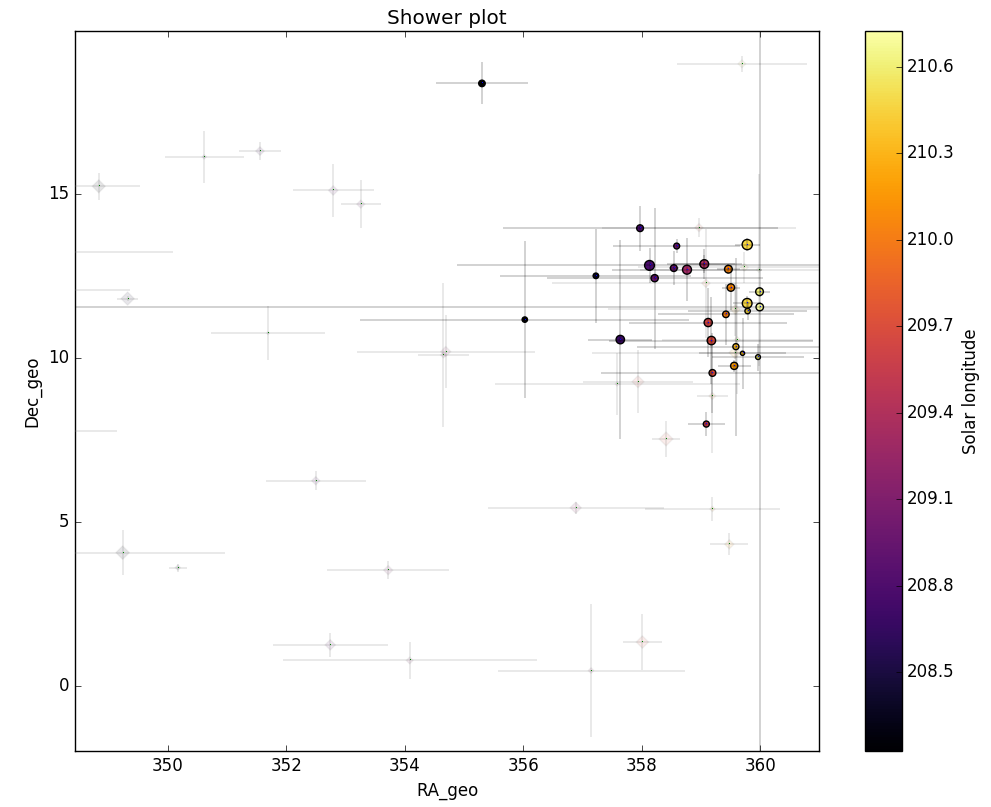
Figure 8 – The reverse of Figure 7, now the shower meteors are shown as circles and the non shower meteors as grayed out diamonds.
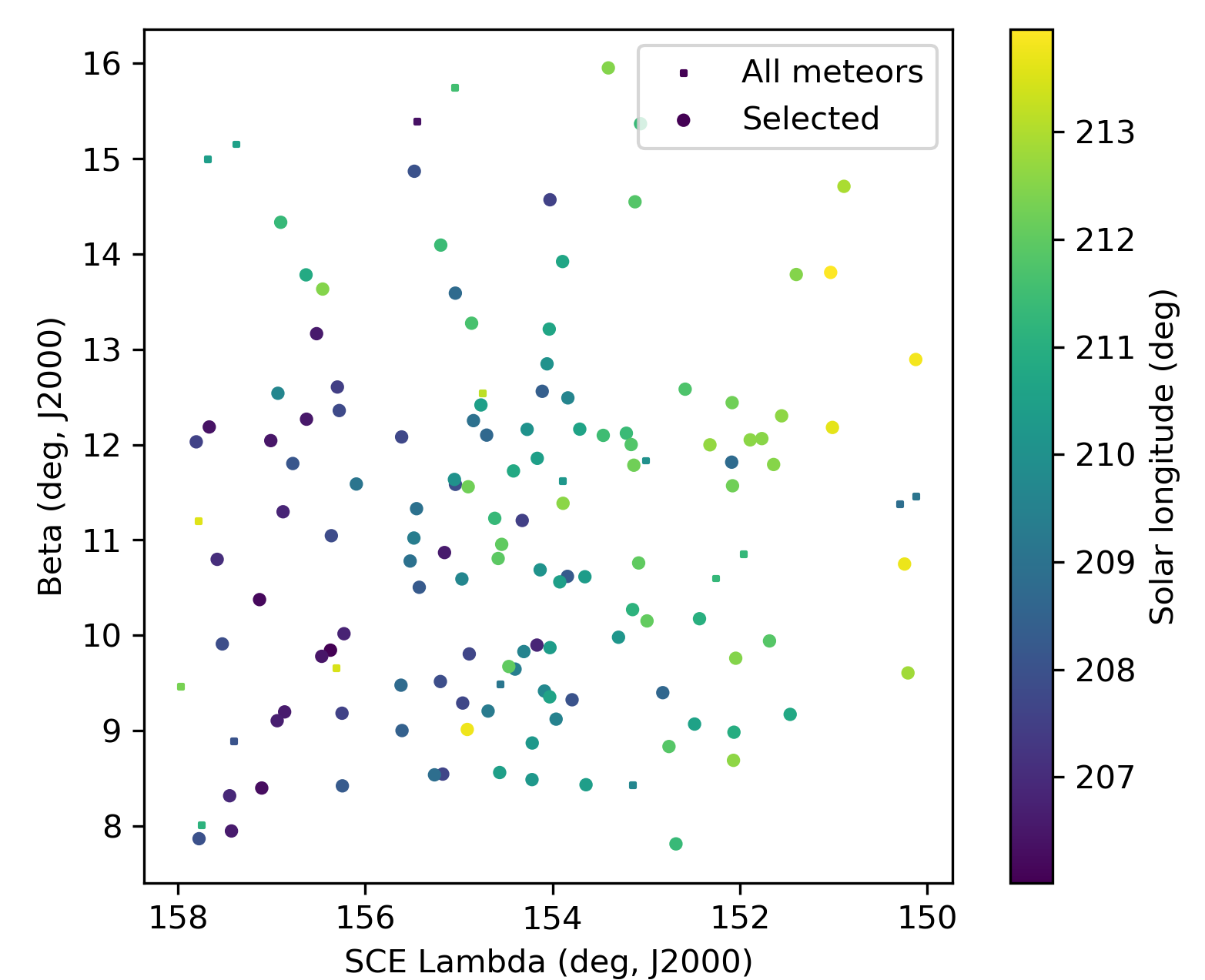
Figure 9 – The radiant distribution during the solar-longitude interval 206° – 214° in Sun centered geocentric ecliptic coordinates.
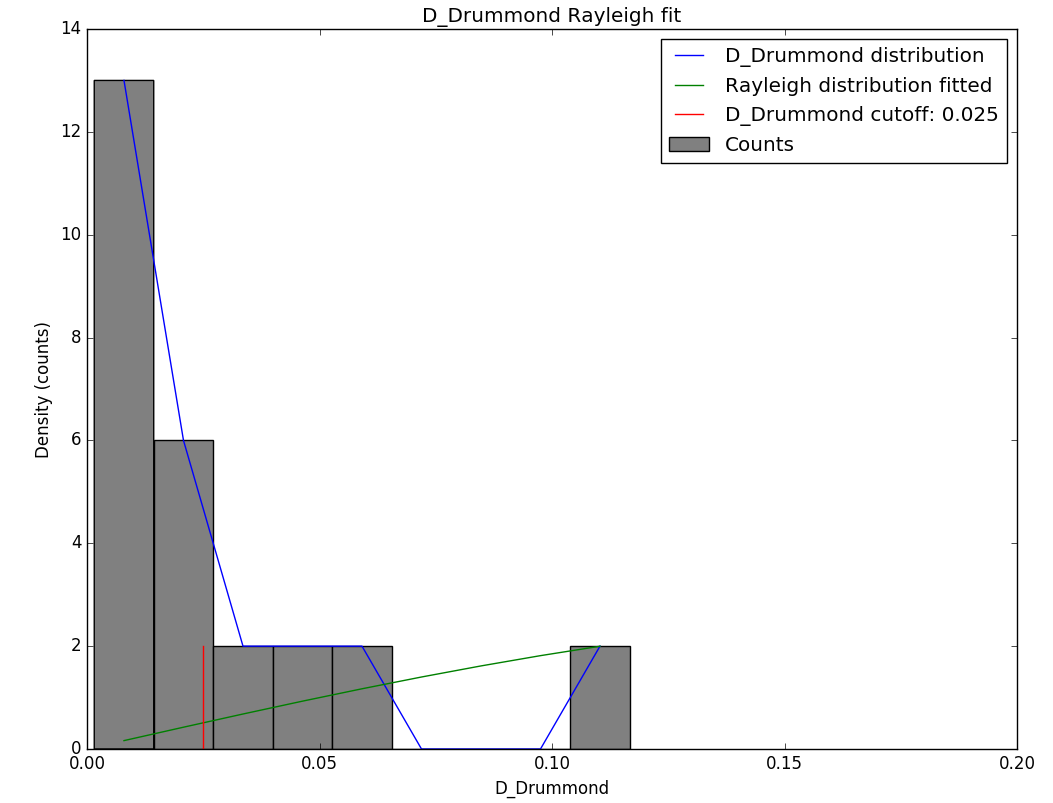
Figure 10 – Rayleigh distribution fit and Drummond DD criterion cutoff.
3 Shower classification based on orbits
Meteor shower identification strongly depends upon the methodology used to select candidate shower members. The sporadic background is everywhere present and risks contamination of the selections of shower candidates. In order to double check GMN meteor shower detections, another method based on orbit similarity criteria is used. This approach serves to make sure that no spurious radiant concentrations are mistaken as new meteor showers.
A reference orbit is required to start an iterative procedure to approach a mean orbit, which is the most representative orbit for the meteor shower as a whole because it removes outliers and sporadic orbits (Roggemans et al., 2019). Three different discrimination criteria are combined in order to have only those orbits that fit the different criteria thresholds. The D-criteria that we use are these of Southworth and Hawkins (1963), Drummond (1981) and Jopek (1993) combined. Instead of using a cutoff value for the thresholds of the D-criteria, these values are considered in different classes with different thresholds of similarity. Depending on the dispersion and the type of orbits, the most appropriate threshold of similarity is selected to locate the best fitting mean orbit as the result of an iterative procedure.
The Rayleigh distribution fit indicates that a very small cut-off value is required with DD < 0.025 (Figure 10). The use of D-criteria requires caution as the threshold values differ for different types of orbits. Because of the very small cutoff for the threshold values of the D-criteria, only three classes were plotted:
- Medium high: DSH < 0.075 & DD < 0.03 & DJ < 0.075.
- High: DSH < 0.05 & DD < 0.02 & DJ < 0.05.
- Very high: DSH < 0.025 & DD < 0.01 & DJ < 0.025;
This method resulted in a mean orbit with 89 related orbits that fit within the similarity threshold with DSH < 0.05, DD < 0.02 and DJ < 0.05, recorded between October 18 and 29, 2025. The plot of the radiant positions in equatorial coordinates, color-coded for different D-criteria thresholds, has its radiant at 358.4° in Right Ascension and +11.6° in declination (Figure 10). A slightly more tolerant threshold of the D-criteria with DSH < 0.075, DD < 0.03 and DJ < 0.075 results in 125 orbits that fit these threshold values, but with a risk of including contamination with sporadics. Both solutions are mentioned in Table 1.
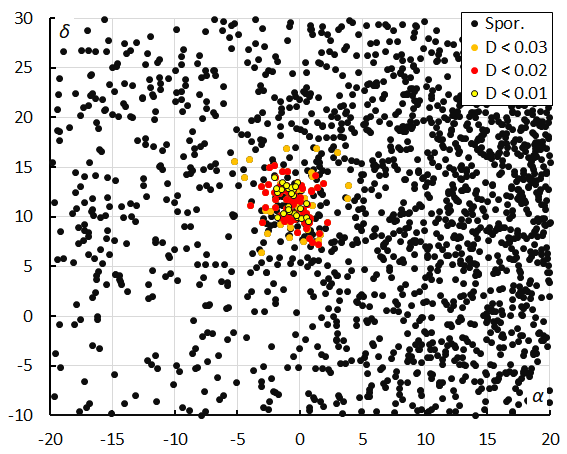
Figure 11 – The radiant distribution during the solar-longitude interval 204° – 216° in equatorial coordinates, color-coded for three threshold values of the DD orbit similarity criterion.
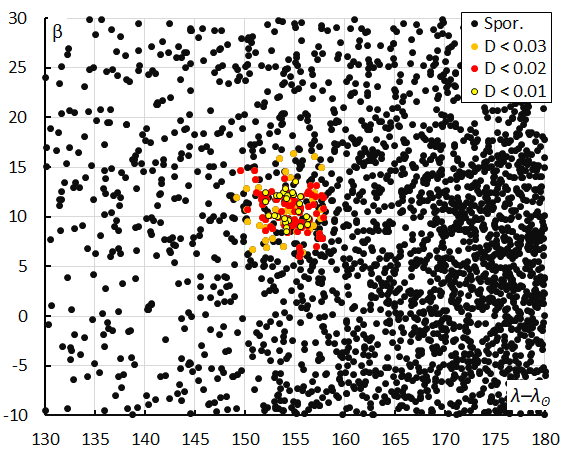
Figure 12 – The radiant distribution during the solar-longitude interval 204° – 216° in Sun-centered geocentric ecliptic coordinates, color-coded for three threshold values of the DD orbit similarity criterion.
If we look at the ratio shower meteors to non-shower meteors recorded by GMN (Figure 13) in 1.5°-time bins in solar longitude in steps of 0.25°, we see an almost constant activity level from λʘ = 207.0° to λʘ = 212.8°. The orbit-based shower identification found some orbits before λʘ = 206.0° and after λʘ = 214.0° but the main activity period is situated between solar longitude 206° and 214°.
The results obtained from both shower association methods are in good agreement although both methods identified 99 meteors in common with a number of different meteors in each selection. 25 meteors were identified based on the radiant but not selected by the orbit method with DSH < 0.075 & DD < 0.03 & DJ < 0.075. 26 orbits were identified as shower members but not identified by the radiant based method, 16 of these before or after the activity period determined by the radiant method.
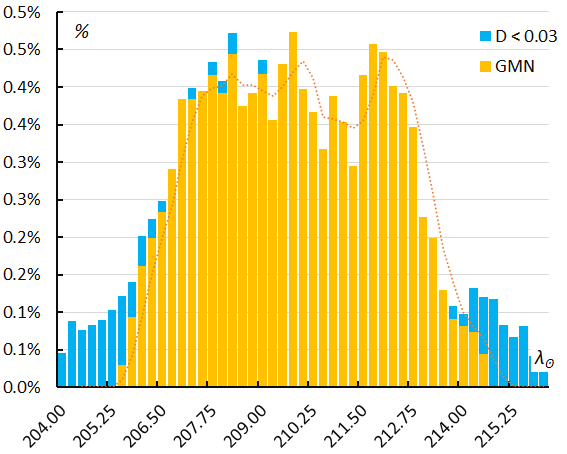
Figure 13 – The percentage of shower meteors relative to the total number of meteors recorded by GMN. Orange is the result for the GMN shower classification, blue for the orbit D-criteria method.
4 Orbit and parent body
Looking at the diagrams of inclination versus longitude of perihelion (Figure 14) and eccentricity versus longitude of perihelion (Figure 15), the concentration of shower points appears very distinct. Figure 16 shows the dense population of low inclination meteor orbits in which this new meteor shower is situated.
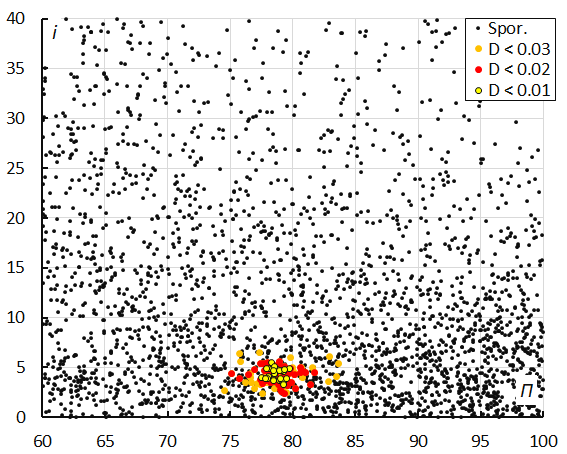
Figure 14 – The diagram of the inclination i against the longitude of perihelion Π color-coded for different classes of D criterion threshold, for λʘ between 204° and 216°.
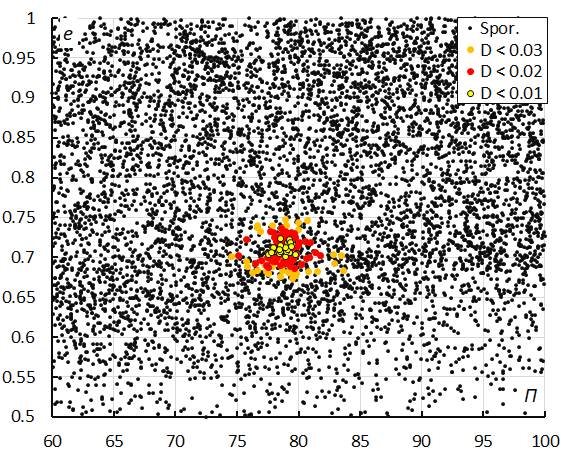
Figure 15 – The diagram of the eccentricity e against the longitude of perihelion Π color-coded for different classes of D criterion threshold, for λʘ between 204° and 216°.
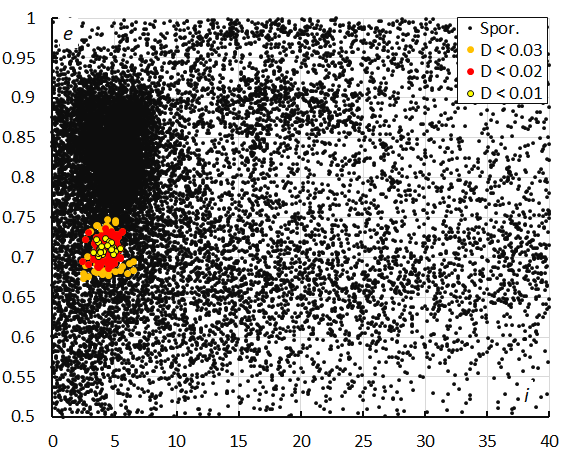
Figure 16 – The diagram of the eccentricity e against the inclination i color-coded for different classes of D criterion threshold, for λʘ between 204° and 216°.
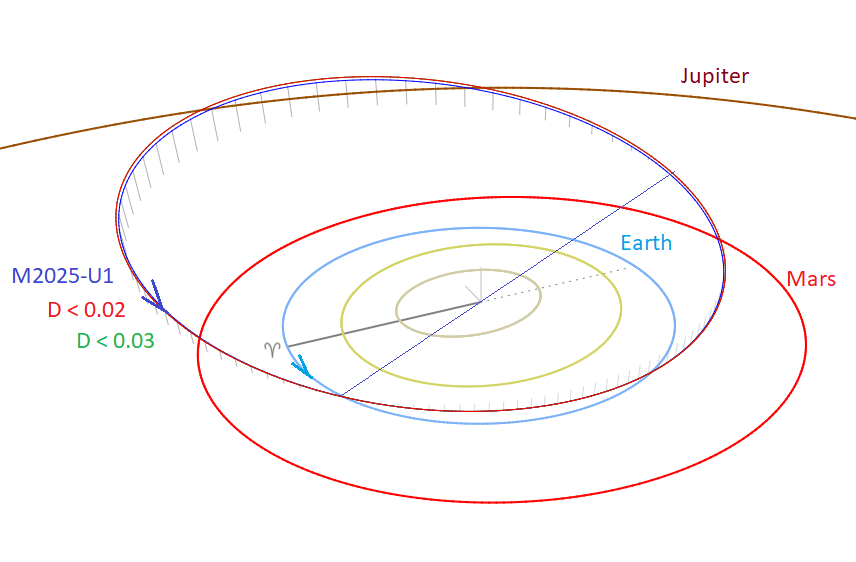
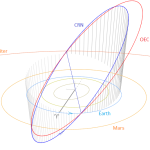
Figure 17 – Comparing the mean orbits for the three solutions obtained by two methods, close-up at the inner Solar System. (Plotted with the Orbit visualization app provided by Pető Zsolt).
The Tisserand’s parameter relative to Jupiter, Tj (= 2.87) identifies the orbit as of a Jupiter Family Comet type orbit. Figure 17 compares the three solutions as listed in Table 1 obtained by two different methods. The different solutions almost coincide in the plotted version. The M2025-U1 meteoroid stream encounters the Earth at its descending node, with a low inclination (~4°). The aphelion relatively close to Jupiter and low inclination means that the dust will suffer significant gravitational perturbation during each passage of Jupiter.
A top 10 parent-body search resulted in candidates with a threshold for the Drummond DD criterion value lower than 0.05 (Table 2). Asteroids 2017 UP and 2010 UM7 look plausible candidate parent bodies. However, Greaves (2025) warned that these two asteroids had very few observations spread over only a day or three days, respectively, so the orbits for them are poor and not worth considering at all.
Table 1 – Comparing solutions derived by two different methods, GMN-method based on radiant positions and orbit association for DD < 0.03 and DD < 0.02.
| GMN | DD < 0.03 | DD < 0.02 | |
| λʘ (°) | 211.0 | 209.7 | 209.3 |
| λʘb (°) | 206.0 | 204.5 | 204.7 |
| λʘe (°) | 214.0 | 215.8 | 215.8 |
| αg (°) | 359.7 | 359.4 | 359.3 |
| δg (°) | +12.2 | +11.6 | +11.6= |
| Δαg (°) | 0.22 | 0.25 | 0.15 |
| Δδg (°) | 0.34 | 0.27 | 0.31 |
| vg (km/s) | 14.0 | 14.4 | 14.4 |
| Hb (km) | 92.3 | 92.5 | 92.9 |
| He (km) | 80.9 | 80.9 | 80.9 |
| Hp (km) | 85.5 | 85.5 | 85.5 |
| MagAp | +0.6 | +0.4 | +0.3 |
| λg (°) | 4.6 | 4.1 | 4.1 |
| λg – λʘ (°) | 153.6 | 154.3 | 154.7 |
| βg (°) | +11.3 | +10.8 | +11.0 |
| a (A.U.) | 2.868 | 2.95 | 2.95 |
| q (A.U.) | 0.853 | 0.851 | 0.851 |
| e | 0.702 | 0.711 | 0.711 |
| i (°) | 4.4 | 4.3 | 4.3 |
| ω (°) | 229.0 | 229.2 | 229.2 |
| Ω (°) | 209.8 | 209.5 | 209.5 |
| Π (°) | 78.9 | 78.7 | 78.7 |
| Tj | 2.87 | 2.82 | 2.82 |
| N | 124 | 125 | 89 |
Table 2 – Top ten matches of a search for possible parent bodies with DD < 0.05.
| Name | DD |
| 2017 UP | 0.013 |
| 2010 UM7 | 0.024 |
| 2018 SP3 | 0.034 |
| 2020 TM7 | 0.034 |
| 2021 CY | 0.039 |
| 2011 SE97 | 0.04 |
| 2020 BJ14 | 0.042 |
| 2019 SV7 | 0.043 |
| 2022 CG2 | 0.043 |
| 2004 TN1 | 0.043 |
5 Past years’ activity
No relevant activity could be found in past years’ meteor orbit data. In 2024, we had 33 orbits with DD < 0.03 and less than half of this number per year in 2021 to 2023. In 2020 and 2019 respectively 20 and 11 orbits were recorded with DD < 0.03. It seems that the activity remained far below the threshold of detectability since the GMN had less cameras than in 2025. Further searches in other meteor orbit datasets revealed only two orbits in 2020 and two orbits in 2014 among the SonotaCo meteor orbit dataset with DD < 0.02. Edmond had only two orbits in 2014 with DD < 0.02. CAMS had five in 2013 and three in 2014 with DD < 0.02. The discovery of this meteor shower was possible thanks to the capacity of the GMN to detect weak activity sources. Future observations may reveal if there is any periodicity.
Greaves (2025) draw our attention at the coincidence with a removed shower in the MDC working list which had 2010 UM7 as a possible parent body. The November gamma-Pegasids (NGP#482) reported by Rudawska and Jenniskens (2014) were removed from the list because it was not found back in larger data samples. The time of observation differs about two weeks from M2025-U1 in solar longitude, and the ascending node and argument of perihelion differ about 20° compared to M2025-U1.
A review of past visual observations revealed a number of scattered radiants in the Pegasus region throughout the whole of October. Most of these are outside the date range parameters determined for this study.
A possible early sighting of M2025-U1 was by William Denning (Denning, 1899) where he recorded a radiant at R.A. 011° and Dec. +8° from 19–21 October, 1871. Denning assigned this the name epsilon-Piscids. Further detections were made during the first half of the 1890’s by W. Denning, H. Corder and W. Doberek (Denning, 1899).
The next potential sighting of M2025-U1 was by Cuno Hofmeister from 20–21 October, 1909 with a radiant at R.A. 350° and Dec. +7° (Hoffmeister, 1948).
In more recent times M2025-U1 has potentially been detected on several occasions during the period 1978–1998 by WAMS/NAPOMS observers. A mean radiant position from nine radiants derived from meteor plots using gnomic projection charts was R.A. 004° and Dec. +07°. The meteors were characterized as having a slow speed. Rates varied from year to year. On some occasions no meteors were recorded whereas in other years rates reached as high as 2–3 meteors per hour. The observed meteor shower appeared to be active from 10 October to 23 October with a broad maximum from 16–21 October.
6 Conclusions
The discovery of a new meteor shower with a radiant in the constellation of Pegasus based on 124 meteors during 2025 October 19 – 27 has been confirmed by using two independent meteor shower search methods. The resulting mean orbits for both search methods are in good agreement. All meteors appeared during the solar-longitude interval 206° – 210° with a constant activity level without any peak. Orbits of this meteor shower were detected in previous years, but the activity level in past years remained well below the detection threshold. Future observations should confirm if this activity is annual or episodic.
The new meteor shower has been listed in the IAU MDC Working List of Meteor Showers under the temporary name-designation: M2025-U1.
Acknowledgments
This report is based on the data of the Global Meteor Network (Vida et al., 2020a; 2020b; 2021) which is released under the CC BY 4.0 license. We thank all 825 participants in the Global Meteor Network project for their contribution and perseverance. A list with the names of the volunteers who contribute to GMN has been published in the 2024 annual report (Roggemans et al., 2025).
The following 348 cameras recorded one or more meteors that were identified as members of this new meteor shower: AU000D, AU000T, AU000V, AU000W, AU000X, AU000Y, AU0010, AU001A, AU001B, AU001E, AU001F, AU001P, AU001Q, AU001R, AU001S, AU002E, AU0030, AU003G, AU0046, AU0048, AU004J, BA0001, BA0003, BA0004, BA0005, BE0009, BE000G, BE000W, BE0010, BG0003, BG0004, BG0009, BG000B, BG000G, BR000F, BR000G, BR001H, BR001R, CA000E, CA000R, CA0032, CA0035, CH0002, CH0003, CL0002, CL0003, CZ0009, CZ000C, CZ000E, CZ000K, CZ000L, CZ000M, CZ000Q, CZ000R, DE0001, DE000B, DE000K, DE000Q, DE000W, DE000X, DK0007, DK0009, DK000A, DK000D, ES000C, ES001A, ES001D, FR000Y, FR0016, GR0009, HR0025, HR002T, HU0003, HU0004, HU0005, HU0006, HU0008, HU000B, KR0002, KR0004, KR000E, KR000F, KR000K, KR000P, KR000R, KR000S, KR0010, KR0016, KR001C, KR001D, KR001H, KR001J, KR001Y, KR0021, KR0023, KR0024, KR0027, KR0028, KR002A, KR002D, KR002R, KR0036, KR003G, KR003Q, NL000B, NL000S, NL000W, NL000Z, NL0011, NL0013, NL0014, NZ0004, NZ0008, NZ000W, NZ000Y, NZ0013, NZ0018, NZ001P, NZ001S, NZ001X, NZ002F, NZ002G, NZ002N, NZ002Q, NZ002S, NZ002T, NZ002U, NZ002V, NZ002Y, NZ002Z, NZ0032, NZ0035, NZ003C, NZ003G, NZ003K, NZ003N, NZ003Q, NZ003Y, NZ0040, NZ0042, NZ0045, NZ004B, NZ004E, NZ004L, NZ004N, NZ004U, NZ004V, NZ005B, NZ005G, NZ005H, NZ0061, NZ0063, NZ0065, NZ0066, PL000A, PL000B, PL000E, PL000F, PT0002, RO0001, RO0002, RU0008, RU0017, SK0005, SK0006, UA0001, UA0002, UK0001, UK0004, UK0006, UK0009, UK000F, UK000H, UK000S, UK001K, UK001L, UK0022, UK0025, UK0026, UK002D, UK002F, UK002J, UK002K, UK002L, UK002Q, UK003N, UK003T, UK003W, UK003Z, UK004B, UK004E, UK004F, UK004G, UK004H, UK0051, UK0057, UK005C, UK005G, UK005H, UK005M, UK005N, UK0061, UK006C, UK006G, UK006H, UK006J, UK006P, UK0078, UK0079, UK007G, UK007H, UK007J, UK007P, UK007R, UK007U, UK007Y, UK0081, UK0084, UK008C, UK008D, UK008F, UK008G, UK008K, UK008Q, UK008S, UK008T, UK008U, UK008V, UK008X, UK008Z, UK0092, UK0098, UK0099, UK009C, UK009F, UK009G, UK009K, UK009M, UK009V, UK009W, UK009X, UK00A0, UK00A3, UK00A4, UK00A5, UK00A6, UK00AB, UK00AF, UK00AG, UK00AK, UK00AL, UK00AM, UK00AN, UK00AP, UK00AQ, UK00B1, UK00B2, UK00B5, UK00BA, UK00BJ, UK00BW, UK00C0, UK00C2, UK00C6, UK00C7, UK00CE, UK00D6, UK00D7, UK00DF, UK00DG, UK00DH, US0001, US0003, US0004, US0005, US0006, US0007, US0008, US0009, US000C, US000D, US000G, US000H, US000J, US000K, US000L, US000N, US000P, US000R, US000S, US000U, US000V, US001Q, US001R, US001U, US001V, US0020, US002A, US002R, US002X, US002Z, US0035, US0036, US0038, US0039, US003G, US003N, US003T, US0044, US0046, US0047, US004A, US004D, US004N, US0051, US005A, US005G, US005H, US005J, US005P, US005W, US005X, US005Y, US005Z, US0062, US0066, US0068, US006A, USL00G, USL00K, USL00L, USL00M, USL00N, USL00P, USL00Q, USL013, USL014, USL017, USL018, USL01B, USL01C, USL01D, USL01E, USN001, USN003, USN004, USN009, USV001.
References
Denning W.F. (1899). “General Catalogue of Radiant Points and Meteoric Showers and of Fireballs and of Shooting Stars observed at more than one station”. Memoirs of the Royal Astronomical Society, 53, 203–292.
Drummond J. D. (1981). “A test of comet and meteor shower associations”. Icarus, 45, 545–553.
Greaves J. (2025). Personal communications.
Hoffmeister C. (1948). “Meteorstrome”. Leipzig, J. A. Barth.
Jopek T. J. (1993). “Remarks on the meteor orbital similarity D-criterion”. Icarus, 106, 603–607.
Jopek T. J., Rudawska R. and Pretka-Ziomek H. (2006). “Calculation of the mean orbit of a meteoroid stream”. Monthly Notices of the Royal Astronomical Society, 371, 1367–1372.
Moorhead A. V., Clements T. D., Vida D. (2020). “Realistic gravitational focusing of meteoroid streams”. Monthly Notices of the Royal Astronomical Society, 494, 2982–2994.
Roggemans P., Johannink C. and Campbell-Burns P. (2019a). “October Ursae Majorids (OCU#333)”. eMetN Meteor Journal, 4, 55–64.
Roggemans P., Campbell-Burns P., Kalina M., McIntyre M., Scott J. M., Šegon D., Vida D. (2025). “Global Meteor Network report 2024”. eMetN Meteor Journal, 10, 67–101.
Rudawska R., Jenniskens P. (2014). “New meteor showers identifed in the CAMS and SonotaCo meteoroid orbit surveys”. In, T.J. Jopek, F.J.M. Rietmeijer, J. Watanabe, I.P. Williams, A.M., editors, Meteoroids 2013, Proceedings of the Astronomical Conference held at A.M. University, Poznań, Poland, Aug. 26-30, 2013. University Press, pages 217–224.
Southworth R. B. and Hawkins G. S. (1963). “Statistics of meteor streams”. Smithsonian Contributions to Astrophysics, 7, 261–285.
Vida D., Gural P., Brown P., Campbell-Brown M., Wiegert P. (2020a). “Estimating trajectories of meteors: an observational Monte Carlo approach – I. Theory”. Monthly Notices of the Royal Astronomical Society, 491, 2688–2705.
Vida D., Gural P., Brown P., Campbell-Brown M., Wiegert P. (2020b). “Estimating trajectories of meteors: an observational Monte Carlo approach – II. Results”. Monthly Notices of the Royal Astronomical Society, 491, 3996–4011.
Vida D., Šegon D., Gural P. S., Brown P. G., McIntyre M. J. M., Dijkema T. J., Pavletić L., Kukić P., Mazur M. J., Eschman P., Roggemans P., Merlak A., Zubrović D. (2021). “The Global Meteor Network – Methodology and first results”. Monthly Notices of the Royal Astronomical Society, 506, 5046–5074.