By Paul Roggemans, Denis Vida, Damir Šegon, James M. Scott, Jeff Wood
Abstract: An activity source identified as the delta1-Canis Minorids was detected between the 9th and 19th of January 2025–2026 with a radiant at R.A. = 109.9° and Decl.= +1.1°, and a geocentric velocity of 23.8 km/s. The shower displayed an activity outburst in 2026. This case study confirms the existence of this annual meteor shower and fulfils the criteria in order to be nominated for established status by the IAU-MDC.
1 Introduction
A weak source of activity appeared on the GMN radiant density plots, about 20° south of the anti-helion point, in January 2026. The radiant was identified as the delta1-Canis Minorids (DCN#1168). This shower was noticed by Jenniskens (2023) in CAMS data as an annual shower with episodic outbursts in 2015 and 2020. A first solution was reported to the IAU Meteor Data Center (MDC) Working List of Meteor Showers, based upon 105 meteors recorded by CAMS until 2023.
GMN has collected enough data on this weak activity to confirm the existence of this meteor shower that fulfills the IAU-MDC criteria of having its parameters (radiant coordinates, velocity and orbit) determined by independent studies that it can be nominated for established status.
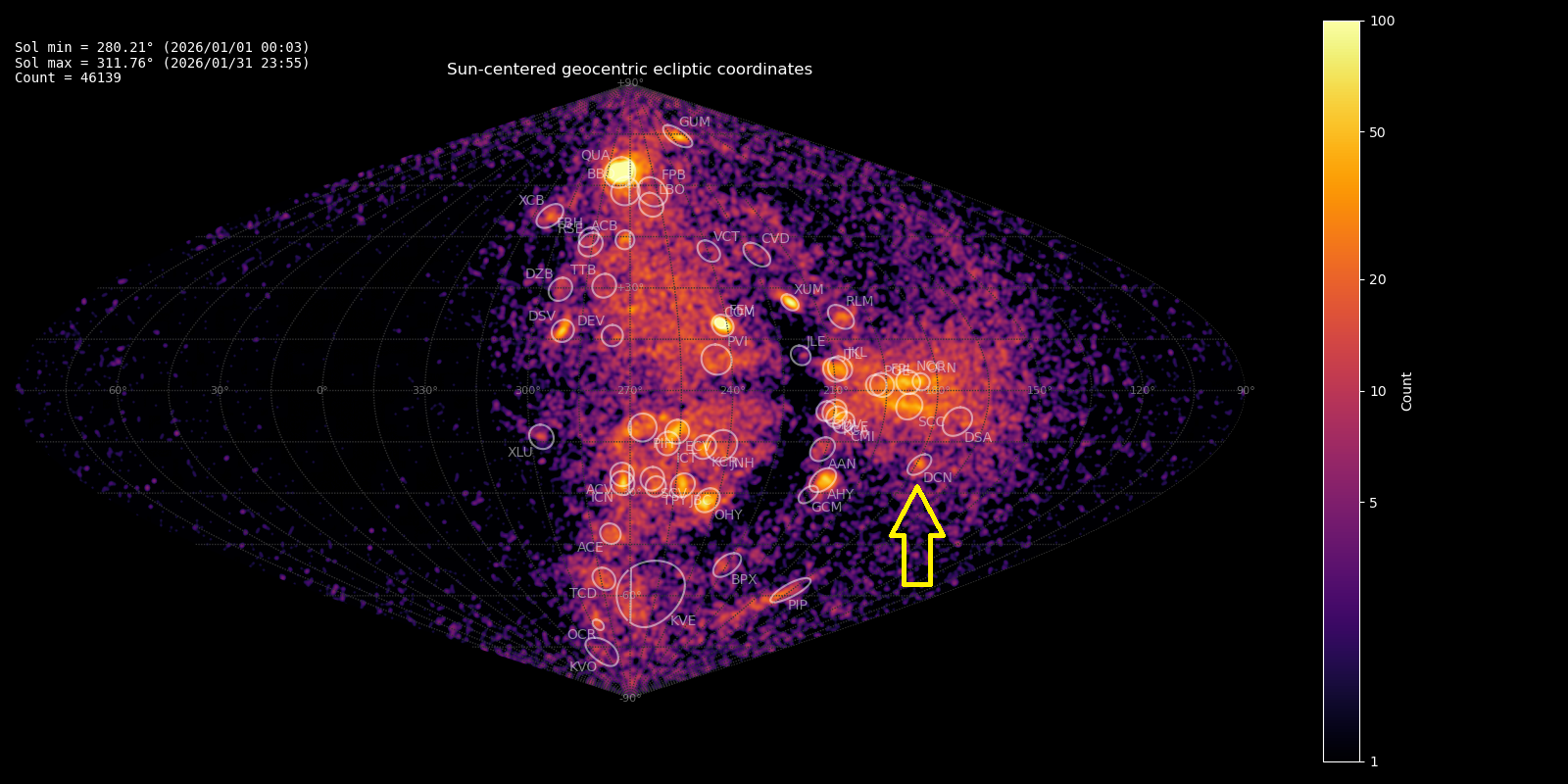
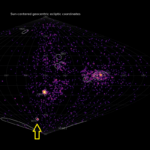
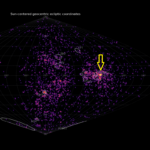
Figure 1 – Radiant density map with 46139 radiants obtained by the Global Meteor Network during January, 2026. The position of the delta1-Canis Minorid in Sun-centered geocentric ecliptic coordinates is marked with a yellow arrow.
2 Shower classification based on radiants
The GMN shower association criteria assume that meteors within 1° in solar longitude, within 2.5° in radiant in this case, and within 10% in geocentric velocity of a shower reference location are members of that shower. Further details about the shower association are explained in Moorhead et al. (2020). Using these meteor shower selection criteria, 108 orbits have been identified as delta1-Canis Minorids recorded in 2025–2026 by 243 GMN cameras installed in Austria, Australia, Belgium, Bosnia Herzegovina, Bulgaria, Chile, Croatia, France, Germany, Greece, Hungary, Israel, Italy, New Zealand, Russia, Slovenia, South Korea, United Kingdom, United States and South Africa. The final results have been listed in Table 2.
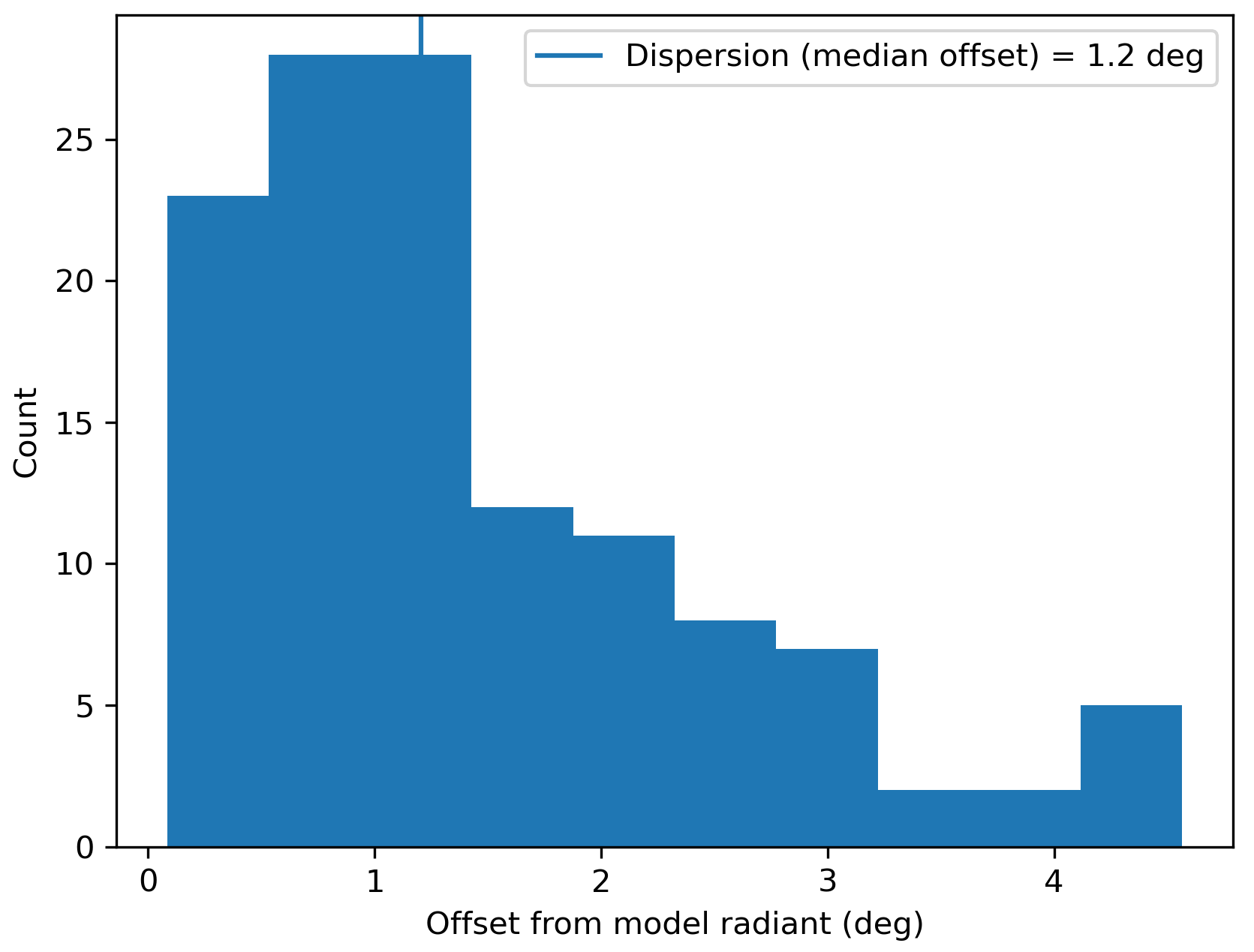
Figure 2 – Dispersion median offset on the radiant position.
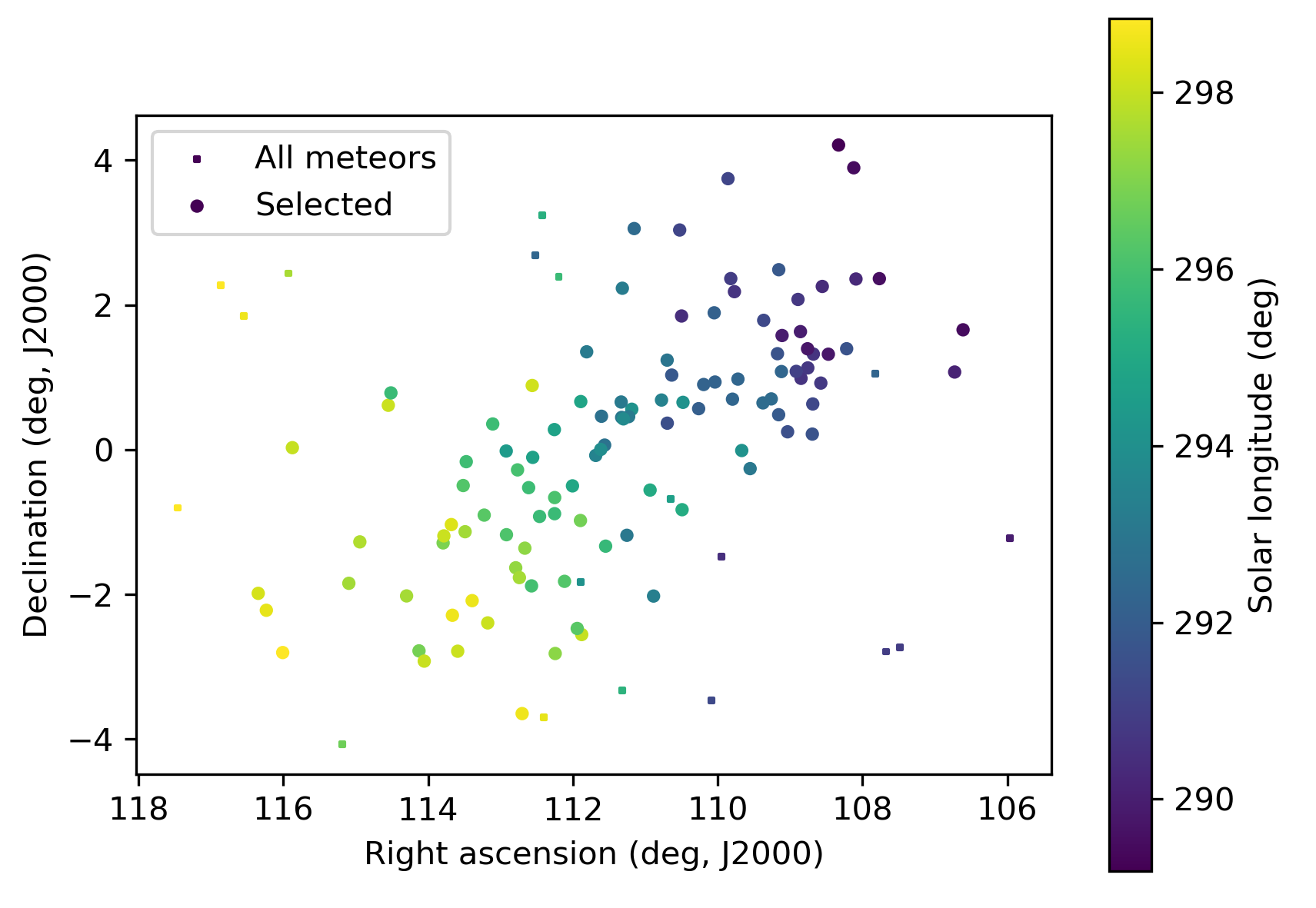
Figure 3 – The radiant distribution during the solar-longitude interval 291.5° – 298.5° in equatorial coordinates.
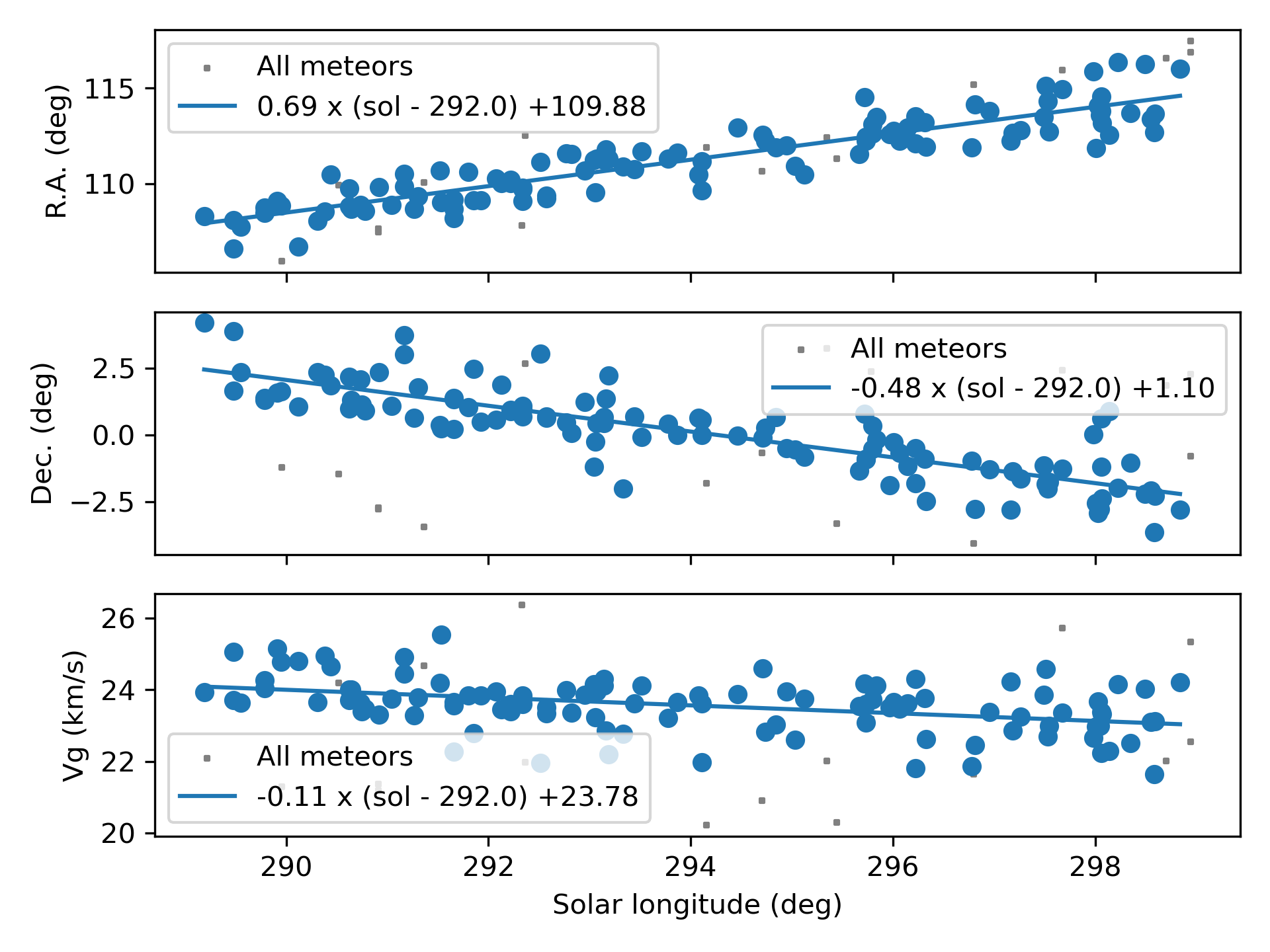
Figure 4 – The radiant drift.
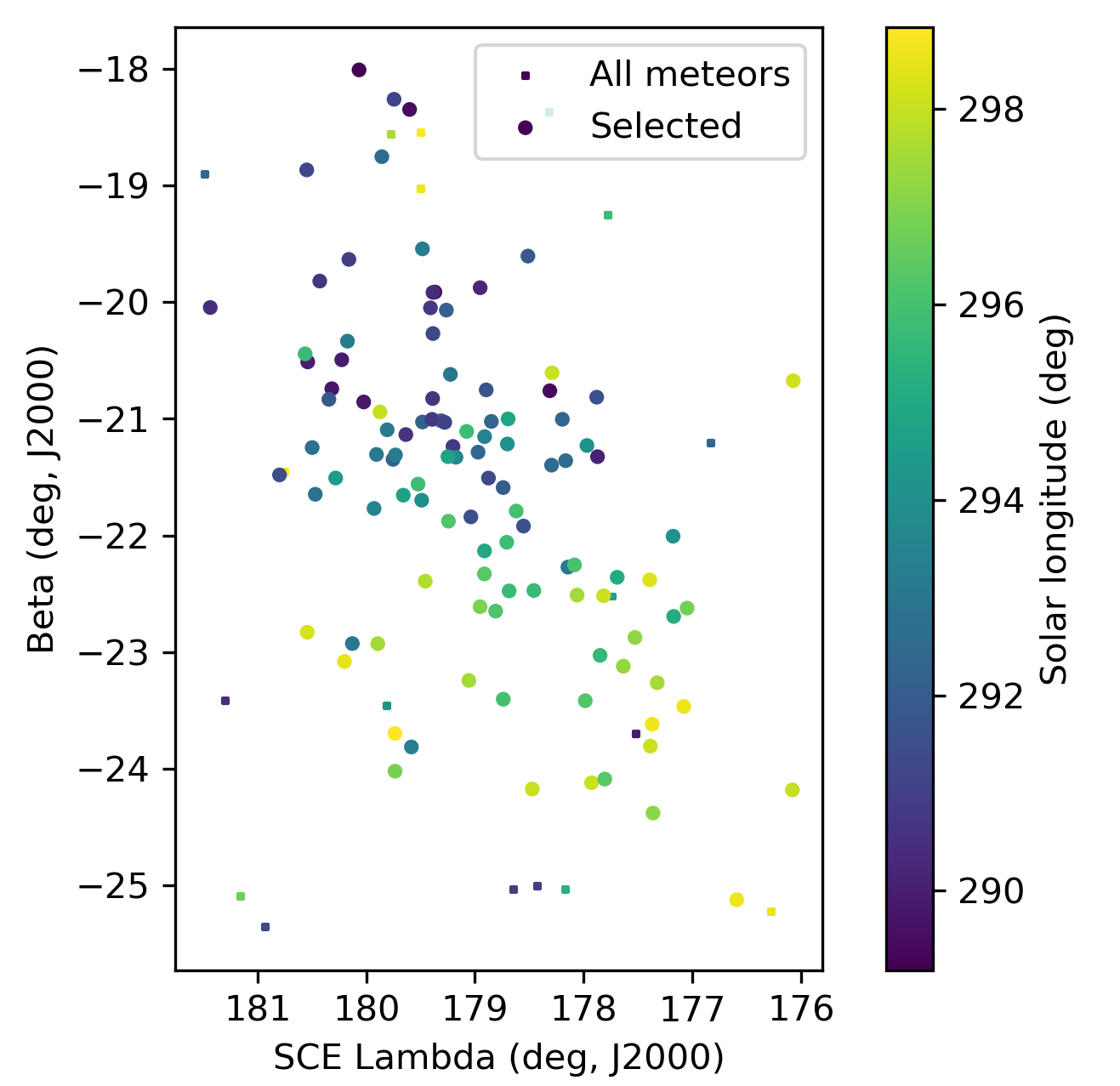
Figure 5 – The radiant distribution during the solar-longitude interval 291.5° – 298.5° in Sun centered geocentric ecliptic coordinates.
3 Shower classification based on orbits
A complete independent meteoroid stream search has been applied for confirmation based upon orbit data obtained between Solar Longitude 282.0° and 303.0° during the years 2019 to 2026. 159494 orbits were available within this time interval and a final mean orbit has been computed by the method of Jopek et al. (2006) for the thresholds according to the Rayleigh fit in Figure 6. DSH < 0.100 and DD < 0.04 and DJ < 0.100 (Southworth and Hawkins, 1963; Drummond, 1981; Jopek, 1993. The results with the mean orbit based upon 234 meteors for 2019–2026 are listed in Table 2. The method has been described in detail in a separate publication (Roggemans et al., 2026a).
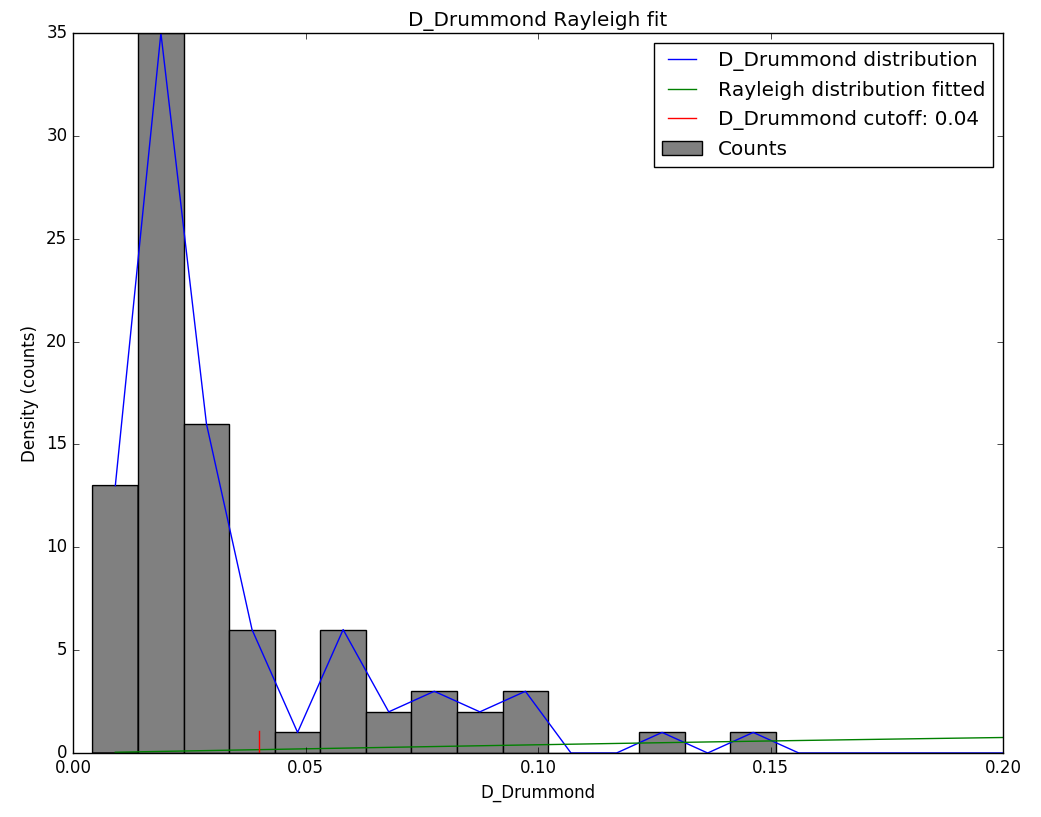
Figure 6 – Rayleigh fit on the Drummond criterion for delta1-Canis Minorid, 2026 data.
The radiant plot in equatorial coordinates (Figure 7) appears stretched due to the radiant drift caused by the movement of the Earth on its orbit around the Sun. The dense cluster east (left) from DCN are the alpha-Hydrids (AHY#331) an established minor shower. In Sun-centered ecliptic coordinates the radiant appears more concentrated (Figure 8). The orange dots with the threshold class DSH < 0.125 and DD < 0.05 and DJ < 0.125 appear very dispersed and represent outliers that are difficult to distinguish from the sporadic background. This threshold class appears to be too tolerant for this stream.
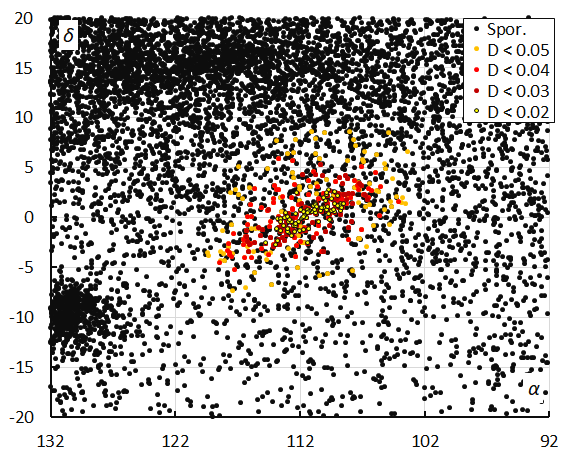
Figure 7 – The radiant distribution during the solar-longitude interval 287° – 300° in equatorial coordinates, color-coded for different threshold values of the combined similarity criteria.
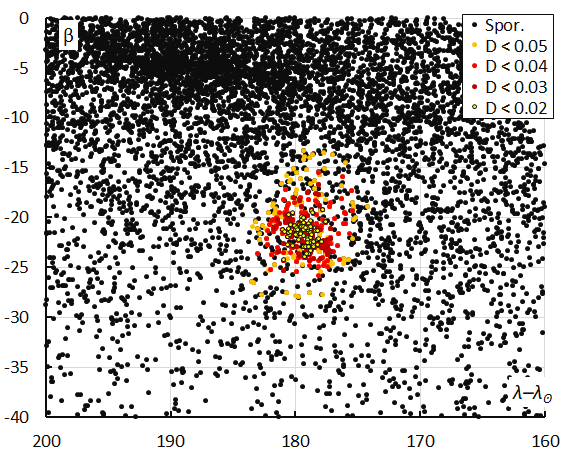
Figure 8 – The radiant distribution during the solar-longitude interval 287° – 300° in Sun-centered geocentric ecliptic coordinates, color-coded for different threshold values of the combined similarity criteria.
Both methods identified 123 DCN-meteors in 2025-2026 during the activity period covered by the radiant method within Solar Longitude 289°–299°. Of these, 99 (76.7%) DCN meteors were identified in common, nine (7%) were identified by the radiant method but failed to fit the orbit similarity threshold, and 15 (12.2%) meteors were identified by the orbit method but not by the radiant method. The orbit method found 100 more DCN-meteors in the years 2019–2024 that were not covered by the radiant method. The orbit method also identified 20 orbits in 2025–2026 beyond the activity period assumed in the radiant method.
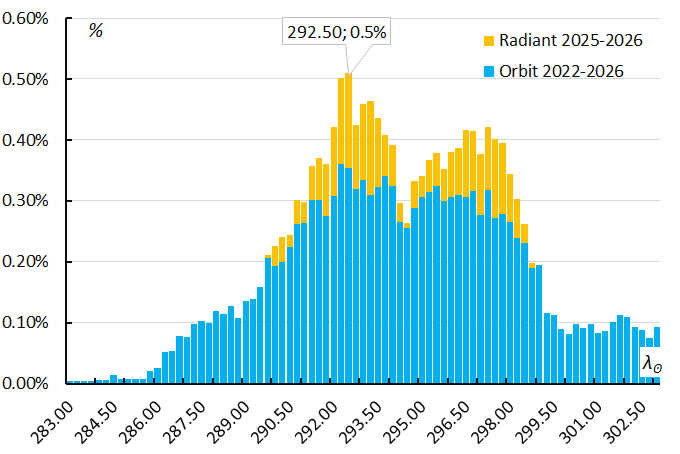
Figure 9 – The percentage of delta1-Canis Minorids relative to the total number of meteors, for the radiant method (2025–2026) and the orbit classification method 2019–2026.
The low ratio of DCN-meteors to the overall activity, with 0.5% at best, means that this is a barely detectable meteor shower. The profile shows two peaks separated by a dip (Figure 9), with best rates at λʘ = 292.5°. The relative activity was higher for 2025–2026 than for 2019–2026 due to the strong contribution in 2026. The number of shower meteors counted per year reflects the expansion of the GMN, but in recent years the network capacity remained relatively stable. Jenniskens (2023) mentions that outbursts occurred in 2015 and 2020. 2026 brought another outburst as the number of DCN-meteors was significantly higher than previous years (Table 1).
Table 1 – Number of delta1-Canis Minorid orbits detected by GMN per year.
| Year | Orbit method | Radiant method |
| 2019 | 1 | – |
| 2020 | 13 | – |
| 2021 | 10 | – |
| 2022 | 10 | – |
| 2023 | 17 | – |
| 2024 | 49 | – |
| 2025 | 49 | 31 |
| 2026 | 85 | 77 |
4 Orbit and parent body
The diagram of the inclination i versus the Longitude of Perihelion Π shows a concentration in i, stretched in Π (Figure 10). The eccentricity e versus the Longitude of Perihelion Π also appears stretched in Π (Figure 11). The spread in Longitude of Perihelion is caused by a steep increase in Longitude of Perihelion during the activity period (Figure 12). The background activity is very dense close to the anti-helion (Figures 13 and 15). The cluster of DCN orbits is best visible in the diagram perihelion distance versus inclination (Figure 14). There is a gradual increase in perihelion distance with 0.004AU/λʘ (Figure 16).
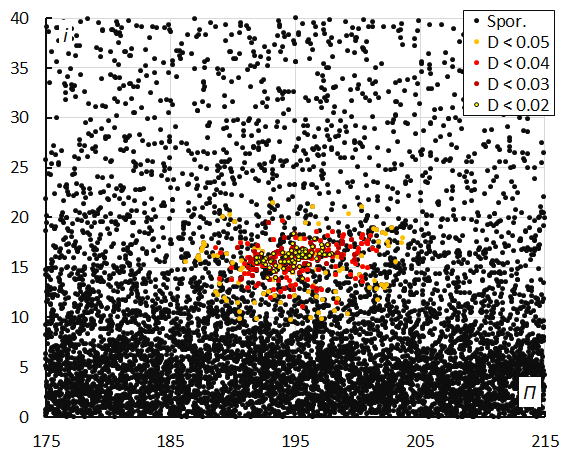
Figure 10 – Inclination i versus the longitude of perihelion Π color-coded for different classes of D-criteria thresholds, for λʘ between 287° and 300°. Spor. = sporadics.
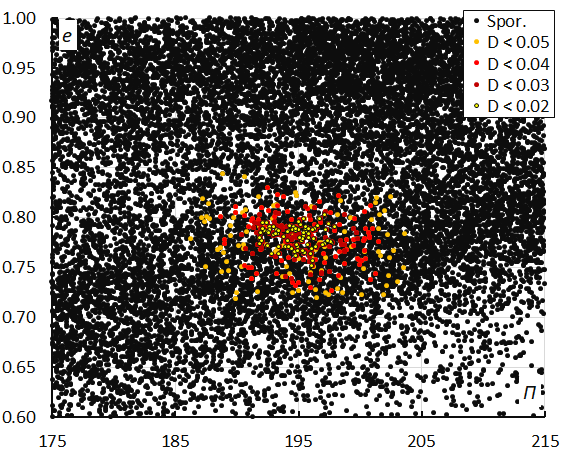
Figure 11 – Eccentricity e versus the longitude of perihelion Π color-coded for different classes of D-criteria thresholds, for λʘ between 287° and 300°. Spor. = sporadics.
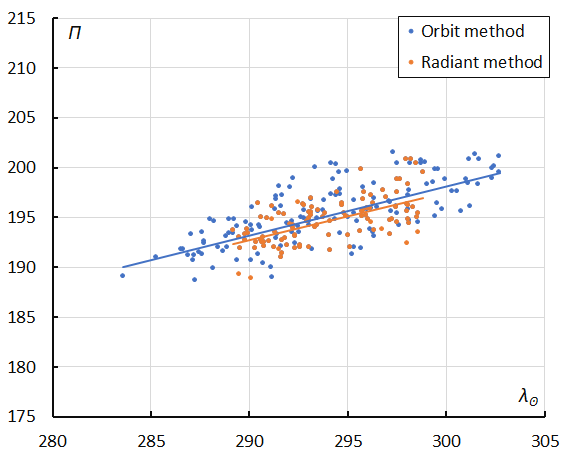
Figure 12 – The evolution of the Longitude of Perihelion Π in function of the Solar Longitude λʘ based upon the radiant method (2025–2026) and upon the orbit method (2019–2026).
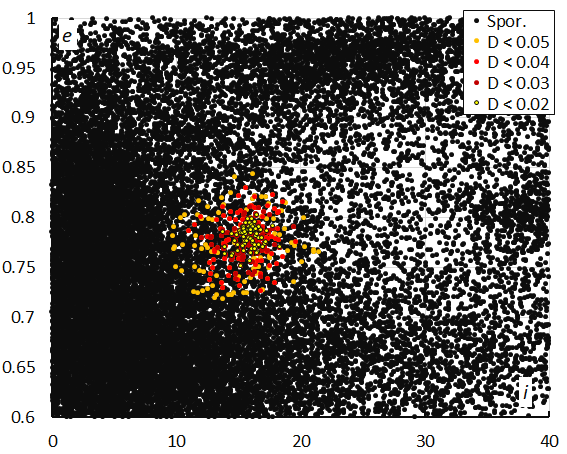
Figure 13 – Eccentricity e versus the inclination i color-coded for different classes of D-criteria thresholds, for λʘ between 287° and 300°. Spor. = sporadics.
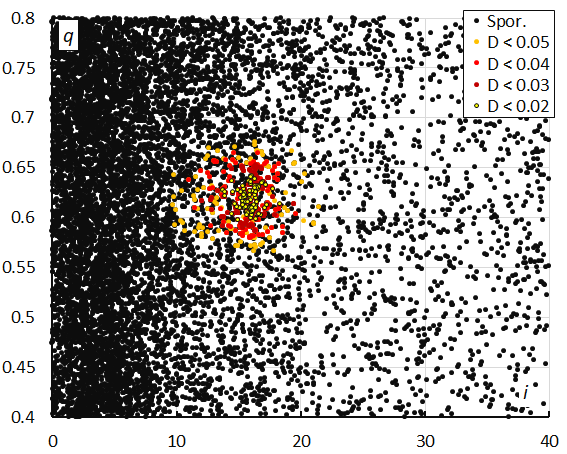
Figure 14 – Perihelion distance q versus the inclination i color-coded for different classes of D-criteria thresholds, for λʘ between 287° and 300°. Spor. = sporadics.
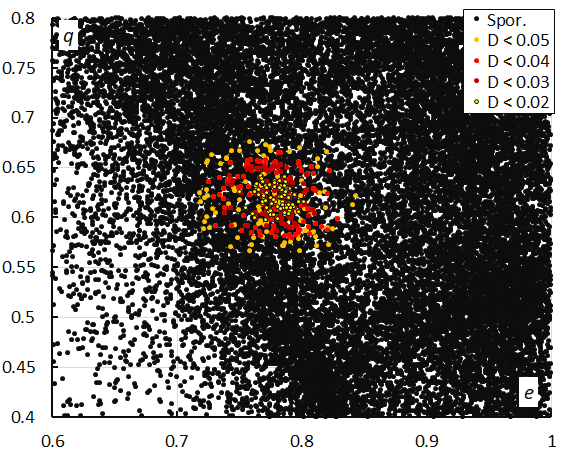
Figure 15 – Perihelion distance q versus the eccentricity e color-coded for different classes of D-criteria thresholds, for λʘ between 287° and 300°. Spor. = sporadics.
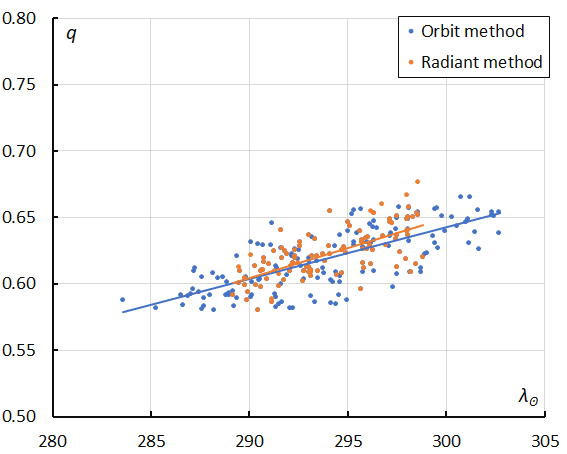
Figure 16 – The evolution of the perihelion distance q in function of the Solar Longitude λʘ based upon the radiant method (2025–2026) and upon the orbit method (2019–2026).
Table 2 – Comparing solutions obtained by the radiant method for 2025–2026, the orbit method 2019–2026 for DD < 0.04 and DD < 0.03, compared to the solution by Jenniskens (2023).
| Radiant 2025–26 | Orbit
DD < 0.04 |
Orbit
DD < 0.03 |
Jenniskens (2023) | |
| λʘ (°) | 292.5 | 292.5 | 292.5 | 293.2 |
| λʘb (°) | 283.6 | 283.6 | 286.5 | 282.0 |
| λʘe (°) | 302.7 | 302.7 | 301.1 | 303.0 |
| αg (°) | 109.9 | 111.6 | 111.3 | 110.6 |
| δg (°) | +1.1 | +0.4 | +0.3 | –0.1 |
| Δαg (°) | +0.69 | +0.68 | +0.68 | +0.56 |
| Δδg (°) | –0.48 | –0.33 | –0.41 | –0.45 |
| vg (km/s) | 23.8 | 23.6 | 23.6 | 23.6 |
| Hb (km) | 91.6 | 91.7 | 91.7 | 95.0 |
| He (km) | 78.4 | 79.6 | 78.9 | 77.2 |
| Hp (km) | 83.3 | 83.8 | 83.5 | 84.3 |
| MagAp | +0.3 | +0.5 | +0.4 | +0.8 |
| λg (°) | 111.4 | 113.2 | 112.9 | 112.2 |
| λg – λʘ (°) | 179.4 | 179.2 | 179.2 | 179.0 |
| βg (°) | –20.9 | –21.3 | –21.5 | –22.0 |
| a (A.U.) | 2.830 | 2.78 | 2.80 | 2.83 |
| q (A.U.) | 0.622 | 0.619 | 0.619 | 0.622 |
| e | 0.780 | 0.778 | 0.779 | 0.780 |
| i (°) | 15.8 | 15.7 | 15.8 | 16.1 |
| ω (°) | 80.6 | 81.1 | 81.0 | 80.5 |
| Ω (°) | 114.1 | 114.1 | 113.8 | 113.2 |
| Π (°) | 194.7 | 195.2 | 194.8 | 194.0 |
| Tj | 2.73 | 2.76 | 2.75 | 2.71 |
| N | 108 | 234 | 147 | 132 |
The Tisserand value relative to Jupiter with TJ = 2.73 is typical for a Jupiter-family cometary orbit. This may explain the 2026 outburst, relative to 2024 and 2025, as due to a close pass of the parent body to Jupiter at some unknown time in the past. The meteoroid stream crosses the ecliptic and Earth’s orbit at its ascending node (Figure 16). The solutions found with the radiant and orbit method are in agreement and confirm the orbit obtained by CAMS (Jenniskens, 2023). A search for candidate parent bodies did not result in any convincing associations (Table 3). A value of DD = 0.073 looks acceptable, but this type of orbit requires a better threshold with DD < 0.04 to be a likely parent body.
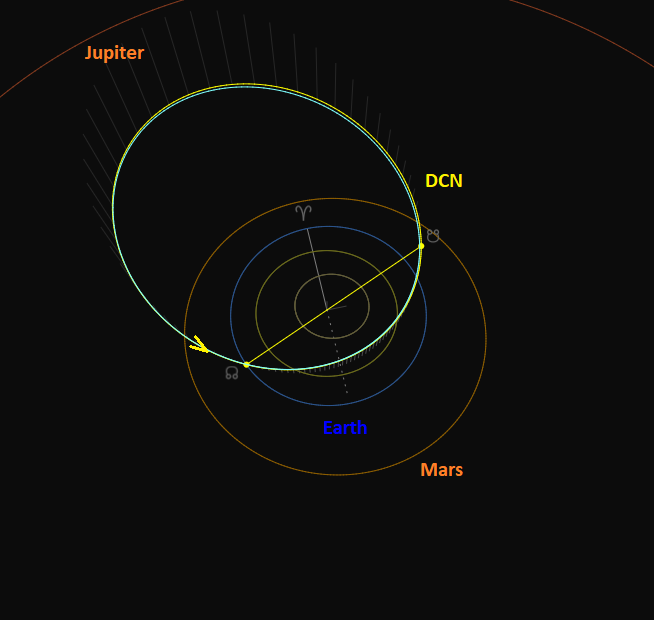
Figure 16 – Comparing the radiant determined delta1-Canis Minorids solution (yellow) with the orbit determined solution (blue), close-up at the inner Solar System. (Plotted with the Orbit visualization app provided by Pető Zsolt).
Table 3– Top ten matches of a search for possible parent bodies with DD < 0.1, based upon the mean orbit derived from the radiant classification method.
| Name | DD |
| 2017 NN6 | 0.073 |
| 2026 AS3 | 0.081 |
| 2023 YL | 0.083 |
| 2025 AE1 | 0.084 |
| 2017 WR13 | 0.086 |
| 2017 BE3 | 0.086 |
| 2025 XS1 | 0.087 |
| 2020 YC3 | 0.087 |
| 2024 XZ7 | 0.090 |
| 501P/Rankin | 0.091 |
5 Conclusion
This GMN meteoroid orbit data case study confirms the existence of the delta1-Canis Minorids. The shower produced an outburst in 2026 and confirms its annual shower status with periodic outbursts. The solution has been double checked by using two independent shower identification methods as a two-factor authentication for the validation of the analyses. Our independent solution has been reported to the IAU-MDC, and the shower now fulfils the criteria for being upgraded to be nominated for established status.
Acknowledgments
This report is based on the data of the Global Meteor Network (Vida et al., 2020a; 2020b; 2021) which is released under the CC BY 4.0 license. We thank all 927 participants in the Global Meteor Network project for their contribution and perseverance. A list with the names of the volunteers who contribute to GMN has been published in the 2025 annual report (Roggemans et al., 2026b). The following 459 cameras contributed to paired meteors used in this study:
AT0004, AU0002, AU0003, AU0006, AU0007, AU000B, AU000C, AU000D, AU000E, AU000F, AU000G, AU000S, AU000V, AU000W, AU000X, AU000Y, AU000Z, AU0010, AU001A, AU001B, AU001E, AU001F, AU001K, AU001L, AU001N, AU001P, AU001S, AU001W, AU001X, AU001Y, AU001Z, AU0028, AU0029, AU002A, AU002F, AU0030, AU003E, AU003G, AU0046, AU004L, BA0003, BA0005, BE0004, BE0005, BE0008, BE0009, BE000B, BE000C, BE000G, BE000H, BE000K, BE000P, BE000T, BE0010, BE0012, BG0003, BG000K, CA0007, CA0011, CA001J, CA002N, CL0002, CL0003, DE000B, DE000K, DE000S, DE000W, DE000X, DE0016, DE0017, DK0006, ES0007, ES0008, ES000C, ES000Q, ES0016, ES001A, ES001J, FR000F, FR0014, FR0016, GR0006, GR0009, HR0001, HR0006, HR0008, HR000D, HR000K, HR000M, HR000N, HR000P, HR000Q, HR000U, HR000V, HR000W, HR001A, HR001D, HR001N, HR001R, HR001T, HR001X, HR0021, HR0025, HR002D, HR002E, HR002G, HR002H, HR002J, HR002V, HR002W, HR002X, HR002Y, HU0003, HU000B, IL0004, IL0009, IT0001, KR0004, KR0009, KR000B, KR000E, KR000F, KR000H, KR000K, KR000M, KR000N, KR000P, KR000R, KR000Y, KR000Z, KR0010, KR0012, KR0013, KR0019, KR001H, KR0023, KR0024, KR0028, KR0029, KR002C, KR002D, KR002G, KR002S, KR002U, KR002Y, KR002Z, KR0036, KR0039, KR003D, KR003E, KR003G, KR003H, KR003J, KR003N, KR003P, KR003R, KR003U, KR003V, KR003W, MA0001, MA0003, MX000D, NL0001, NL000D, NL000P, NL000R, NL000S, NZ0003, NZ0007, NZ000J, NZ000Q, NZ000Y, NZ000Z, NZ0012, NZ0014, NZ0015, NZ0017, NZ0018, NZ001Q, NZ001V, NZ0023, NZ0029, NZ002H, NZ002K, NZ002L, NZ002N, NZ002R, NZ002T, NZ002U, NZ002V, NZ002X, NZ002Z, NZ0032, NZ0034, NZ0036, NZ0037, NZ0038, NZ003A, NZ003B, NZ003E, NZ003F, NZ003G, NZ003H, NZ003K, NZ003N, NZ003Q, NZ003R, NZ003T, NZ003U, NZ003Y, NZ003Z, NZ0040, NZ0042, NZ0045, NZ0049, NZ004A, NZ004B, NZ004J, NZ004L, NZ004N, NZ004R, NZ004S, NZ004T, NZ004U, NZ0059, NZ005A, NZ005B, NZ005N, NZ0063, PT0002, RU0003, RU0008, RU000B, RU000C, RU000F, RU0019, SI0001, SI0002, UK0001, UK0006, UK000B, UK000F, UK000H, UK000S, UK000W, UK000Y, UK000Z, UK001E, UK001H, UK001K, UK001N, UK001T, UK001W, UK001Z, UK0022, UK0025, UK002J, UK002K, UK002L, UK002Q, UK002W, UK002X, UK002Y, UK002Z, UK0030, UK0031, UK0035, UK003E, UK003F, UK003J, UK003L, UK003M, UK003N, UK003R, UK003T, UK003U, UK003Y, UK003Z, UK0041, UK0042, UK0045, UK0049, UK004B, UK004F, UK004G, UK004M, UK004N, UK004V, UK0050, UK0057, UK005H, UK005J, UK005L, UK005M, UK005P, UK005R, UK005S, UK0067, UK006C, UK006D, UK006H, UK006L, UK006T, UK006V, UK0070, UK0075, UK0077, UK007A, UK007B, UK007G, UK007M, UK007P, UK007Y, UK007Z, UK0081, UK0083, UK0085, UK0088, UK0089, UK008A, UK008B, UK008C, UK008K, UK008S, UK008V, UK0098, UK009P, UK009Q, UK00A1, UK00A2, UK00A3, UK00A6, UK00AA, UK00AB, UK00AJ, UK00AK, UK00AM, UK00AN, UK00AQ, UK00AT, UK00B0, UK00B5, UK00BA, UK00BB, UK00BJ, UK00BK, UK00BW, UK00C1, UK00CA, UK00CC, UK00CH, UK00CV, UK00CZ, UK00DA, UK00DG, UK00DH, UK00DJ, UK00DK, UK00DN, US0001, US0002, US0003, US0004, US0005, US0006, US0007, US0008, US0009, US000A, US000C, US000D, US000E, US000G, US000H, US000J, US000K, US000L, US000M, US000N, US000P, US000R, US000S, US000U, US000V, US001P, US001R, US001U, US0020, US0021, US0022, US0027, US002P, US002Q, US002R, US0030, US0038, US003G, US003N, US003P, US0044, US004C, US004N, US004Q, US004U, US004V, US0054, US0055, US0057, US005B, US005J, US005W, US005X, US005Y, US005Z, US0066, USL001, USL002, USL003, USL004, USL005, USL006, USL007, USL008, USL009, USL00A, USL00B, USL00C, USL00D, USL00E, USL00F, USL00G, USL00K, USL00L, USL00M, USL00P, USL00Q, USL00Y, USL00Z, USL010, USL011, USL012, USL013, USL014, USL015, USL017, USL018, USL019, USL01A, USL01B, USL01D, USL01E, USN004, USV002, USV003, ZA0001, ZA0006, ZA0007, ZA0008 and ZA000C.
References
Drummond J. D. (1981). “A test of comet and meteor shower associations”. Icarus, 45, 545–553.
Jenniskens P. (2023). Atlas of Earth’s meteor showers. Elsevier, Cambridge, United states. ISBN 978-0-443-23577-1. Page 665.
Jopek T. J. (1993). “Remarks on the meteor orbital similarity D-criterion”. Icarus, 106, 603–607.
Jopek T. J., Rudawska R. and Pretka-Ziomek H. (2006). “Calculation of the mean orbit of a meteoroid stream”. Monthly Notices of the Royal Astronomical Society, 371, 1367–1372.
Moorhead A. V., Clements T. D., Vida D. (2020). “Realistic gravitational focusing of meteoroid streams”. Monthly Notices of the Royal Astronomical Society, 494, 2982–2994.
Roggemans P., Vida D., Šegon D., Scott J.M. (2026a). “Meteoroid orbit shower identification”. eMetN Meteor Journal, 11, TBP.
Roggemans P., Campbell-Burns P., Kalina M., McIntyre M., Scott J. M., Šegon D., Vida D. (2026b). “Global Meteor Network report 2025”. eMetN Meteor Journal, 11, 89–129.
Southworth R. B. and Hawkins G. S. (1963). “Statistics of meteor streams”. Smithsonian Contributions to Astrophysics, 7, 261–285.
Vida D., Gural P., Brown P., Campbell-Brown M., Wiegert P. (2020a). “Estimating trajectories of meteors: an observational Monte Carlo approach – I. Theory”. Monthly Notices of the Royal Astronomical Society, 491, 2688–2705.
Vida D., Gural P., Brown P., Campbell-Brown M., Wiegert P. (2020b). “Estimating trajectories of meteors: an observational Monte Carlo approach – II. Results”. Monthly Notices of the Royal Astronomical Society, 491, 3996–4011.
Vida D., Šegon D., Gural P. S., Brown P. G., McIntyre M. J. M., Dijkema T. J., Pavletić L., Kukić P., Mazur M. J., Eschman P., Roggemans P., Merlak A., Zubrović D. (2021). “The Global Meteor Network – Methodology and first results”. Monthly Notices of the Royal Astronomical Society, 506, 5046–5074.