Damir Šegon, Denis Vida, Paul Roggemans, James M. Scott, Jeff Wood
Abstract: A new meteor shower has been detected between the 17th and 22nd of February 2026 from a radiant at R.A. = 69.4° and Decl.= –54.8° in the constellation of Dorado. It has a geocentric velocity of 17.3 km/s and a Jupiter family comet orbit. The new shower has been included in the IAU-MDC working list of meteor showers with the provisional identification M2026-E1.
1 Introduction
A very diffuse radiant concentration appeared near the Southern ecliptic pole at the rear of the Earth where meteoroids must overtake Earth in its orbit around the Sun (about 30 km/s) to produce a meteor. The activity was noticed on 22 February, but monitored before being reported as the radiants appeared very dispersed. The activity was recorded by 175 cameras in Australia and New Zealand in 2026.
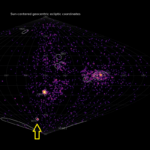
Such diffuse radiants prove a challenge to distinguish from the sporadic background. The only way this caught attention was because this part of the sky normally is rather empty. The shower is barely visible on the daily radiant density maps but is well visible on the cumulated monthly plot for February 2026 (Figure 1). The shower was reported to the IAU-MDC Working List of Meteor Showers and it has received the provisional identification M2026-E1.
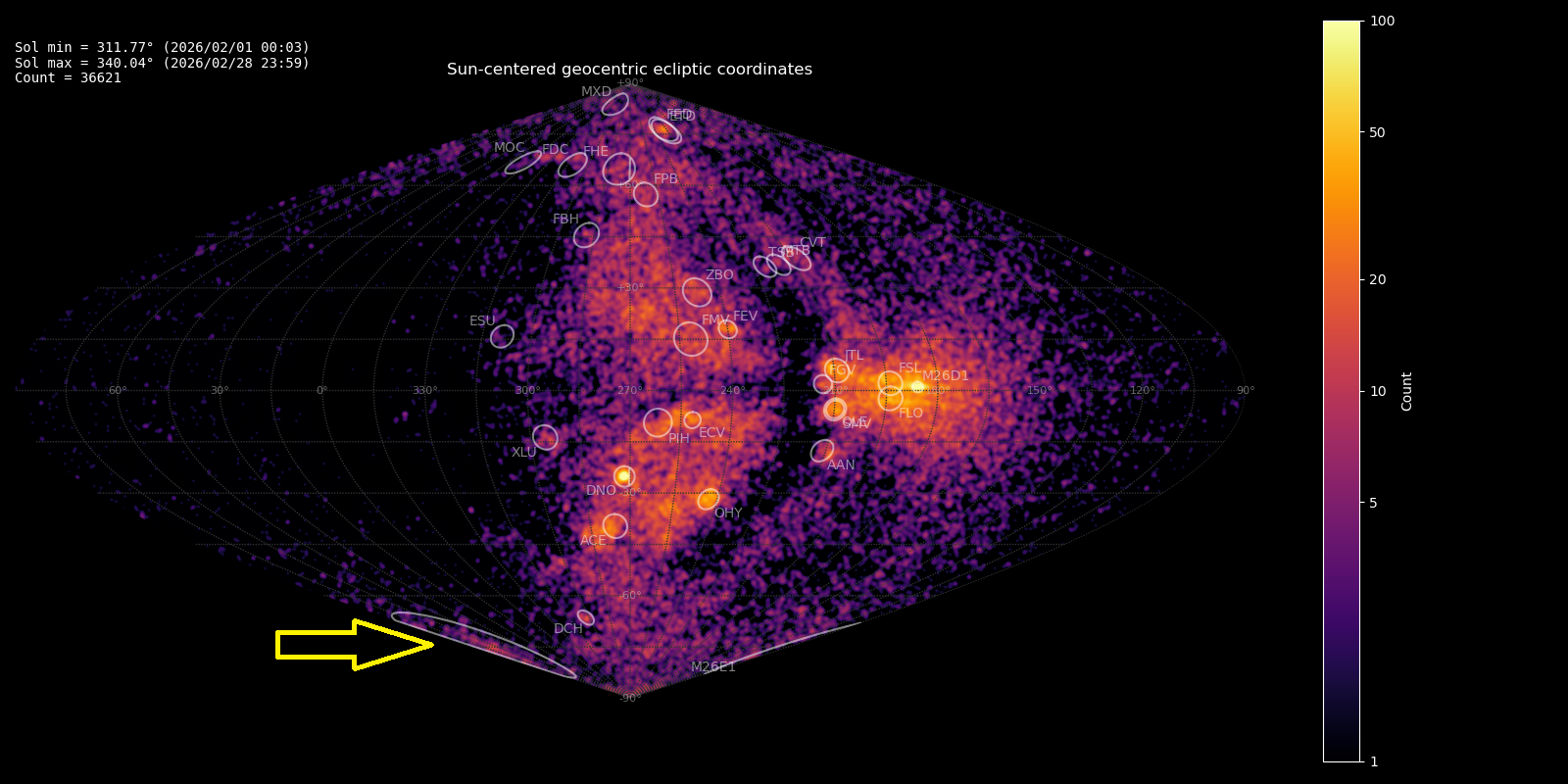
Figure 1 – Radiant density map with 36621 radiants obtained by the Global Meteor Network during February, 2026. The position of the M2026-E1 radiant in Sun-centered geocentric ecliptic coordinates is marked with a yellow arrow.
2 Shower classification based on radiants
The GMN shower association criteria assume that meteors within 1° in solar longitude, within 7.3° in radiant in this case, and within 10% in geocentric velocity of a shower reference location are members of that shower. Further details about the shower association are explained in Moorhead et al. (2020). Using these meteor shower selection criteria, 76 orbits have been identified as M2026-E1 meteors. The final results have been listed in Table 1.
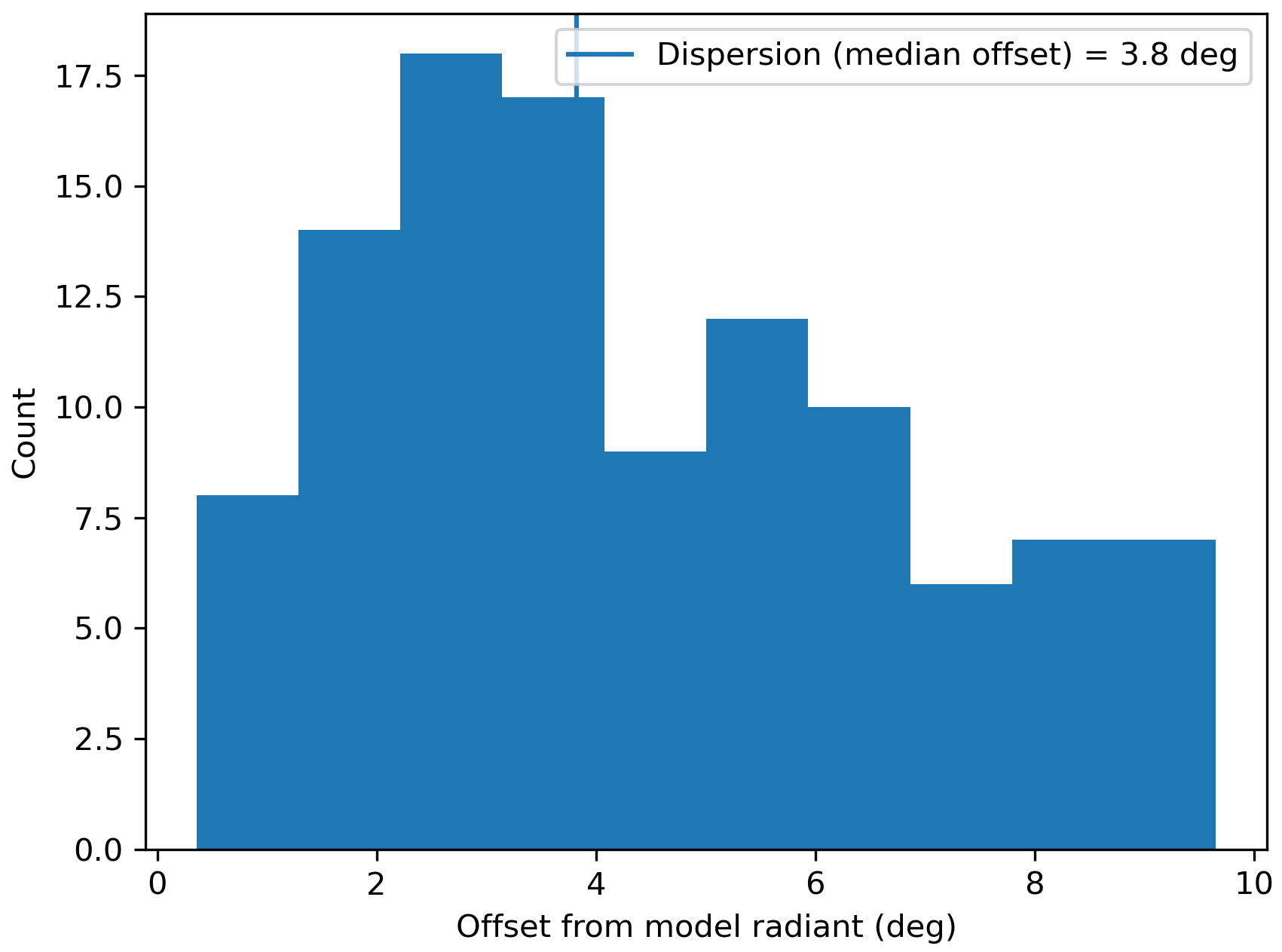
Figure 2 – Dispersion median offset on the radiant position.
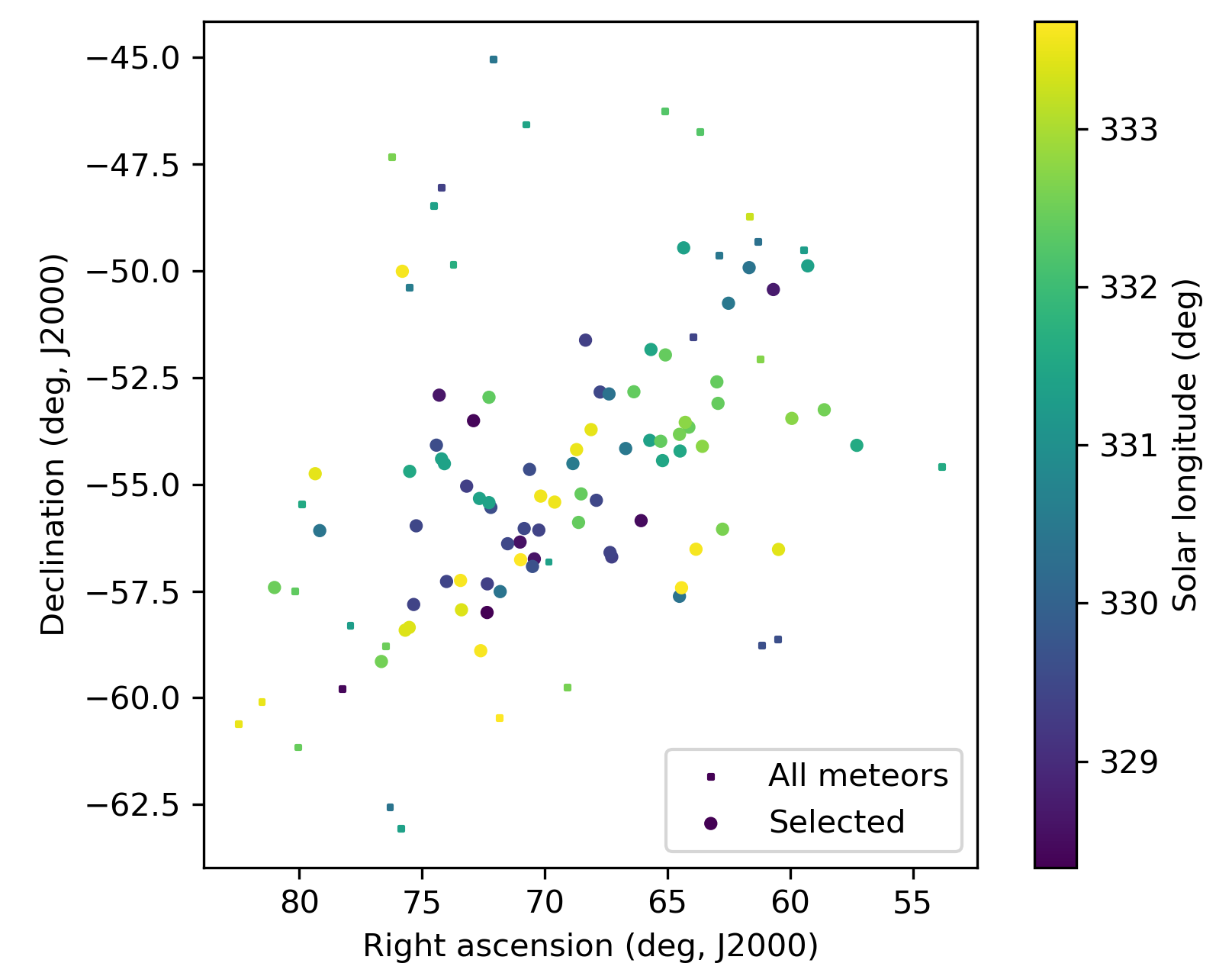
Figure 3 – The radiant distribution during the solar-longitude interval 328° – 334° in equatorial coordinates in 2026.
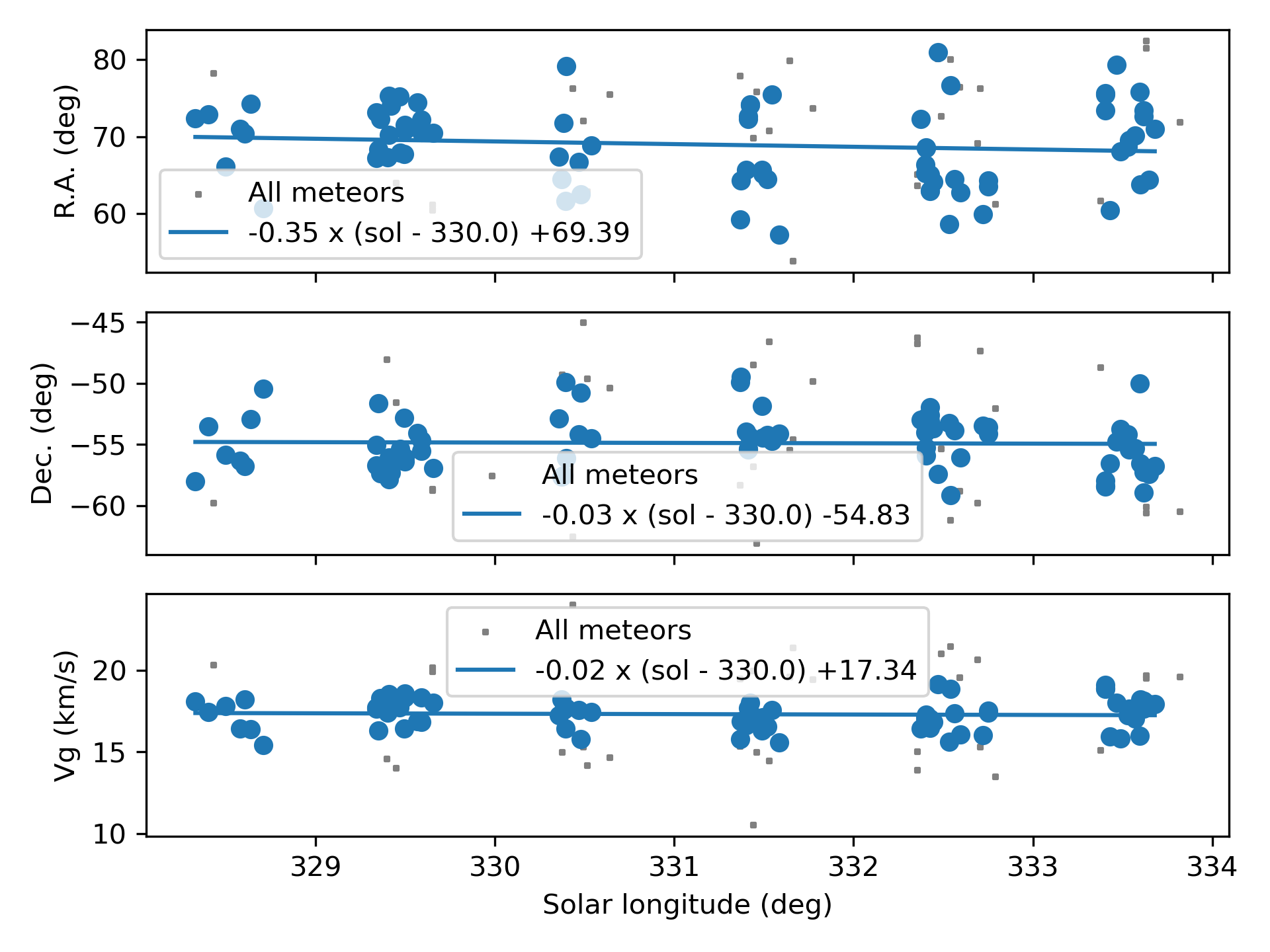
Figure 4 – The radiant drift.
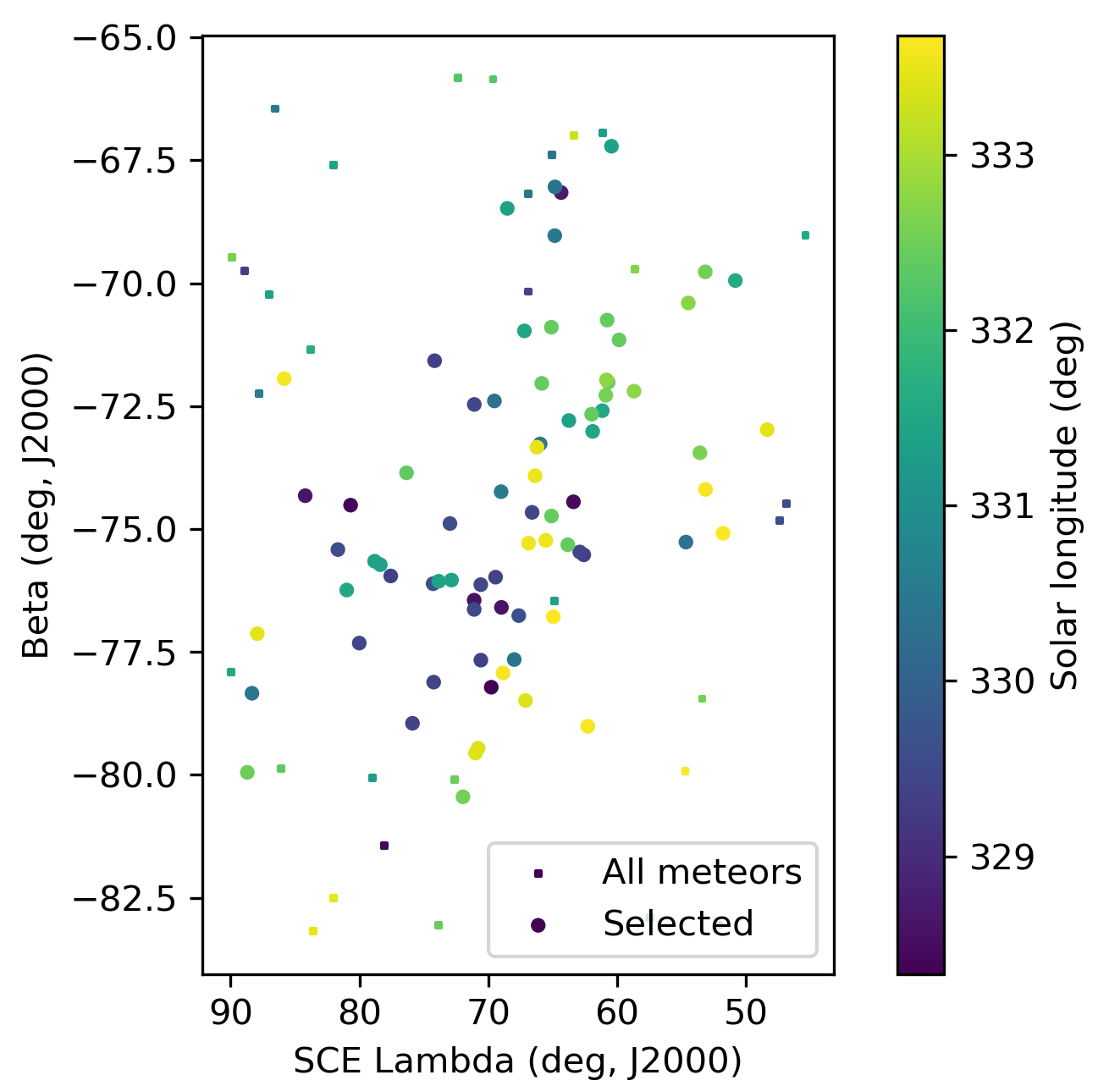
Figure 5 – The radiant distribution during the solar-longitude interval 328° – 334° in Sun-centered geocentric ecliptic coordinates.
3 Shower classification based on orbits
A complete independent meteoroid stream search has been applied for confirmation based upon orbit data obtained between Solar Longitude 322.0° and 339.0° during the years 2019 to 2026. 99772 orbits were available within this time interval and a final mean orbit has been computed by the method of Jopek et al. (2006) for the thresholds DSH < 0.10 and DD < 0.04 and DJ < 0.10 (Southworth and Hawkins, 1963; Drummond, 1981; Jopek, 1993), based upon the Rayleigh fit in Figure 6. The solutions with a mean orbit based upon 244 meteors for 2022–2026 and upon 122 meteors for 2026 are listed in Table 1. The method has been described in detail in a separate publication (Roggemans et al., 2026a).
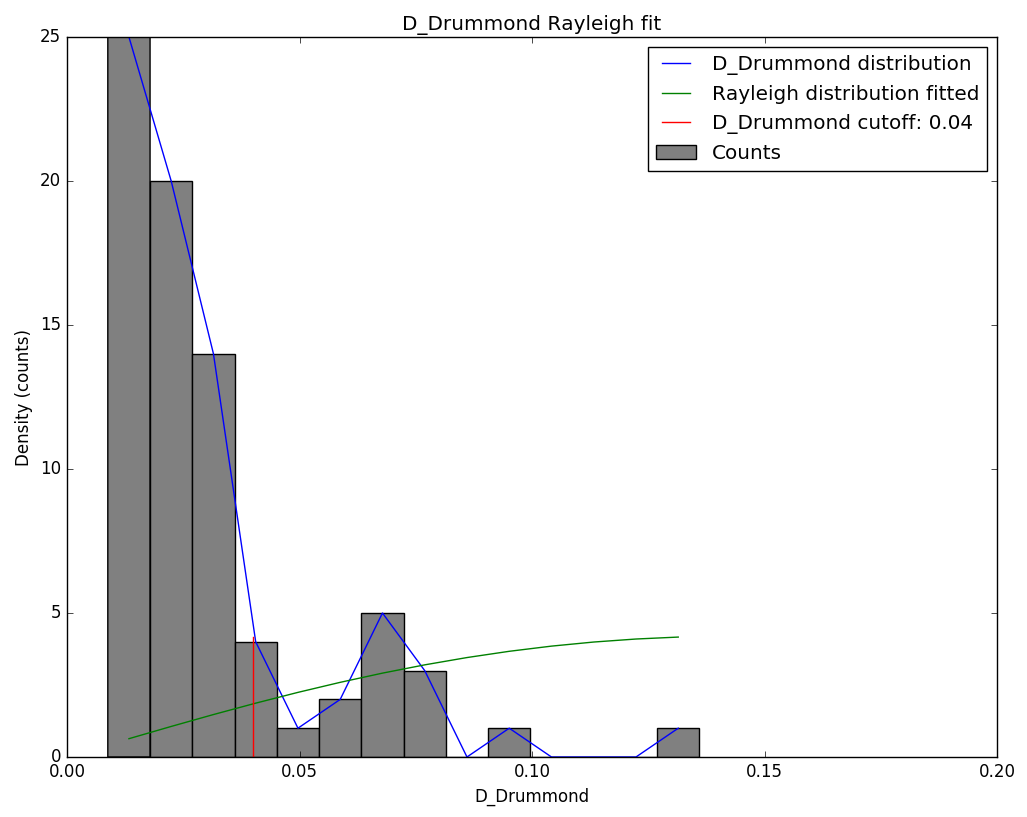
Figure 6 – Rayleigh fit on the Drummond criterion for the 2026 data of M2026-E1.
The radiant area is very diffuse stretched over about 30 degrees in Right Ascension and 15 degrees in Declination (Figure 7).
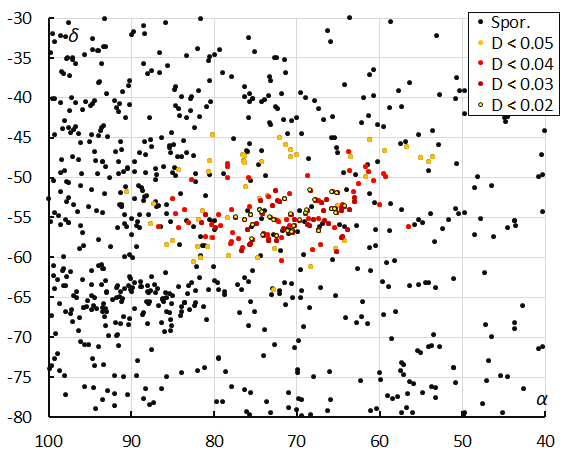
Figure 7 – The radiant distribution during the solar-longitude interval 322° – 339° in equatorial coordinates, color-coded for different threshold values of the combined similarity criteria.
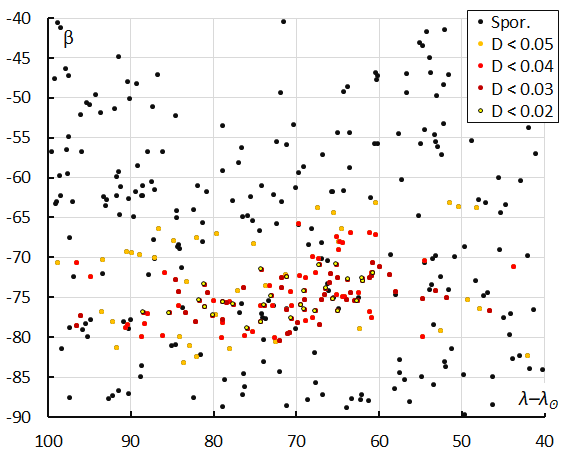
Figure 8 – The radiant distribution during the solar-longitude interval 322° – 339° in Sun-centered geocentric ecliptic coordinates, color-coded for different threshold values of the combined similarity criteria.
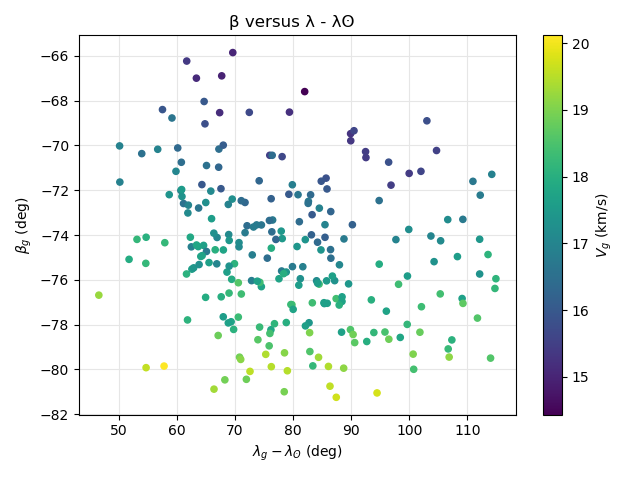
Figure 9 – The radiant distribution during the solar-longitude interval 322° – 339° in Sun-centered geocentric ecliptic coordinates, color-coded for the geocentric velocity.
The Sun-centered geocentric ecliptic coordinates appear dispersed due to the plotting projection near the ecliptic South pole (Figure 8). There is a large variation in geocentric velocity with the fastest meteors being those with their radiant close to the ecliptic South pole. The more to the north in the direction of the Antapex, the slower the meteors (Figure 9). There is a remarkable strong drift in Sun-centered geocentric ecliptic longitude with Δ(λ–λʘ)/Δλʘ = –1.61° which compensates the usual radiant drift due to the rotation of the Earth around the Sun in Equatorial coordinates and resulting in Δ(α)/Δλʘ = –0.35°, which is a negative value and indicates a drift in the opposite direction than normal. This rapid decline in λ–λʘ can be seen in Figure 10.
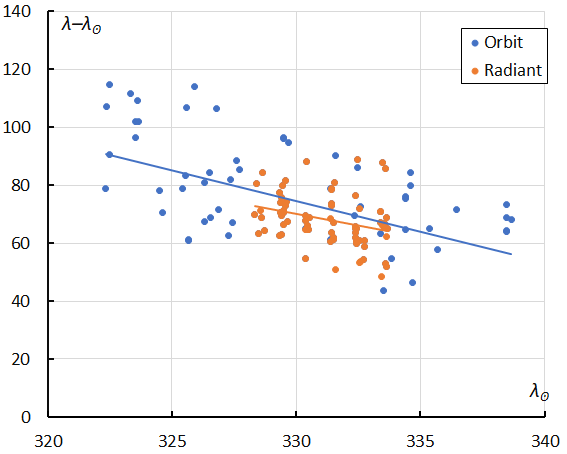
Figure 10 – The Sun-centered geocentric longitude λ–λʘ in function of the Solar Longitude λʘ for M2026-E1 based upon orbits classification (2026) and radiant classification (2026).
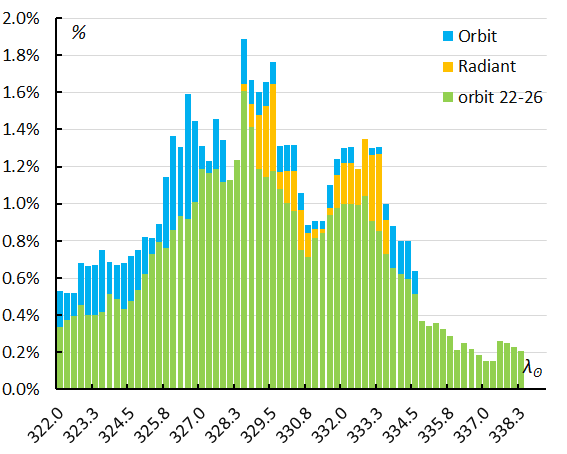
Figure 11 – The percentage of M2026-E1-meteors relative to the total number of meteors at the Southern Hemisphere, for the radiant method 2026 (orange), the orbit classification method 2026 (blue) and orbit classification method 2022–2026 (green).
The radiant-based shower identification covered an activity period in Solar Longitude from 328° to 334° and identified 76 M2026-E1 candidates. The orbit-based shower identification detected 122 possible M2026-E1 orbits between Solar Longitude 322° to 339°. During the common activity period 67 (75%) of the M2026-E1 meteors were detected by both methods, 13 (15%) by the orbit method but not by the radiant method and 9 (10%) by the radiant method but failing to fit the thresholds DSH < 0.10 and DD < 0.04 and DJ < 0.10 on their orbits.
Plotting the ratio of M2026-E1 meteors relative to the total number of meteors recorded at the Southern hemisphere, counted per two degrees in Solar Longitude, in steps of 0.25° (Figure 11), reveals three peaks and two dips in 2026. The radiant method missed the first peak because the activity period was assumed to start from λʘ = 328°. As the 2026 data is solely based upon data from Australia and New Zealand without any input from South America or South Africa, no 24-on-24 coverage is available. Adding the ratio of M2026-E1 activity for the period 2022–2026, the first peak and dip are smoothed out, best rates occurred at λʘ = 328.5° followed by a dip at λʘ = 330.8° and a secondary peak at λʘ = 332.5°. The activity ratio in 2026 was slightly higher than in the period 2022–2026.
4 Orbit and parent body
Despite the differences in numbers of possible M2026-E1 meteors between both methods, the final mean orbits and shower parameters are in good agreement (Table 1). The difference in node, argument and longitude of perihelion is due to the longer activity period used for the mean orbit based upon the orbit shower identification.
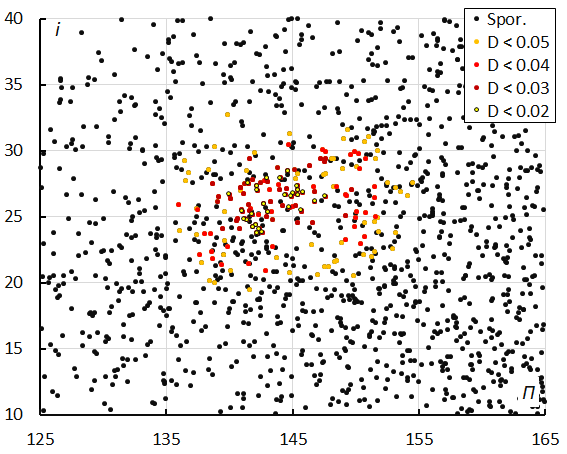
Figure 12 – I inclination i versus the longitude of perihelion Π color-coded for different classes of D-criteria thresholds, for λʘ between 322°and 339°.
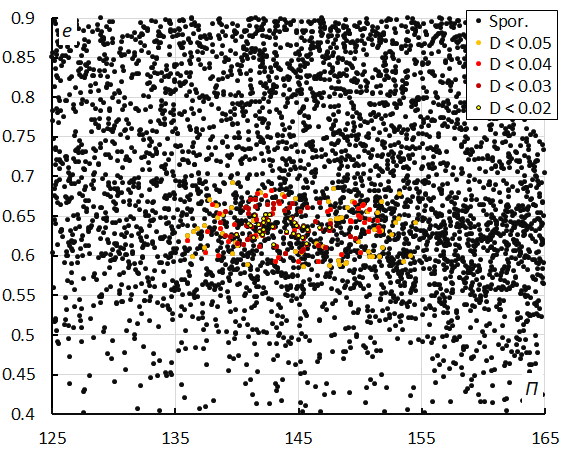
Figure 13 – Eccentricity e versus the longitude of perihelion Π color-coded for different classes of D-criteria thresholds, for λʘ between 322°and 339°.
Table 1 – Comparing solutions derived by the radiant based method and the orbit based menthod for DSH < 0.10 & DD < 0.04 & DJ < 0.10, in 2026 and for the years 2022–2026.
| Radiant method 2026 | Orbit method 2026 | Orbit method 2022–2026 | |
| λʘ (°) | 330.0 | 328.5 | 328.5 |
| λʘb (°) | 328.0 | 322.3 | 322.1 |
| λʘe (°) | 334.0 | 338.7 | 339.0 |
| αg (°) | 69.4 | 71.1 | 73.4 |
| δg (°) | –54.8 | –55.0 | –54.2 |
| Δαg (°) | –0.35 | –0.57 | –0.68 |
| Δδg (°) | –0.03 | +0.06 | –0.01 |
| vg (km/s) | 17.3 | 17.6 | 17.4 |
| Hb (km) | 93.7 | 93.5 | 93.6 |
| He (km) | 83.2 | 83.2 | 82.5 |
| Hp (km) | 89.3 | 88.6 | 87.8 |
| MagAp | +0.6 | +0.8 | +0.5 |
| λg (°) | 40.05 | 41.6 | 48.7 |
| λg – λʘ (°) | 70.05 | 70.6 | 78.1 |
| βg (°) | –74.6 | –75.3 | –74.9 |
| a (A.U.) | 2.660 | 2.700 | 2.697 |
| q (A.U.) | 0.984 | 0.984 | 0.985 |
| e | 0.630 | 0.635 | 0.635 |
| i (°) | 25.9 | 26.2 | 26.0 |
| ω (°) | 351.9 | 353.7 | 355.4 |
| Ω (°) | 151.9 | 150.3 | 150.0 |
| Π (°) | 143.1 | 144.0 | 145.4 |
| Tj | 2.96 | 2.93 | 2.93 |
| N | 76 | 122 | 244 |
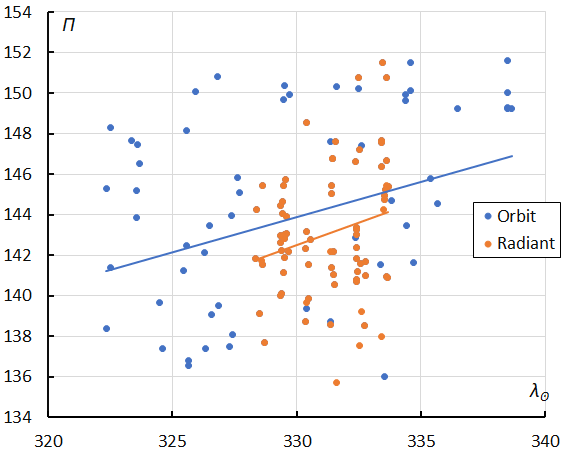
Figure 14 – The evolution of the Longitude of perihelion Π in function of the Solar Longitude λʘ for the M2026-E1 based upon orbits (2022–2026) and radiant classification (2026).
Looking at the inclination (Figure 12) and eccentricity (Figure 13) against longitude of perihelion shows there to be a large spread in perihelion longitude. Figure 14 shows a significant increase in longitude of perihelion during the activity period. The other Kepler elements remain relatively stable during the activity period.
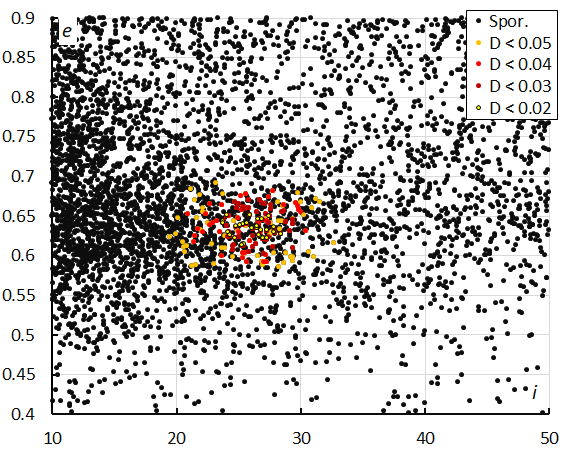
Figure 15 – Eccentricity e versus the inclination i color-coded for different classes of D-criteria thresholds, for λʘ between 322°and 339°.
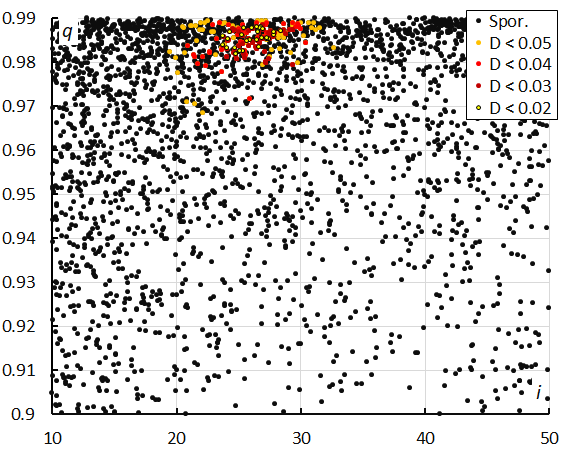
Figure 16 – Perihelion distance q versus the inclination i color-coded for different classes of D-criteria thresholds, for λʘ between 322°and 339°.
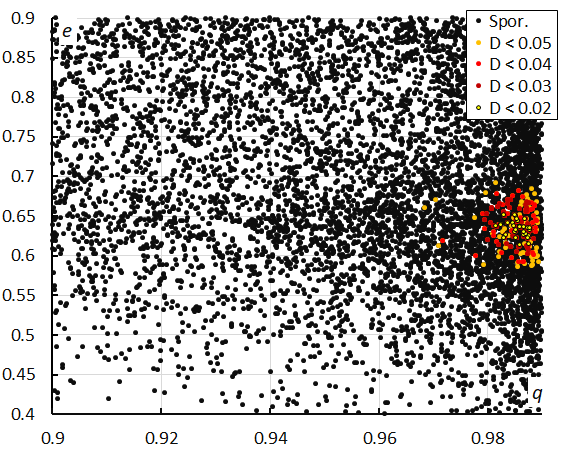
Figure 17 – Eccentricity e versus the perihelion distance q color-coded for different classes of D-criteria thresholds, for λʘ between 322°and 339°.
The concentration in orbits is best visible in eccentricity e and perihelion distance q (Figures 15, 16 and 17).
The M2026-E1 meteoroid stream has a Jupiter-family comet type orbit with a Tisserand value relative to planet Jupiter of TJ = 2.96. The meteoroid stream intersects the Earth orbit at its ascending node (Ω) while the descending node (℧) is situated between the asteroid belt and Jupiter (Figure 18).
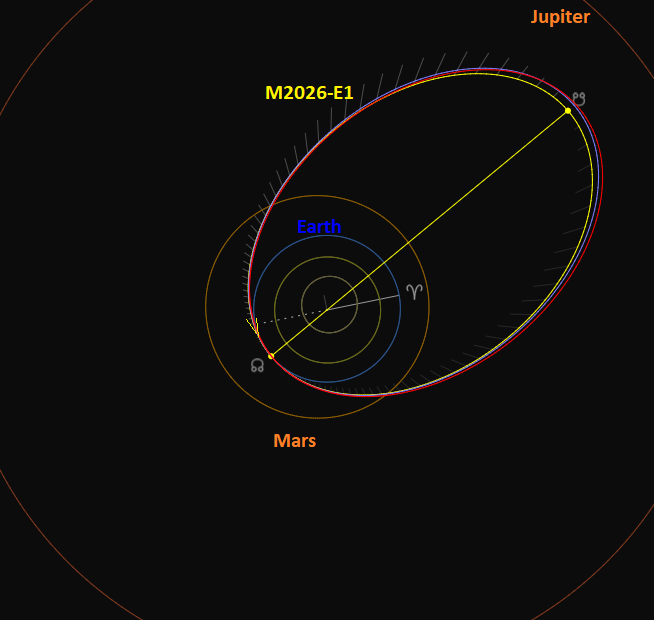
Figure 18 – Comparing the M2026-E1 solution (yellow) obtained by the radiant method with the solutions obtained by the orbit method for 2026 (blue) and 2022–2026 (red). (Plotted with the Orbit visualization app provided by Pető Zsolt).
The number of orbits per year reflects the expansion of GMN in the Southern Hemisphere, although in detail the camera coverage has not changed significantly since 2024. The number of M2026-E1 meteors in 2026 (Table 2) was much higher than in previous years. The very diffuse nature of the radiant area explains why it was overlooked in previous years when much less of these meteors were recorded.
Table 2 – The number of M2026-E1 orbits with DSH < 0.10 and DD < 0.04 and DJ < 0.10 per year during the period 2022–2026.
| Year | Number of orbits |
| 2022 | 2 |
| 2023 | 16 |
| 2024 | 49 |
| 2025 | 55 |
| 2026 | 121 |
| Total | 243 |
A search for possible parent bodies resulted in the top ten candidates listed in Table 3. None of the discrimination thresholds is conclusive to confirm any of these objects as a possible parent body. Numeric integrations of the orbital evolution are required to reconstruct the most likely behavior of the stream and its possible parent bodies.
Table 3 – Top ten matches of a search for possible parent bodies with DD < 0.085, based upon the mean orbit derived from the radiant classification method.
| Name | DD |
| 2010JF87 | 0.057 |
| 2017FL127 | 0.058 |
| 499P/Catalina | 0.064 |
| 2016DK | 0.072 |
| 2017FG63 | 0.074 |
| 2018DG | 0.074 |
| 2025CV2 | 0.078 |
| 2025DC25 | 0.080 |
| 2016CC30 | 0.081 |
| 2025DP13 | 0.083 |
5 Conclusion
A reliable orbit has been established for a newly discovered meteor shower that has a diffuse radiant in the constellation Dorado, and which displayed activity between 11 and 27 February 2026. The large dispersed radiant with slow meteors means the shower was barely detectable, which may account for it not having been discovered in the past. The shower has been added to the IAU-MDC Working List of Meteor Showers and has the temporary assignation M2026-E1.
Acknowledgments
This report is based on the data of the Global Meteor Network (Vida et al., 2020a; 2020b; 2021) which is released under the CC BY 4.0 license. We thank all 927 participants in the Global Meteor Network project for their contribution and perseverance. A list with the names of the volunteers who contribute to GMN has been published in the 2025 annual report (Roggemans et al., 2026). The following 256 cameras contributed to paired meteors used in this study:
AU0002, AU0003, AU0004, AU0006, AU0007, AU0009, AU000A, AU000B, AU000C, AU000D, AU000E, AU000G, AU000L, AU000Q, AU000R, AU000S, AU000T, AU000V, AU000W, AU000X, AU000Y, AU0010, AU001A, AU001B, AU001C, AU001D, AU001E, AU001F, AU001K, AU001L, AU001N, AU001P, AU001Q, AU001R, AU001S, AU001U, AU001V, AU001W, AU001X, AU001Y, AU001Z, AU0029, AU002A, AU002B, AU002C, AU002E, AU0030, AU003C, AU003E, AU003G, AU003H, AU003J, AU0047, AU0048, AU004B, AU004J, AU004K, ES000U, KR0005, KR000A, KR000J, KR000K, KR000L, KR000N, KR001C, KR002E, KR003X, MX0002, MX000E, MX000F, NZ0001, NZ0002, NZ0003, NZ0004, NZ0007, NZ0008, NZ0009, NZ000A, NZ000B, NZ000C, NZ000D, NZ000G, NZ000H, NZ000L, NZ000M, NZ000N, NZ000P, NZ000Q, NZ000S, NZ000T, NZ000W, NZ000X, NZ000Y, NZ000Z, NZ0010, NZ0011, NZ0012, NZ0013, NZ0014, NZ0015, NZ0016, NZ0017, NZ0018, NZ0019, NZ001C, NZ001E, NZ001F, NZ001G, NZ001H, NZ001J, NZ001K, NZ001L, NZ001N, NZ001P, NZ001Q, NZ001R, NZ001S, NZ001V, NZ001W, NZ001X, NZ0020, NZ0022, NZ0023, NZ0024, NZ0025, NZ0026, NZ0027, NZ0029, NZ002B, NZ002C, NZ002D, NZ002E, NZ002F, NZ002G, NZ002H, NZ002J, NZ002K, NZ002L, NZ002M, NZ002N, NZ002P, NZ002Q, NZ002R, NZ002S, NZ002T, NZ002U, NZ002W, NZ002X, NZ002Y, NZ002Z, NZ0030, NZ0032, NZ0033, NZ0034, NZ0035, NZ0036, NZ0037, NZ0038, NZ0039, NZ003A, NZ003B, NZ003C, NZ003E, NZ003F, NZ003H, NZ003K, NZ003N, NZ003R, NZ003T, NZ003U, NZ003V, NZ003W, NZ003X, NZ003Y, NZ003Z, NZ0040, NZ0041, NZ0042, NZ0043, NZ0044, NZ0045, NZ0046, NZ0049, NZ004A, NZ004B, NZ004C, NZ004D, NZ004E, NZ004F, NZ004H, NZ004J, NZ004L, NZ004M, NZ004N, NZ004R, NZ004T, NZ004U, NZ004W, NZ004X, NZ004Y, NZ004Z, NZ0051, NZ0059, NZ005B, NZ005C, NZ005D, NZ005F, NZ005G, NZ005H, NZ005J, NZ005K, NZ005L, NZ005M, NZ005N, NZ005Q, NZ005R, NZ005S, NZ005T, NZ005U, NZ005Y, NZ0063, NZ0065, NZ0066, NZ0067, NZ0068, NZ0069, NZ006A, NZ006C, NZ006D, NZ006E, NZ006F, NZ006G, NZ006K, NZ007B, NZ007C, NZ007D, NZ007F, PT0002, US0006, US0008, US000A, US000C, US000E, US000H, US000M, US0023, US0030, US005C, ZA0002, ZA0007, ZA0008, ZA000A, ZA000C, ZA000D.
References
Drummond J. D. (1981). “A test of comet and meteor shower associations”. Icarus, 45, 545–553.
Jopek T. J. (1993). “Remarks on the meteor orbital similarity D-criterion”. Icarus, 106, 603–607.
Jopek T. J., Rudawska R. and Pretka-Ziomek H. (2006). “Calculation of the mean orbit of a meteoroid stream”. Monthly Notices of the Royal Astronomical Society, 371, 1367–1372.
Moorhead A. V., Clements T. D., Vida D. (2020). “Realistic gravitational focusing of meteoroid streams”. Monthly Notices of the Royal Astronomical Society, 494, 2982–2994.
Roggemans P., Vida D., Šegon D., Scott J. M. (2026a). “Meteoroid orbit shower identification method and its application in meteor shower case studies”. eMetN Meteor Journal, 11, TBP.
Roggemans P., Campbell-Burns P., Kalina M., McIntyre M., Scott J. M., Šegon D., Vida D. (2026b). “Global Meteor Network report 2025”. eMetN Meteor Journal, 11, 89–129.
Southworth R. B. and Hawkins G. S. (1963). “Statistics of meteor streams”. Smithsonian Contributions to Astrophysics, 7, 261–285.
Vida D., Gural P., Brown P., Campbell-Brown M., Wiegert P. (2020a). “Estimating trajectories of meteors: an observational Monte Carlo approach – I. Theory”. Monthly Notices of the Royal Astronomical Society, 491, 2688–2705.
Vida D., Gural P., Brown P., Campbell-Brown M., Wiegert P. (2020b). “Estimating trajectories of meteors: an observational Monte Carlo approach – II. Results”. Monthly Notices of the Royal Astronomical Society, 491, 3996–4011.
Vida D., Šegon D., Gural P. S., Brown P. G., McIntyre M. J. M., Dijkema T. J., Pavletić L., Kukić P., Mazur M. J., Eschman P., Roggemans P., Merlak A., Zubrović D. (2021). “The Global Meteor Network – Methodology and first results”. Monthly Notices of the Royal Astronomical Society, 506, 5046–5074.