By Paul Roggemans, Denis Vida, Damir Šegon, James M. Scott, Jeff Wood
Abstract: An activity source identified as the delta-Chamaeleontids has been detected between the 19th and 25th of February 2026 from a radiant at R.A. = 3.9° and Decl.= –87.1°, with a geocentric velocity of 40.8 km/s. This case study confirms the existence of this annual meteor shower and that it fulfils the criteria to be nominated for established status by the IAU-MDC.
1 Introduction
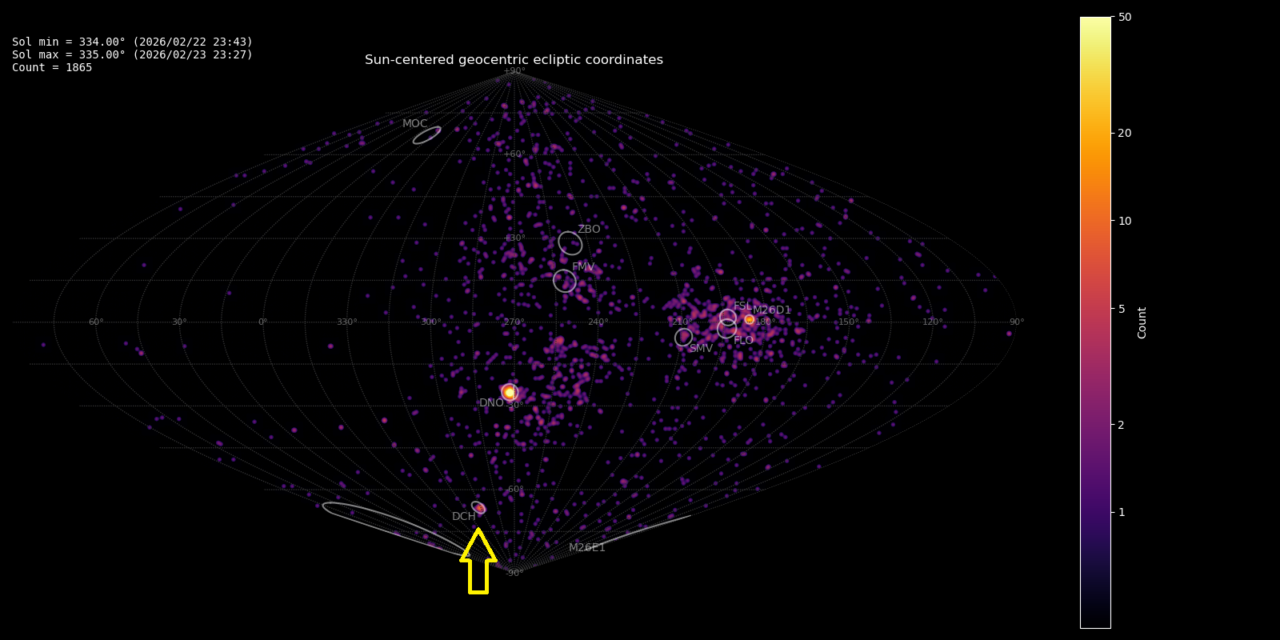
During the delta-Normids outburst on 22–23 February 2026 (Figure 1), a weaker activity source caught attention. The shower wasn’t included in the list of showers monitored by GMN. The radiant position in equatorial coordinates at Right Ascension 4° and Declination –87° is very close to the Southern Hemisphere pole in the constellation Octans. The activity corresponds to the delta-Chamaeleontids (DCH#107) in the IAU-MDC Working List of Meteor Showers. The name is weird as the star δ-Chamaeleonis is nowhere near this radiant. According to Jenniskens (2023), the shower was first noticed and named based upon Adelaide radar data from December 1968 to June 1969 (Gartrell and Elford, 1975). However, Gartrell and Elford mention a radiant position at R.A. 250° and Decl. –86°, based upon only 4 meteors, located in Octans, but without defining and naming the association of meteors as a shower.
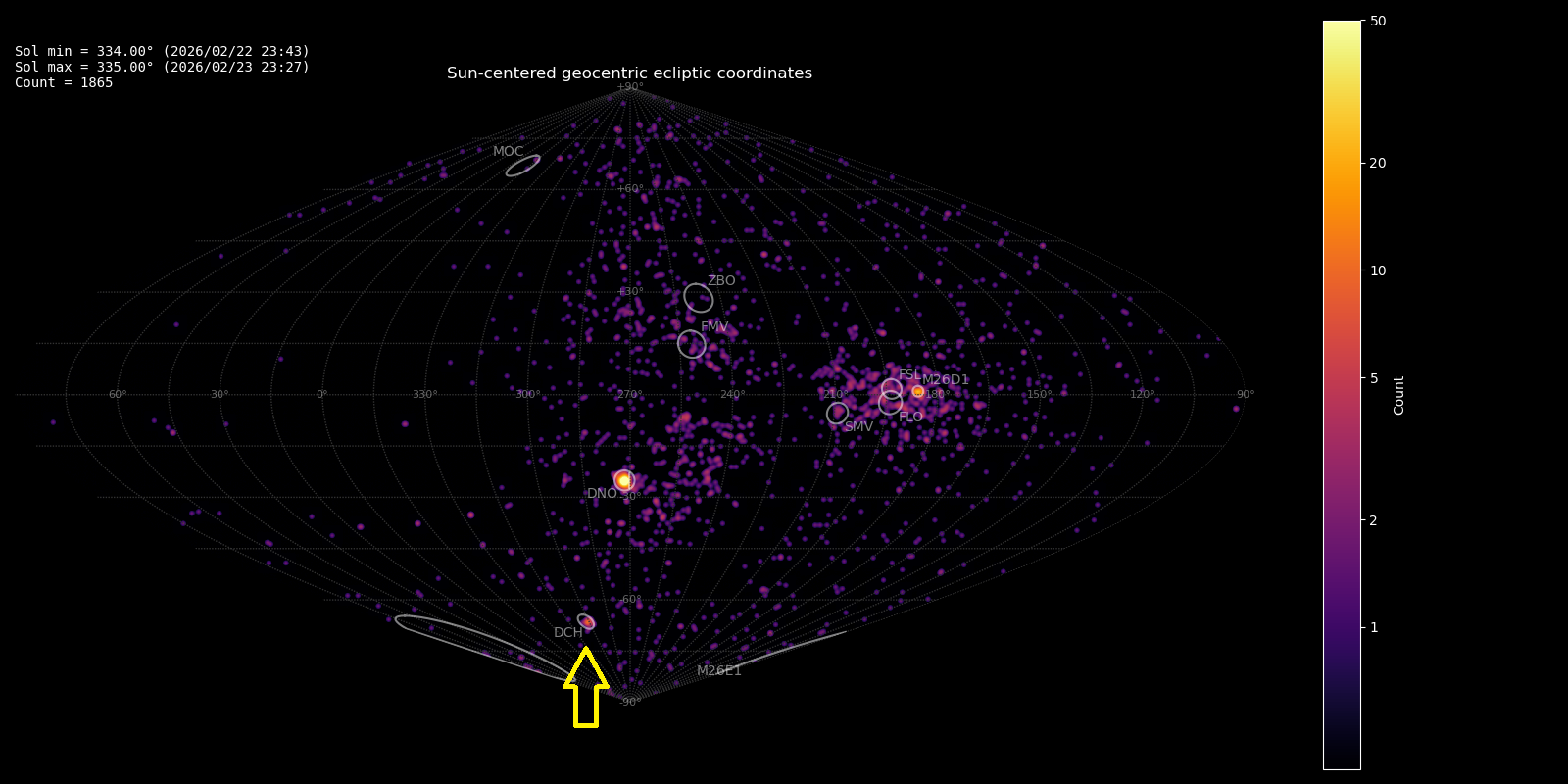
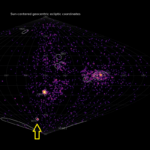
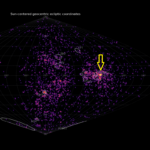
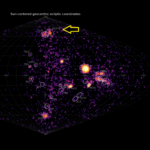
Figure 1 – Radiant density map with 1865 radiants obtained by the Global Meteor Network during 22–23 February, 2026. The position of the delta-Chamaeleontids in Sun-centered geocentric ecliptic coordinates is marked with a yellow arrow.
This solution is DCH#107.000 in the IAU-MDC list and it was associated by Gartrell and Elford with comet C/1930 D1 Peltier-Schwassmann-Wachmann as likely parent body. The second solution, DCH#107.001, is based upon 47 meteors but differs a lot in velocity and eccentricity and is based upon a very poor D-criterion threshold of DSH = 0.39. Given that radar meteoroid orbits at that time had large uncertainties, combined with such a poor discrimination threshold, solution DCH#107.001 should be removed from the IAU-MDC list. Gartrell and Elford nowhere link it to DCH#107.000.
The name Chamaeleontids appears in a later study by Jopek et al. (1999) where the distance function DN by Valsecchi et al. (1999) was applied on the Adelaide radar data. This solution was based upon 33 radar meteors recorded between 10 and 17 February 1969, listed as DCH#107.002. The radiant was at R.A. 207° and Decl. –78° which is in the constellation Chamaeleon but nowhere near the star delta. The radar observations covered only one week per month and missed the activity period of the shower completely. The activity period, eccentricity and inclination of DCH#107.002 differ a lot from the observed shower in recent times. This solution may refer to another activity or may be even a spurious association. Jopek et al. marked it as probably never identified before, thus not related to the solution published by Gartrell and Elford. This solution may be also considered to be removed from IAU-MDC list.
The name delta-Chamaeleontids first appears in Jenniskens (2006) where the two unrelated solutions from Gartrell and Elford (1975) are combined, although the radiant positions based upon four meteors is in Octans and the radiant based upon 47 meteors was derived with a very poor discrimination threshold and therefore highly uncertain.
2 Shower classification based on radiants
The GMN shower association criteria assume that meteors within 1° in solar longitude, within 2.0° in radiant in this case, and within 10% in geocentric velocity of a shower reference location are members of that shower. Further details about the shower association are explained in Moorhead et al. (2020). Using these meteor shower selection criteria, 60 orbits have been identified as delta-Chamaeleontids recorded in 2025–2026 by 130 GMN cameras installed in Australia, New Zealand and South Africa. Since the shower is only observable from the Southern Hemisphere only data from this part of the world has been used. The final results have been listed in Table 1.
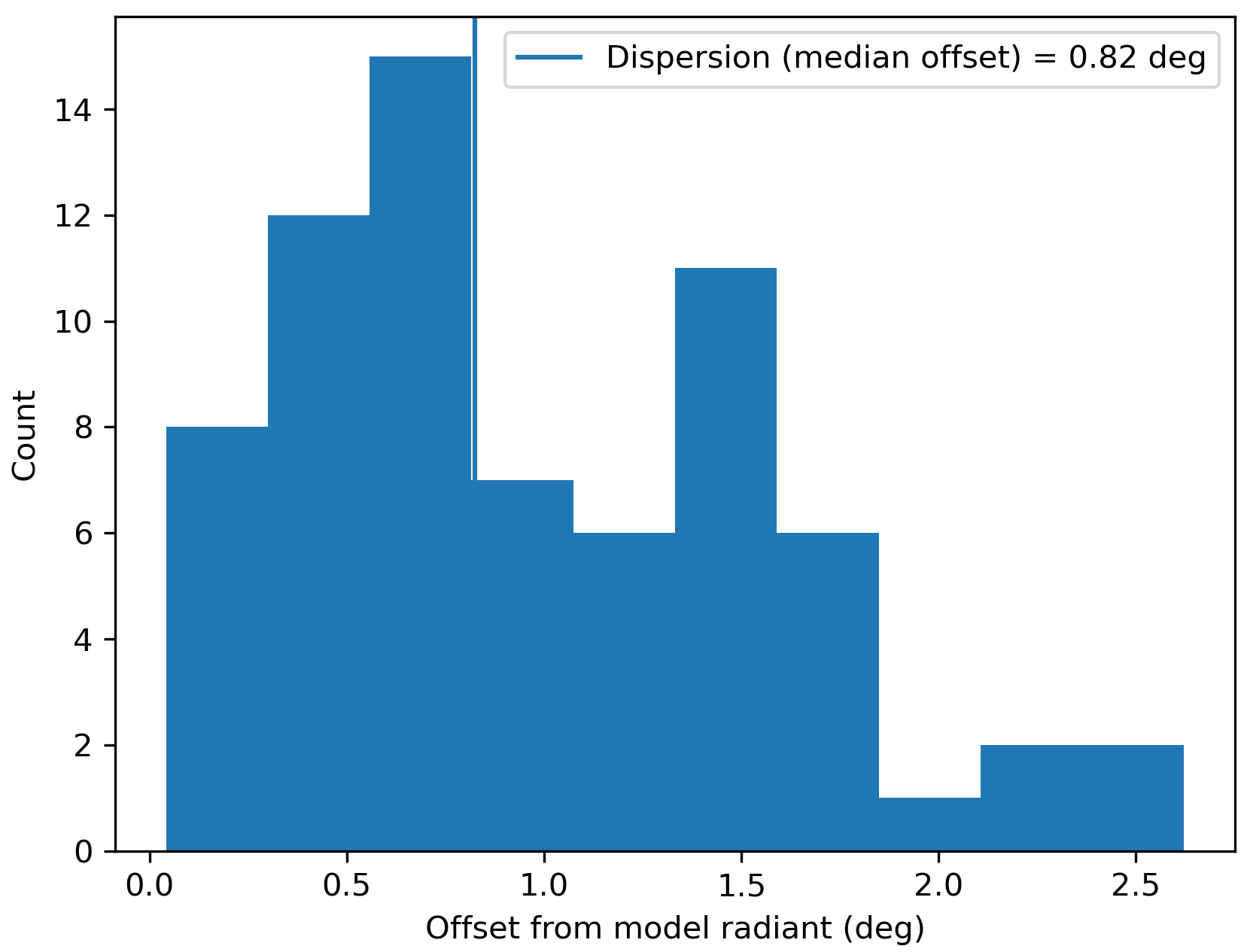
Figure 2 – Dispersion median offset on the radiant position.
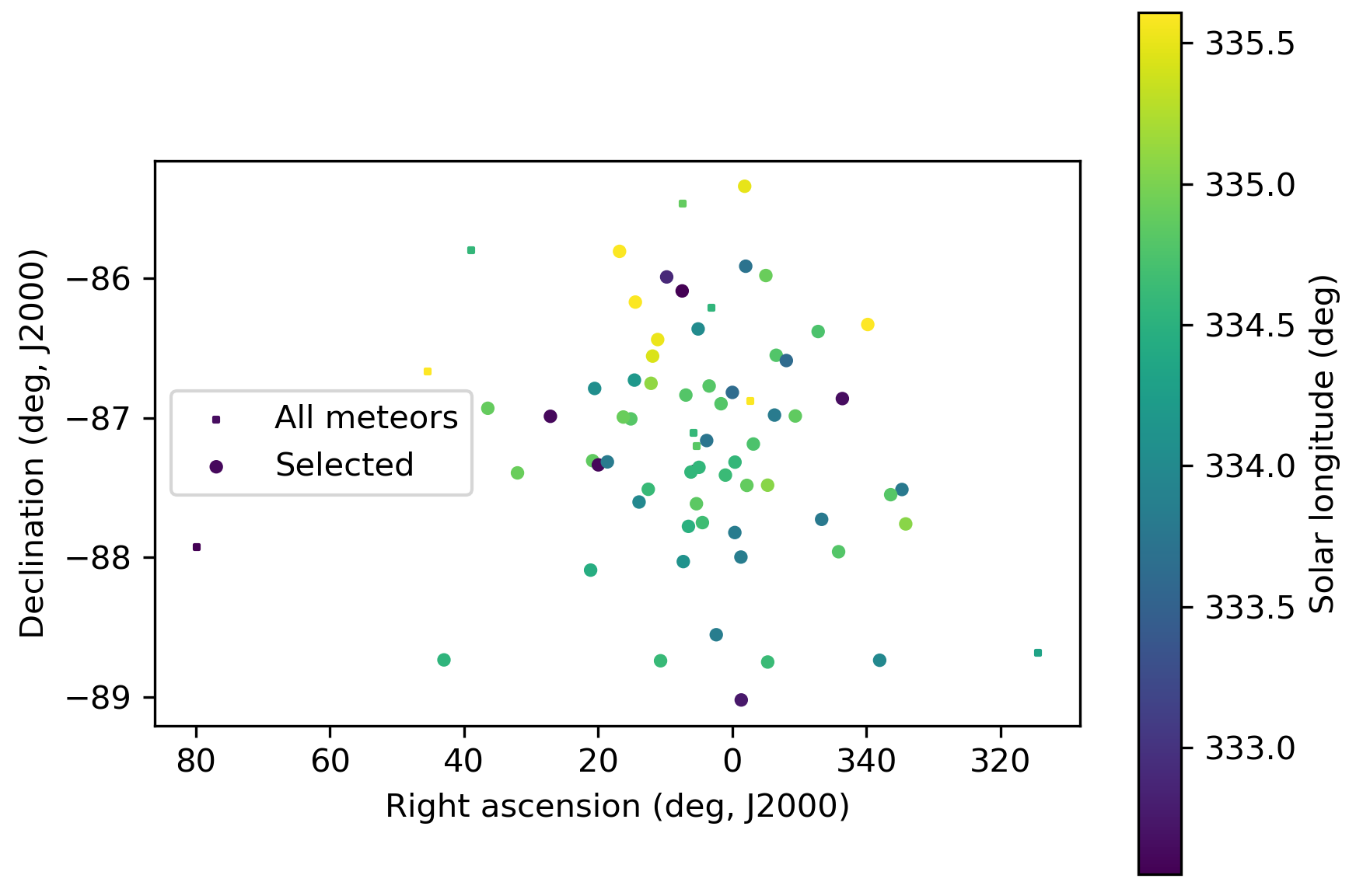
Figure 3 – The radiant distribution during the solar-longitude interval 332.5° – 335.5° in equatorial coordinates.
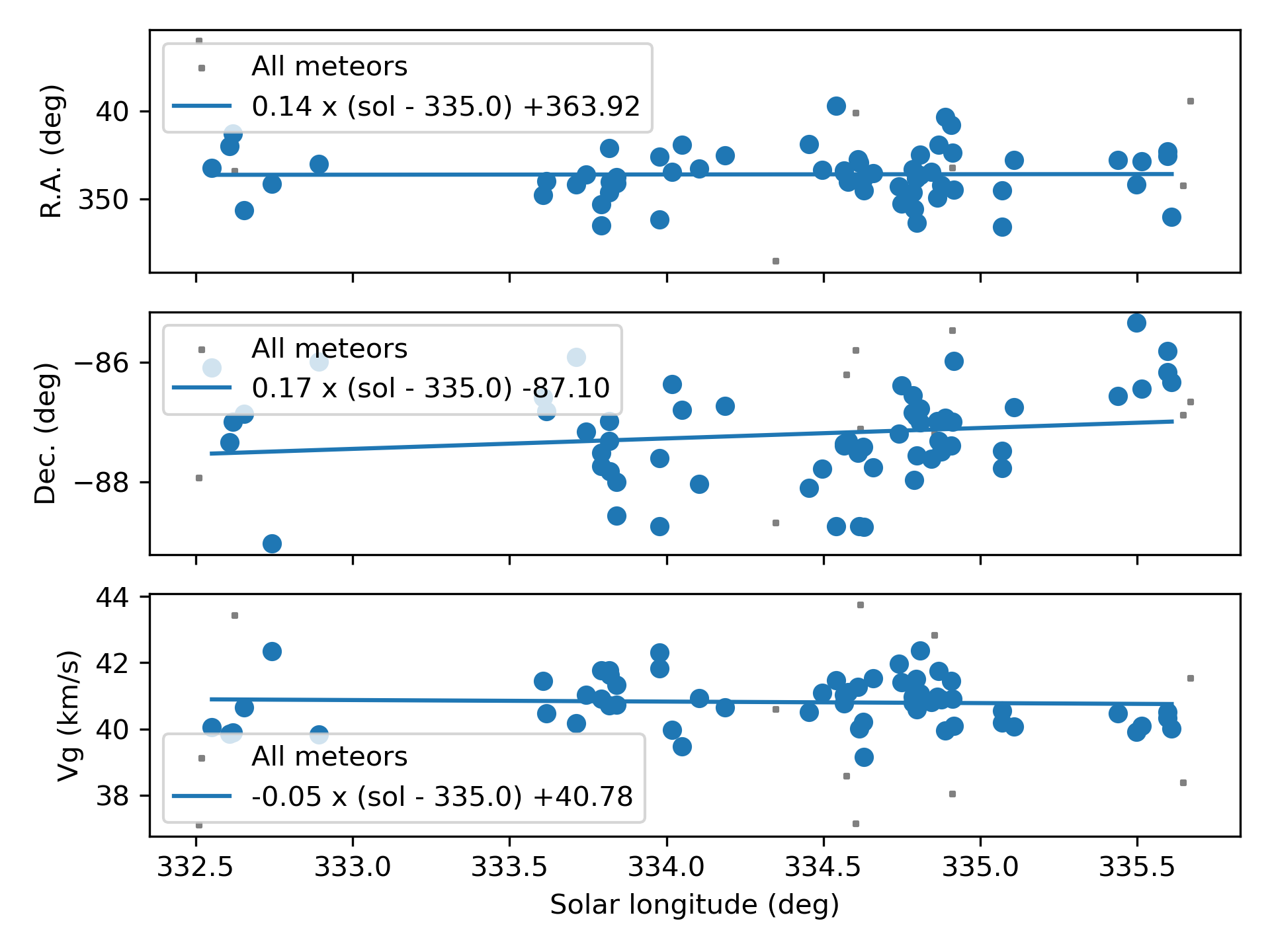
Figure 4 – The radiant drift.
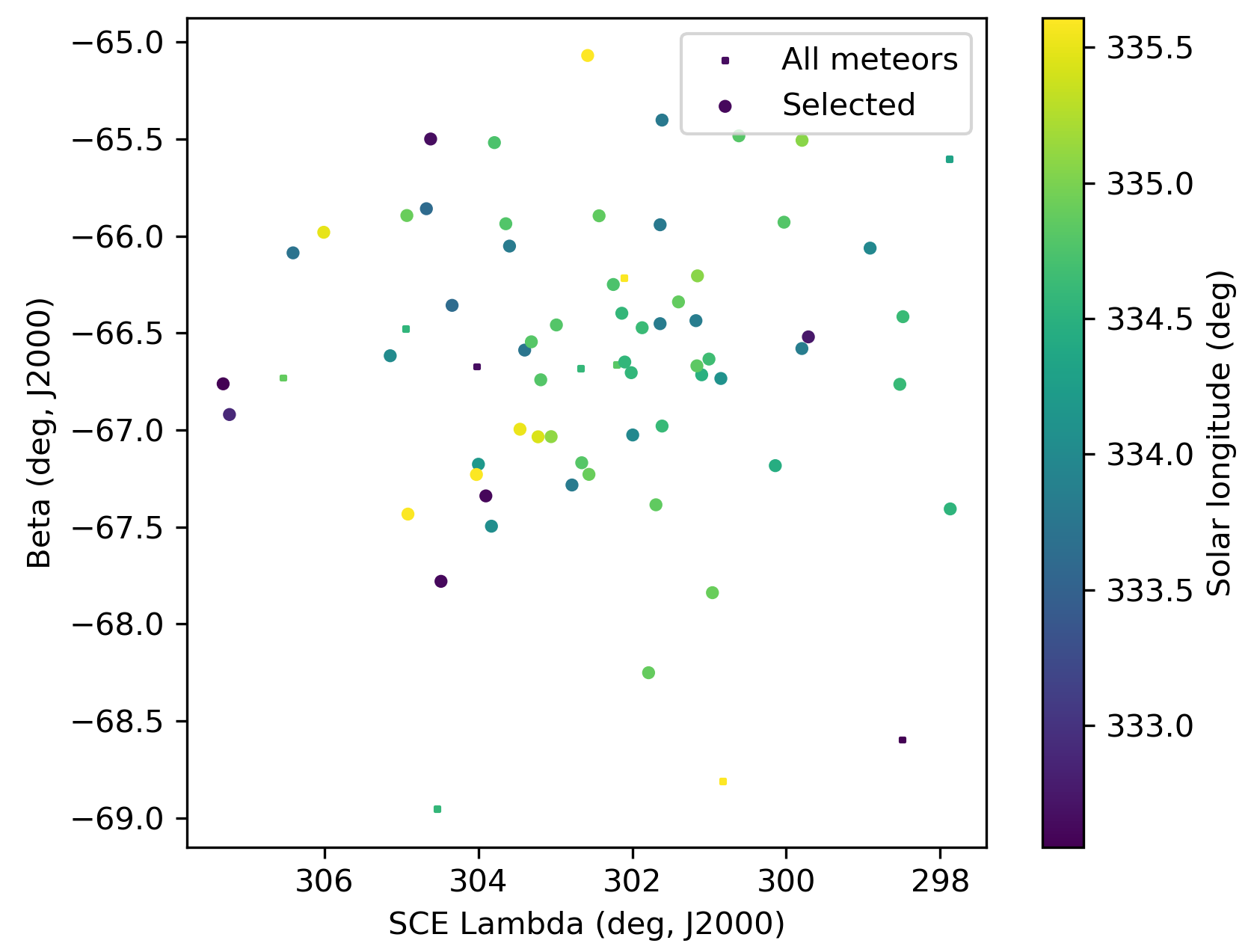
Figure 5 – The radiant distribution during the solar-longitude interval 332.5° – 335.5° in Sun centered geocentric ecliptic coordinates.
3 Shower classification based on orbits
A complete independent meteoroid stream search has been applied for confirmation based upon orbit data obtained between Solar Longitude 330.0° and 338.0° during the years 2019 to 2026. 51612 orbits were available within this time interval and a final mean orbit has been computed by the method of Jopek et al. (2006) for the thresholds DSH < 0.125 and DD < 0.05 and DJ < 0.125 (Southworth and Hawkins, 1963; Drummond, 1981; Jopek, 1993. No data are available for the Southern Hemisphere before 2022. The results with the mean orbit based upon 83 meteors for 2022–2026 have been listed in Table 1. The method has been described in detail in a separate publication (Roggemans et al., 2026a).
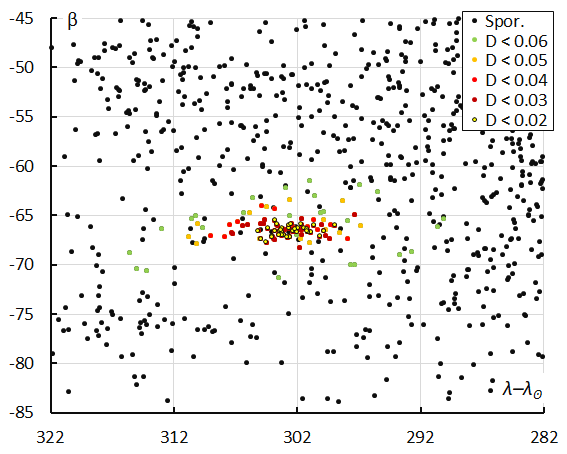
Figure 6 – The radiant distribution during the solar-longitude interval 330° – 338° in Sun-centered geocentric ecliptic coordinates, color-coded for different threshold values of the combined similarity criteria.
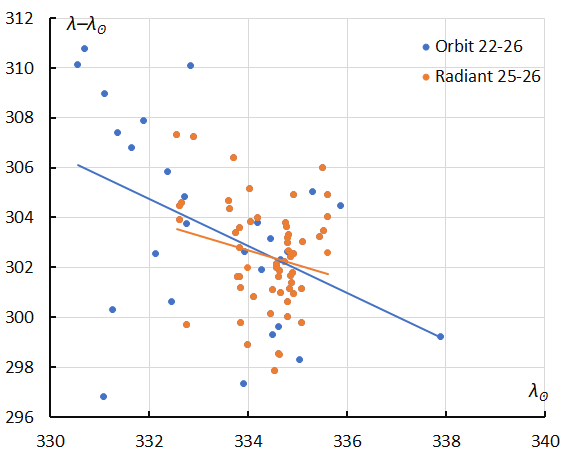
Figure 7 – The Sun-centered geocentric longitude λ–λʘ in function of the Solar Longitude λʘ for DCH#107 based upon orbits (2022–2026) and radiant classification (2025–2026).
The green dots in Figure 6 with DSH < 0.15 and DD < 0.06 and DJ < 0.15 appear rather dispersed and were ignored as outliers. The cutoff for the thresholds on the D criteria was set at DSH < 0.125 and DD < 0.05 and DJ < 0.125. The Sun-centered ecliptic longitude appears stretched in Figure 6 due to the radiant drift Δ(λ–λʘ)/Δλʘ with –0.59°/Δλʘ (Figure 7). No drift in ecliptic latitude occurs.
Both methods identified 87 meteors as delta-Chamaeleontids with 56 (or 64%) of them in common, four by the radiant method that fail to fit the DSH < 0.125 and DD < 0.05 and DJ < 0.125 thresholds, and 27 (or 31%) identified by the orbit method but ignored by the radiant method, 14 of which from years not covered by the radiant method.
The orbit classification method detects a longer activity period than the period assumed for the radiant classification method. Plotting the ratio delta-Chamaeleontids meteors/all meteors, for time intervals of 1.5° in Solar Longitude, plotted every 0.25°, results in a skewed profile with a slow incline followed by a steep decline in activity (Figure 8). The orbit method (blue) identified more delta-Chamaeleontids candidates than the radiant method (orange). The best rates occurred at λʘ = 334.5°. The shower activity duration lasts one week from 19 until 26 February making it very unlikely that the 1969 radar data recorded between 10 and 17 February includes any data related to the currently known delta-Chamaeleontids.
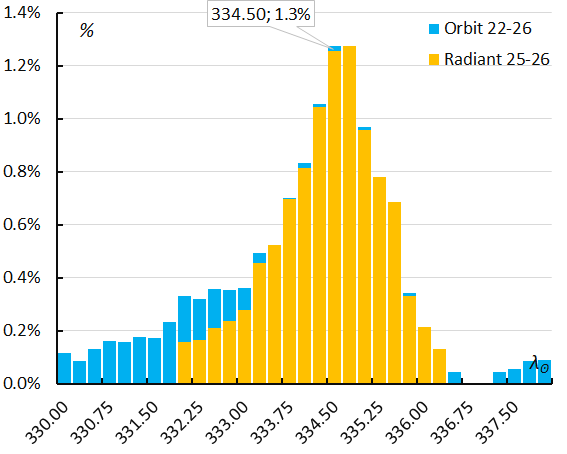
Figure 8 – The percentage of delta-Chamaeleontids relative to the total number of meteors, for the radiant method (2025–2026) and the orbit classification method 2022–2026.
4 Orbit and parent body
The diagram of the inclination i versus the Longitude of Perihelion Π shows a concentration in i, stretched in Π (Figure 9). The eccentricity e versus the Longitude of Perihelion Π appears very scattered (Figure 10). The spread in Longitude of Perihelion is caused by a steep increase in Longitude of Perihelion during the activity (Figure 11), while the spread in eccentricity is caused by the larger uncertainty on this Kepler element with values close to the hyperbolic limit (e > 1). This spread in eccentricity appears in the diagrams versus inclination (Figure 12) and versus perihelion distance (Figure 14). There is a small increase in inclination with 0.3°/λʘ and in perihelion distance with 0.002AU/λʘ. The cluster of orbits is best visible in the diagram of the perihelion distance q versus inclination i (Figure 13). The eccentricity remains constant during the activity period.
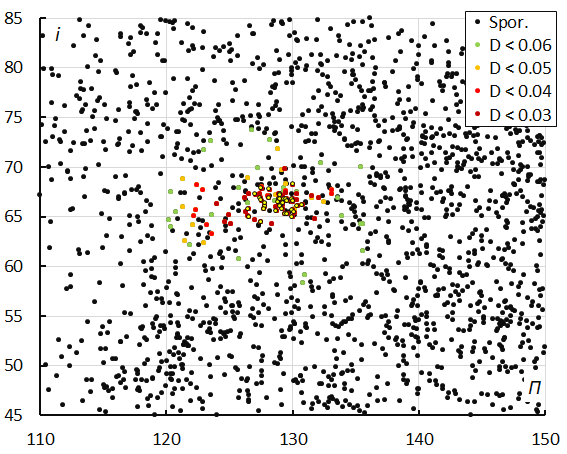
Figure 9 – Inclination i versus the longitude of perihelion Π color-coded for different classes of D-criteria thresholds, for λʘ between 330° and 338°. Spor. = sporadics.
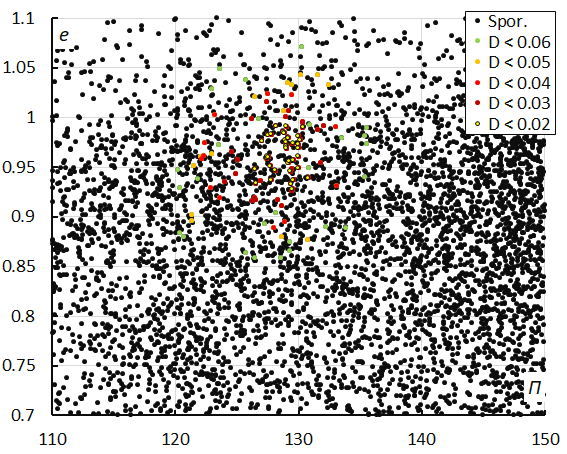
Figure 10 – Eccentricity e versus the longitude of perihelion Π color-coded for different classes of D-criteria thresholds, for λʘ between 330° and 338°. Spor. = sporadics.
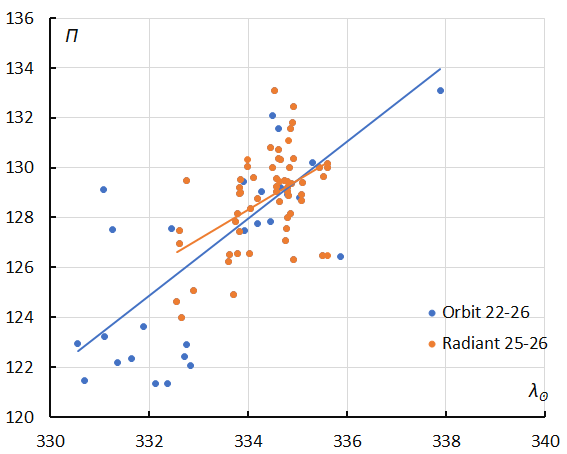
Figure 11 – The evolution of the Longitude of Perihelion Π in function of the Solar Longitude λʘ based upon the radiant method (2025–2026) and upon the orbit method (2022–2026).
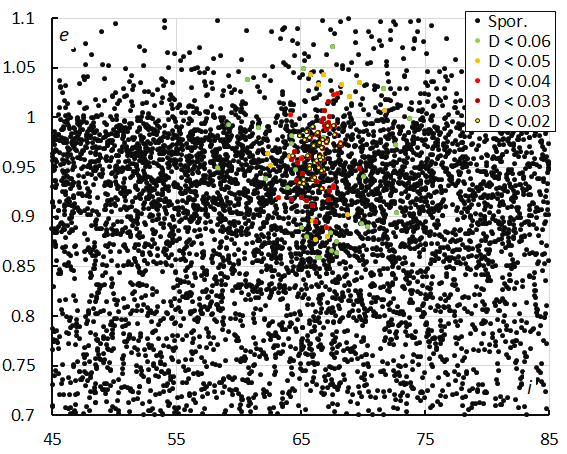
Figure 12 – Eccentricity e versus the inclination i color-coded for different classes of D-criteria thresholds, for λʘ between 330° and 338°. Spor. = sporadics.
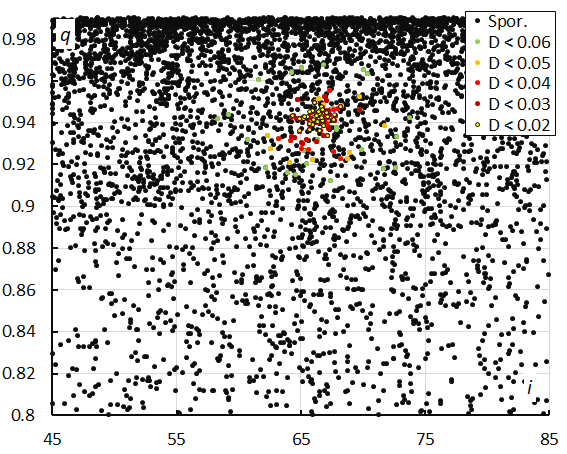
Figure 13 – Perihelion distance q versus the inclination i color-coded for different classes of D-criteria thresholds, for λʘ between 330° and 338°. Spor. = sporadics.
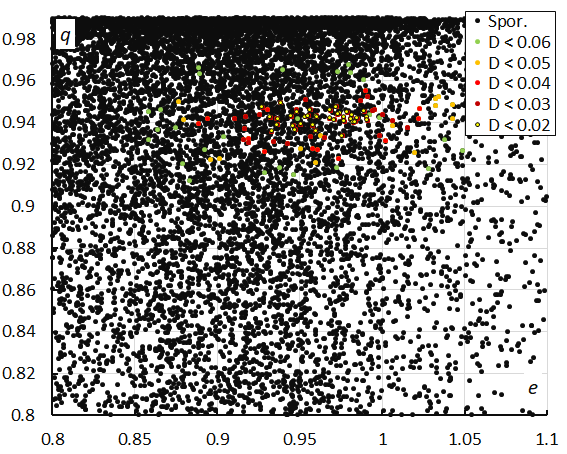
Figure 14 – Perihelion distance q versus the eccentricity e color-coded for different classes of D-criteria thresholds, for λʘ between 330° and 338°. Spor. = sporadics.
Table 1 – Comparing solutions obtained by the radiant method for 2025–2026, the orbit method 2022–2026 for DD < 0.05 and DD < 0.04, compared to the solution by Jenniskens (2023).
| Radiant 2025-26 | Orbit
DD < 0.05 |
Orbit
DD < 0.04 |
Jenniskens (2023) | |
| λʘ (°) | 334.5 | 334.5 | 334.5 | 334.8 |
| λʘb (°) | 332.0 | 330.5 | 331.0 | 330.0 |
| λʘe (°) | 337.0 | 337.9 | 337.9 | 336.0 |
| αg (°) | 3.9 | 43.0 | 36.4 | 1.8 |
| δg (°) | –87.1 | –87.0 | –87.0 | –87.3 |
| Δαg (°) | +0.14 | – | – | +7.50 |
| Δδg (°) | +0.17 | –0.03 | +0.01 | +0.30 |
| vg (km/s) | 40.8 | 40.9 | 40.9 | 41.3 |
| Hb (km) | 106.4 | 106.1 | 106.1 | 108.3 |
| He (km) | 94.7 | 94.5 | 94.2 | 92.6 |
| Hp (km) | 98.7 | 98.7 | 98.7 | 98.0 |
| MagAp | –0.6 | –0.4 | –0.4 | +1.9 |
| λg (°) | 277.1 | 277.0 | 277.1 | 277.0 |
| λg – λʘ (°) | 302.6 | 302.6 | 302.6 | 302.2 |
| βg (°) | –66.6 | –66.5 | –66.5 | –66.5 |
| a (A.U.) | 23.4 | 24.7 | 23.6 | 58.3 |
| q (A.U.) | 0.941 | 0.939 | 0.940 | 0.942 |
| e | 0.960 | 0.962 | 0.960 | 0.984 |
| i (°) | 66.3 | 66.4 | 66.3 | 66.8 |
| ω (°) | 334.4 | 334.0 | 334.1 | 334.9 |
| Ω (°) | 154.4 | 154.0 | 154.1 | 154.8 |
| Π (°) | 128.8 | 128.0 | 128.2 | 129.2 |
| Tj | 0.70 | 0.69 | 0.70 | 0.56 |
| N | 60 | 83 | 69 | 16 |
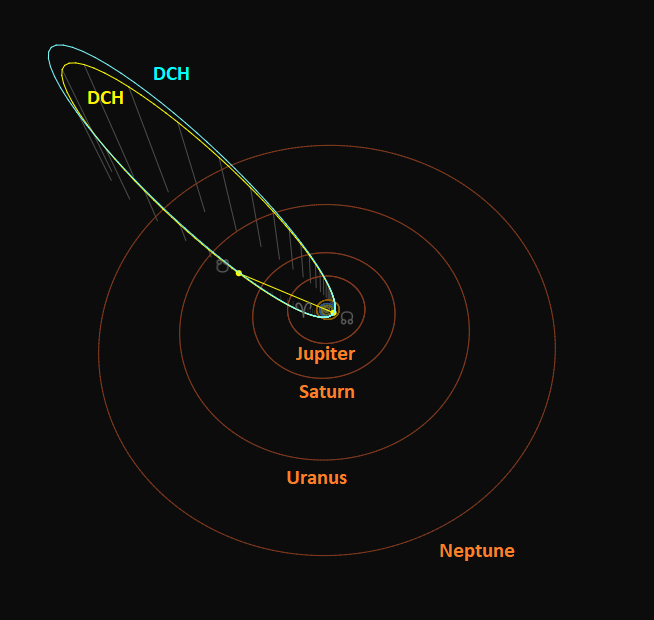
Figure 15 – Comparing the radiant determined delta-Chamaeleontids solution (yellow) with the orbit determined solution (blue). (Plotted with the Orbit visualization app provided by Pető Zsolt).
With a Tisserand value relative to Jupiter of TJ = 0.70 the delta-Chamaeleontids are a long-period comet type meteoroid stream steeply inclined to the ecliptic (Figure 15). The meteoroids cross the Earth orbit at the ascending node (Figure 16). The descending node is situated in the ecliptic plane between the orbits of Saturn and Uranus.
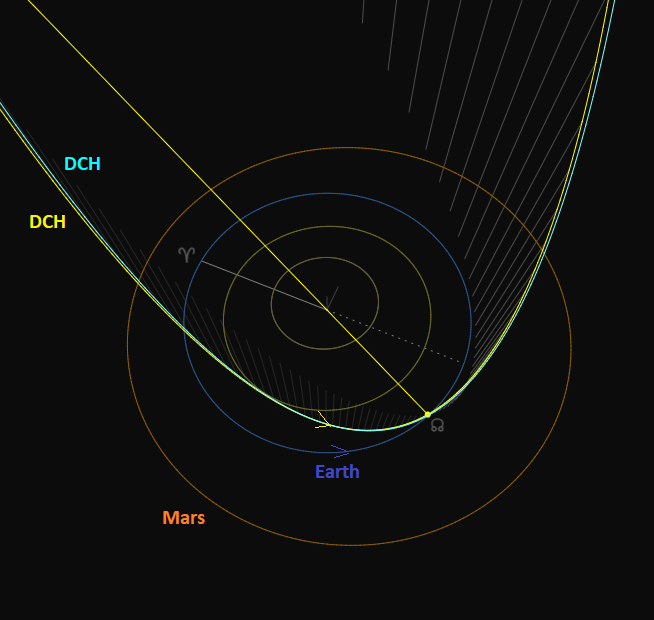
Figure 16 – Comparing the radiant determined delta-Chamaeleontids solution (yellow) with the orbit determined solution (blue), close-up at the inner Solar System. (Plotted with the Orbit visualization app provided by Pető Zsolt).
Table 2– Top ten matches of a search for possible parent bodies with DD < 0.25, based upon the mean orbit derived from the radiant classification method.
| Name | DD |
| C/574 G1 | 0.153 |
| C/1976 D1 (Bradfield) | 0.162 |
| C/1993 Y1 (McNaught-Russell) | 0.177 |
| C/1804 E1 (Pons) | 0.179 |
| C/1905 F1 (Giacobini) | 0.218 |
| C/1930 D1 (Peltier-Schwassmann-Wachmann) | 0.219 |
| C/1240 B1 | 0.221 |
| (248590) 2006 CS | 0.226 |
| C/1931 O1 (Nagata) | 0.236 |
| C/1942 EA (Vaisala) | 0.244 |
A search for possible parent bodies did not result in any convincing association. C/1930 D1 (Peltier-Schwassmann-Wachmann), which was proposed as a very likely parent body for some radar meteors by Gartrell and Elford (1975), differs a lot in inclination by 33° and is rather unlikely as a candidate parent body. Either the parent body has yet to be discovered or stream modeling may prove how the stream has been formed and separated from its parent body.
The shower has produces annual activity. The GMN recorded two DCH meteors in 2022, six in 2023, six in 2024, 40 in 2025 and 29 in 2026. The numbers of shower meteors per year reflect the expansion of the GMN network at the Southern Hemisphere and the weather circumstances during the rather short activity period.
5 Conclusions
This GMN meteoroid orbit data case study confirms the existence of the delta-Chamaeleontids. Our independent solution has been reported to the IAU-MDC, and the shower now fulfils the criteria to be nominated for established status. The new GMN solution has been double checked by using two independent shower identification methods as a two-factor authentication for the validation of the analyses.
Some corrections are required to the IAU-MDC Working List of Meteor Showers for the stream data entry for the delta-Chamaeleontids. The listed solutions under 00107.000, 00107.001 and 00107.002 are based on radar orbit data recorded during 10 and 17 February 1969 which is too far off in time from the current activity period, which is between 19 and 25 February. Moreover, the original paper by Gartrell and Elford (1975) searched among 1667 radar orbits spread over six weeks of which one week in February. Using the Southworth and Hawkins D-criterion to look for similar orbits with two, three or more members, these small groups are listed as simple associations of three or more meteors most of which are nowhere defined as meteor showers by the authors, including the solutions 00107.000 based upon four meteors with a radiant in Octans and 00107.001 based upon 47 meteors but with a far too tolerant DSH = 0.39. Nowhere do Gartrell and Elford claim these associations represent meteor showers, and the name delta-Chamaeleontids is not mentioned anywhere. Given the uncertainties typical for radar orbit data and the small numbers of orbits available, the associations may be regarded as possible spurious combinations. Jopek et al. (1999) used 3675 Adelaide radio meteors, including the 1667 used by Gartrell and Elford in 1975. In that publication the name Chamaeleontids appears based upon 33 meteors but with an activity period of 11 to 17 February. Activity period, eccentricity and inclination differ too much to link this activity to the currently known shower.
The naming of delta-Chamaeleontids appears in Jenniskens (2006) based upon the sources of the unrelated solutions 00107.000 and 00107.001. The naming of meteor showers remains problematic as the actual radiant of the delta-Chamaeleontids is located in the constellation Octans instead of near delta Chamaeleonis, which is based upon incorrect associations in the past. This situation favors the current procedure with a provisional naming until the shower is confirmed for established status.
Acknowledgments
This report is based on the data of the Global Meteor Network (Vida et al., 2020a; 2020b; 2021) which is released under the CC BY 4.0 license. We thank all 927 participants in the Global Meteor Network project for their contribution and perseverance. A list with the names of the volunteers who contribute to GMN has been published in the 2025 annual report (Roggemans et al., 2026b). The following 157 cameras contributed to paired meteors used in this study:
AU0002, AU0003, AU0004, AU0006, AU0007, AU0009, AU000B, AU000D, AU000E, AU000F, AU000G, AU000L, AU000Q, AU000R, AU000S, AU000T, AU000U, AU000V, AU000Z, AU0010, AU001A, AU001B, AU001E, AU001F, AU001K, AU001L, AU001N, AU001P, AU001Q, AU001R, AU001S, AU001U, AU001V, AU001W, AU0029, AU002B, AU002D, AU0030, AU0038, AU003E, AU003G, AU003J, AU0042, AU0047, AU0048, AU004K, AU004L, AU004Q, NZ0001, NZ0002, NZ0003, NZ0004, NZ0007, NZ0009, NZ000B, NZ000G, NZ000L, NZ000P, NZ000Q, NZ000V, NZ000Z, NZ0010, NZ0011, NZ0012, NZ0014, NZ0015, NZ0016, NZ0017, NZ0018, NZ001E, NZ001G, NZ001J, NZ001L, NZ001N, NZ001R, NZ001S, NZ001V, NZ001Z, NZ0022, NZ0023, NZ0024, NZ0025, NZ0026, NZ0027, NZ0028, NZ0029, NZ002C, NZ002D, NZ002E, NZ002F, NZ002H, NZ002L, NZ002N, NZ002P, NZ002Q, NZ002T, NZ002U, NZ002V, NZ002X, NZ002Y, NZ002Z, NZ0030, NZ0033, NZ0034, NZ0035, NZ0036, NZ0037, NZ003B, NZ003C, NZ003E, NZ003H, NZ003K, NZ003N, NZ003Q, NZ003R, NZ003S, NZ003T, NZ003U, NZ003V, NZ003W, NZ003X, NZ003Y, NZ003Z, NZ0041, NZ0042, NZ0046, NZ004B, NZ004H, NZ004J, NZ004M, NZ004R, NZ004U, NZ004W, NZ004X, NZ004Y, NZ004Z, NZ0051, NZ0059, NZ005D, NZ005G, NZ005K, NZ005L, NZ005N, NZ005T, NZ005U, NZ005Z, NZ0067, NZ006C, NZ006E, NZ006F, NZ006G, NZ006K, ZA0006, ZA0007, ZA0008, ZA0009 and ZA000A.
References
Drummond J. D. (1981). “A test of comet and meteor shower associations”. Icarus, 45, 545–553.
Gartrell G., Elford W.G. (1975). “Southern Hemisphere Meteor Stream Determinations”. Australian Journal of Physics, 28, 521–620.
Jenniskens P. (2006). “Meteor showers and their parent comets”. Cambridge University Press. Page 695.
Jenniskens P. (2023). Atlas of Earth’s meteor showers. Elsevier, Cambridge, United states. ISBN 978-0-443-23577-1. Page 535.
Jopek T. J. (1993). “Remarks on the meteor orbital similarity D-criterion”. Icarus, 106, 603–607.
Jopek T. J., Valsecchi G. B., Froeschle Cl. (1999). “Meteor stream identification a new approach. Application to 3675 radio meteors”. In, W. J. Baggaley and V. Porubcan, editors, Meteoroids 1998: Proceedings of the International Conference held at Tatranska Lomnica, Slovakia, August 17-21, 1998. Astronomical Institute of the Slovak Academy of Sciences, 307–310.
Jopek T. J., Rudawska R. and Pretka-Ziomek H. (2006). “Calculation of the mean orbit of a meteoroid stream”. Monthly Notices of the Royal Astronomical Society, 371, 1367–1372.
Moorhead A. V., Clements T. D., Vida D. (2020). “Realistic gravitational focusing of meteoroid streams”. Monthly Notices of the Royal Astronomical Society, 494, 2982–2994.
Roggemans P., Vida D., Šegon D., Scott J.M. (2026a). “Meteoroid orbit shower identification”. eMetN Meteor Journal, 11, TBP.
Roggemans P., Campbell-Burns P., Kalina M., McIntyre M., Scott J. M., Šegon D., Vida D. (2026b). “Global Meteor Network report 2025”. eMetN Meteor Journal, 11, 89–129.
Southworth R. B. and Hawkins G. S. (1963). “Statistics of meteor streams”. Smithsonian Contributions to Astrophysics, 7, 261–285.
Valsecchi G. B., Jopek T. J., Froeschle Cl. (1999). “Meteoroid stream identification: a new approach – I. Theory”. Monthly Notices of the Royal Astronomical Society, 304, 743–750.
Vida D., Gural P., Brown P., Campbell-Brown M., Wiegert P. (2020a). “Estimating trajectories of meteors: an observational Monte Carlo approach – I. Theory”. Monthly Notices of the Royal Astronomical Society, 491, 2688–2705.
Vida D., Gural P., Brown P., Campbell-Brown M., Wiegert P. (2020b). “Estimating trajectories of meteors: an observational Monte Carlo approach – II. Results”. Monthly Notices of the Royal Astronomical Society, 491, 3996–4011.
Vida D., Šegon D., Gural P. S., Brown P. G., McIntyre M. J. M., Dijkema T. J., Pavletić L., Kukić P., Mazur M. J., Eschman P., Roggemans P., Merlak A., Zubrović D. (2021). “The Global Meteor Network – Methodology and first results”. Monthly Notices of the Royal Astronomical Society, 506, 5046–5074.