By Paul Roggemans, Denis Vida, Damir Šegon, James M. Scott, Jeff Wood
Abstract: An outburst of the Volantids has been detected between the 23rd of December 2025 and the 4th of January 2026 from a radiant at R.A. = 125.4° and Decl.= –72.0°, with a geocentric velocity of 30.3 km/s. This case study confirms the existence of this episodic meteor shower with a five-year periodicity. The KVO#787 and VOL#758 entries in the MDC list were found to be the same shower on the basis of our observations, we recommend merging them with VOL#758 in the MDC list. The shower fulfils the criteria to be nominated for established status by the IAU-MDC.
1 Introduction
On 30 December 2025 the GMN radiant density map revealed that an optical outburst of the kappa-Volantids was ongoing. The first results matched the orbit of the kappa-Volantids (KVO#787) with D-criteria thresholds of DSH < 0.038 & DD < 0.015 & DJ < 0.038. Another positive match with the Volantids (VOL#758) had worse similarity thresholds and therefore the outburst was identified in first instance as the kappa-Volantids.
The shower appeared to have been active several days earlier and lasted until 4 January 2026. It was monitored by 202 GMN cameras installed in Australia, Brazil, Chile, New Zealand and South Africa. A CBET was issued to report the outburst (Vida et al., 2026). This publication also covered the results by the CAMS-network on this shower, identified as the Volantids (VOL#758) by Jenniskens et al. (2026). Both showers in the IAU-MDC list refer to the same activity and should be moved under a single entry.
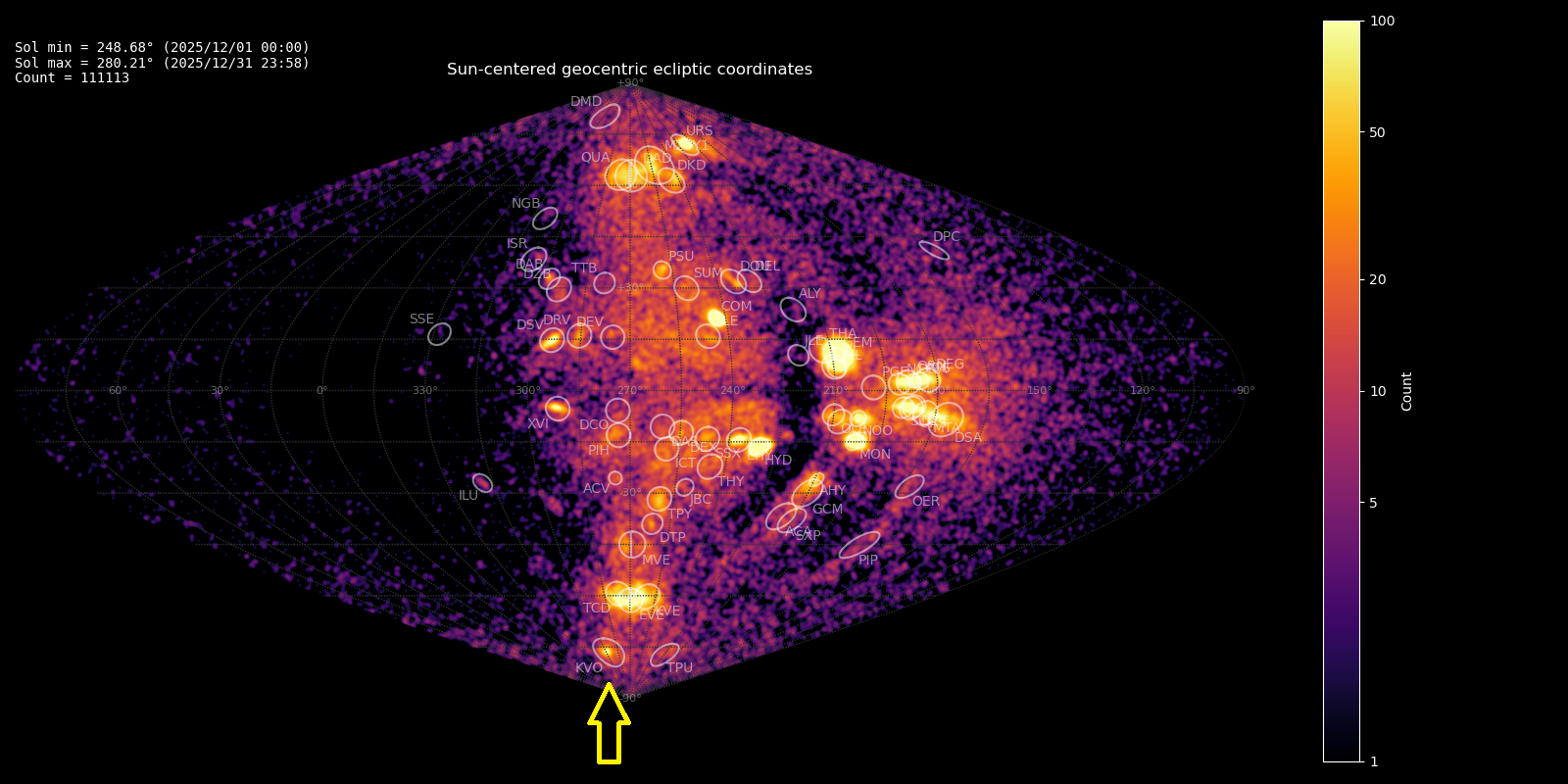
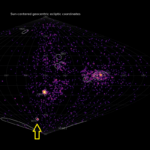
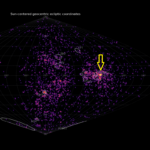
Figure 1 – Radiant density map with 111113 radiants obtained by the Global Meteor Network during December, 2025. The position of the kappa-Volantids in Sun-centered geocentric ecliptic coordinates is marked with a yellow arrow.
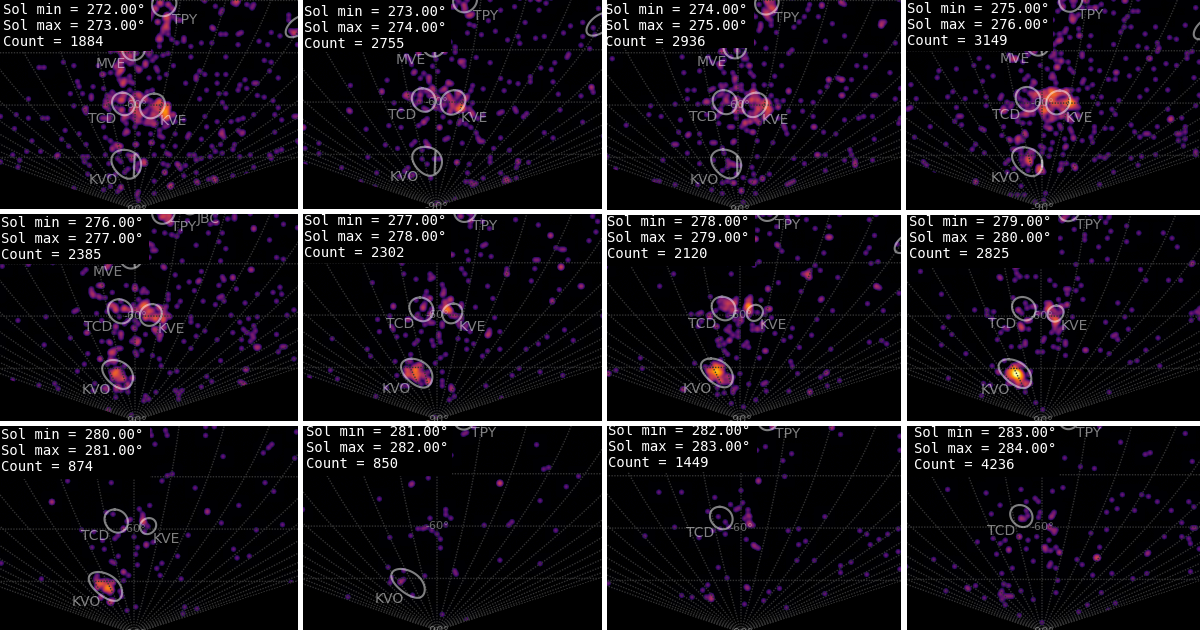
Figure 2 – Changes in the radiant appearance of the kappa-Volantids during the activity period.
2 Shower classification based on radiants
The GMN shower association criteria assume that meteors within 1° in solar longitude, within 3.3° in radiant in this case, and within 10% in geocentric velocity of a shower reference location are members of that shower. Further details about the shower association are explained in Moorhead et al. (2020). Using these meteor shower selection criteria, 304 orbits have been identified as kappa-Volantids. The final results have been listed in Table 1.
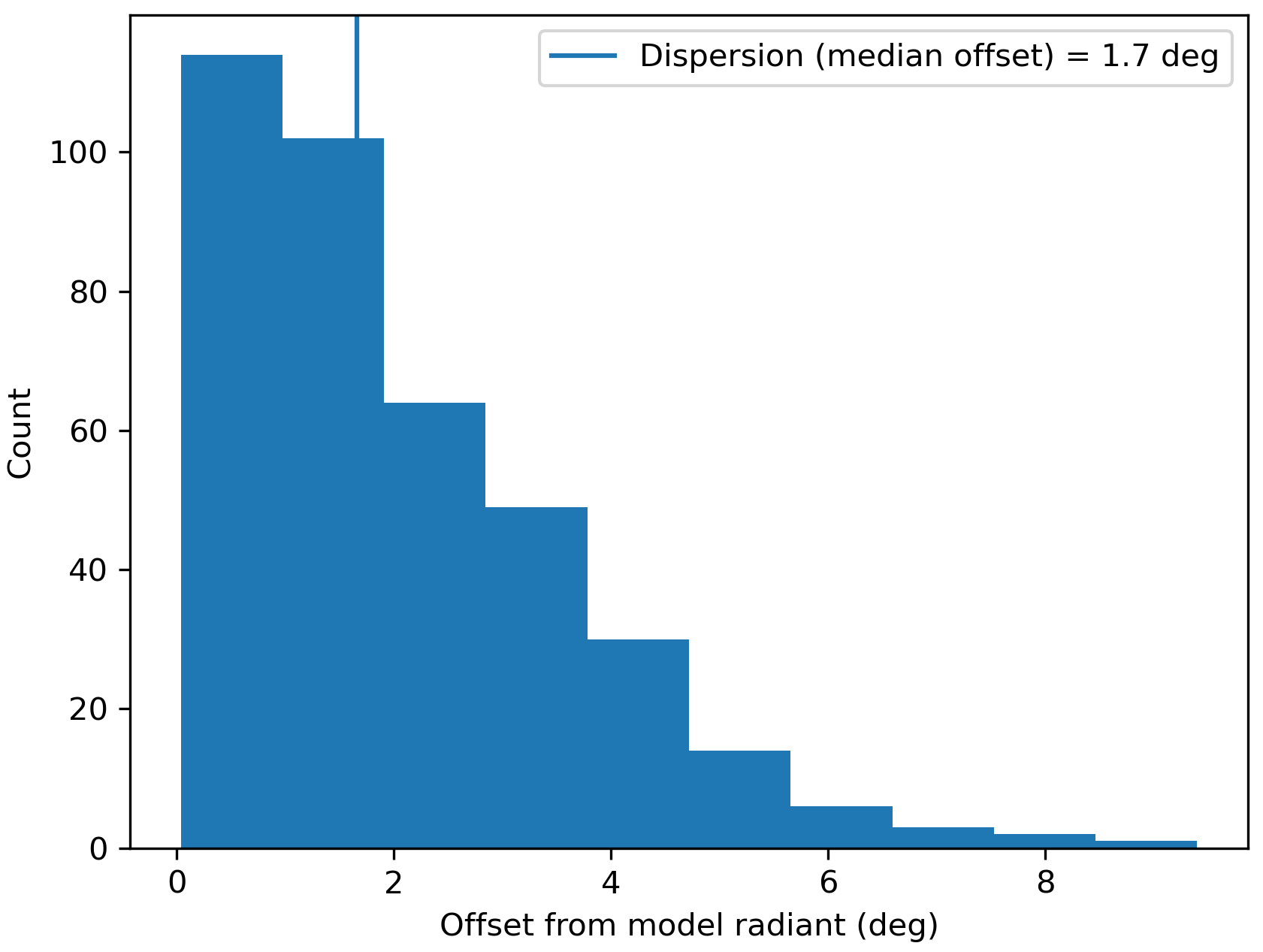
Figure 3 – Dispersion median offset on the radiant position.
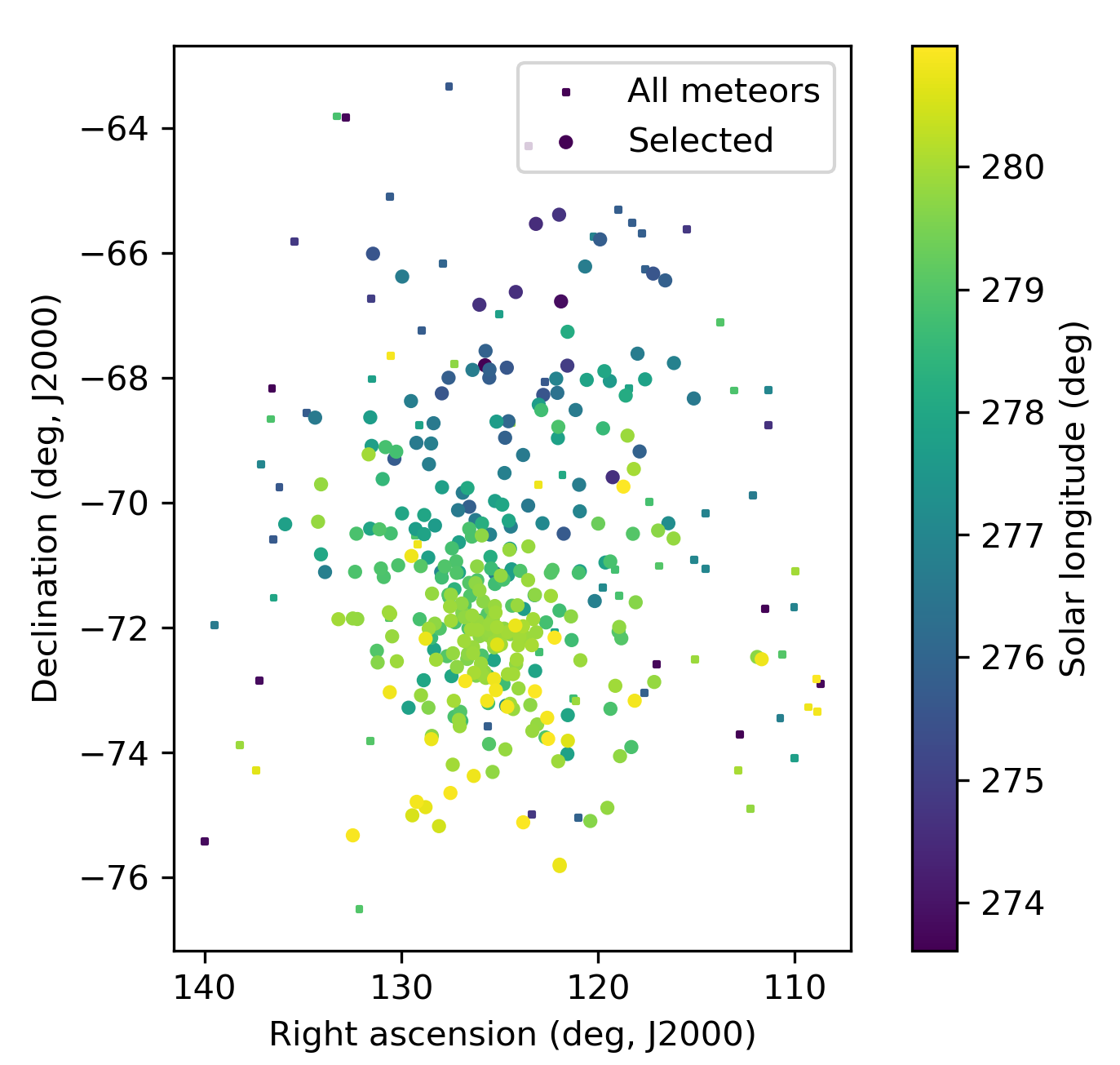
Figure 4 – The radiant distribution during the solar-longitude interval 274° – 281° in equatorial coordinates.
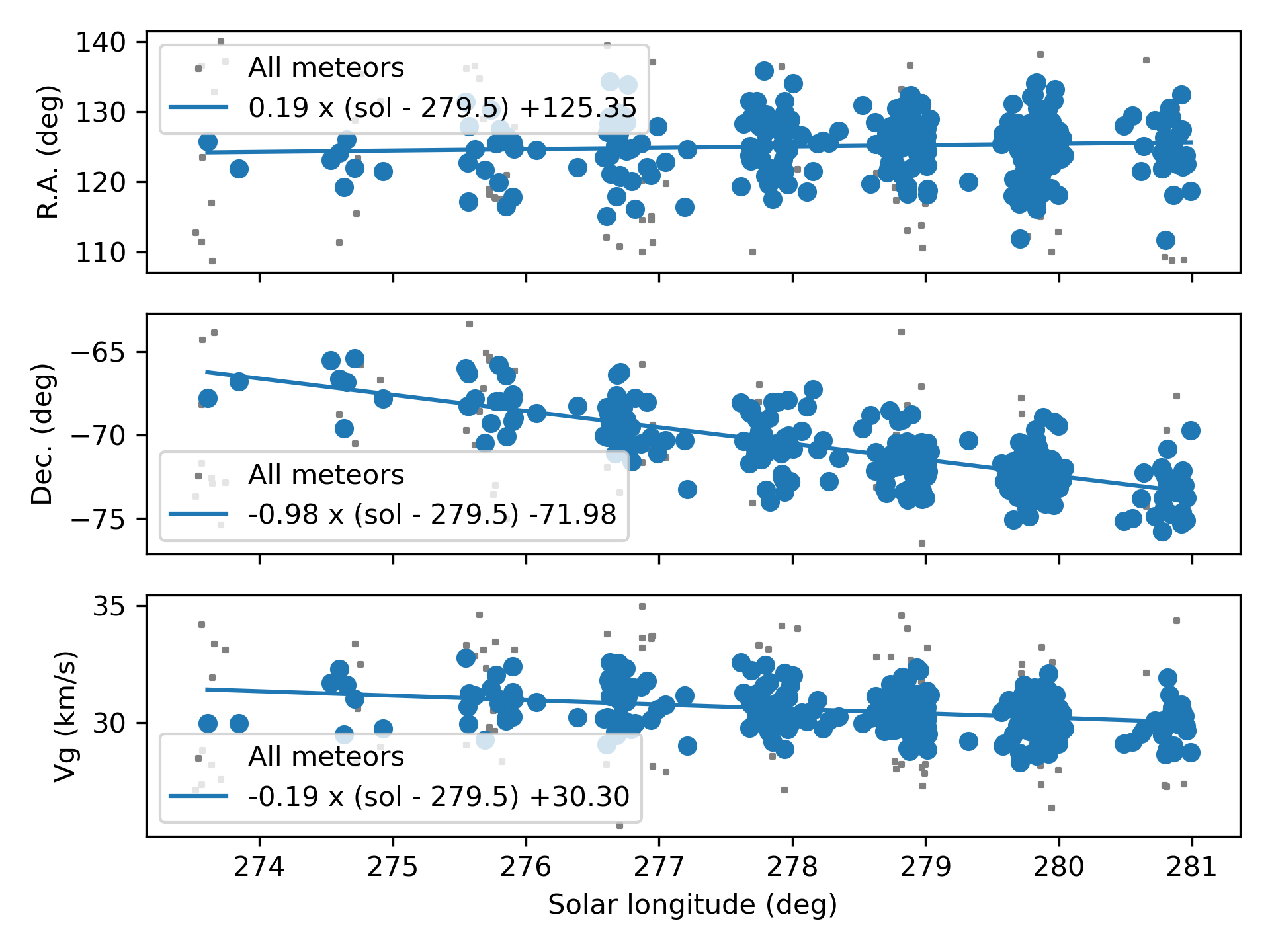
Figure 5 – The radiant drift.
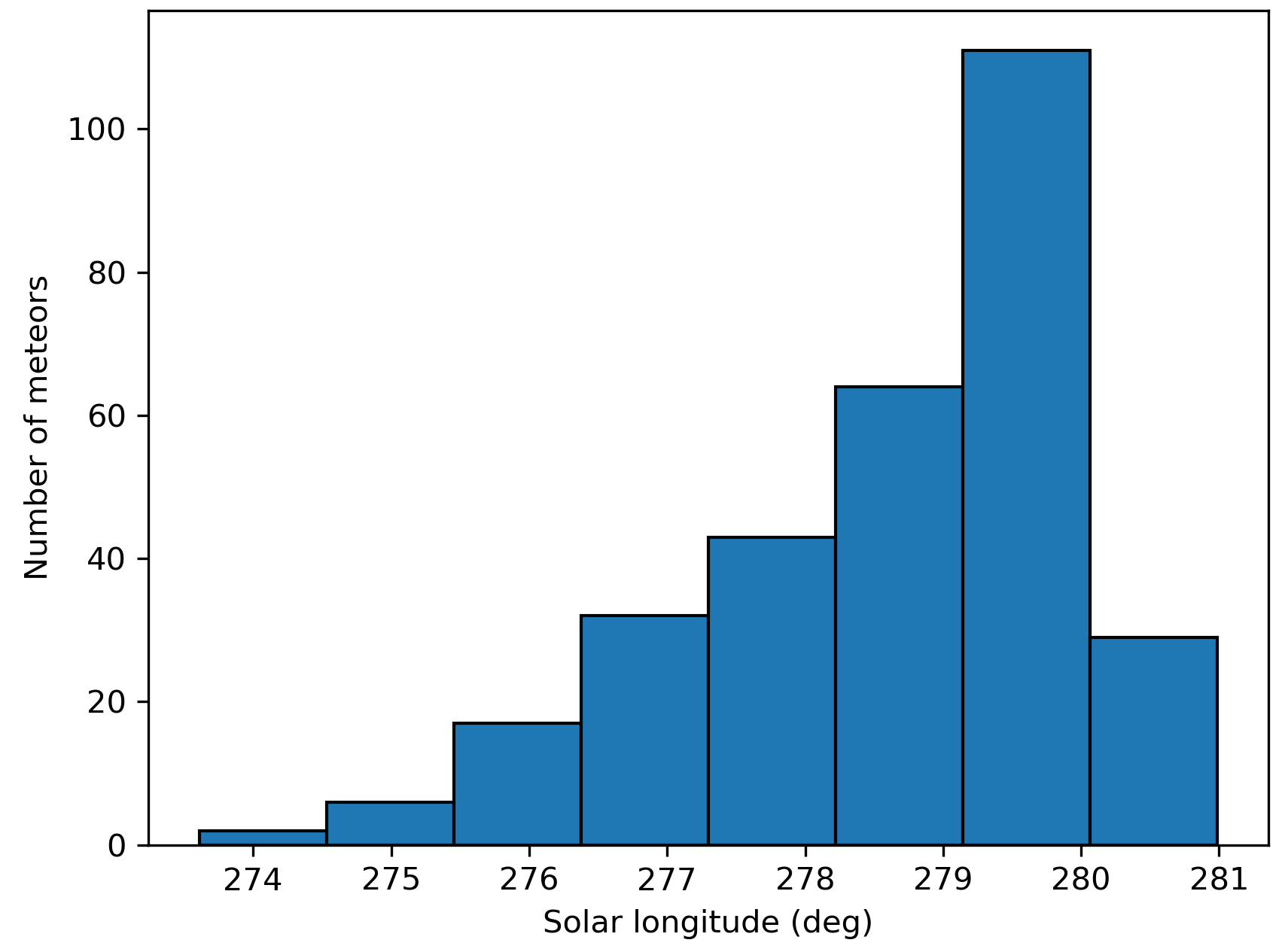
Figure 6 – The uncorrected number of shower meteors recorded per degree in solar longitude.
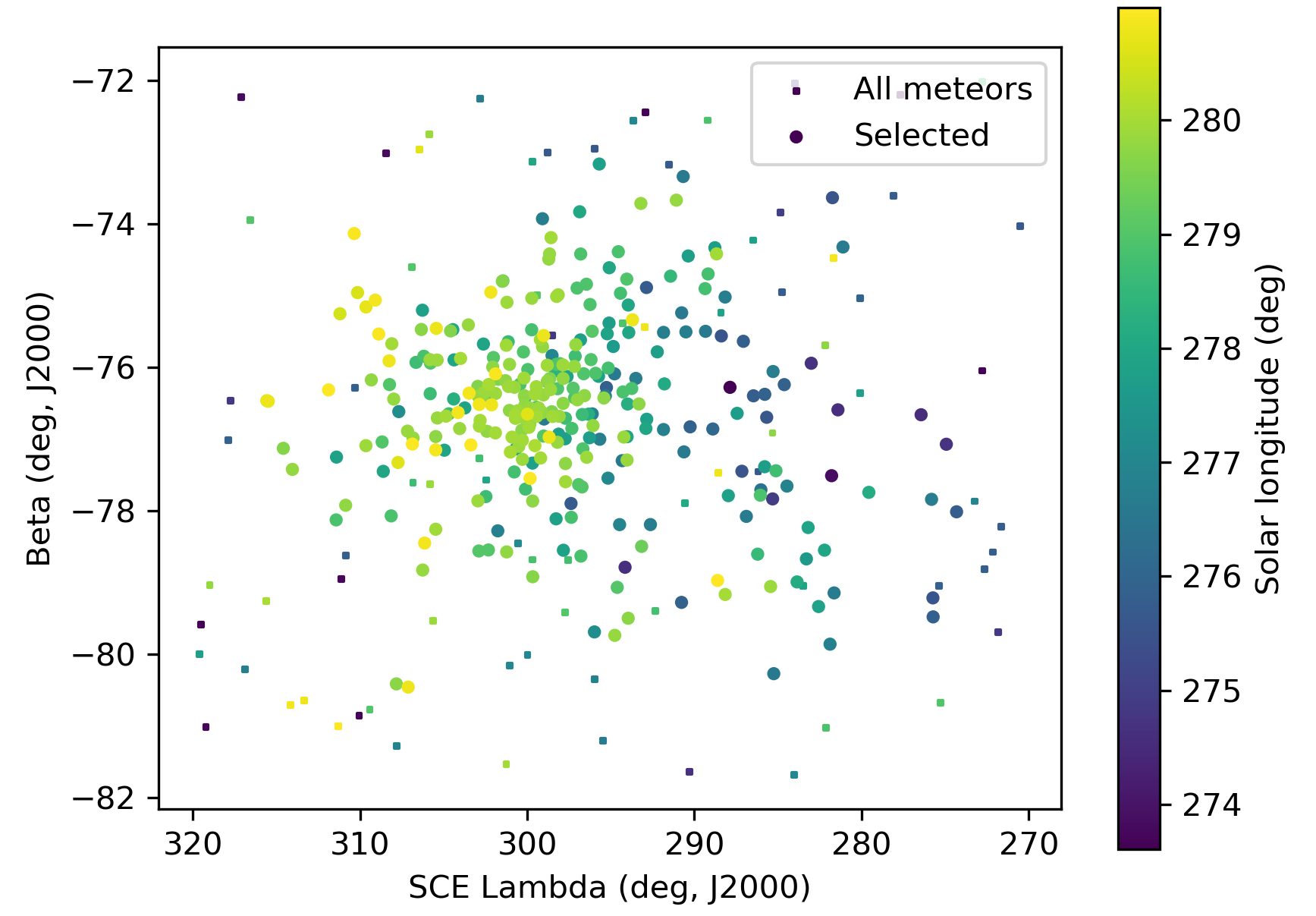
Figure 7 – The radiant distribution during the solar-longitude interval 274° – 281° in Sun centered geocentric ecliptic coordinates.
3 Shower classification based on orbits
A complete independent meteoroid stream search has been applied for confirmation based upon orbit data. This method has been described in a separate publication (Roggemans, 2026). The mean orbit has been computed by the method of Jopek et al. (2006) for all 293 orbits that fit the thresholds DSH < 0.125 & DD < 0.05 & DJ < 0.125 (Southworth and Hawkins, 1963; Drummond, 1981; Jopek, 1993). The results have been listed in Table 1.
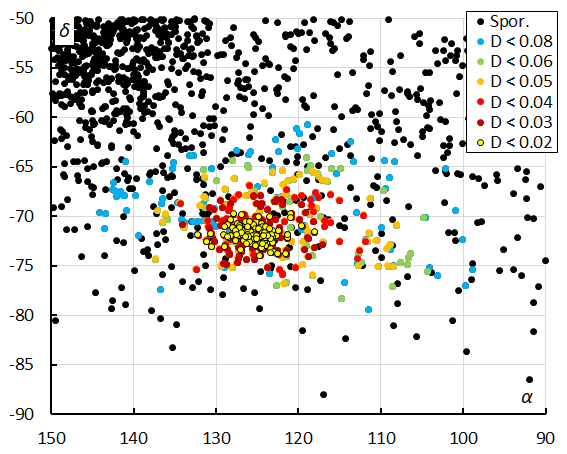
Figure 8 – The radiant distribution during the solar-longitude interval 270° – 285° in equatorial coordinates, color-coded for different classes of D-criteria thresholds.
The radiant plots in equatorial coordinates (Figure 8) and in Sun-centered ecliptic coordinates (Figure 9) show a distinct concentration stretched out because of the projection near the poles in both equatorial as ecliptic coordinates. The dense concentration in the upper left corner of Figure 8 is mainly due to the kappa-Velids (KVE#784), another shower that had its maximum activity a bit earlier than the kappa-Volantids outburst. These kappa-Velid radiants are also visible in the upper right corner of Figure 9. GMN detected as many as 230 kappa-Velids in December 2025.
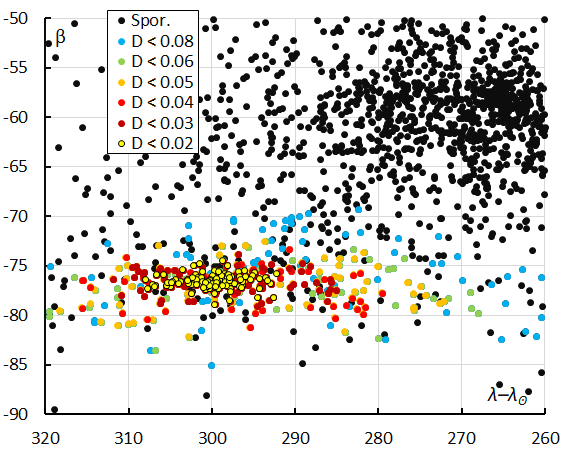
Figure 9 – The radiant distribution during the solar-longitude interval 270° – 285° in Sun-centered geocentric ecliptic coordinates, color-coded for different classes of D-criteria thresholds.
4 Activity based on the two methods
256 kappa-Volantids were identified in common by both methods. 48 were found by the radiant identification method but not found by the orbit method. 37 were identified by the orbit identification but not detected by the radiant method. The radiant classification method counts all possible kappa-Volantids if their radiants fit within a given radiant size, regardless deviant orbits. The orbit classification method counts all possible kappa-Volantids if their orbits fit with the mean orbit within chosen similarity thresholds, regardless the radiant position. The percentage of KVO-meteors relative to the total number of meteors recorded at the Southern Hemisphere, counted in time bins of one degree every 0.25° in Solar Longitude results in the skew activity profile in Figure 10 for both methods. Orbit classification indicates longer activity duration starting earlier than λʘ = 274° and lasting longer than λʘ = 281°.
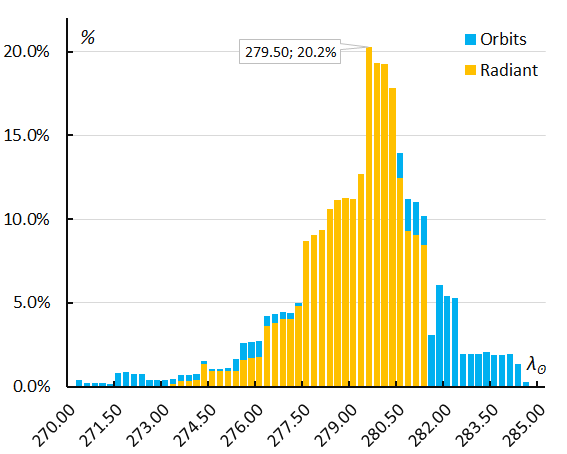
Figure 10 – The percentage of KVO-meteors relative to the total number of meteors recorded by cameras at the Southern Hemisphere. Orange is the result for the radiant shower classification, blue for the orbit classification method.
5 Orbit and parent body
The final orbits obtained by the two classifications are listed in Table 1 and compared to the results obtained by radar (Pokorný, 2017) and the CAMS-network (Jenniskens, 2023). The radiant method had 84% of its meteors in common with the orbit method and the orbit method 87% of its meteors in common with the radiant method. Despite the differences in selection of the KVO-meteors, the resulting mean orbits computed by the method of Jopek et al. (2006) are in excellent agreement. The 2025 result of GMN is also in very good agreement with Pokorný et al. (2017), reason why the outburst was identified as the kappa-Volantids. The CAMS-result differs quite a lot in eccentricity but the other elements are in good agreement. The CAMS results were listed as Volantids (VOL#758) although this is the same activity as the kappa-Volantids.
Table 1 – Comparing solutions derived by the radiant based method and the orbit orbit based menthod for DD < 0.05, both compared to Pokorný et al. (2017) and Jenniskens (2023).
| Radiant method | Orbit method | Pokorný (2017) | CAMS (2023) | |
| λʘ (°) | 279.5 | 279.0 | 280.0 | 279.3 |
| λʘb (°) | 273.0 | 270.6 | 274 | 276 |
| λʘe (°) | 281.0 | 284.2 | 283 | 283 |
| αg (°) | 125.4 | 125.2 | 121.1 | 123.4 |
| δg (°) | –72.0 | –71.7 | –72.7 | –72.1 |
| Δαg (°) | +0.19 | –0.12 | –1.42 | –0.96 |
| Δδg (°) | –0.98 | –0.84 | –0.64 | –0.88 |
| vg (km/s) | 30.3 | 30.3 | 29.6 | 30.4 |
| Hb (km) | 94.5 | 94.7 | – | – |
| He (km) | 82.6 | 82.2 | – | – |
| Hp (km) | 87.1 | 86.8 | – | – |
| MagAp | +0.1 | +0.0 | – | – |
| λg (°) | 219.49 | 218.4 | 223.58 | 220.48 |
| λg – λʘ (°) | 299.99 | 298.8 | 303.58 | 301.1 |
| βg (°) | –76.53 | –76.6 | –77.76 | –77.2 |
| a (A.U.) | 2.628 | 2.65 | 2.72 | 2.81 |
| q (A.U.) | 0.973 | 0.973 | 0.973 | 0.973 |
| e | 0.630 | 0.633 | 0.642 | 0.654 |
| i (°) | 50.9 | 50.6 | 49.1 | 50.5 |
| ω (°) | 347.6 | 347.8 | 346.7 | 347.1 |
| Ω (°) | 98.7 | 98.7 | 100 | 99.3 |
| Π (°) | 86.3 | 86.5 | 86.7 | 86.4 |
| Tj | 2.68 | 2.67 | 2.64 | 2.57 |
| N | 304 | 293 | 398 | 205 |
Looking at the diagram of inclination versus longitude of perihelion, we can see a distinct concentration of KVO-meteors (Figure 11). The dense concentration at the top are mainly Quadrantids, the concentration at right are the Ursids. The spread on the blue dots indicates that the thresholds with DSH < 0.20 & DD < 0.08 & DJ < 0.20 are contaminated with sporadics and too tolerant for orbit classification. There is a slight decreasing trend in the inclination (Figure 12) and in the longitude of perihelion (Figure13) during the activity period. The other orbital elements, semi-major axis a, perihelion distance q and eccentricity e, show no changes during the activity period.
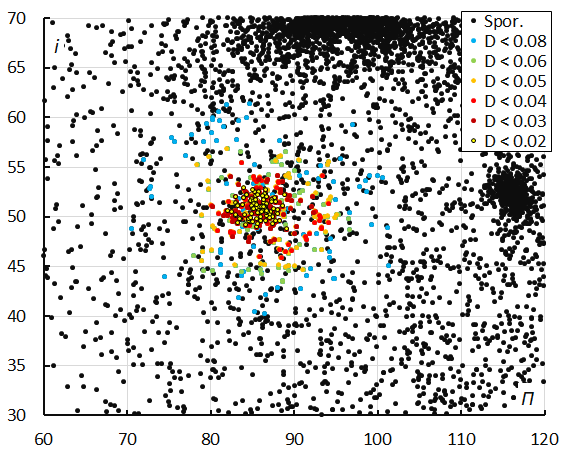
Figure 11 – The diagram of the inclination i versus the longitude of perihelion Π color-coded for different classes of D-criteria thresholds, for λʘ between 270° and 285°.
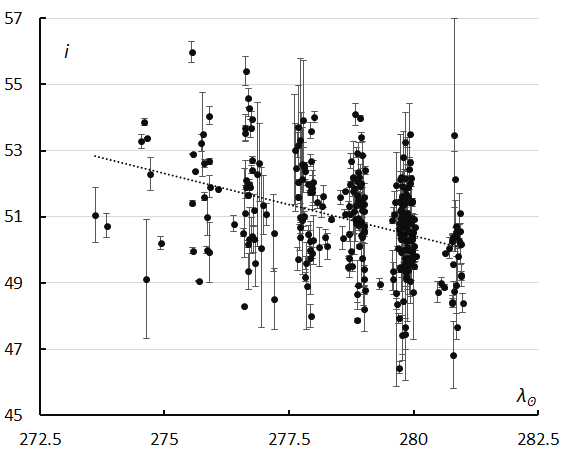
Figure 12 – The evolution of the inclination i in function of the solar longitude λʘ for the kappa-Volantids 2025–2026.
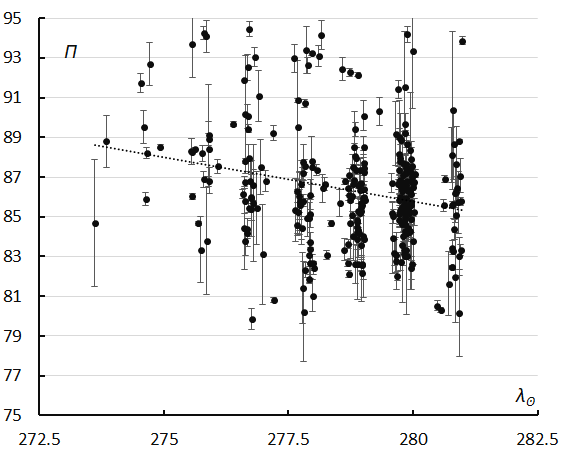
Figure 13 – The evolution of the longitude of perihelion Π in function of the solar longitude λʘ for the kappa-Volantids 2025–2026.
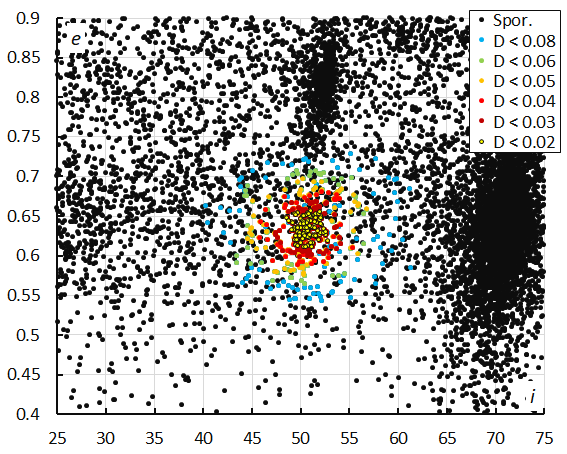
Figure 14 – The diagram of the eccentricity e versus the inclination i color-coded for different classes of D-criteria thresholds, for λʘ between 270° and 285°.
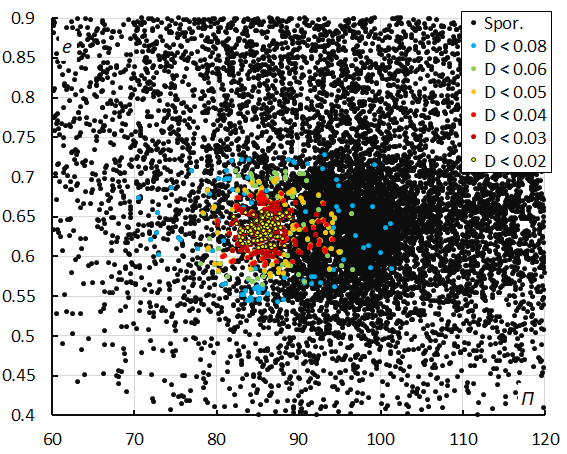
Figure 15 – The diagram of the inclination e versus the longitude of perihelion Π color-coded for different classes of D-criteria thresholds, for λʘ between 270° and 285°.
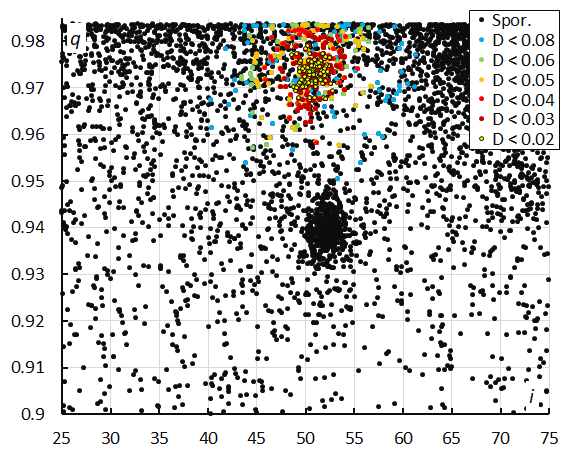
Figure 16 – The diagram of the perihelion distance q versus the inclination i color-coded for different classes of D-criteria thresholds, for λʘ between 270° and 285°.
The distribution of the eccentricity e versus inclination i displays the KVO-meteors as a dense concentration (Figure 14). The dense concentration above the KVO-meteors are the Ursids, the concentration at right are the Quadrantids and the kappa-Velids. The distribution of the eccentricity e versus longitude of perihelion Π displays the KVO-meteors as a dense concentration just left of a dense concentration caused by the Quadrantids (Figure 15). The distribution of the perihelion distance q versus the inclination i shows the concentration of KVO-meteors, the dense concentration in the middle of the plot are the Ursids (Figure 16).
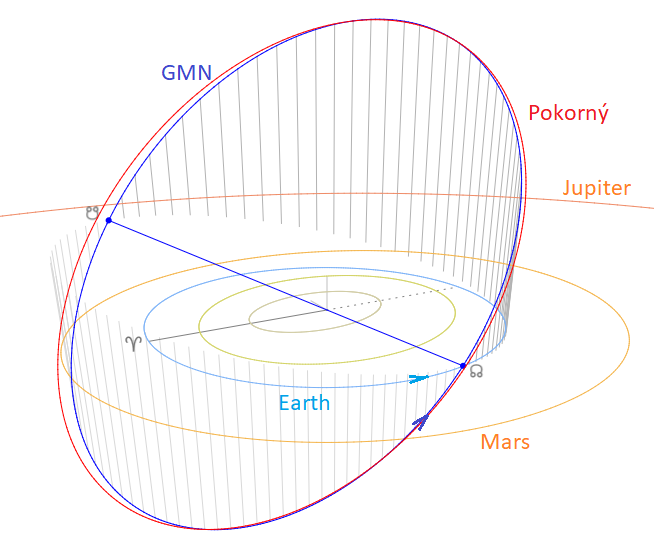
Figure 17 – Comparing the GMN solutions (blue) for the kappa-Volantids 2025 with the solution obtained by Pokorný et al. (2017) (red), close-up at the inner Solar System. (Plotted with the Orbit visualization app provided by Pető Zsolt).
The kappa-Volantids encounter the Earth at their ascending node Ω on an orbit steep to the ecliptic plane. Figure 17 shows the agreement between the GMN result for 2025 and the radar result for 2015. The Tisserand value relative to Jupiter with TJ = 2.68 is typical for a Jupiter-family comet type orbit. A parent body search did not reveal any convincing candidate. Either the meteoroid streams’ parent has still to be discovered or orbit integrations may reveal the connection of some known object and the meteoroid dust. The ten best matches are listed in Table 2.
Table 2 – Top ten matches of a search for possible parent bodies with DD < 0.17
| Name | DD |
| 2017 YN3 | 0.116 |
| 2022 WC12 | 0.127 |
| 2022 BJ3 | 0.14 |
| 2018 AG | 0.149 |
| 2020 WS5 | 0.151 |
| 2024 AA2 | 0.152 |
| 2018 AG13 | 0.157 |
| 2019 AW7 | 0.159 |
| 2017 XH2 | 0.16 |
| 2002 AA2 | 0.162 |
6 Past activity
The shower has been first noticed on 31 December 2015 by CAMS-New Zealand (Jenniskens et al., 2016) and was confirmed by radar observations by Younger et al. (2016). The activity was recorded during several days until 2 January 2016. The same radiant appears in the orbital meteoroid stream survey in the SAAMER meteor radar data (Pokorný et al., 2017) which was added to the IAU-MDC Working List of Meteor Showers as the kappa-Volantids (KVO#787) while the CAMS results were included as Volantids (VOL#758). The next few years the shower didn’t produce any activity until 2020.
The shower reoccurred on 27–28 December 2020 (Jenniskens, 2021). The activity was detected until 3 January 2021 and the final orbital parameters for 2020–2021 CAMS data by Jenniskens and Cooper (2021) are in better agreement with the 2025–2026 GMN results than the 2015–2016 CAMS results based on a much smaller number of meteors.
Global Meteor Network obtained good coverage at the Southern Hemisphere since 2022, but no activity from this radiant has been observed in previous years. A search through available visual observations from the Southern Hemisphere revealed no records of any activity in the past.
7 Conclusion
Global Meteor Network detected a meteor shower outburst near the Southern Hemisphere pole during 30–31 December 2025. The activity was identified as the kappa-Volantids (VKO#787) as best matching meteoroid stream listed in the IAU-MDC Working List of Meteor Showers. Another matching meteoroid stream listed as the Volantids (VOL#758), had a positive match but with a much weaker correlation. The 2025–2026 activity has been also observed by CAMS, confirming the observations by GMN, but identified as the Volantids (VOL#758) (Jenniskens et al., 2026).
The confirmation of the kappa-Volantids (KVO#787) by GMN in 2025–2026 with an independent solution reported to the IAU-MDC, fulfils the criteria to be nominated for established status. The confusion created by using two different identifications for the same shower should be resolved. This coincidence between both listed showers has been documented before by Masahiro Koseki (2023) who made a detailed evaluation of the IAU-MDC Working List with many suggestions for corrections.
Meteoroid stream identification by GMN is based solely on the latest status of the IAU-MDC Working List of Meteor Showers. Literature searches for specific case studies often reveal very interesting data that is not cited in the IAU-MDC Working List. Such sources may be cited in the case study, but any initial identifications are based solely upon the IAU-MDC Working List as universal reference source. The final decision about the naming of meteor showers is at the discretion of the IAU Commission F1 working group. During the review period of this paper the IAU-MDC staff has communicated the following proposal. “If a shower is found to be a duplicate of another shower, its parameters will be moved to the earlier discovered shower as a further solution, and only a single (the first given) name will be retained. The discovery date of a shower is considered to be the date it was submitted to the MDC or, where applicable, the date it was announced in the CBET.
This implies that we should keep the earlier discovered shower, VOL#758 (Jenniskens, 2016), and add to it both solutions of the KVO#787 (Pokorny et al., 2017 and Roggemans et al., 2026); the shower KVO#787 (kappa-Volantids) will be moved to the List of removed shower data, with links to the publications where it is identified as a duplicate shower of VOL#758 (Volantids)”. To facilitate future literature consultations, the authors refer to the Volantids in the title, abstract and metadata while the content of the case study has been left unchanged referring to the kappa-Volantids like the data were originally analyzed. This way this paper documents how the two shower names were merged under Volantids (VOL#758).
Acknowledgments
This report is based on the data of the Global Meteor Network (Vida et al., 2020a; 2020b; 2021) which is released under the CC BY 4.0 license. We thank all 927 participants in the Global Meteor Network project for their contribution and perseverance. A list with the names of the volunteers who contribute to GMN has been published in the 2025 annual report (Roggemans et al., 2026). The following 202 cameras recorded kappa-Volantids that have been used in this study:
AU0002, AU000A, AU000B, AU000C, AU000D, AU000F, AU000G, AU000L, AU000R, AU000T, AU000U, AU000V, AU000W, AU000X, AU000Y, AU000Z, AU0010, AU001A, AU001B, AU001C, AU001D, AU001E, AU001F, AU001K, AU001L, AU001N, AU001P, AU001Q, AU001R, AU001S, AU001U, AU001V, AU001W, AU001X, AU001Y, AU001Z, AU0028, AU0029, AU002A, AU002B, AU002C, AU002D, AU0030, AU003E, AU003G, AU003H, AU0040, AU0046, AU004H, AU004L, AU004M, AU004Q, AU004R, BR000F, BR000Y, BR001H, BR002C, CL0002, CL0003, NZ0001, NZ0003, NZ0004, NZ0007, NZ0008, NZ000B, NZ000D, NZ000G, NZ000H, NZ000M, NZ000N, NZ000P, NZ000Q, NZ000S, NZ000T, NZ000X, NZ000Y, NZ000Z, NZ0010, NZ0011, NZ0012, NZ0014, NZ0015, NZ0016, NZ0017, NZ0018, NZ0019, NZ001C, NZ001E, NZ001G, NZ001J, NZ001L, NZ001N, NZ001P, NZ001R, NZ001S, NZ001V, NZ001W, NZ001X, NZ0020, NZ0021, NZ0022, NZ0023, NZ0024, NZ0025, NZ0026, NZ0027, NZ0028, NZ0029, NZ002C, NZ002D, NZ002E, NZ002F, NZ002G, NZ002J, NZ002K, NZ002L, NZ002N, NZ002P, NZ002Q, NZ002R, NZ002S, NZ002T, NZ002U, NZ002W, NZ002X, NZ002Y, NZ002Z, NZ0030, NZ0033, NZ0034, NZ0036, NZ0037, NZ0038, NZ003A, NZ003B, NZ003C, NZ003E, NZ003K, NZ003N, NZ003Q, NZ003R, NZ003S, NZ003U, NZ003V, NZ003W, NZ003Y, NZ003Z, NZ0040, NZ0041, NZ0042, NZ0044, NZ0046, NZ0049, NZ004A, NZ004B, NZ004C, NZ004D, NZ004H, NZ004J, NZ004L, NZ004M, NZ004N, NZ004R, NZ004T, NZ004U, NZ004V, NZ004W, NZ004Y, NZ004Z, NZ0051, NZ0059, NZ005A, NZ005B, NZ005C, NZ005D, NZ005E, NZ005F, NZ005G, NZ005J, NZ005K, NZ005L, NZ005M, NZ005N, NZ005R, NZ005S, NZ005T, NZ005Y, NZ005Z, NZ0061, NZ0063, NZ0065, NZ0066, NZ0068, NZ0069, NZ006F, NZ006K, ZA0002, ZA0006, ZA0007, ZA000C, ZA000F and ZA000G.
References
Drummond J. D. (1981). “A test of comet and meteor shower associations”. Icarus, 45, 545–553.
Jenniskens P., Baggaley J., Crumpton I., Aldous P., Gural P. S., Samuels D., Albers J., Soja R. (2016). “A surprise southern hemisphere meteor shower on New-Year’s Eve 2015: the Volantids (IAU#758, VOL)”. WGN, Journal of the International Meteor Organization, 44, 35–41.
Jenniskens P. (2021). “Return of Volantid meteor shower, expected to peak on New Year’s Eve”. eMetN Meteor Journal, 6, 22–23.
Jenniskens P., Cooper T. (2021). “The 2020 return of the Volantids (VOL#758)”. eMetN Meteor Journal, 6, 262–263.
Jenniskens P., Lauretta D. S., Baggaley J., Scott J., Devillepoix H. A. R., Rollinson D. (2026). “Volantid meteors 2025-2026”. CBET 5653, 2026 January 7, D.W.E. Green, editor.
Jopek T. J. (1993). “Remarks on the meteor orbital similarity D-criterion”. Icarus, 106, 603–607.
Jopek T. J., Rudawska R. and Pretka-Ziomek H. (2006). “Calculation of the mean orbit of a meteoroid stream”. Monthly Notices of the Royal Astronomical Society, 371, 1367–1372.
Koseki M. (2023). “Grading evaluation of meteor showers’ report in the IAU Meteor Data Center Shower Database”. eMetN Meteor Journal, 8, 337–367.
Moorhead A. V., Clements T. D., Vida D. (2020). “Realistic gravitational focusing of meteoroid streams”. Monthly Notices of the Royal Astronomical Society, 494, 2982–2994.
Pokorný P., Janches D., Brown P. G., Hormaechea J. L. (2017). “An orbital meteoroid stream survey using the Southern Argentina Agile MEteor Radar (SAAMER) based on a wavelet approach”. Icarus, 290, 162–182.
Roggemans P. and Vida D. (2026). “Meteoroid orbit shower identification”. eMetN Meteor Journal, 11, TBP.
Roggemans P., Campbell-Burns P., Kalina M., McIntyre M., Scott J. M., Šegon D., Vida D. (2026). “Global Meteor Network report 2025”. eMetN Meteor Journal, 11, TBP.
Southworth R. B. and Hawkins G. S. (1963). “Statistics of meteor streams”. Smithsonian Contributions to Astrophysics, 7, 261–285.
Younger J, Reid I., Murphy D. (2016). “Radar observations of the Volantids meteor shower”. In, Roggemans A., Roggemans P., editors, Proceedings of the International Meteor Conference. Egmond, the Netherlands, 2-5 June 2016. IMO ISBN 978-2-87355-030-1, 352–357.
Vida D., Gural P., Brown P., Campbell-Brown M., Wiegert P. (2020a). “Estimating trajectories of meteors: an observational Monte Carlo approach – I. Theory”. Monthly Notices of the Royal Astronomical Society, 491, 2688–2705.
Vida D., Gural P., Brown P., Campbell-Brown M., Wiegert P. (2020b). “Estimating trajectories of meteors: an observational Monte Carlo approach – II. Results”. Monthly Notices of the Royal Astronomical Society, 491, 3996–4011.
Vida D., Šegon D., Gural P. S., Brown P. G., McIntyre M. J. M., Dijkema T. J., Pavletić L., Kukić P., Mazur M. J., Eschman P., Roggemans P., Merlak A., Zubrović D. (2021). “The Global Meteor Network – Methodology and first results”. Monthly Notices of the Royal Astronomical Society, 506, 5046–5074.
Vida D., Šegon D., Roggemans P., Wood J., Scott J., Cooke W.J., Vriezelaar A. (2026). “Volantid meteors 2025-2026”. CBET 5653, 2026 January 7, D.W.E. Green, editor.