By Paul Roggemans, Denis Vida, Damir Šegon, James M. Scott, Jeff Wood
Abstract: A case study based on Global Meteor Network data is presented for the 62-Andromedids, which is determined to have a radiant at R.A. = 38.2°, Decl.= +46.3° and a geocentric velocity of 17.0 km/s active around λʘ = 197°. This analysis confirms the existence of this annual meteor shower and the shower fulfils the criteria to be nominated for established status by the IAU-MDC. The Aten-class object 1998 ST27 is confirmed as the most likely parent object.
1 Introduction
A paper on the Eccentrids of the Mars family by Terentjeva and Bakanas (2026) and the request to lookup very short orbits in the GMN meteoroid orbit dataset revealed the occurrence of 62-Andromedids activity (Roggemans, 2026). This shower has an unusual short period orbit of 0.74 years or 271 days, a perihelion between the orbits of the planets Mercury and Venus and an aphelion within the orbit of the planet Mars. The shower was discovered by Jenniskens et al. (2018) based upon 19 orbits triangulated by CAMS. Jenniskens suggested 363027 (1998 ST27), a primitive asteroid, as likely parent body (Jenniskens, 2023).
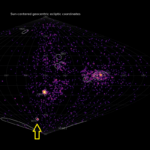
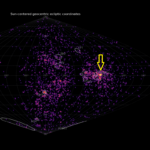
The shower activity is barely detectable in the GMN data with only one orbit in 2019, three in 2020, 20 in 2021, five in 2022, 26 in 2023, 16 in 2024 and only six in 2025, 77 in total. As such, it can be hardly seen on the radiant density map of October 2023 (Figure 1). Its detection strongly depends upon the camera coverage during the Solar Longitude interval 196°–198° (Figure 2). In 2025 this coverage was poor due to bad weather.
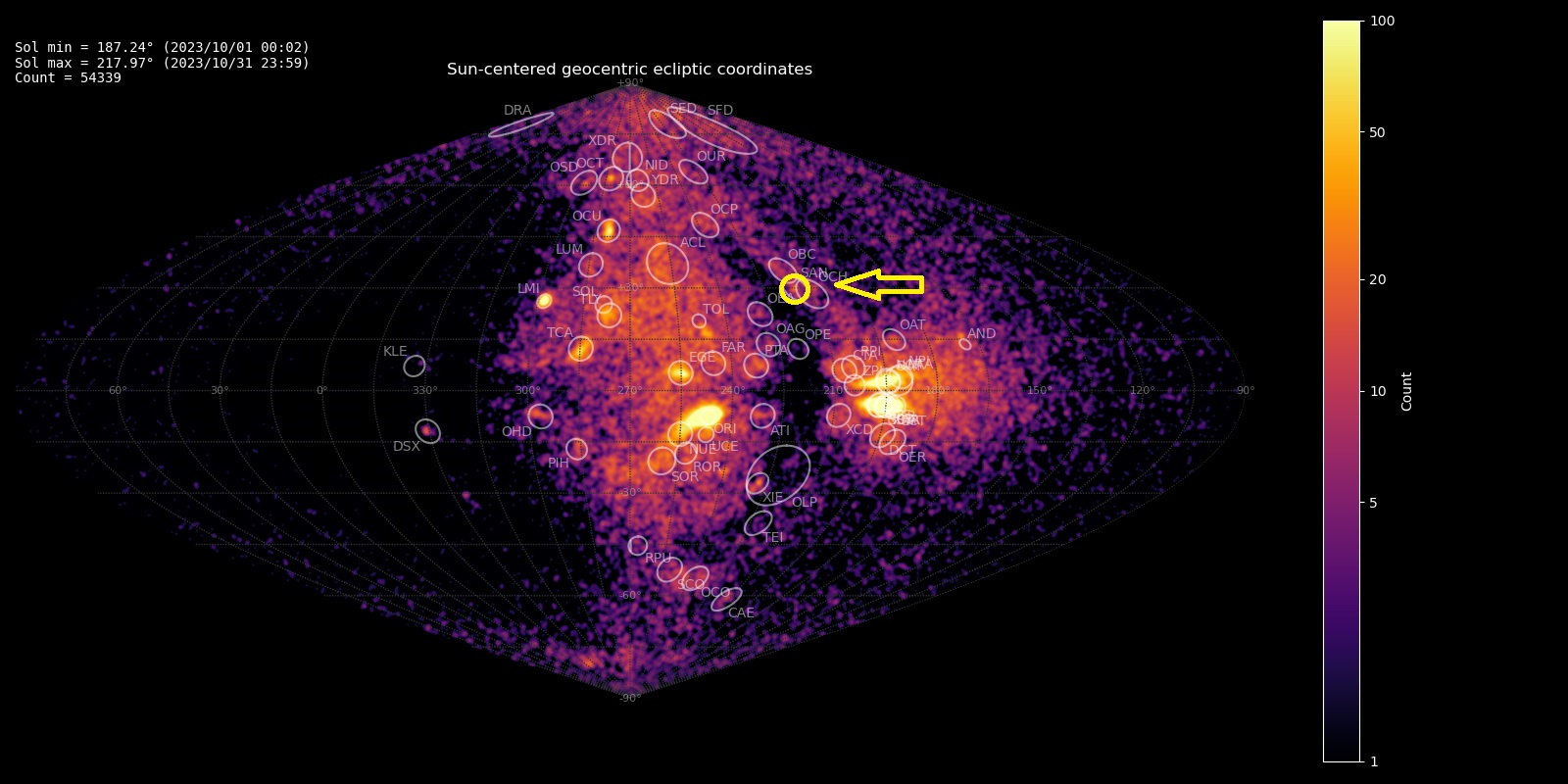
Figure 1 – Radiant density map with 54339 radiants obtained by the Global Meteor Network in October, 2023. The position of the 62-Andromedids (SAN#924) in Sun-centered geocentric ecliptic coordinates is marked with a yellow arrow.
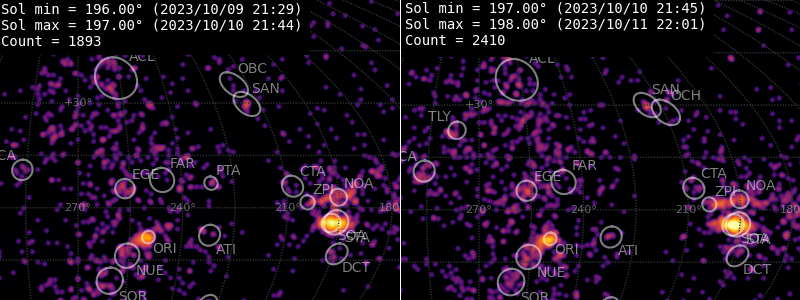
Figure 2 – Radiant density maps for 9–10–11 October 2023. The shower is labeled SAN.
2 Shower classification based on radiants
The GMN shower association criteria assume that meteors within 1° in Solar Longitude, within 1.0° in radiant in this case, and within 10% in geocentric velocity of a shower reference location are members of that shower. Further details about the shower association are explained in Moorhead et al. (2020). Using these meteor shower selection criteria, 76 orbits have been identified as 62- Andromedids in the years 2019–2025 by 186 GMN cameras installed in Australia, Belgium, Canada, Croatia, Czech Republic, Germany, France, Hungary, Italy, Netherlands, New Zealand, Slovenia, South Korea, Spain, Switzerland, United Kingdom and the United States. The weak activity of this shower requires a high-performance camera network to sample the 62-Andromedid meteoroid orbits. The camera coverage of the GMN is useful for detecting and documenting this kind of minor showers. The final results are listed in Table 1.
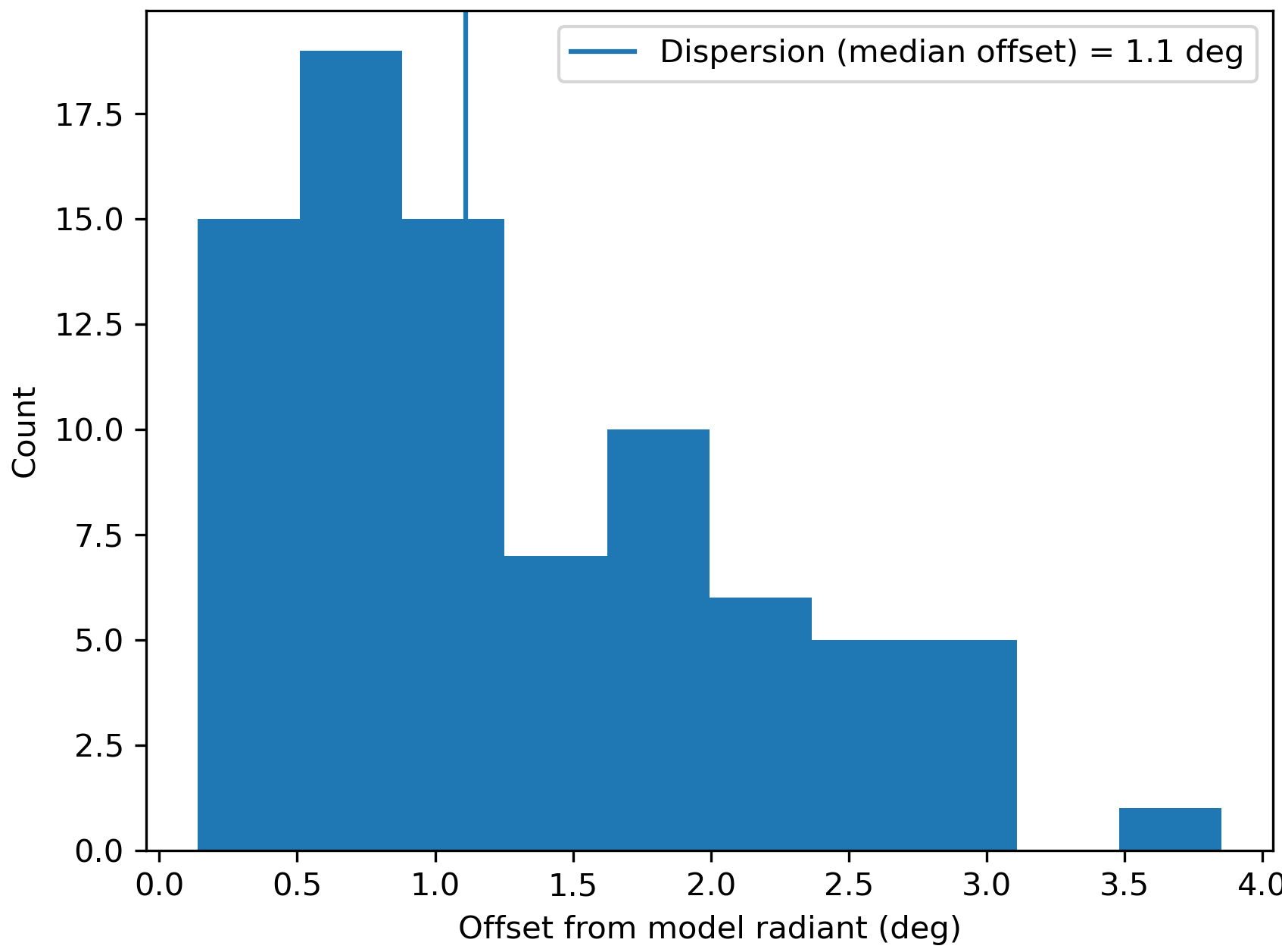
Figure 3 – Dispersion median offset on the radiant position.
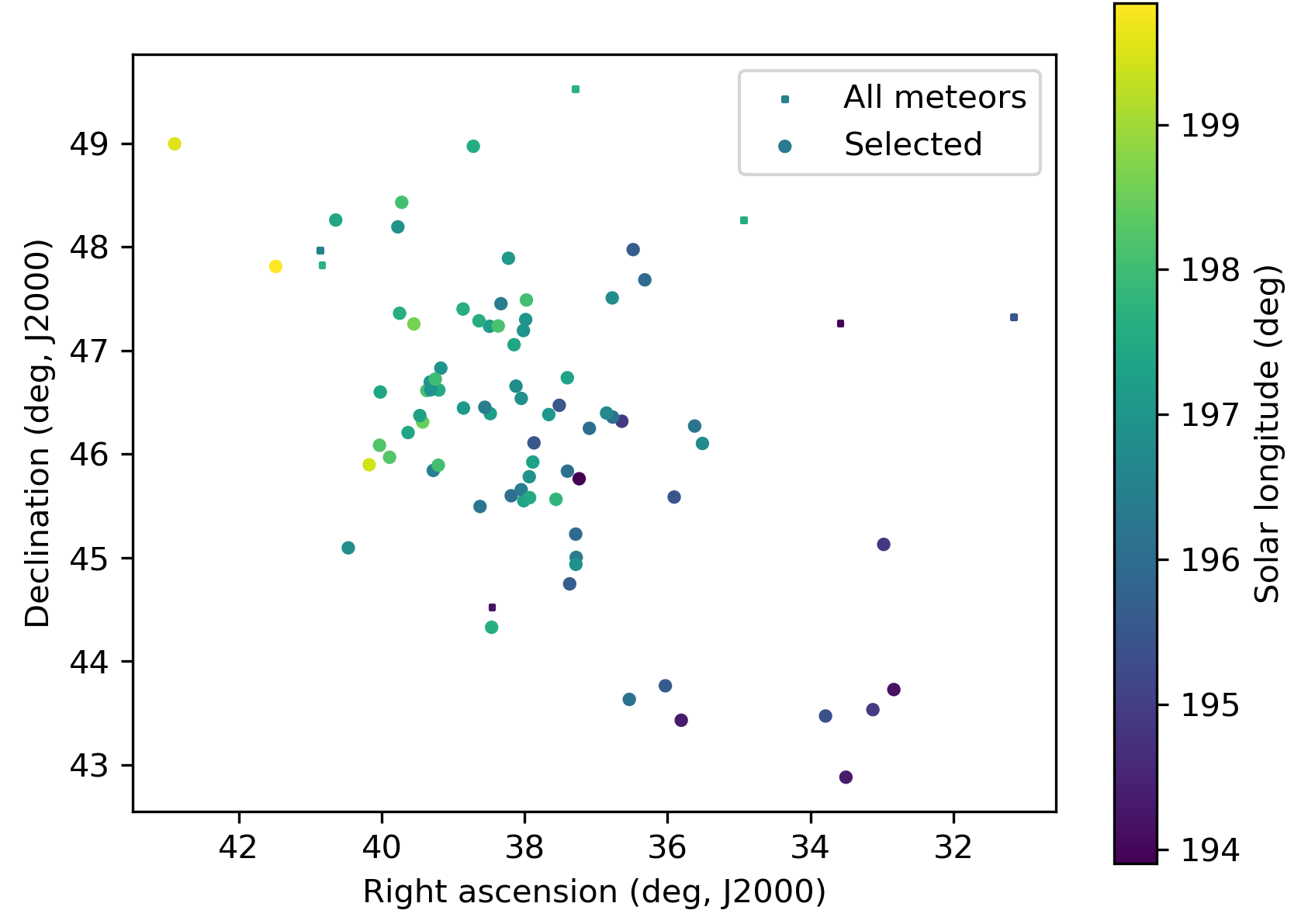
Figure 4 – The radiant distribution during the solar-longitude interval 194° – 200° in equatorial coordinates.
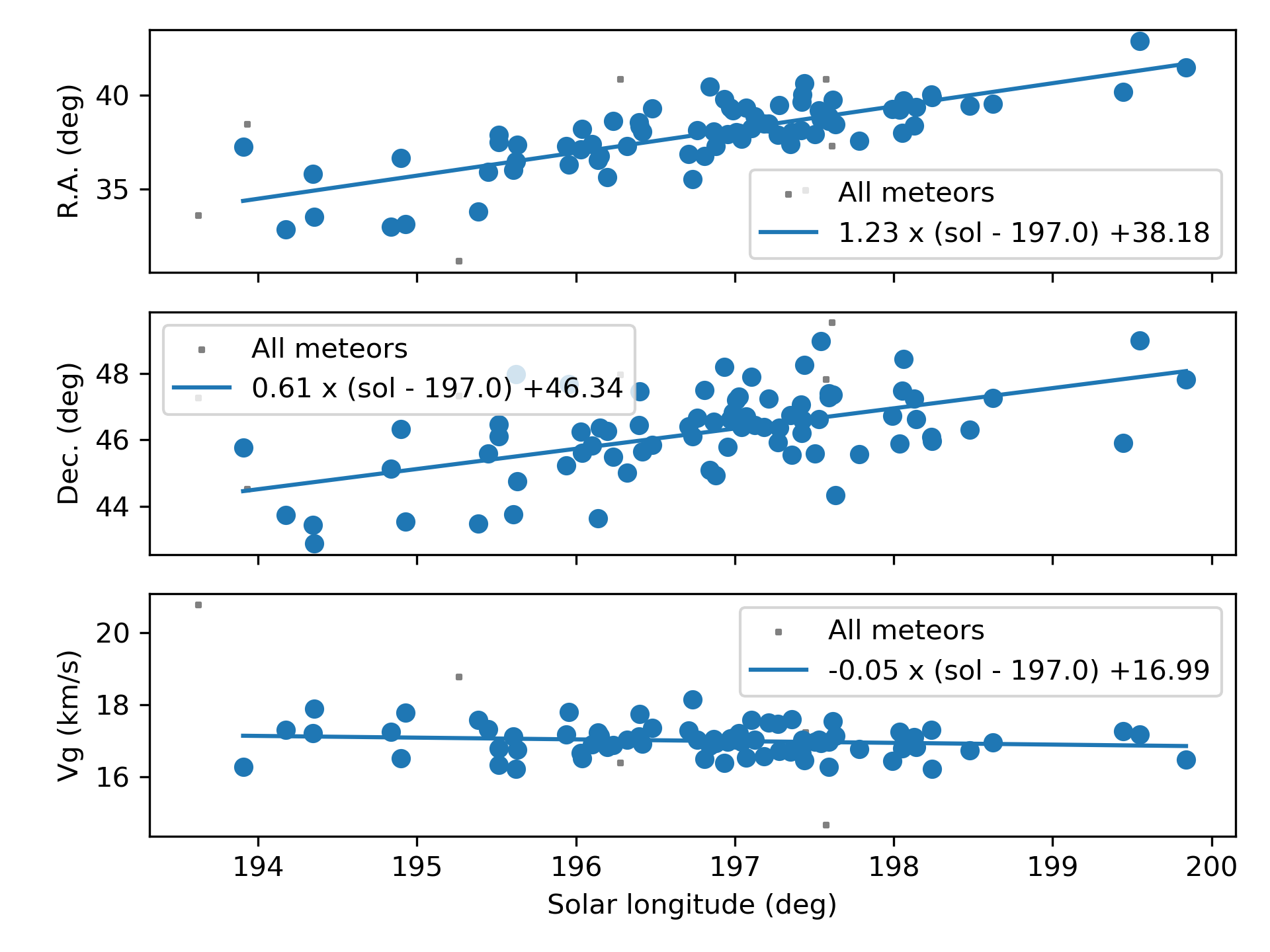
Figure 5 – The radiant drift.
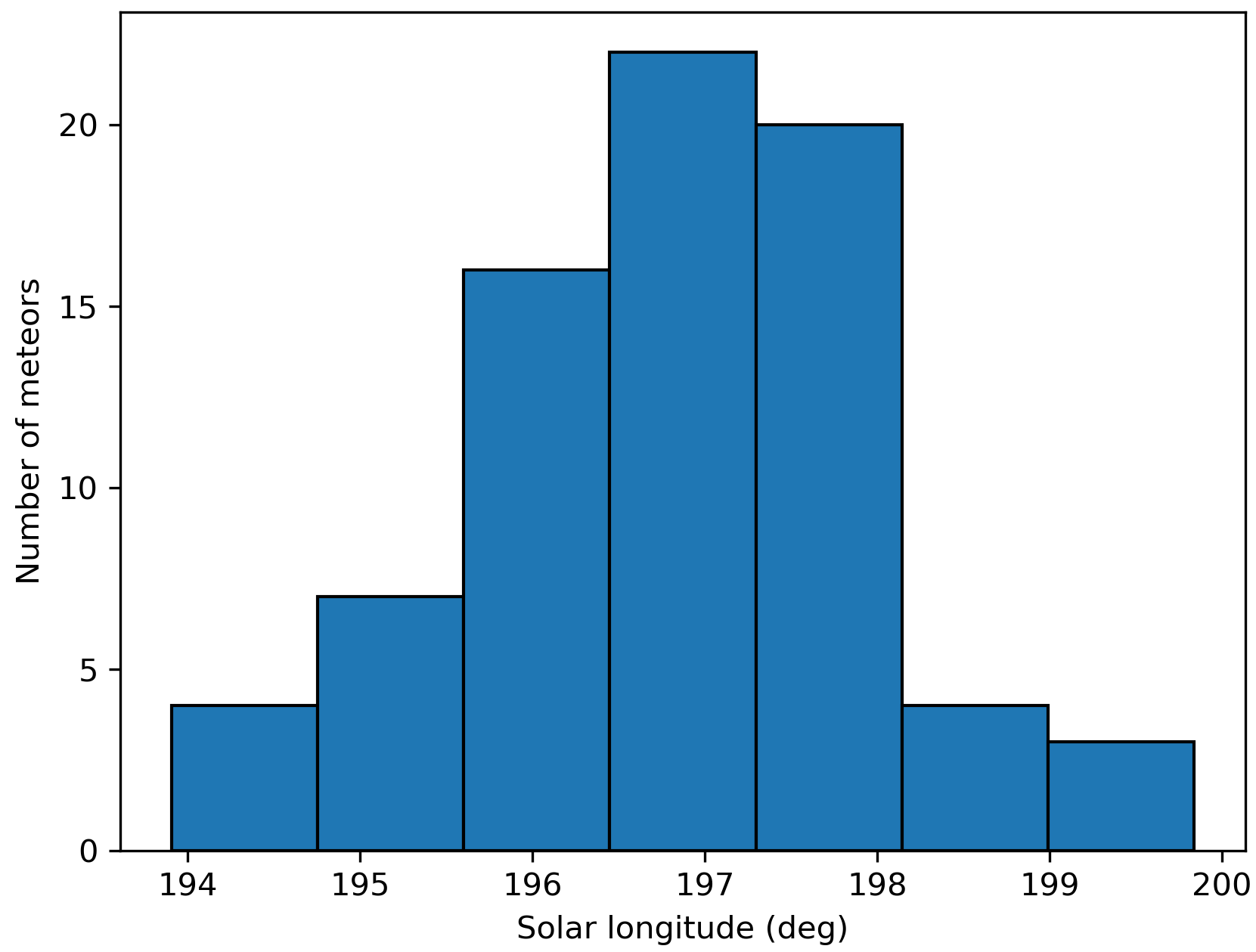
Figure 6 – The uncorrected number of shower meteors recorded per degree in solar longitude.
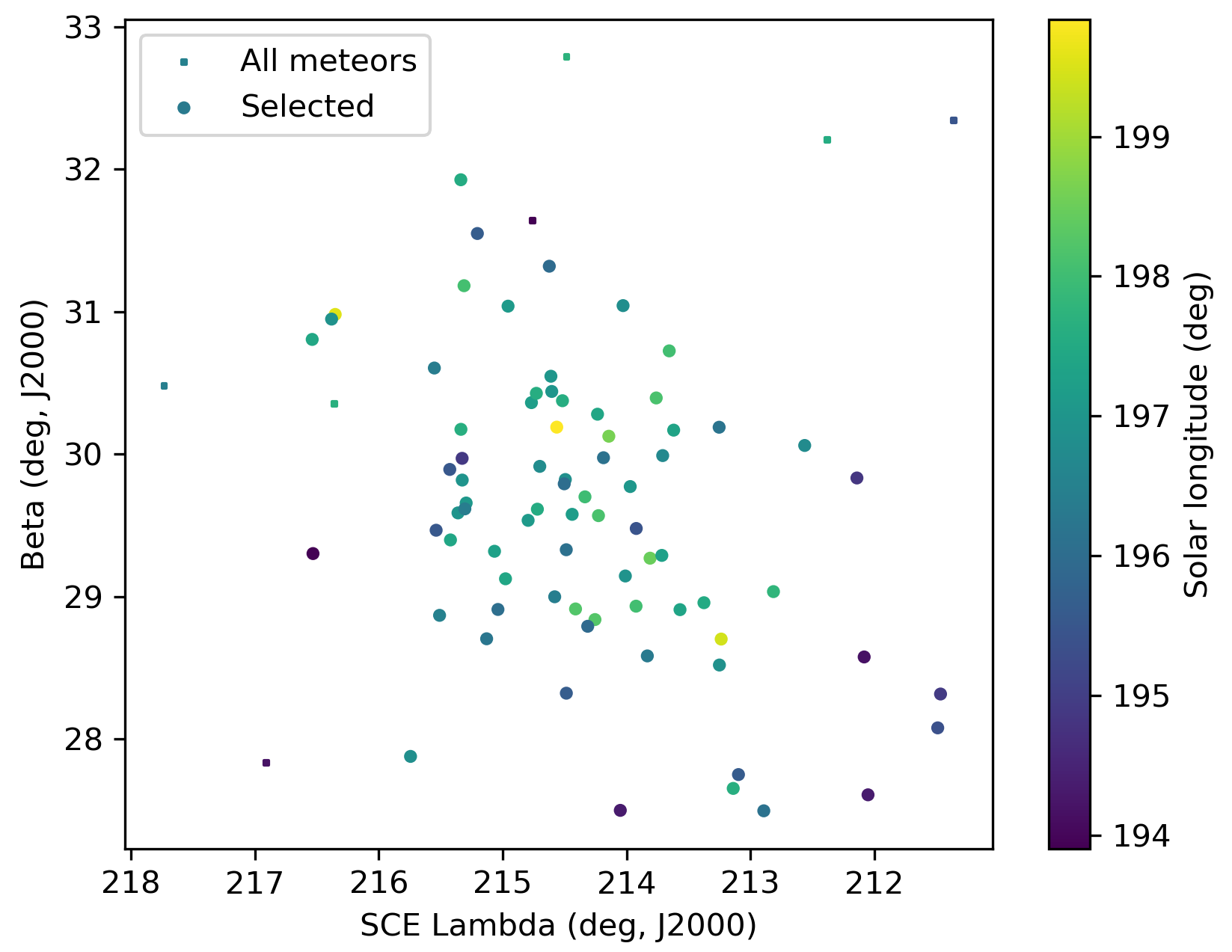
Figure 7 – The radiant distribution during the solar-longitude interval 194° – 200° in Sun-centered geocentric ecliptic coordinates.
3 Shower classification based on orbits
A complete independent meteoroid stream search has been applied based upon orbit data for confirmation. This method has been described in a separate publication (Roggemans and Vida, 2026). The mean orbit was computed by the method of Jopek et al. (2006) for all orbits that fit the thresholds DSH < 0.075 & DD < 0.03 & DJ < 0.075 (Southworth and Hawkins, 1963; Drummond, 1981; Jopek, 1993). The results have been listed in Table 1.
The 62-Andromedid radiant occurs next to other meteor activity (see Figure 2). The October beta-Camelopardalids (OBC#386) have a rather dispersed radiant immediately north of the 62-Andromedids in Figures 8 and 9. Right next to the 62-Andromedids are the October chi-Andromedids (OCH#716) in both coordinate systems. The presence of these two other meteor showers presents a challenge for identifying the shower association based upon the radiant position with the key difference being in geocentric velocity, which allows proper identification of the 62-Andromedids as very slow meteors with 17 km/s, while the October chi-Andromedids with 41 km/s and the October beta-Camelopardalids with 44 km/s are significant faster.
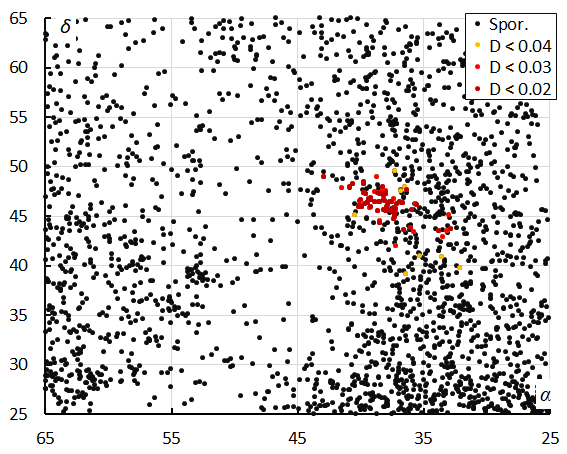
Figure 8 – The radiant distribution during the solar-longitude interval 193° – 201° in equatorial coordinates, color-coded for different threshold values of the DD orbit similarity criterion.
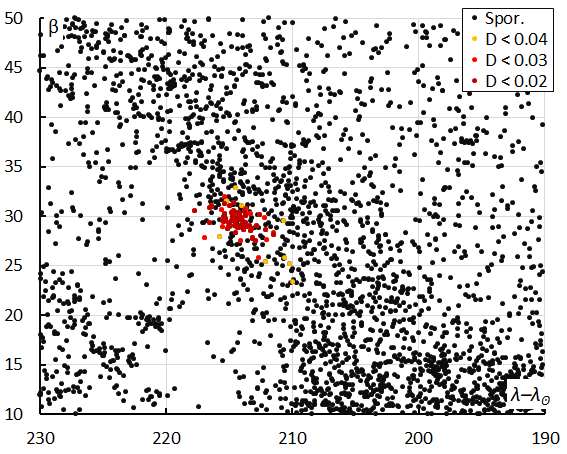
Figure 9 – The radiant distribution during the solar-longitude interval 193° – 201° in Sun-centered geocentric ecliptic coordinates, color-coded for different threshold values of the DD orbit similarity criterion.
The 62-Andromedid radiant appears as a distinct concentration in both coordinate systems (Figures 8 and 9). Counting the numbers of 62-Andromedid meteors and the total number of meteors per degree in Solar Longitude in steps of 0.25 degree, enables expression of the 62-Andromedid activity as a percentage of the total activity. Despite the very low activity level of 4 permille at best, an acceptable activity profile emerges with best rates around λʘ = 197.0° (Figure 10).
Seventy-three 62-Andromedids were identified in common by both methods, with three found by the radiant identification method but not confirmed by the orbit method and three that were identified by the orbit identification but not detected by the radiant method. Both methods produce the same results.
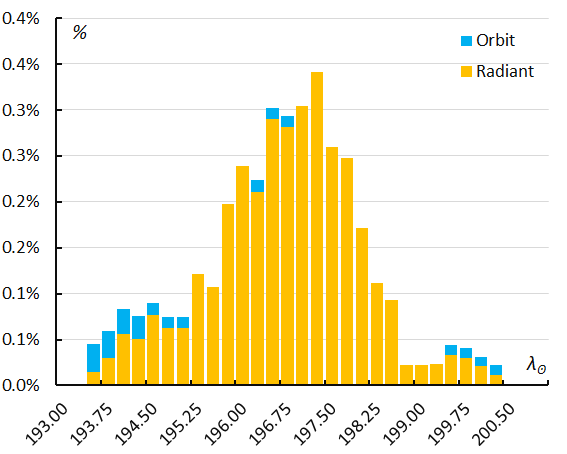
Figure 10 – The percentage of SAN-meteors relative to the total number of meteors. Orange is the result for the radiant shower classification, blue for the orbit classification method.
4 Orbit and parent body
The only previously known record for the 62-Andromedids orbit has been obtained by CAMS (Jenniskens, 2023) and the orbital parameters are in excellent agreement with the GMN results (Table 1).
Table 1 – Two solutions for the 62-Andromedids derived by two different methods, radiant based method and orbit based menthod for DD < 0.03, both compared to Jenniskens (2023) and 1998 ST27.
| Radiant method | Orbit method | CAMS | 1998 ST27 | |
| λʘ (°) | 197.0 | 197.0 | 196.5 | – |
| λʘb (°) | 193.9 | 193.9 | 190 | – |
| λʘe (°) | 199.9 | 199.9 | 200 | – |
| αg (°) | 38.2 | 38.1 | 37.9 | – |
| δg (°) | +46.3 | +46.3 | +46.3 | – |
| Δαg (°) | +1.23 | +1.11 | +1.18 | – |
| Δδg (°) | +0.61 | +0.64 | +0.28 | – |
| vg (km/s) | 17.0 | 17.0 | 16.9 | – |
| Hb (km) | 87.0 | 87.0 | – | – |
| He (km) | 72.2 | 72.2 | – | – |
| Hp (km) | 78.5 | 78.5 | – | – |
| MagAp | +0.7 | +0.6 | – | – |
| λg (°) | 51.37 | 51.4 | 51.1 | – |
| λg – λʘ (°) | 214.37 | 214.4 | 214.6 | – |
| βg (°) | +29.61 | +29.6 | +29.6 | – |
| a (A.U.) | 0.819 | 0.818 | 0.82 | 0.8194 |
| q (A.U.) | 0.394 | 0.393 | 0.395 | 0.386 |
| e | 0.519 | 0.520 | 0.518 | 0.5299 |
| i (°) | 21.3 | 21.3 | 20.9 | 21.06 |
| ω (°) | 320.5 | 320.6 | 320.7 | 322.49 |
| Ω (°) | 196.9 | 196.8 | 196.5 | 197.53 |
| Π (°) | 157.4 | 157.4 | 157.6 | 160.02 |
| Tj | 6.99 | 6.99 | 6.99 | 6.98 |
| N | 76 | 76 | 79 | – |
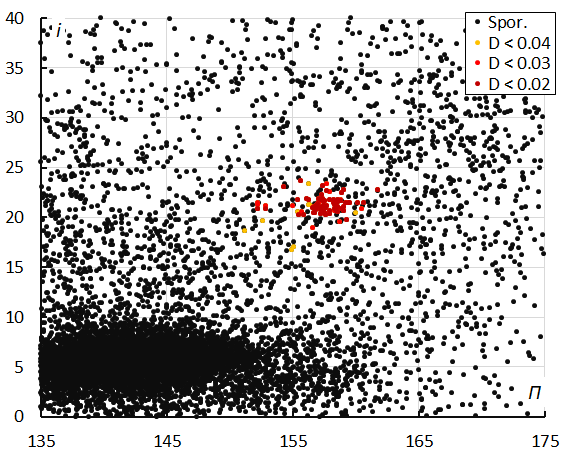
Figure 11 – The diagram of the inclination i versus the longitude of perihelion Π color-coded for different classes of D-criteria thresholds, for λʘ between 193° and 201°.
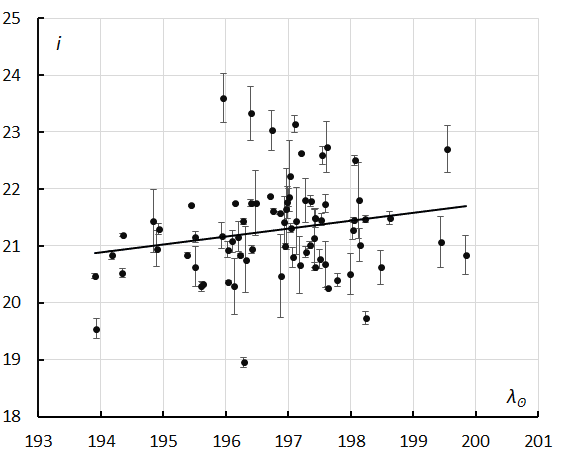
Figure 12 – The evolution of the inclination i in function of the solar longitude λʘ for the 62-Andromedids 2019–2025.
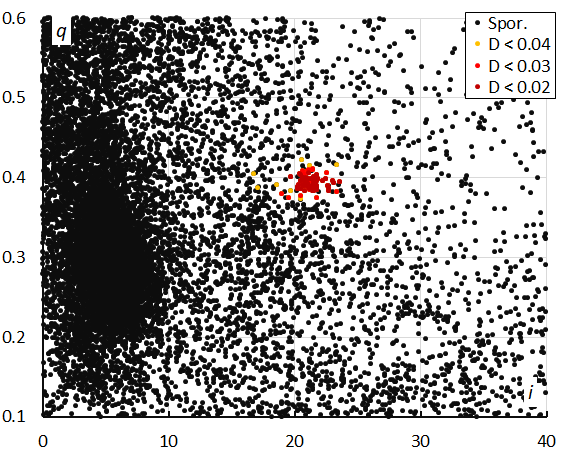
Figure 13 – The diagram of the perihelion distance q versus the inclination i color-coded for different classes of D-criteria thresholds, for λʘ between 193° and 201°.
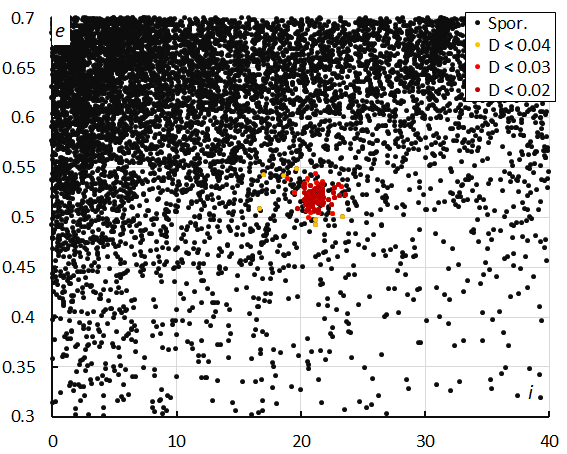
Figure 14 – The diagram of the eccentricity e versus the inclination i color-coded for different classes of D-criteria thresholds, for λʘ between 193° and 201°.
The diagram of inclination versus longitude of perihelion (Figure 11) shows a clear concentration of 62-Andromedid orbits in inclination and longitude of perihelion. The large dense concentration at the bottom left are mainly Southern Taurids (STA#2) and some other ecliptic meteoroid streams. The inclination i displays a slight trend to increase during the activity period (Figure 12). All the other Kepler elements remain constant during the activity.
The diagram with perihelion distance q versus inclination i shows a very strong concentration of 62-Andromedid orbits (Figure 13). This diagram also shows several other concentrations caused by other meteoroid streams. In the diagram with the eccentricity e versus the inclination i (Figure 14), the 62-Andromedids appear as very dense cluster at the edge of what appears like a very densely populated distribution with several meteoroid streams and sporadics with the 62-Andromedids as a border case.
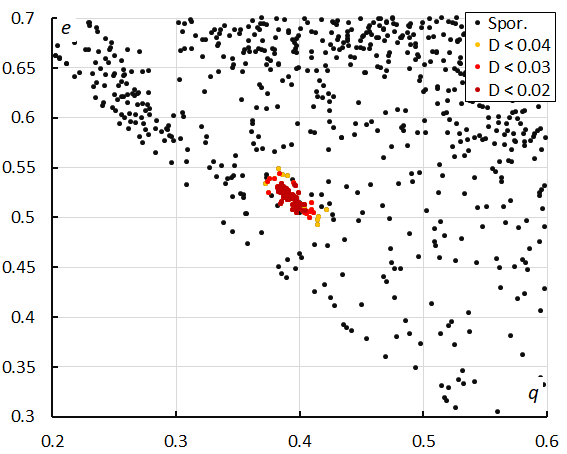
Figure 15 – The diagram of the eccentricity e versus the perihelion distance q color-coded for different classes of D-criteria thresholds, for λʘ between 193° and 201°.
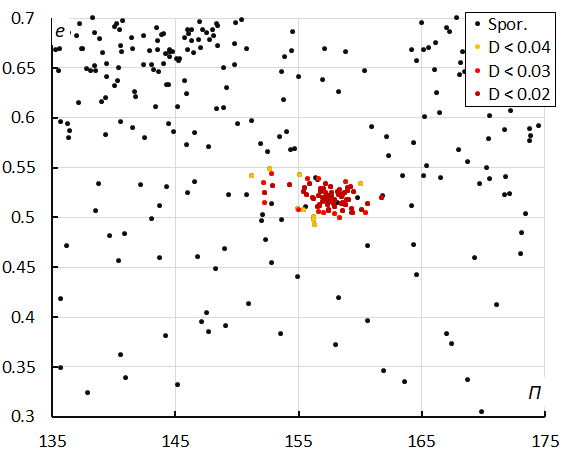
Figure 16 – The diagram of the eccentricity e versus the longitude of perihelion Π color-coded for different classes of D-criteria thresholds, for λʘ between 193° and 201°.
The distribution of the eccentricity e versus the perihelion distance q shows the cluster of 62-Andromedid orbits close to the limit beyond which meteoroids cannot encounter Earth, the white space in Figure 15. The distribution eccentricity e versus longitude of perihelion Π also reveals the shower as a dense cluster within a sparsely scattered distribution (Figure 16).
The 62-Andromedids cross the ecliptic at their descending node (℧) at the Earth orbit (Figure 17). The orbit is among the shortest in period among known meteoroid streams. A search for possible parent bodies has one positive match that is most likely the parent body for this shower, (363027) 1998 ST27 with DD = 0.016 (Table 2). Jenniskens (2023) also associated this shower with this parent object. 1998 ST27 was discovered by LINEAR in September, 1998, and has a diameter of 0.58±0.23 km. It is a triple system and the largest satellite has a diameter of about 100 meters and a period of more than seven days around the main object. Goldstone radar imaging has revealed a second satellite having less than 50m in diameter. 1998 ST27 is an Aten-class object with an orbital period of 0.74 years. The perihelion distance is a relatively low with 0.385 AU. 1998 ST27 made a flyby near Earth in 2024 which was the closest since 1958 and for more than 500 years into the future. The Minor Planet Center has designated this object as a Potentially Hazardous Asteroid. A triple system may indicate that more small fragments remain undetected and that we are dealing with a breaking up body that produced a meteoroid stream. 1998 ST27 is a very dark object with an albedo of only 0.059±0.066 according to NASA’s NEOWISE mission. The spectral data, combined with a low albedo, suggest the surface composition is most consistent with CM2 or CI1-type carbonaceous chondrites (Abell et al., 2006). Obtaining spectra from 62-Andromedids may confirm the relationship but is a challenge seen the low activity level of this meteor shower. The Tisserand value relative to Jupiter with TJ = 6.99 indicates an asteroid type orbit but does not exclude a Jupiter-family comet origin.
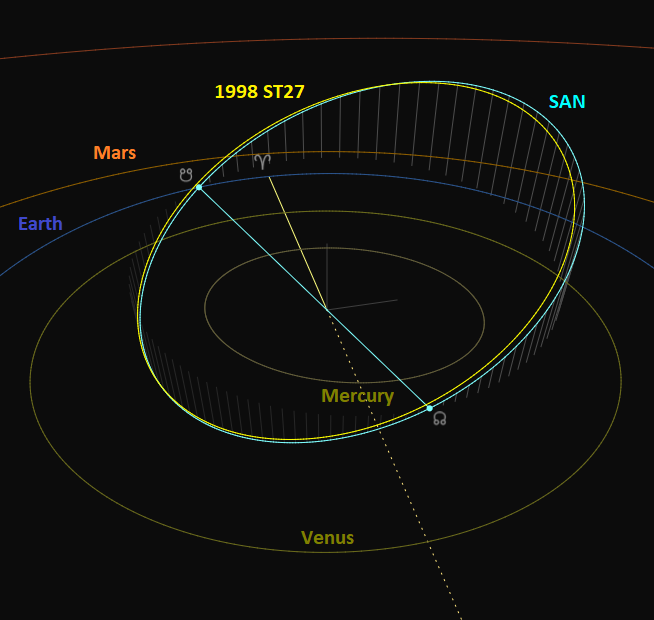
Figure 17 – Comparing the GMN solutions (blue) for the 62-Andromedids with the orbit of the most likely parent body 1998 ST27 (yellow), close-up at the inner Solar System. (Plotted with the Orbit visualization app provided by Pető Zsolt).
Table 2 – Top ten matches of a search for possible parent bodies with DD < 0.12.
| Name | DD |
| (363027) 1998 ST27 | 0.016 |
| (337248) 2000 RH60 | 0.077 |
| 2019 TL6 | 0.092 |
| 2016 VA | 0.096 |
| 2014 QE365 | 0.101 |
| 2009 UM1 | 0.107 |
| (614134) 2008 TC4 | 0.11 |
| 2019 PM2 | 0.112 |
| 2017 TG5 | 0.112 |
| (475534) 2006 TS7 | 0.113 |
The 62-Andromedids penetrate very deep into the atmosphere before ablating with a beginning height of 87 km and an ending height of 72 km. The particles in this meteoroid stream are most of the time exposed to thermal stresses while moving far within the Earth and the Venus orbits. This exposure is very destructive for fragile cometary material, nevertheless, Jenniskens derived a fragile meteoroid density from CAMS data (Jenniskens, 2023). The nature of these meteoroids and the decisive association with the likely parent body may be obtained from spectral meteor observations.
5 Conclusion
The confirmation of the existence of the 62-Adromedids (SAN#924) by GMN data from 2019–2025 with an independent solution reported to the IAU-MDC, fulfils the criteria to be nominated for established status. The GMN solution has been double checked by using two independent shower identification methods as a two-factor authentication for the validation of the analyses.
We confirm the earlier suggestion by Jenniskens et al. (2018) these meteoroids are derived from the Aten-class object (363027) 1998 ST27.
Acknowledgments
This report is based on the data of the Global Meteor Network (Vida et al., 2020a; 2020b; 2021) which is released under the CC BY 4.0 license. We thank all 927 participants in the Global Meteor Network project for their contribution and perseverance. A list with the names of the volunteers who contribute to GMN has been published in the 2025 annual report (Roggemans et al., 2026). The following 186 cameras recorded 62-Andromedids that have been used in this study:
AU0006, AU000D, AU0028, AU002A, AU002B, AU0030, AU003J, BE0001, BE0003, BE0004, BE0005, BE0006, BE0007, BE0008, BE000A, BE000B, BE000C, BE000D, BE000E, BE000G, CA000D, CA000E, CA000P, CA0022, CA0026, CA002F, CH0002, CH0003, CH0005, CZ0002, CZ000F, DE0005, DE0006, DE0008, DE000B, DE000X, ES0007, ES0008, ES000D, ES000F, ES000H, ES000K, ES000N, ES000T, ES000W, ES000Z, ES0019, FR0008, FR000A, FR000X, FR000Z, FR0012, FR0014, HR0001, HR0006, HR000M, HR000Q, HR000S, HR000V, HR001A, HR0024, HR002E, HU0001, HU0002, IT0001, KR000B, KR000F, KR000P, KR000S, KR0011, KR001G, KR001H, KR0024, KR002U, KR002W, KR003G, KR003H, NL0002, NL000K, NL000M, NZ0018, NZ0022, NZ0023, NZ002B, NZ002X, SI0001, SI0005, UK000D, UK000F, UK000H, UK000P, UK000U, UK001L, UK001P, UK001T, UK0025, UK0026, UK002J, UK002K, UK002X, UK0030, UK0031, UK003U, UK0045, UK004D, UK004N, UK0050, UK005S, UK0067, UK006C, UK006S, UK007E, UK007G, UK007N, UK007V, UK0080, UK0082, UK0083, UK0085, UK0086, UK0087, UK0089, UK008W, UK008X, UK0090, UK0098, UK0099, UK009A, UK009V, UK00A5, UK00AB, UK00AE, UK00AK, UK00B2, UK00BQ, US0001, US0003, US0005, US0006, US0007, US0008, US000A, US000C, US000E, US000G, US000H, US000J, US000K, US000L, US000M, US000N, US000P, US0038, US003G, US003N, US003P, US004B, US004C, US004P, US005Q, USL001, USL002, USL003, USL004, USL005, USL007, USL008, USL009, USL00A, USL00B, USL00C, USL00D, USL00E, USL00F, USL00G, USL00H, USL00J, USL00K, USL00M, USL00P, USL00Q, USL00V, USL014, USL017, USL01A and USL01D.
References
Abell P. A., Gaffey M. J., Hardersen P. S., Reddy V., Kumar S. (2006). “Compositions of binary near-Earth objects: implications for their internal structure”. Spacecraft Reconnaissance of Asteroid and Comet Interiors. 3024.pdf.
Drummond J. D. (1981). “A test of comet and meteor shower associations”. Icarus, 45, 545–553.
Jenniskens P., Baggaley J., Crumpton I., Aldous P., Pokorny P., Janches D., Gural P. S., Samuels D., Albers J., Howell A., Johannink C., Breukers M., Odeh M., Moskovitz N., Collison J., Ganju S. (2018). “A survey of southern hemisphere meteor showers”. Planetary and Space Science, 154, 21–29.
Jenniskens P. (2023). Atlas of Earth’s meteor showers. Elsevier, Cambridge, United states. ISBN 978-0443-23577-1. Page 203.
Jopek T. J. (1993). “Remarks on the meteor orbital similarity D-criterion”. Icarus, 106, 603–607.
Jopek T. J., Rudawska R. and Pretka-Ziomek H. (2006). “Calculation of the mean orbit of a meteoroid stream”. Monthly Notices of the Royal Astronomical Society, 371, 1367–1372.
Moorhead A. V., Clements T. D., Vida D. (2020). “Realistic gravitational focusing of meteoroid streams”. Monthly Notices of the Royal Astronomical Society, 494, 2982–2994.
Roggemans P. (2026). “Eccentrids in the GMN orbit dataset”. eMetN Meteor Journal, 11, 60–62.
Roggemans P. and Vida D. (2026). “Meteoroid orbit shower identification”. eMetN Meteor Journal, 11, TBP.
Roggemans P., Campbell-Burns P., Kalina M., McIntyre M., Scott J. M., Šegon D., Vida D. (2026). “Global Meteor Network report 2025”. eMetN Meteor Journal, 11, TBP.
Southworth R. B. and Hawkins G. S. (1963). “Statistics of meteor streams”. Smithsonian Contributions to Astrophysics, 7, 261–285.
Terentjeva A., Bakanas E. (2026). “The Eccentrids of the Mars family in the minor bodies system”. eMetN Meteor Journal, 11, 56–59.
Vida D., Gural P., Brown P., Campbell-Brown M., Wiegert P. (2020a). “Estimating trajectories of meteors: an observational Monte Carlo approach – I. Theory”. Monthly Notices of the Royal Astronomical Society, 491, 2688–2705.
Vida D., Gural P., Brown P., Campbell-Brown M., Wiegert P. (2020b). “Estimating trajectories of meteors: an observational Monte Carlo approach – II. Results”. Monthly Notices of the Royal Astronomical Society, 491, 3996–4011.
Vida D., Šegon D., Gural P. S., Brown P. G., McIntyre M. J. M., Dijkema T. J., Pavletić L., Kukić P., Mazur M. J., Eschman P., Roggemans P., Merlak A., Zubrović D. (2021). “The Global Meteor Network – Methodology and first results”. Monthly Notices of the Royal Astronomical Society, 506, 5046–5074.