Mariasole Maglione (GAV, Gruppo Astrofili Vicentini)
Lorenzo Barbieri (CARMELO network and AAB, Associazione Astrofili Bolognesi)
Introduction
January opened with the peak of the Quadrantids, which is the main and dominant shower for the entire month. The peak of the Quadrantids occurred between January 3 and 4.
Methods
The CARMELO network consists of SDR radio receivers. In them, a microprocessor (Raspberry) performs three functions simultaneously:
- By driving a dongle, it tunes the frequency on which the transmitter transmits and tunes like a radio, samples the radio signal and through the FFT (Fast Fourier Transform) measures frequency and received power.
- By analyzing the received data for each packet, it detects meteoric echoes and discards false positives and interference.
- It compiles a file containing the event log and sends it to a server.
The data are all generated by the same standard, and are therefore homogeneous and comparable. A single receiver can be assembled with a few devices whose total current cost is about 210 euros.
To participate in the network read the instructions on this page.
January data
In the plots that follow, all available at this page, the abscissae represent time, which is expressed in UT (Universal Time) or in solar longitude (Solar Long), and the ordinates represent the hourly rate, calculated as the total number of events recorded by the network in an hour divided by the number of operating receivers.
In fig.1, the trend of signals detected by the receivers for the month of January.
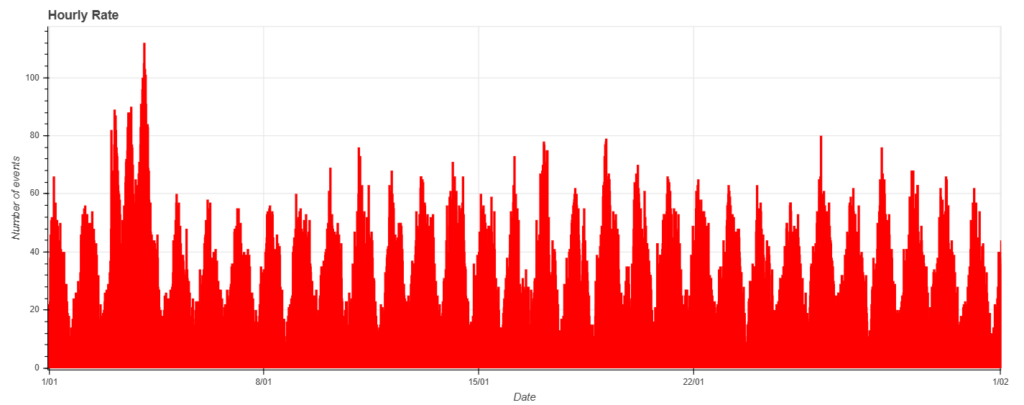
Fig. 1: January 2026 data trend.
Quadrantids
Among the annual meteor showers, the January Quadrantids usually stand out for their intensity, reaching peaks of activity between 60 and 200 meteors per hour. Despite this, they remain less well known than other more famous showers, such as the Perseids or Geminids. Their less notoriety is also due to the very short peak of activity, which lasts about 24 hours.
The radiant of the Quadrantids is located in the Boote constellation, in a rather low position in the northern sky, between the head of the Dragon and the helm of the Big Dipper. The name is derived from Quadrans Muralis, an ancient constellation created in 1795 by the French astronomer Jérôme Lalande that included parts of Boote and the Dragon, and which is not on the list of 88 constellations drawn up by the International Astronomical Union (IAU) in 1922 and published in 1930 (1).
The origin of this swarm remains a debated topic. In 2003, following an observational campaign on minor bodies in the Solar System, astronomer Peter Jenniskens found a possible progenitor body of the Quadrantids in the Near Earth (196256) asteroid 2003 EH1, a hypothesis that would make them one of the few meteor showers arising from an asteroid and not a comet, similar to the Geminids in December (2). Since then, 2003 E1 has been considered the most likely progenitor body of the Quadrantids. It may itself be a fragment of comet C/1490 Y1 , which was observed by Chinese, Japanese and Korean astronomers just over 500 years ago in 1490 (3).
This year, visual observation of the Quadrantids was hampered by the presence of the full moon, and radio observation was penalized by the fact that the peak of the shower’s activity occurred just when the radiant was on the horizon. In the plot in fig. 2, which shows the hourly rate on the days when the Quadrantids were most active, a first filament is clearly visible, reaching its maximum at a solar longitude of about 282.4° (first black arrow), while the second and much more consistent maximum is expected at a solar longitude of about 283. 1° (second black arrow) occurs with the minimum height of the radiant in the early evening of January 3. The double filament also confirms the observations of January 2025 (4).
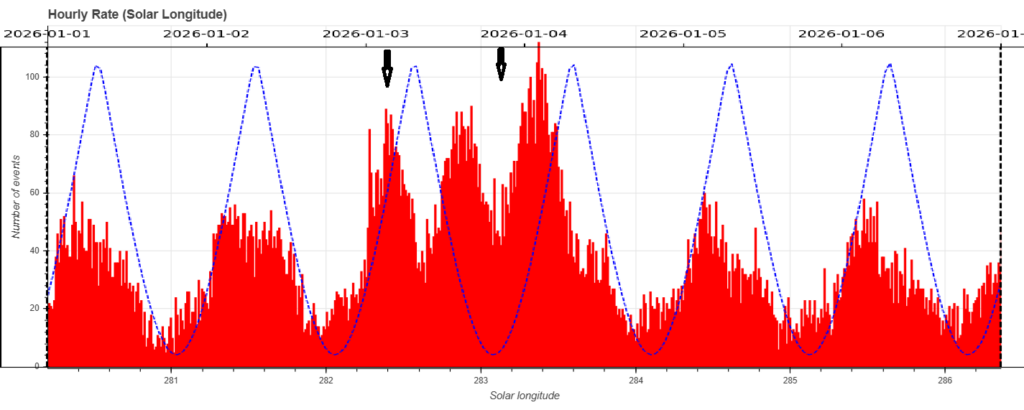
Fig. 2: Hourly rate of events recorded between January 1 and 7, based on solar longitude. In blue, the height of the radiant in the sky. The two arrows indicate the maximum at two different filaments.
The passage of the shower is also visible in the measurement of the average power of the signals received (see fig. 3), which shows an increase during the night between January 3 and 4, with a maximum value centered at a solar longitude of approximately 283.1°. The data for the first filament, on the other hand, is much lower, a result that suggests a different mass index, with smaller and lighter meteors than the main filament.
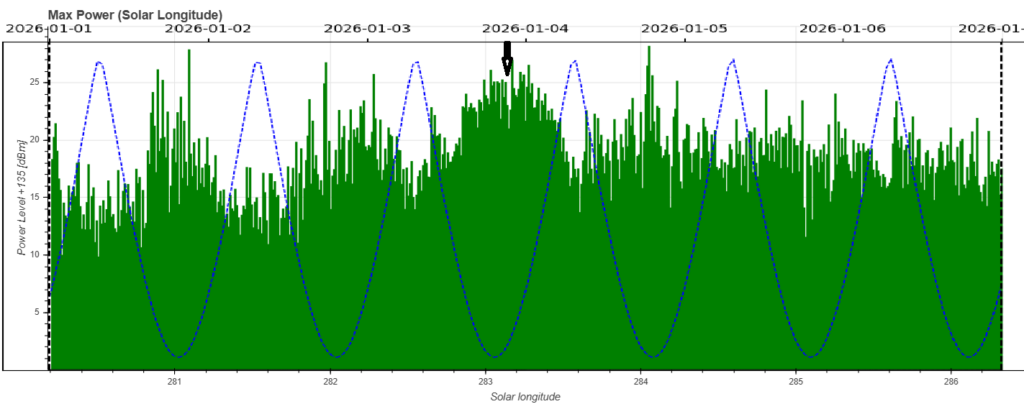
Fig. 3: Average power of signals recorded between January 1 and 7, as a function of solar longitude. In blue, the height of the radiant in the sky. The arrow indicates the maximum value, centered at a solar longitude of approximately 283.1°, corresponding to the second filament.
Furthermore, throughout the day on January 17, from 9 UT to 16 UT, the CARMELO network recorded a slight increase in the average power of the signals received (see fig. 4). This average increase can be associated with weak daylight showers activity, therefore without observational counterparts in the visible spectrum. Among these, considering observations from previous years, we could mention Serpentis-Coronae Borealis (594 RSE) or γ-Ursae Minoris (404 GUM).
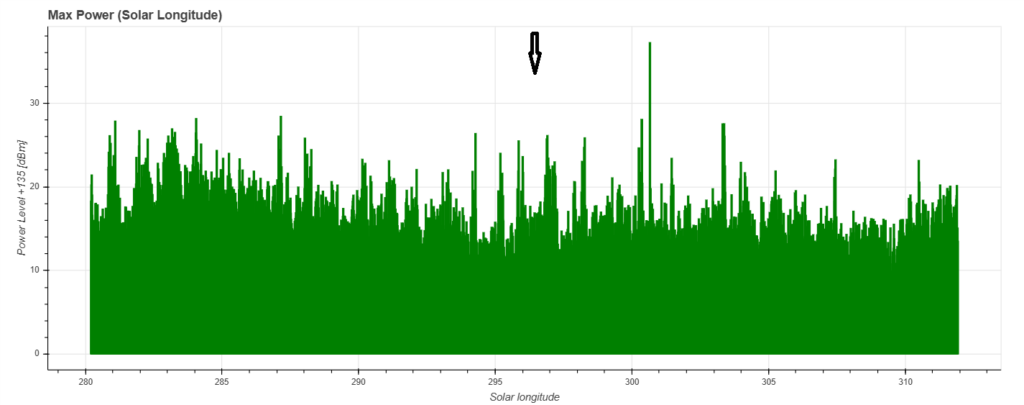
Fig. 4: Average power of signals recorded between solar longitude 280° and 312° approximately, with a peak indicated by the black arrow between 9 UT and 16 UT on January 17.
The CARMELO network
The network currently consists of 14 receivers located in Italy, the UK, Switzerland and the USA. The European receivers are tuned to the Graves radar station frequency in France, which is 143.050 MHz. Participating in the network are:
- Lorenzo Barbieri, Budrio (BO) ITA
- Associazione Astrofili Bolognesi, Bologna ITA
- Associazione Astrofili Bolognesi, Medelana (BO) ITA
- Paolo Fontana, Castenaso (BO) ITA
- Paolo Fontana, Belluno (BL) ITA
- Associazione Astrofili Pisani, Orciatico (PI) ITA
- Gruppo Astrofili Persicetani, San Giovanni in Persiceto (BO) ITA
- Roberto Nesci, Foligno (PG) ITA
- MarSEC, Marana di Crespadoro (VI) ITA
- Gruppo Astrofili Vicentini, Arcugnano (VI) ITA
- Associazione Ravennate Astrofili Rheyta, Ravenna (RA) ITA
- Mike German a Hayfield, Derbyshire UK
- Mike Otte, Pearl City, Illinois USA
- Yuri Malagutti, Comano (TI) CH
The authors’ hope is that the network can expand both quantitatively and geographically, thus allowing the production of better quality data.
References
(1) Eugène Delporte (1930), IAU: “Délimitation Scientifique des Constellations”. At the University Press
(2 )Peter Jenniskens (2004): “2003 EH_1 and the Quadrantid shower”. WGN, Journal of the International Meteor Organization, vol. 32, no.1, p.7-10
(3) Ki-Won Lee et al. (2009): “Orbital Elements of Comet C/1490 Y1 and the Quadrantid shower”. Monthly Notices of the Royal Astronomical Society, vol. 400
(4) Mariasole Maglione, Lorenzo Barbieri (2025): “Bollettino delle radiometeore di gennaio 2025”