By Hiroshi Ogawa
Abstract: Global radio meteor observations caught an unusual activity in 2025. The activity level reached AL=1.1±0.3 at λʘ = 270.38° (December 22, 08h30m UT). This activity was possibly mixed with a traditional annual activity and a predicted encounter with a dust filament. The activity was estimated as AL=0.9 at λʘ = 270.38°.
1 Introduction
The Ursids is one of the major annual meteor showers. The shower reaches a maximum with a ZHR = 10 at λʘ = 270.7° in visual observations (Rendtel, 2024). Although it usually shows a weak activity level in ordinary years, some activity outburst caused by dust trails and filaments have been detected in the past.
With radio meteor observations it is possible to obtain a complete activity profile even during bad weather and daytime. Therefore, the International Project for Radio Meteor Observations (IPRMO) has been organized in 2001 to analyze a complete meteor shower activity without any radiant problem (Ogawa et al., 2001). In past research, activity profiles were derived from worldwide radio data from Radio Meteor Observation Bulletin (RMOB).
A long-term study of the Ursids by radio meteor observations has clearly established the annual activity profile. IPRMO concluded that the peak of the Ursids occurred at λʘ = 270.5° with a peak Activity Level Index (AL) of 0.4 using worldwide data during the period of 2004–2024. Radio meteor observations registered also some unusual activities. For example, in recent years enhanced activity was observed twice in 2020 and 2021 (Ogawa and Sugimoto, 2021; 2022). Ogawa and Steyaert (2017) reported outburst activities in 2008, 2009 ,2014 and 2016.
In 2025, some researchers had computed some possible encounters with dust filaments (Rendtel, 2024). This paper reports the result for the Ursids 2025 using worldwide radio meteor observations.
2 Data
Data from 52 observers in 12 countries has been used in this analysis. These data were provided by the following observers who reported to RMOB and Japanese observers:
Johan Bogaerts (Belgium), Chris Steyaert (Belgium), Felix Verbelen (Belgium), Lucas Frederic (France), Philippe Rainard (France), Pierre Heinz (France), Pierre Terrier (France), SAT00 Observatoire_SAT00 (France), Bernd Wallbaum (Germany), Klaus Henning (Germany), WHS Essen (Germany), Istvan Tepliczky (Hungary), Observatory Szeged (Hungary), Vilmos Keresztesi (Hungary), GABB .IT (Italy), Licei Lunigianesi (Italy), APA Latina (Italy), Mario Bombardini (Italy), Hirofumi Sugimoto (Japan), Hironobu Shida (Japan), Hiroshi Suzuki (Japan), Kenji Fujito (Japan), Koichiro Okuno (Japan), Mai Wakita (Japan), Masahiko Matsuda (Japan), Masaki Kano (Japan), Masaki Tsuboi (Japan), Nobuo Katsura (Japan), Norihiro Nakamura (Japan), Yasufumi Yoshikawa (Japan), Jean-Claude Thibaut (Luxembourg), Aguirre Salvador (Mexico), Michal Biernacki (Poland), MAR JEN (Poland), Joan Figueras (Spain), Jochen Richert (Switzerland), Philip Norton (United Kingdom), Philip Norton Vert (United Kingdom), Philip Rourke (United Kingdom), Stephen Grimes (United Kingdom), Mike Otte (United States of America), Stanley Nelson (United States of America).
3 Method
The meteor activity is calculated by the “Activity Level Index: AL(t)” (Ogawa et al., 2001) to analyze the worldwide radio meteor observation data. The activity profile was estimated using the Lorentz activity profile (Jenniskens et al., 2000).
4 Results
Figure 1 shows the result of the Activity Level Index. A clear peak was observed at λʘ = 270.38° (December 22, 8h30m UT) with AL = 1.1 ± 0.3. The beginning of increase was around λʘ = 270.25° (December 22, 5h00m UT). After that, the activity level dropped back to the level of the annual activity profile (gray line in Figure 1) around λʘ = 270.5° (December 22, 11h00m UT).
The activity level AL of the Ursids 2025 displays two estimated components using the Lorentz profile (Figure 2 and Table 1). One component corresponds to the traditional annual activity. The peak occurred at λʘ = 270.47° (December 22, 10h30m UT). This is a similar result as in ordinary years (λʘ = 270.5°).
The other component indicates an unusual activity that has AL = 0.9 at λʘ = 270.38° (December 22, 08h30m UT). The Full Width of Half Maximum (FWHM) has a –2.0 hours and + 1.5 hours.
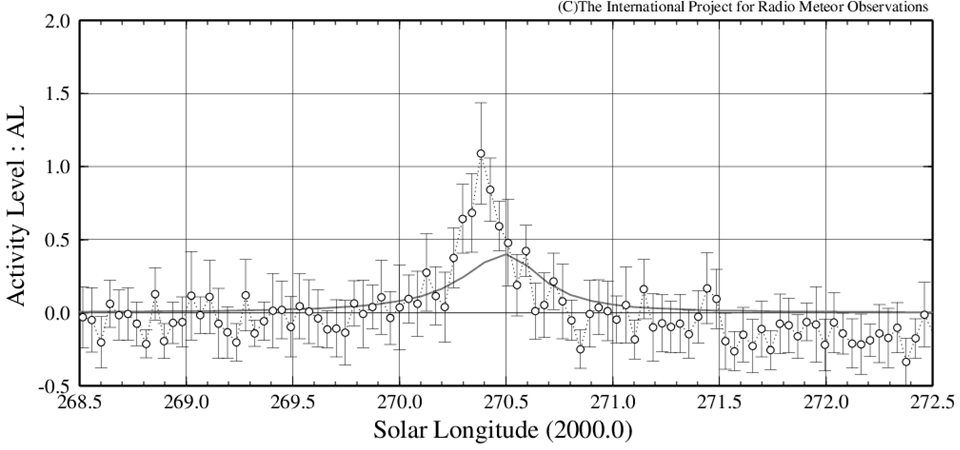
Figure 1 – Activity Level Index of the Ursids 2025 (gray line: average for the period of 2004–2024).
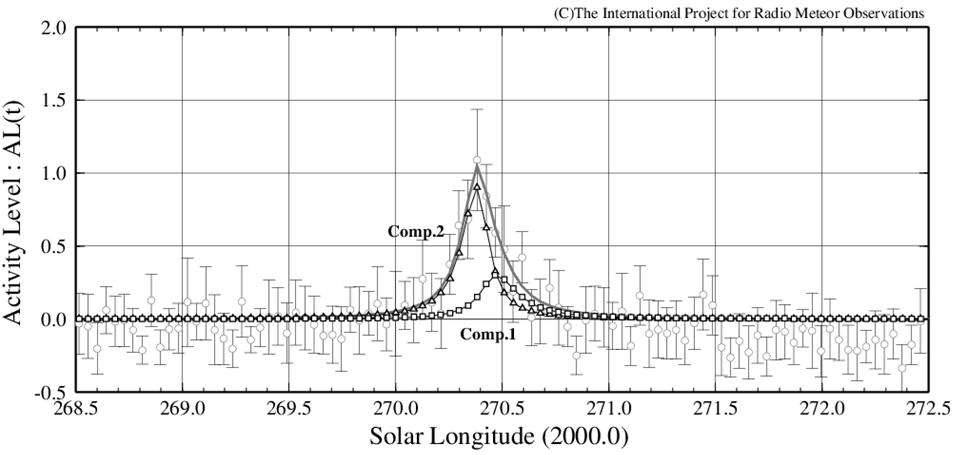
Figure 2 – The Activity Level Index: the estimated components using the Lorentz Profile (solid line: total activity of Comp1- Comp3).
5 Discussion
Table 1 compares the estimated components by IPRMO and published information. Comp.1 in Figure 2 was the same result as the traditional annual activity by IPRMO. However, it requires discussion to explain Comp.2.
Table 1 – Comparison between the estimated components by IPRMO and the predictions.
| Source | λʘ (max) | Activity | Comments |
| Comp.1 | 270.47° | AL = 0.3 | – |
| Comp.2 | 270.38° | AL = 0.9 | – |
| IPRMO | 270.5° | AL = 0.4 | ave.(2004–2024) |
| IMO | 270.7° | ZHR 10 | traditional activity |
| Jenniskens | 270.26° | ZHR 25 | filament |
| Vaubaillon | 270.7° | – | densest section |
Jenniskens (2006) described a possible encounter with the filament at λʘ = 270.26°. However, the densest section was indicated by Vaubaillon at λʘ = 270.7° (Table 1). The peak time of Comp.2 was slightly earlier than Vaubaillon, but slightly later than Jenniskens. The Activity Level was about three times higher, which was close to the ZHR given by Jenniskens. Therefore, it is possible that the encounter with the filament predicted by Jenniskens occurred later than predicted.
6 Conclusion
The worldwide radio meteor observers caught an unusual activity around λʘ =270.38° for the Ursids in 2025. The Activity Level reached AL = 0.9. It is possible that this activity was caused by the encounter with a dust filament.
Acknowledgment
The worldwide data were provided by the Radio Meteor Observation Bulletin (RMOB).
We wish to thank Pierre Terrier for developing and hosting rmob.org. A very special thank you to Paul Roggemans for proofreading this article.
References
Jenniskens P., Crawford C., Butow S. J., Nugent D., Koop M., Holman D., Houston J., Jobse K., Kronk G., and Beatty K. (2000). “Lorentz shaped comet dust trail cross section from new hybrid visual and video meteor counting technique imprications for future Leonid storm encounters”. Earth, Moon and Planets, 82–83, 191–208.
Jenniskens P. (2006). “Meteor showers and their parent comets”. Cambr. Univ. Press.
Ogawa H., Toyomasu S., Ohnishi K., and Maegawa K. (2001). “The Global Monitor of Meteor Streams by Radio Meteor Observation all over the world”. In, Warmbein Barbara, editor, Proceeding of the Meteoroids 2001 Conference, 6-10 August 2001, Swedish Institute of Space Physics, Kiruna, Sweden. ESA Publications Division, European Space Agency, Noordwijk, The Netherlands, 189–191.
Ogawa H. and Steyaert C. (2017). “Major and Daytime Meteor Showers using Global Radio Meteor Observations covering the period 2001-2016”. WGN, Journal of the IMO, 45, 98–106.
Ogawa H. and Sugimoto H. (2021). “Ursids 2020 with Worldwide Radio Meteor Observations”. eMetN Meteor Journal, 6, 19–21
Ogawa H. and Sugimoto H. (2022). “A strong activity of the Ursids in 2021 by worldwide radio meteor observations”. eMetN Meteor Journal, 7, 32–33
Ogawa H. (2022). “Long-Term Studies of Major and Daytime Meteor Showers using Worldwide Radio Meteor Observations”. WGN, Journal of the IMO, 50, 148–157.
Rendtel J. (2024). “2025 Meteor Shower Calendar”. International Meteor Organization.