Mariasole Maglione (GAV, Gruppo Astrofili Vicentini)
Lorenzo Barbieri (CARMELO network and AAB, Associazione Astrofili Bolognesi)
Introduction
December is the month of the Geminids (GEM), a meteor shower originating from asteroid 3200 Phaethon. The peak of the Geminids’ activity was recorded by the CARMELO network on the night between December 13 and 14. On the other hand, no particularly high activity was recorded from the Ursids, in line with visual observers.
Methods
The CARMELO network consists of SDR radio receivers. In them, a microprocessor (Raspberry) performs three functions simultaneously:
- By driving a dongle, it tunes the frequency on which the transmitter transmits and tunes like a radio, samples the radio signal and through the FFT (Fast Fourier Transform) measures frequency and received power.
- By analyzing the received data for each packet, it detects meteoric echoes and discards false positives and interference.
- It compiles a file containing the event log and sends it to a server.
The data are all generated by the same standard, and are therefore homogeneous and comparable. A single receiver can be assembled with a few devices whose total current cost is about 210 euros.
To participate in the network read the instructions on this page.
December data
In the plots that follow, all available at this page, the abscissae represent time, which is expressed in UT (Universal Time) or in solar longitude (Solar Long), and the ordinates represent the hourly rate, calculated as the total number of events recorded by the network in an hour divided by the number of operating receivers.
In fig.1, the trend of signals detected by the receivers for the month of December.
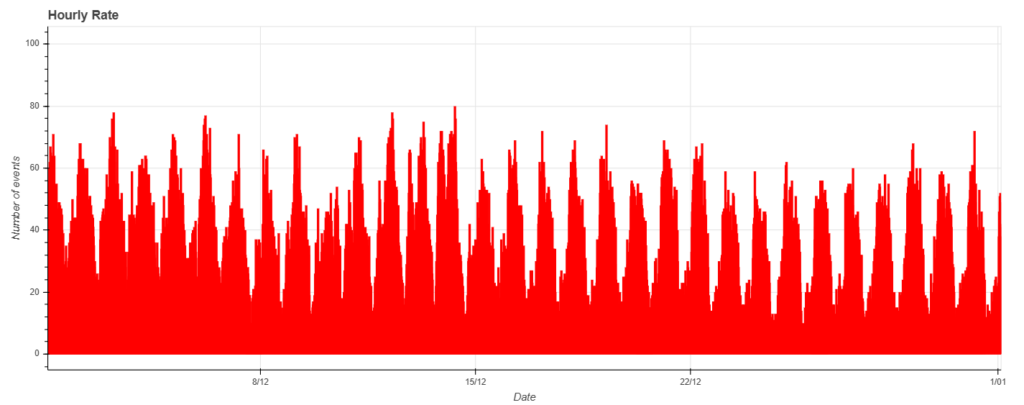
Fig. 1: December 2025 data trend.
Geminids
In December, the most important shower is the one of the Geminids (GEM), that is evolving very rapidly and will probably disappear completely in less than a hundred years.
The Geminids are a unique case among meteor showers: their origin is not linked to a comet, but to an asteroid, 3200 Phaethon (1). Discovered in 1983 by the IRAS satellite (Infrared Astronomical Satellite), 3200 Phaethon is an Apollo-type asteroid with a highly elliptical orbit that crosses those of Mars, Earth, Venus and Mercury, bringing it closer to the Sun than any other known asteroid. This close passage generates extremely high temperatures, exceeding 750°C, enough to cause the sublimation of some surface materials and the release of debris. These debris are precisely the material that gives rise to the Geminids.
Models suggest that significant amounts of debris are produced at each close passage of the asteroid near the Sun and are distributed along its orbit in a compact, well-defined trail.
The Geminids are usually active from December 2 to 19. In recent years, the ZHR (Zenithal Hourly Rate) has remained steady at around 120–150 meteors per hour, with a peak of activity between December 13 and 14.
The radiant of the shower, that is, the point in the sky from which the meteors appear to originate, is located in the constellation Gemini, near the bright star Castor. For skies in the Northern Hemisphere, it rises around 18:00 UT and sets around 09:00 UT.
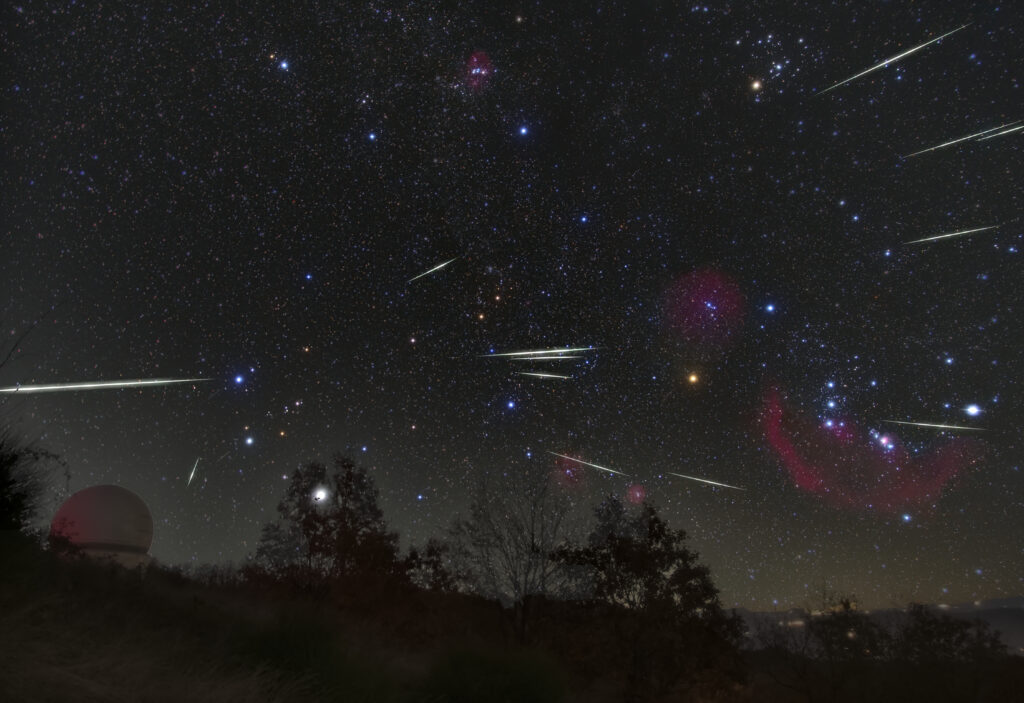
Fig. 2: Image by Davide Alboresi Lenzi, member of AAB (Associazione Astrofili Bolognesi), taken in Medelana (BO, Italy) on 14/12/2025. 355 exposures of 1 minute each, ISO 1600. F = 16 mm, f/3.5. The radiant, located near the star Castor, is positioned at the point where the photographic sequence began, that is around 19:30 local time. From that moment it rises in the sky until it passes almost at the zenith, and then descends again toward the morning.
During the predicted peak of activity of the Geminids, an initial reading of the CARMELO network data might suggest an underestimation of the activity compared to expectations. In reality, this apparent discrepancy is mainly attributable to the current geometric configuration of the receiver network.
At present, the CARMELO network shows a distribution strongly concentrated over Italian territory, with a substantially homogeneous observational point of view. This results in a sampling of the sky that is not isotropic, but strongly dependent on the reception geometry with respect to the position of the shower radiant. The international expansion of the network, currently being implemented with the entry of new observers in other European countries, will in the future allow for a more uniform coverage and a better three-dimensional reconstruction of meteor activity.
In the specific case of the Geminids, the radiant is located near the star Castor, with equatorial coordinates R.A. = 07h 34m 36s and Dec = +31° 53′ 19″. On the nights between December 12 and 14, for Italian latitudes the radiant transited the meridian at a declination close to 80°, therefore near the zenith.
The receivers currently operating within the CARMELO network have an observational field centered on average around a declination of about 40°, with an angular aperture of ±30°. As a result, the geometric sensitivity of the network to the Geminid shower was optimal during the early and late phases of the night, while it was greatly reduced around the meridian transit of the radiant, that is, during the central part of the night.
The trend of the recorded hourly rate, shown in fig. 3, reflects this configuration well: an increase is observed in the early evening hours, followed by a gradual decrease until the middle of the night, with a behavior compatible with a sinusoidal dependence on the incidence angle of the radiant with respect to the receivers’ field of view, and then a new increase toward the morning hours.
On the basis of this geometric distribution, it is possible to hypothesize that the true value of the hourly rate at the time of maximum was significantly higher than what was directly measured by the network (the arrow in fig. 3 and 4), in agreement with what has been reported by radio and visual observations on a global scale.
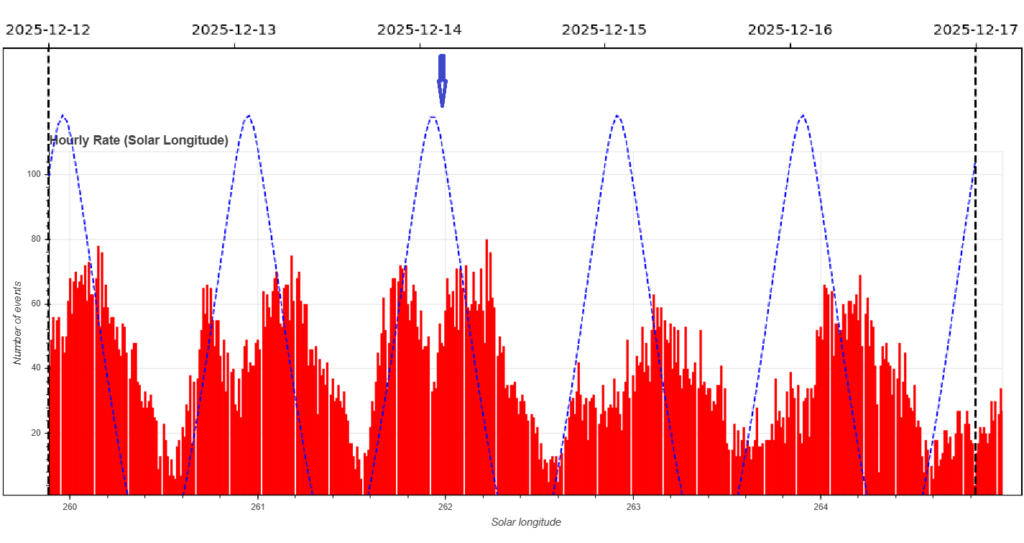
Fig. 3: Hourly rate of recorded events between December 12 and 17, as a function of solar longitude. In blue, the altitude of the radiant in the sky. The arrow indicates the likely maximum peak.
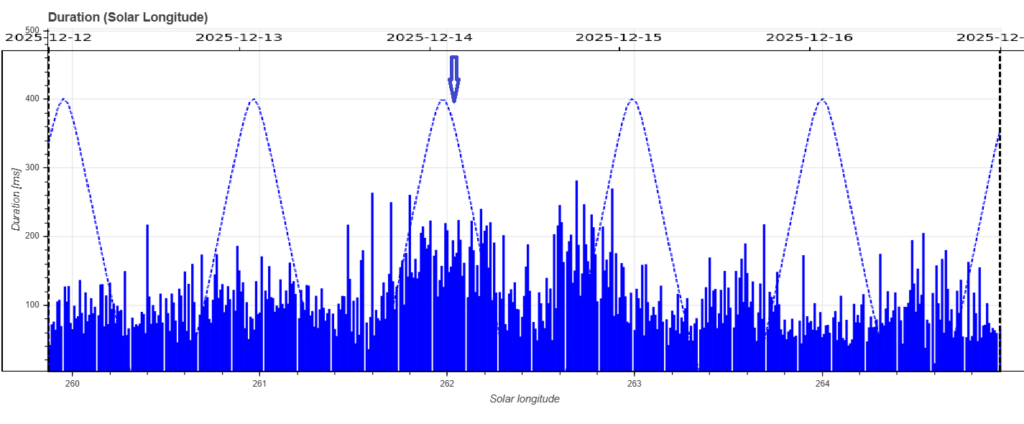
Fig. 4: Duration of the events recorded between December 12 and 17, as a function of solar longitude. In blue, the altitude of the radiant in the sky. The arrow indicates the likely maximum peak.
A comparison with 2024
This is the first bulletin of the second year of monthly reports on the activity recorded by the CARMELO network and on the qualitative analysis of the results. We can therefore proceed with a brief comparison with the results reported in the December 2024 bulletin (2).
Visually, the difference between the two graphs of the recorded hourly rates (fig. 5) is immediately evident, due not to the number of events recorded, but to the different method of temporal sampling. In 2024 the hourly rates were calculated over one-hour intervals, whereas in the last months of this year the resolution was changed to 15-minute intervals. The peaks therefore appear narrower and less averaged, but the overall intensity of the Geminid shower remains comparable to that of last year when integrated on an hourly basis (taking into account the considerations previously discussed regarding the detections).
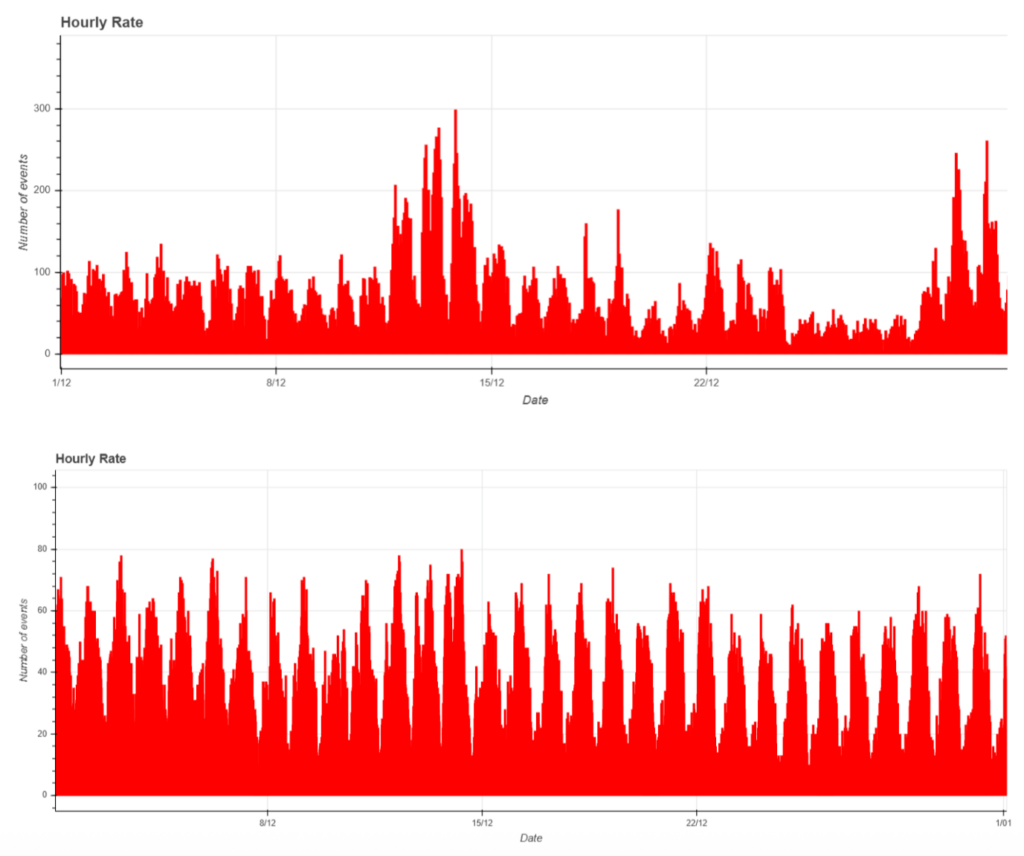
Fig. 5: Above: trend in December 2024. Below: trend in December 2025.
One element that does show a real difference compared to 2024 is the number of counts recorded in the days before and after the shower maximum (again fig. 5), largely dominated by the sporadic component. In 2025 this background is noticeably higher, mainly for three reasons:
- Increase in the number of operational stations in the network;
- Introduction of the new P5 processors in the latest-generation receivers;
- Improvement of the detection and classification algorithms in the software.
These factors have led to an increase in the overall sensitivity of the system and to a greater ability to detect weaker echoes.
The CARMELO network
The network currently consists of 14 receivers, 12 of which are operational, located in Italy, the UK, Croatia and the USA. The European receivers are tuned to the Graves radar station frequency in France, which is 143.050 MHz. Participating in the network are:
- Lorenzo Barbieri, Budrio (BO) ITA
- Associazione Astrofili Bolognesi, Bologna ITA
- Associazione Astrofili Bolognesi, Medelana (BO) ITA
- Paolo Fontana, Castenaso (BO) ITA
- Paolo Fontana, Belluno (BL) ITA
- Associazione Astrofili Pisani, Orciatico (PI) ITA
- Gruppo Astrofili Persicetani, San Giovanni in Persiceto (BO) ITA
- Roberto Nesci, Foligno (PG) ITA
- MarSEC, Marana di Crespadoro (VI) ITA
- Gruppo Astrofili Vicentini, Arcugnano (VI) ITA
- Associazione Ravennate Astrofili Rheyta, Ravenna (RA) ITA
- Mike German a Hayfield, Derbyshire UK
- Mike Otte, Pearl City, Illinois USA
The authors’ hope is that the network can expand both quantitatively and geographically, thus allowing the production of better quality data.
References
(1) Peter Jenniskens et al. (2006): “Meteor showers and their parent comets”. Cambridge University Press, 397-422
(2) Mariasole Maglione, Lorenzo Barbieri (2024): “Bollettino delle radiometeore di dicembre 2024”