By Paul Roggemans, Denis Vida, Damir Šegon, James M. Scott, Jeff Wood
Abstract: A new meteor shower in Fornax discovered in 2024 by GMN, registered by the IAU-MDC as M2024-N1 reoccurred in 2025, from a radiant at R.A. = 44.2°, Decl. = –38.2° between 30 June and 5 July. The radiant position and activity period match perfectly with the 2024 observations but the activity was less intense in 2025. The main component of this meteoroid stream consists of long period orbit but includes also a significant number of shorter period orbits.
1 Introduction
Between the 1st and 5th July 2024, the Global Meteor Network recorded 51 meteors from a radiant in the constellation of Fornax. This activity has been registered in the IAU-MDC Working List of Meteor Showers as M2024-N1 (Šegon et al., 2024). This activity had also been recorded by the CAMS network (Jenniskens, 2024). When the shower is officially confirmed by at least two independent networks, it may be nominated to be listed as an established shower.
This activity source has been detected again in 2025 with 38 M2024-N1 meteors recorded. The shower was independently observed in 2025 by 86 cameras in Australia, Brazil, Chile, New Zealand and South Africa.
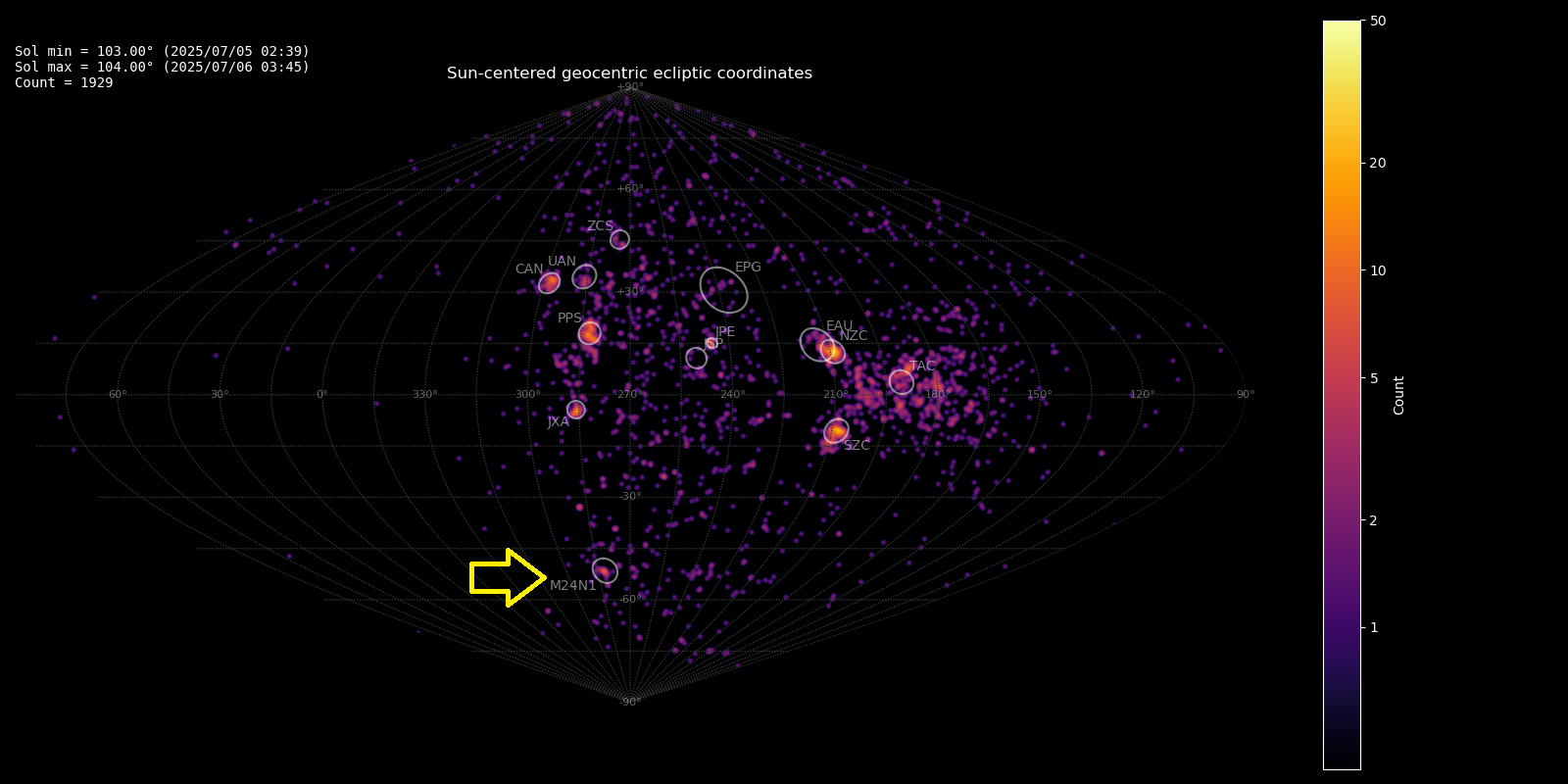
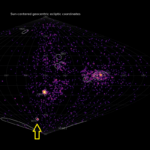
Figure 1 – Radiant density map (sinusoidal projection) with 1929 radiants obtained by the Global Meteor Network during 5–6 July, 2025. The position of the M2024-N1 radiant in Sun-centered geocentric ecliptic coordinates is marked with a yellow arrow.
2 Shower classification based on radiants
The GMN shower association criteria assume that meteors within 1° in solar longitude, within 3.5° in radiant in this case, and within 10% in geocentric velocity of a shower reference location are members of that shower. Further details about the shower association are explained in Moorhead et al. (2020). Using these meteor shower selection criteria, 38 orbits have been identified as M2024-N1 meteors in 2025.
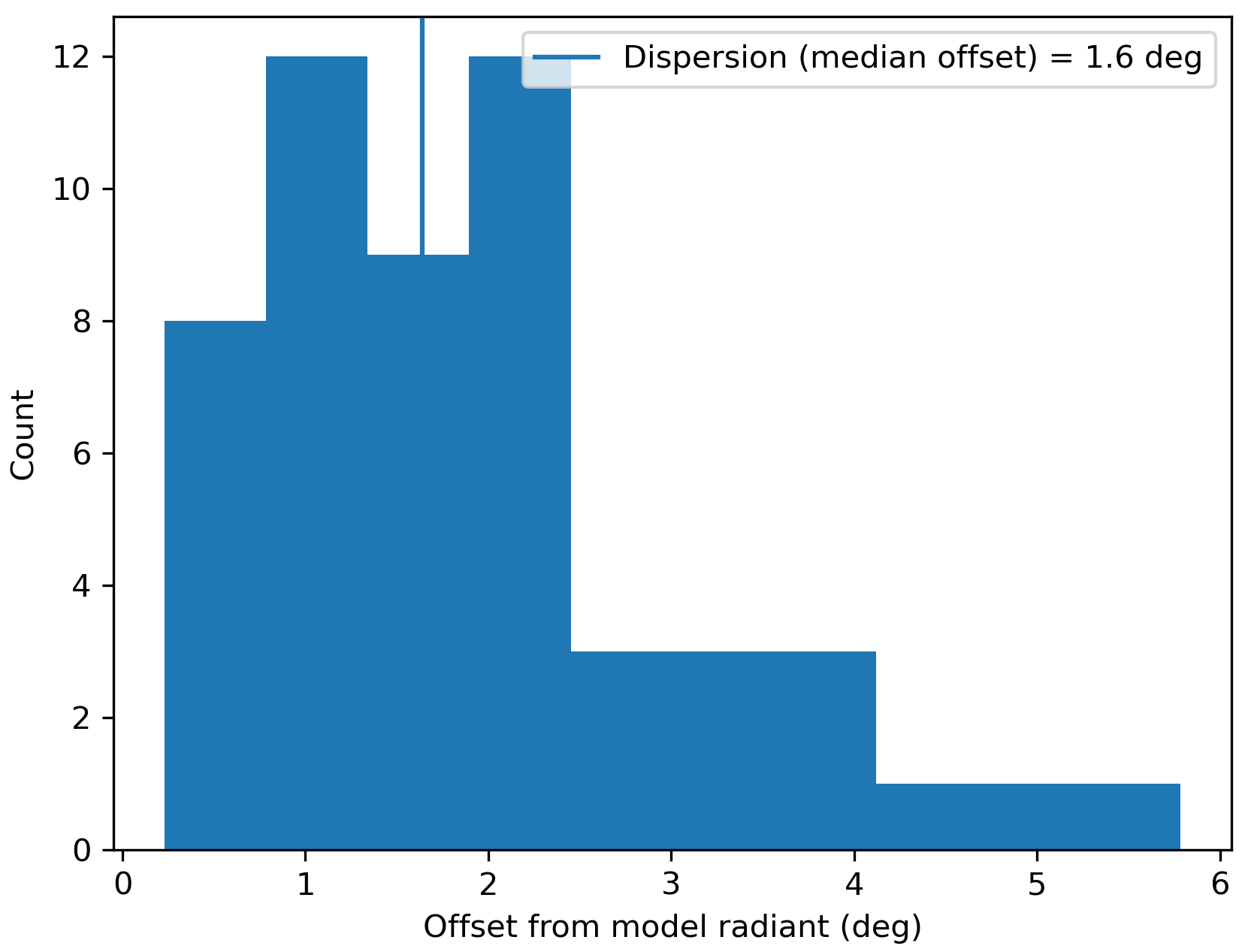
Figure 2 – Dispersion median offset on the radiant position.
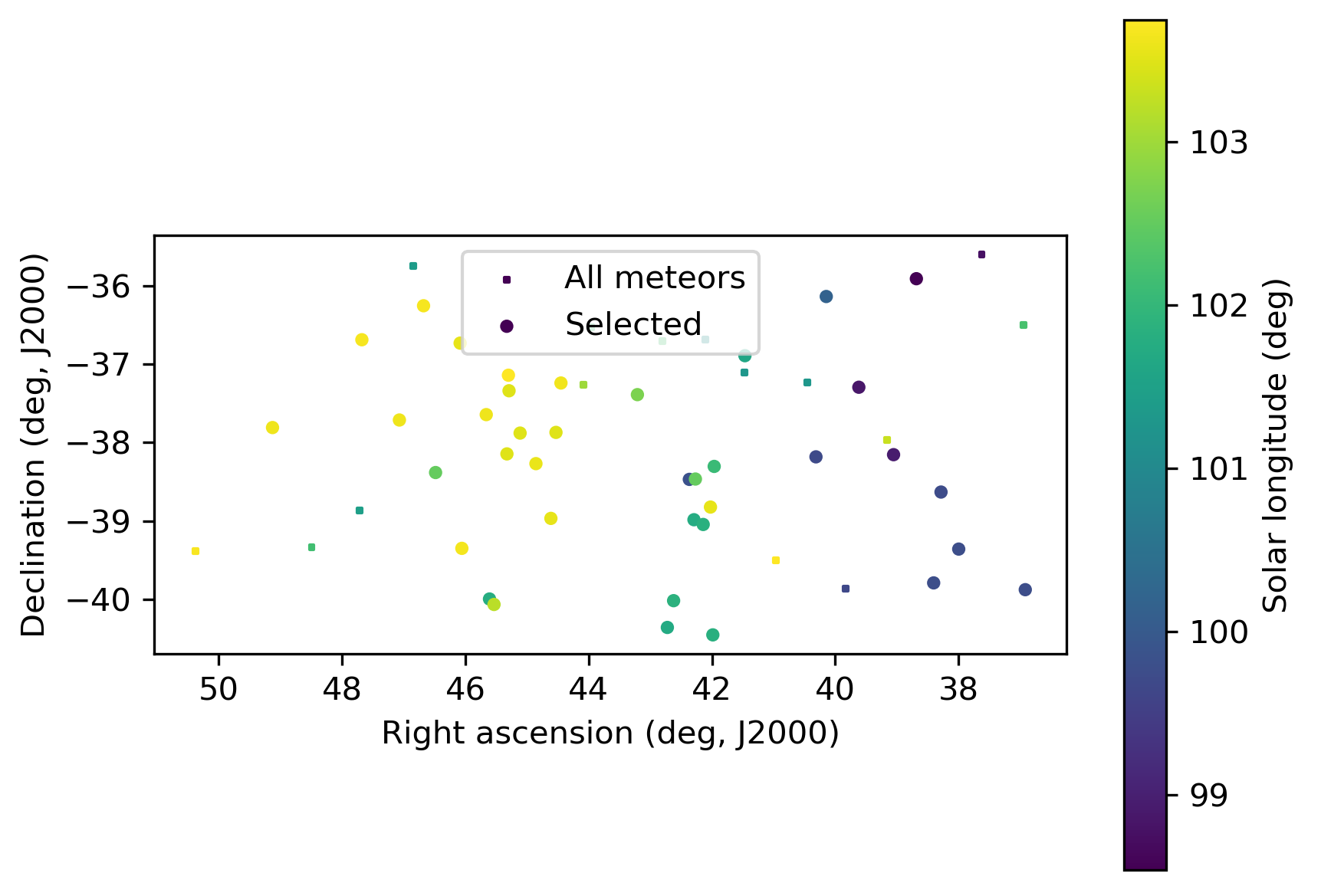
Figure 3 – The radiant distribution during the solar-longitude interval 99.0° – 104° in equatorial coordinates in 2025.
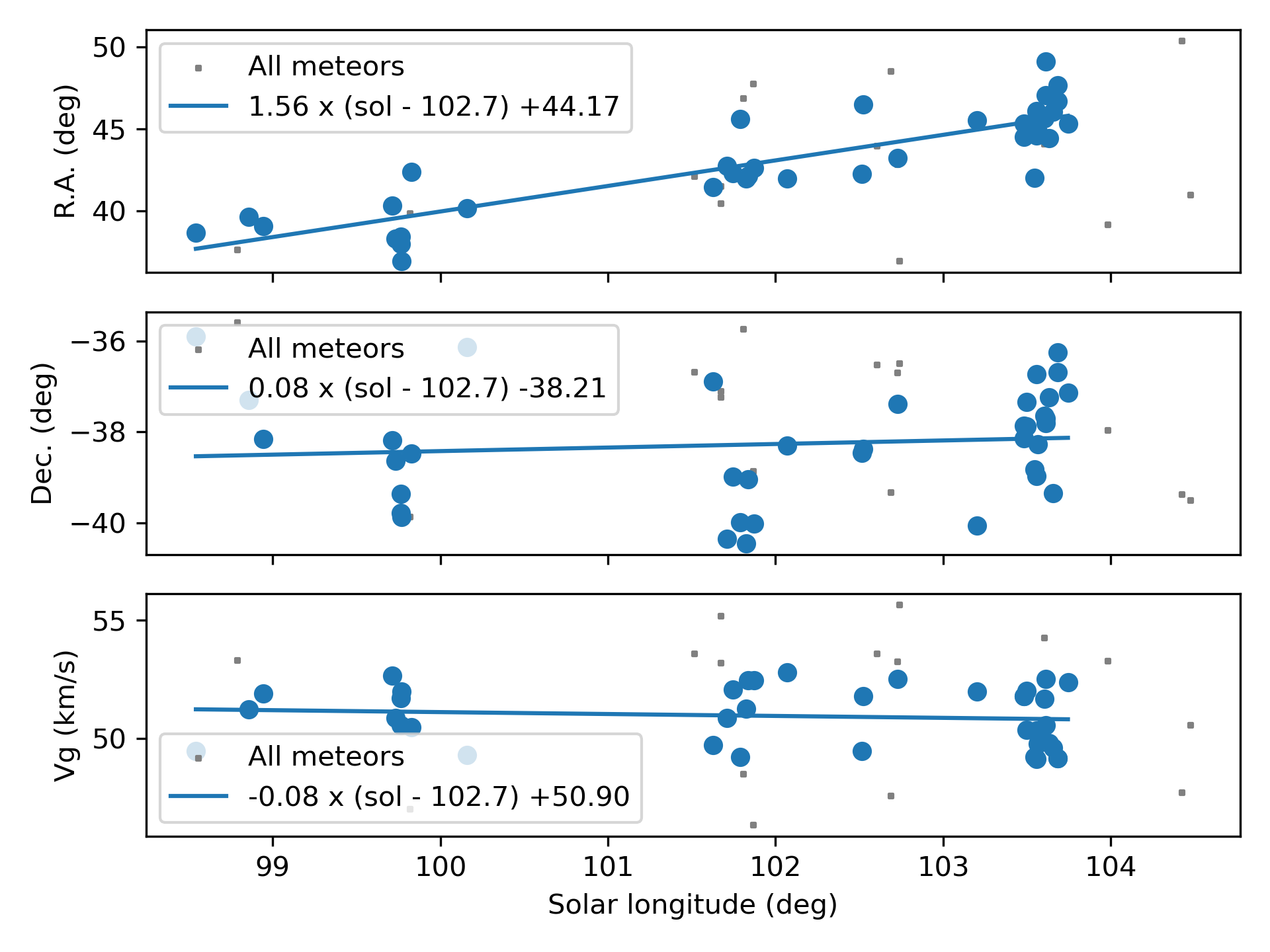
Figure 4 – The radiant drift.
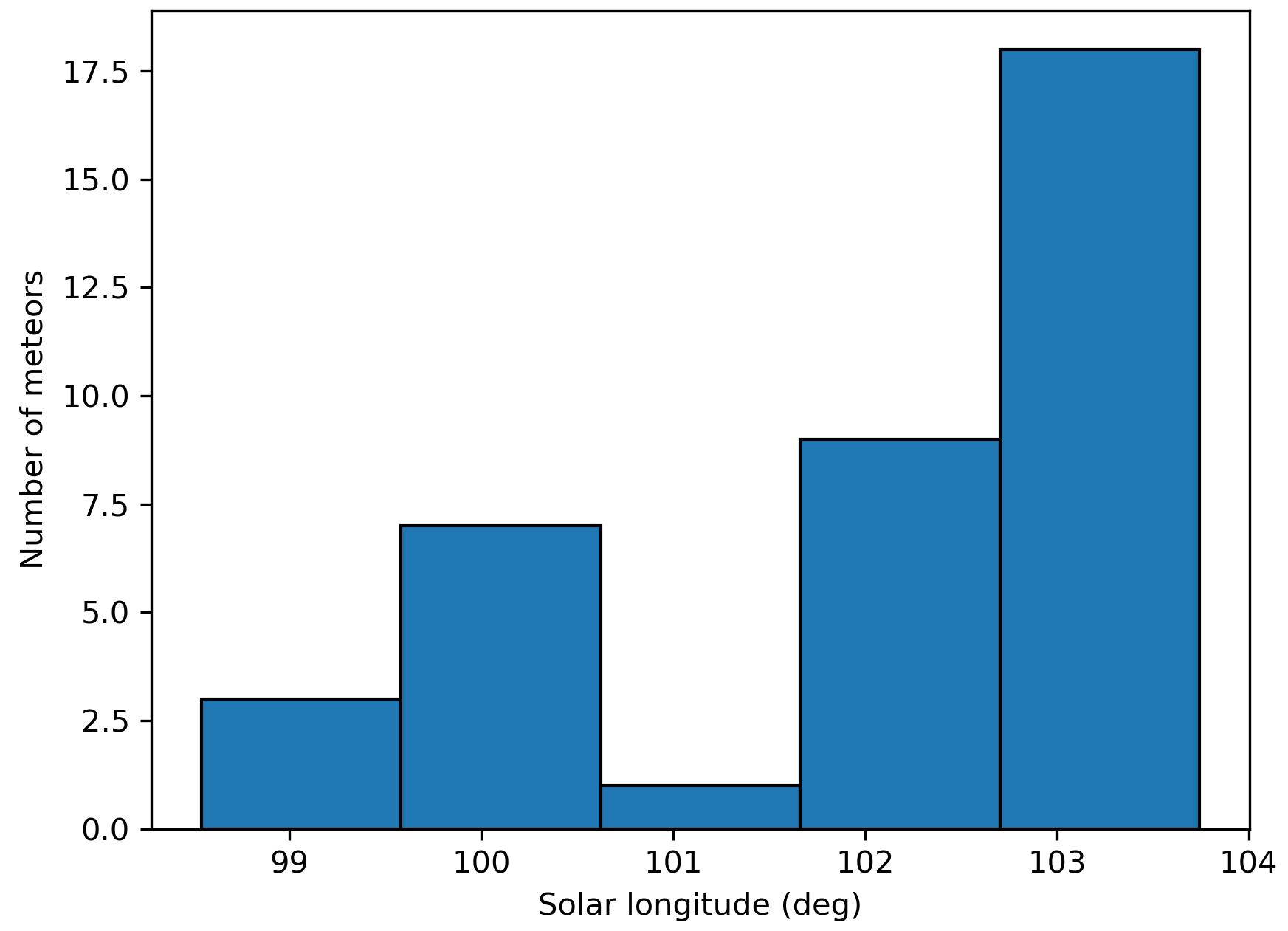
Figure 5 – The uncorrected number of M2024-N1 meteors per degree in solar longitude recorded in 2025.
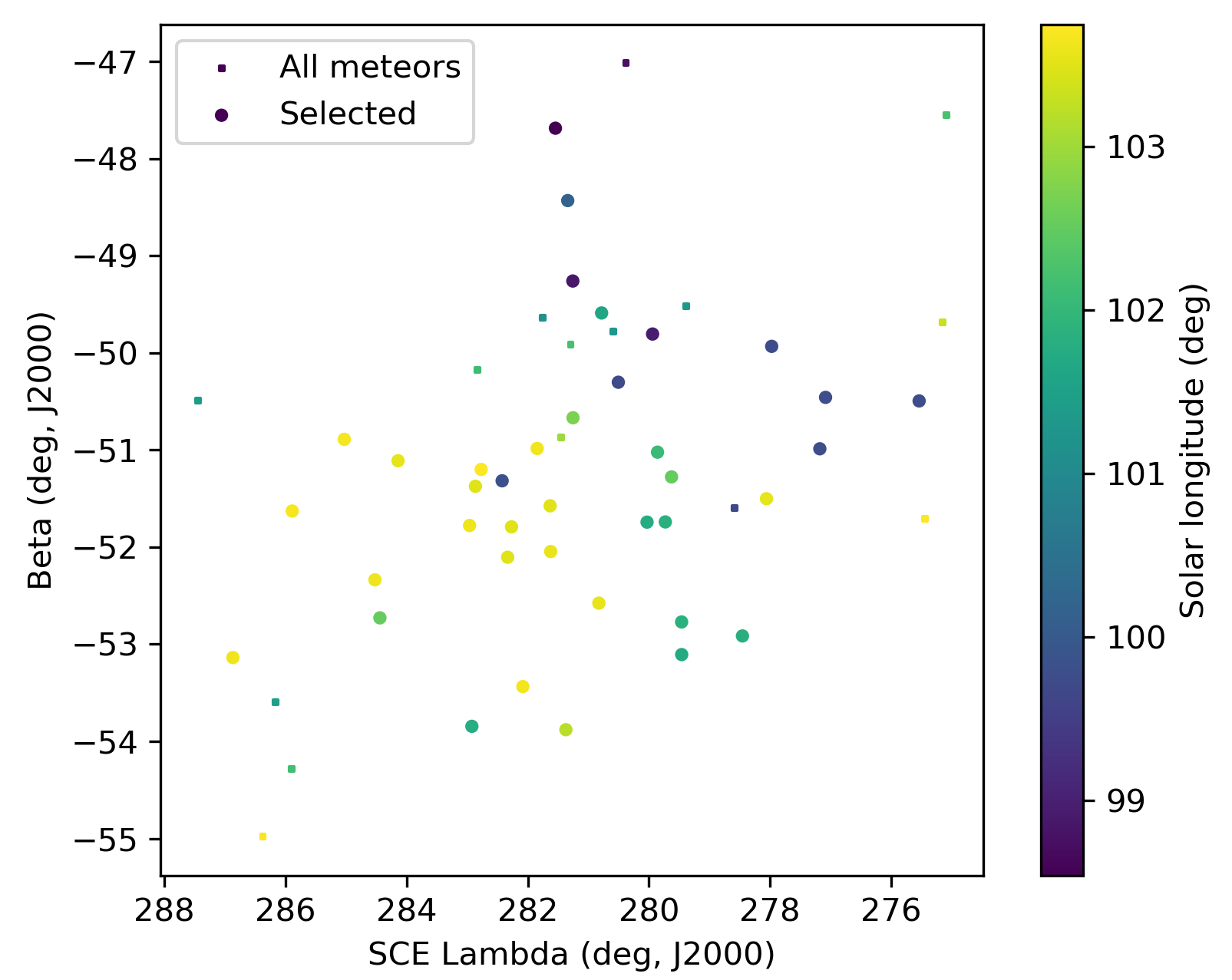
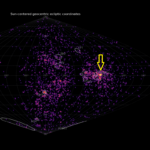
Figure 6 – The radiant distribution during the solar-longitude interval 99° – 104° in Sun centered geocentric ecliptic coordinates.
3 Shower classification based on orbits
Another method applied to classify meteor showers has been explained in Roggemans et al. (2019; 2026). Three different discrimination criteria are combined in order to have only those orbits which fit the different criteria thresholds. The D-criteria that we use are these of Southworth and Hawkins (1963), Drummond (1981) and Jopek (1993) combined. The mean orbits are computed with the method described by Jopek et al. (2006). In 2024, a cutoff value with DD < 0.06 as D-criterion threshold. In 2025, this cutoff value was reduced to DD < 0.05 since last year’s cutoff proved to be too tolerant.
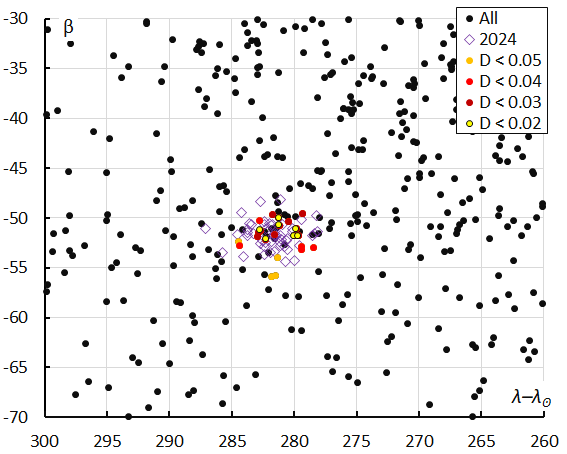
Figure 7 – The radiant distribution during the solar-longitude interval 99° – 104° in Sun centered geocentric ecliptic coordinates. Comparing the 2024 and 2025 results based on orbit identification.
The results obtained by the two methods for both years are listed in Table 1.
Table 1 – Comparing solutions for 2025 and 2024 derived by two different methods, GMN-method based on radiant positions and orbit association for DD < 0.05 in 2025, DD < 0.06 in 2024.
| 2025 | 2024 | ||
| GMN | DD < 0.05 | DD < 0.06 | |
| λʘ (°) | 102.5 | 102.7 | 102.78 |
| λʘb (°) | 98.5 | 99.7 | 100.02 |
| λʘe (°) | 103.8 | 103.8 | 103.98 |
| αg (°) | 44.2 ± 0.3 | 46.6 ± 2.1 | 44.04 ± 1.6 |
| δg (°) | –38.2 ± 0.2 | –38.2 ± 1.5 | –38.3 ± 1.3 |
| Δαg (°) | +1.56 ± 0.15 | +1.80 | +0.63 |
| Δδg (°) | +0.08 ± 0.12 | –0.02 | +0.47 |
| vg (km/s) | 50.9 ± 0.2 | 52.2 ± 1.0 | 51.7 ± 1.0 |
| Hb (km) | 107.4 ± 4.2 | 109.2 ± 3.4 | 109.0 ± 2.8 |
| He (km) | 96.7 ± 5.9 | 92.9 ± 6.1 | 94.3 ± 4.8 |
| Hp (km) | 101.1 ± 5.6 | 101.6 ± 5.2 | 101.2 ± 4.3 |
| MagAp | –0.7 | –1.5 | –0.9 |
| λg (°) | 24.5 ± 0.4 | 24.3 ± 1.4 | 24.24 ± 2.0 |
| λg – λʘ (°) | 281.8 ± 0.4 | 281.5 ± 1.6 | 281.64 ± 1.8 |
| βg (°) | –51.7 ± 0.2 | –51.7 ± 1.7 | –51.72 ± 1.3 |
| a (A.U.) | 7.6 ± 0.08 | 44.5 | 18.3 |
| q (A.U.) | 0.988 ± 0.011 | 0.991 ± 0.007 | 0.988 ± 0.009 |
| e | 0.871 ± 0.113 | 0.978 ± 0.037 | 0.946 ± 0.056 |
| i (°) | 92.7 ± 1.8 | 93.1 ± 2.5 | 92.7 ± 2.0 |
| ω (°) | 341.1 ± 4.3 | 342.3 ± 2.5 | 340.73 ± 3.0 |
| Ω (°) | 282.1 ± 1.7 | 282.6 ± 1.0 | 282.86 ± 0.8 |
| Π (°) | 263.1 ± 4.3 | 264.9 ± 2.3 | 263.9 ± 3.1 |
| Tj | 0.63 ± 0.60 | 0.05 | 0.23 |
| N | 38 | 22 | 51 |
The shower classification and the orbit classification methods agree on the radiant position but differ in eccentricity. The iterations to locate the best fitting mean orbit for the concentration of orbits converge on a selection of orbits with slightly faster geocentric velocity vg, which drastically affects the eccentricity e and semi-major axis a. The uncertainty on the eccentricity derived from the radiant classification method is unusually large. Sorting the dataset on the heliocentric velocity vh shows that 21 of the 38 meteors selected by the radiant classification method had vh < 41 km/s. All these orbits failed to fit the threshold of the similarity criteria and were rejected as outliers by the orbit selection method. The orbit classification method selected only meteors with vh > 41 km/s with a larger spread in radiant position than permitted for the radiant classification method but with a small uncertainty on the eccentricity.
Methods for distinguishing shower meteors always risks some contamination with sporadic meteors that share the same radiant position. In this particular case, it seems that there is a source with a slightly slower velocity and shorter period orbits that fits the radiant classification method but fails to fit with the orbit classification criteria. Therefore, the result of the orbit classification method has here been chosen as the solution for M2024-N1 for 2025.
4 Orbit and parent body
Comparing the diagrams of inclination and eccentricity versus longitude of perihelion in 2024 and in 2025 (Figures 8 and 9), it is evident that a large dispersion in eccentricity appeared for 2024 when a threshold cutoff of DD < 0.06 was used. This value appears to have been too tolerant.
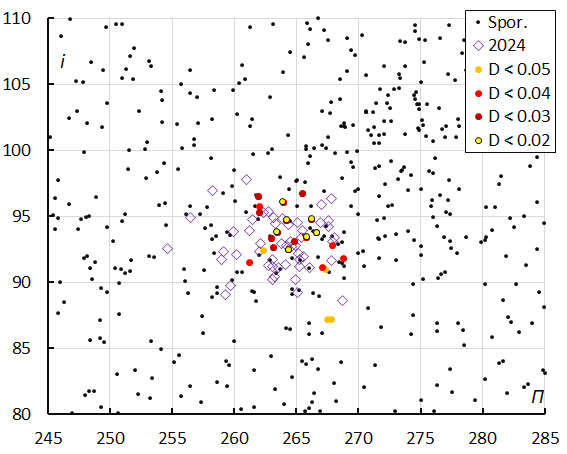
Figure 8 – The diagram of the inclination i versus the longitude of perihelion Π color-coded for different classes of D criteria thresholds, for λʘ between 99° and 104°.

Figure 9 – The diagram of the eccentricity e versus the longitude of perihelion Π color-coded for different classes of D criteria thresholds, for λʘ between 99° and 104°.
The Tisserand’s parameter relative to Jupiter depends mainly upon the semi-major axis. Both values, Tj = 0.23 in 2024 and Tj = 0.05 in 2025, identify the orbit as of a Long Period Comet type orbit. The result of the radiant classification method with Tj = 0.63 also suggests a Long Period Comet type orbit, despite the presence of the many short period orbits. A parent body search did not return any known object with a similar orbit.
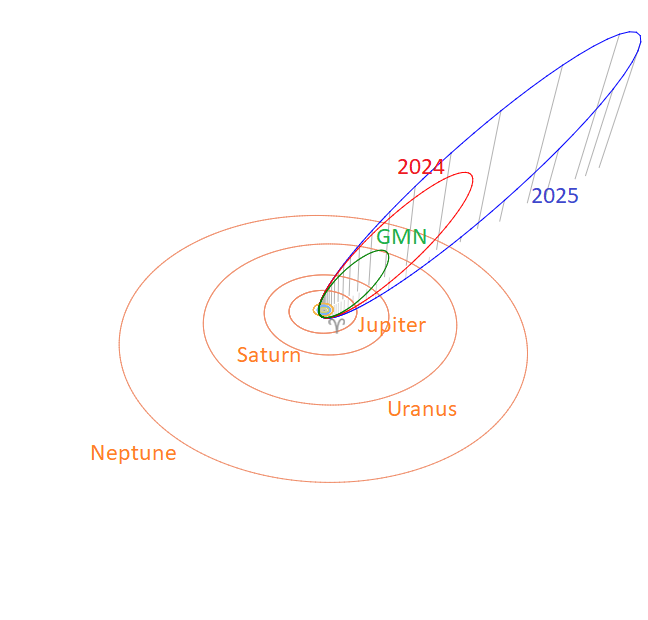
Figure 10 – Comparing the solutions for M2024-N1 in 2025 (blue), in 2024 (red) and the radiant classification method in 2025 (green). (Plotted with the Orbit visualization app provided by Pető Zsolt).
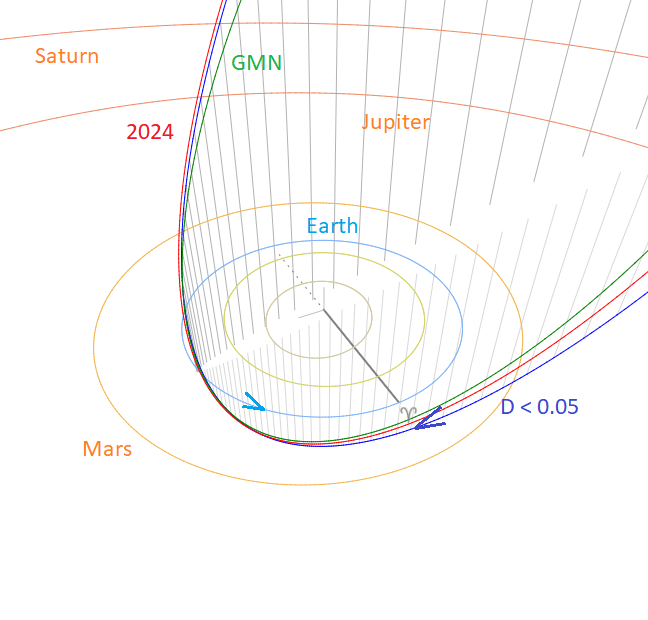
Figure 11 – Comparing the solutions for M2024-N1 in 2025 (blue), in 2024 (red) and the radiant classification solution in 2025 (green), close-up at the inner Solar System. (Plotted with the Orbit visualization app provided by Pető Zsolt).
The M2024-N1 meteor shower consists mainly of very long period orbits with a substantial number of shorter period orbits dispersed inside the main long period component. Figure 10 shows the large difference in aphelia. An error margin of ±0.02 on eccentricities with e > 0.95 results in large uncertainties on semi-major axis a and aphelion distance Q as:
Where q is the perihelion distance. This explains why the aphelion distance Q is not a relevant parameter in this case.
The iterative procedure to locate the most representative mean orbit converged at a very long period orbit in 2025 (blue in Figures 10 and 11) with as similarity thresholds DSH < 0.125 & DD < 0.05 & DJ < 0.125. In 2024 the analysis was done with DSH < 0.15 & DD < 0.06 & DJ < 0.15, which resulted in shorter period orbits. No radiant classification method has been applied in 2024. In 2025 the radiant classification method identifies all long and short period orbits that fit the radiant and velocity selection criteria, resulting in a very large spread on the mean eccentricity. The orbit classification method only looks at the orbit similarity and results in a larger spread in the radiant position. The occurrence of many short period orbits within the main component of long period orbits may indicate an old dust population in which particles gradually loose energy due to different physical processes forcing the dust onto shorter period orbits towards the Sun.
Question is how do we define a meteoroid stream by its radiant and orbit with such a large dispersion in eccentricity? A solution here could be to use the heliocentric velocity instead of the geocentric velocity to filter away outliers that cause the large spread on the eccentricity. In that case we ignore the dust that evolved onto the shorter period orbits inside the main component. Another solution would be to add the error margins on the orbital parameters to indicate the degree of dispersion of the meteor shower.
Zooming in at the orbits in the inner Solar System we see that the three solutions look almost identical, longitude of perihelion, perihelion distance, node and inclination all agree very well (Figure 11). The M2024-N1 meteoroid stream encounters the Earth at its ascending node on a steep retrograde orbit, almost perpendicular to the ecliptic plane.
5 Conclusion
Global Meteor Network cameras confirmed activity from the M2024-N1 meteor shower radiant in Fornax in 2025. As this meteor shower had been independently published by the CAMS network in 2024 (Jenniskens, 2024), reporting of the CAMS solution for this activity to the IAU-MDC would qualify this shower to be listed as a candidate established shower. We trust it is only a matter of time before this M2024-N1 will be confirmed by an independent network.
Acknowledgments
This report is based on the data of the Global Meteor Network (Vida et al., 2020a; 2020b; 2021) which is released under the CC BY 4.0 license. We thank all 825 participants in the Global Meteor Network project for their contribution and perseverance. A list with the names of the volunteers who contribute to GMN has been published in the 2024 annual report (Roggemans et al., 2025). The following 175 cameras contributed to the M2024-N1 discovery in 2024–2025 : AU0002, AU0003, AU000A, AU000B, AU000C, AU000D, AU000F, AU000Q, AU000R, AU000S, AU000V, AU000W, AU000X, AU000Y, AU001A, AU001B, AU001C, AU001E, AU001F, AU001P, AU001Q, AU001R, AU001S, AU001V, AU001W, AU001X, AU001Y, AU001Z, AU0029, AU002A, AU0030, AU0031, AU0035, AU0038, AU003A, AU003F, AU003H, AU003K, AU0040, AU0042, AU0046, AU0047, AU004L, AU004M, BR0001, BR000G, BR000W, BR001F, BR001M, CL0002, CL0003, NZ0003, NZ0004, NZ0007, NZ0008, NZ000B, NZ000D, NZ000F, NZ000G, NZ000N, NZ000Q, NZ000T, NZ000V, NZ000X, NZ000Y, NZ000Z, NZ0010, NZ0012, NZ0013, NZ0014, NZ0015, NZ0016, NZ0017, NZ0018, NZ0019, NZ001A, NZ001B, NZ001C, NZ001F, NZ001G, NZ001H, NZ001J, NZ001L, NZ001N, NZ001P, NZ001Q, NZ001R, NZ001S, NZ001W, NZ001X, NZ001Y, NZ001Z, NZ0020, NZ0022, NZ0023, NZ0024, NZ0026, NZ0027, NZ0028, NZ0029, NZ002B, NZ002C, NZ002E, NZ002F, NZ002G, NZ002H, NZ002K, NZ002L, NZ002N, NZ002P, NZ002Q, NZ002R, NZ002S, NZ002T, NZ002V, NZ002W, NZ002X, NZ002Y, NZ002Z, NZ0030, NZ0032, NZ0033, NZ0034, NZ0036, NZ0037, NZ0038, NZ0039, NZ003A, NZ003C, NZ003E, NZ003F, NZ003G, NZ003H, NZ003K, NZ003N, NZ003R, NZ003S, NZ003T, NZ003U, NZ003V, NZ003W, NZ003X, NZ003Y, NZ003Z, NZ0040, NZ0041, NZ0042, NZ0044, NZ0045, NZ0046, NZ0049, NZ004A, NZ004B, NZ004C, NZ004D, NZ004E, NZ004J, NZ004L, NZ004M, NZ004N, NZ004R, NZ004S, NZ004T, NZ004U, NZ004V, NZ004X, NZ0051, NZ0059, NZ005D, NZ005Y, NZ005Z, ZA0002, ZA0007, ZA0008 and ZA000C.
References
Drummond J. D. (1981). “A test of comet and meteor shower associations”. Icarus, 45, 545–553.
Jenniskens P. (2024). “Psi-Fornacid meteors 2024”. CBET 5415, 2024 July 15, editor D.W.E. Green.
Jopek T. J. (1993). “Remarks on the meteor orbital similarity D-criterion”. Icarus, 106, 603–607.
Jopek T. J., Rudawska R. and Pretka-Ziomek H. (2006). “Calculation of the mean orbit of a meteoroid stream”. Monthly Notices of the Royal Astronomical Society, 371, 1367–1372.
Moorhead A. V., Clements T. D., Vida D. (2020). “Realistic gravitational focusing of meteoroid streams”. Monthly Notices of the Royal Astronomical Society, 494, 2982–2994.
Roggemans P., Johannink C. and Campbell-Burns P. (2019). “October Ursae Majorids (OCU#333)”. eMetN Meteor Journal, 4, 55–64.
Roggemans P., Campbell-Burns P., Kalina M., McIntyre M., Scott J. M., Šegon D., Vida D. (2025). “Global Meteor Network report 2024”. eMetN Meteor Journal, 10, 67–101.
Šegon D., Vida D., Roggemans P. (2024a). “Psi-Fornacid meteors 2024 = M2024-N1”. CBET 5416; 2024 July 16, editor D. W. E. Green.
Šegon D., Vida D., Roggemans P., Rollinson D., Scott J.M. (2024b). “New meteor shower in Fornax”. eMetN Meteor Journal, 9, 279–285.
Southworth R. B. and Hawkins G. S. (1963). “Statistics of meteor streams”. Smithsonian Contributions to Astrophysics, 7, 261–285.
Vida D., Gural P., Brown P., Campbell-Brown M., Wiegert P. (2020a). “Estimating trajectories of meteors: an observational Monte Carlo approach – I. Theory”. Monthly Notices of the Royal Astronomical Society, 491, 2688–2705.
Vida D., Gural P., Brown P., Campbell-Brown M., Wiegert P. (2020b). “Estimating trajectories of meteors: an observational Monte Carlo approach – II. Results”. Monthly Notices of the Royal Astronomical Society, 491, 3996–4011.
Vida D., Šegon D., Gural P. S., Brown P. G., McIntyre M. J. M., Dijkema T. J., Pavletić L., Kukić P., Mazur M. J., Eschman P., Roggemans P., Merlak A., Zubrović D. (2021). “The Global Meteor Network – Methodology and first results”. Monthly Notices of the Royal Astronomical Society, 506, 5046–5074.