By Paul Roggemans, Denis Vida, Damir Šegon, James M. Scott and Jeff Wood
Abstract: A new meteor shower in Hercules that was discovered in 2024 by GMN and registered by the IAU-MDC as M2024-H1 reoccurred in 2025, from a radiant at R.A. = 261.5°, Decl. = +47.7°. The radiant position and activity period match perfectly with the 2024 observations but the activity was less intense in 2025 and the recorded meteors had a slightly slower geocentric velocity than in 2024. No relevant activity from this shower has been found in previous year’s meteor orbit datasets.
1 Introduction
On 27 April 2024 the Global Meteor Network recorded 32 meteors in a short time interval between 20h00m–23h40m UTC (37.70° to 37.85° in solar longitude) from a radiant in the constellation of Hercules. This short outburst has been registered in the IAU-MDC Working List of Meteor Showers as M2024-H1 (Vida and Šegon, 2024).
This activity source has been detected again in 2025 although only sixteen M2024-H1 meteors were recorded, half of the total number recorded in 2024. The shower was independently observed in 2025 by 58 cameras in Australia, Belgium, Canada, Croatia, Czechia, Germany, Hungary, Italy, Netherlands, Portugal, Spain, United Kingdom and United States.
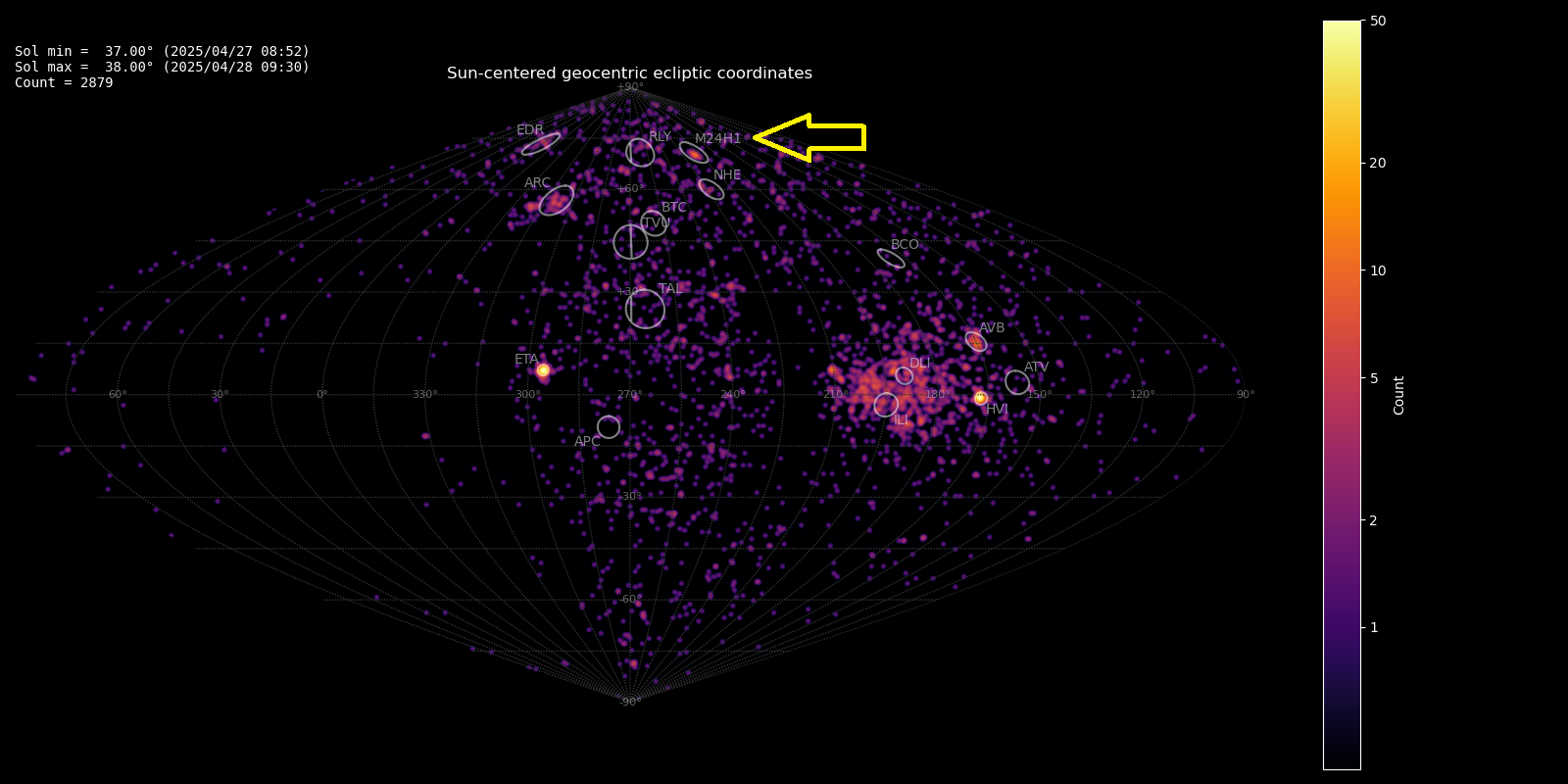
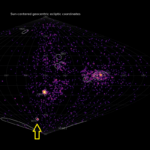
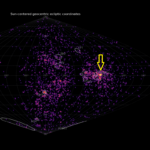
Figure 1 – Radiant density map (sinusoidal projection) with 2879 radiants obtained by the Global Meteor Network during 27–28 April, 2025. The position of the M2024-H1 radiant in Sun-centered geocentric ecliptic coordinates is marked with a yellow arrow.
2 Shower classification based on radiants
The GMN shower association criteria assume that meteors within 1° in solar longitude, within 1.2° in radiant in this case, and within 10% in geocentric velocity of a shower reference location are members of that shower. Further details about the shower association are explained in Moorhead et al. (2020). Using these meteor shower selection criteria, 16 orbits have been identified as M2024-H1 meteors.

Figure 2 – Dispersion median offset on the radiant position.
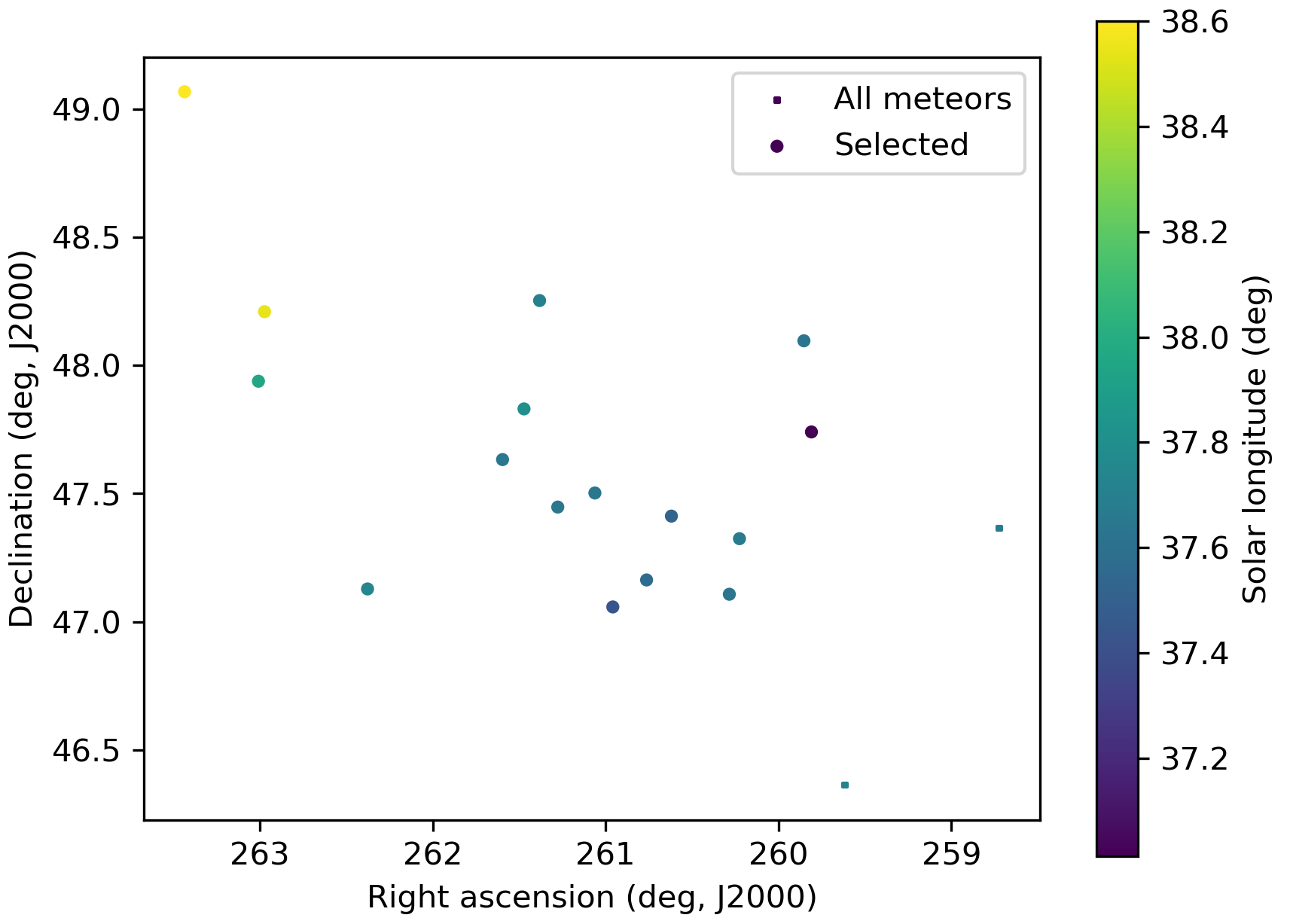
Figure 3 – The radiant distribution during the solar-longitude interval 37.0° – 38.6° in equatorial coordinates.
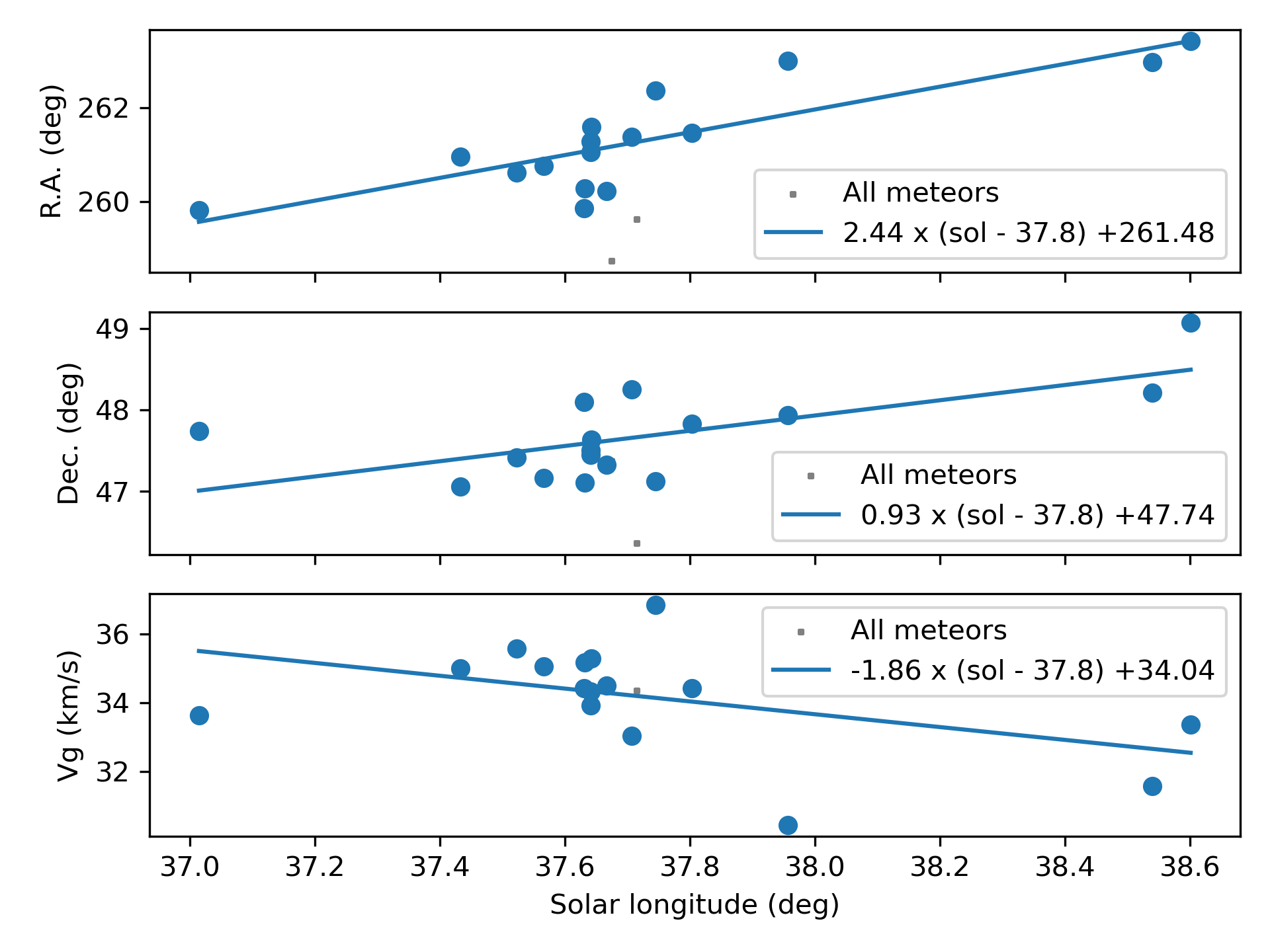
Figure 4 – The radiant drift.
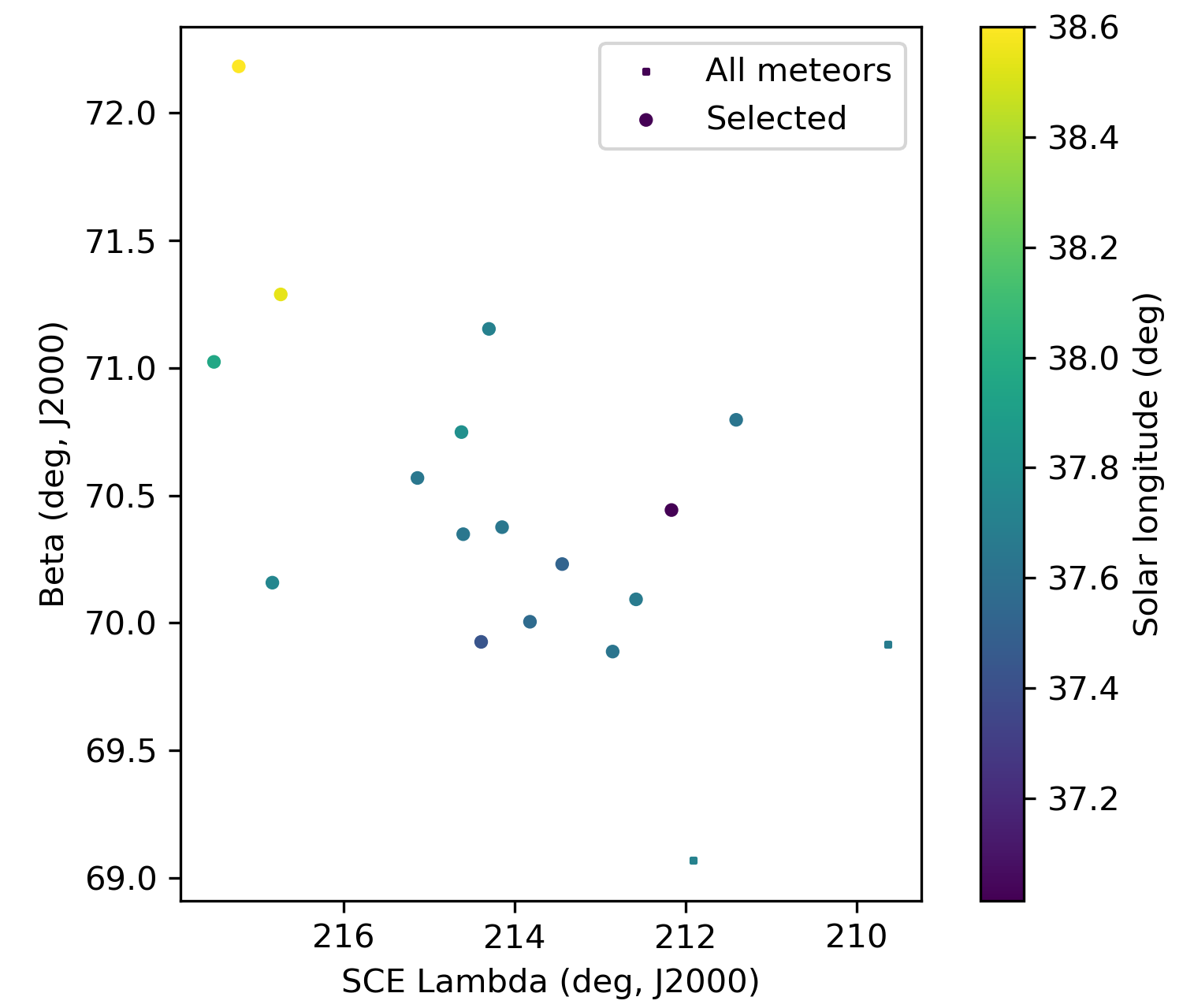
Figure 5 – The radiant distribution during the solar-longitude interval 37.0° – 38.6° in Sun centered geocentric ecliptic coordinates.
Table 1 – Comparing solutions for 2025 and 2024 derived by two different methods, GMN-method based on radiant positions and orbit association for DD < 0.04.
| 2025 | 2024 | |||
| GMN | DD < 0.04 | GMN | DD < 0.04 | |
| λʘ (°) | 37.8 | 37.6 | 37.78 | 37.81 |
| λʘb (°) | 37.0 | 36.6 | 37.71 | 37.71 |
| λʘe (°) | 39.0 | 38.8 | 37.85 | 37.86 |
| αg (°) | 261.5 | 260.0 | 261.0 | 260.9 |
| δg (°) | +47.7 | +47.3 | +47.5 | +47.4 |
| Δαg (°) | +2.44 | – | – | – |
| Δδg (°) | +0.93 | – | – | – |
| vg (km/s) | 34.0 | 34.4 | 35.5 | 35.6 |
| Hb (km) | 103.6 | 103.2 | 104.3 | 105.1 |
| He (km) | 93.5 | 90.8 | 92.3 | 91.2 |
| Hp (km) | 100.0 | 98.5 | 99.1 | 98.7 |
| MagAp | –0.2 | –0.3 | –0.5 | –0.7 |
| λg (°) | 252.52 | 249.9 | 251.7 | 251.3 |
| λg – λʘ (°) | 214.72 | 212.4 | 213.9 | 213.6 |
| βg (°) | +70.66 | +70.0 | +70.3 | +70.2 |
| a (A.U.) | 8.344 | 10.9 | 32.2 | 29.3 |
| q (A.U.) | 0.954 | 0.948 | 0.963 | 0.953 |
| e | 0.886 | 0.913 | 0.9701 | 0.968 |
| i (°) | 54.30 | 53.7 | 55.6 | 55.8 |
| ω (°) | 207.1 | 208.2 | 206.7 | 206.9 |
| Ω (°) | 37. 7 | 37.6 | 37.8 | 37.8 |
| Π (°) | 244.8 | 245.8 | 244.5 | 244.7 |
| Tj | 1.31 | 1.40 | 0.84 | 0.85 |
| N | 16 | 20 | 32 | 24 |
3 Shower classification based on orbits
Another method applied to classify meteor showers has been explained in Roggemans et al. (2019; 2026). Three different discrimination criteria are combined in order to have only those orbits which fit the different criteria thresholds. The D-criteria that we use are these of Southworth and Hawkins (1963), Drummond (1981) and Jopek (1993) combined. The mean orbits are computed with the method described by Jopek et al. (2006). The Rayleigh distribution fit of 2024 indicated that a cutoff value is required with DD < 0.04 as D-criterion threshold.
The results obtained by the two methods for both years are listed in Table 1.
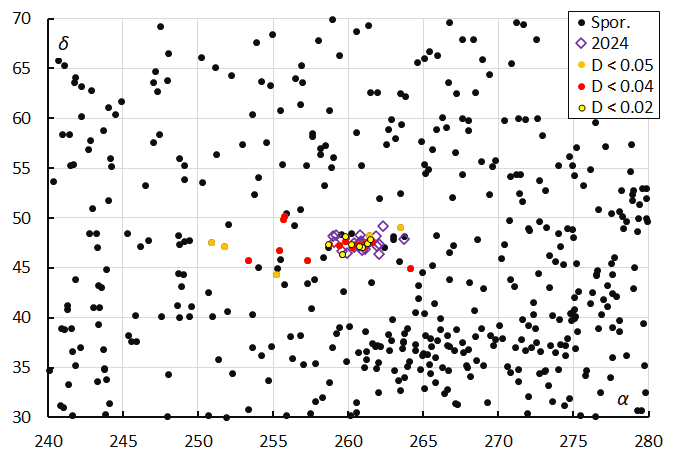
Figure 6 – The radiant distribution during the solar-longitude interval 36° – 39° in equatorial coordinates, color-coded for different threshold values of the DD orbit similarity criterion.
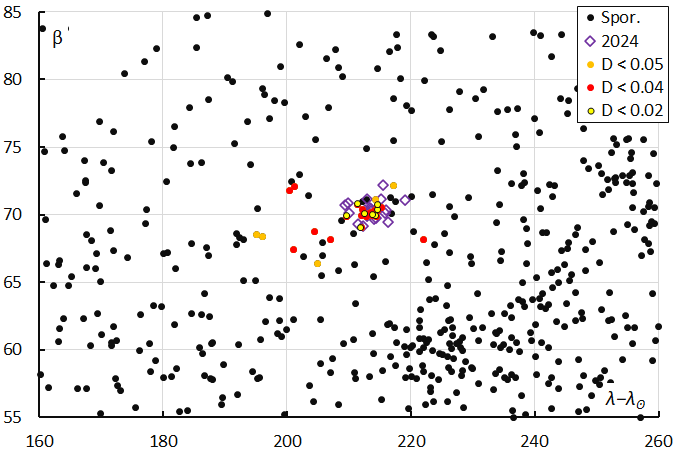
Figure 7 – The radiant distribution during the solar-longitude interval 36° – 39° in Sun-centered geocentric ecliptic coordinates, color-coded for different threshold values of the DD orbit similarity criterion.
Comparing the radiant positions obtained in 2024 and 2025, we see that the radiant was very compact in 2024 and more dispersed in 2025. For 2025, three different D-criteria thresholds are shown, but for 2024 only the class with DSH < 0.1 & DD < 0.04 & DJ < 0.1 has been plotted. In equatorial coordinates (Figure 6) the radiant appears elongated due to the radiant drift in Right Ascension. Figure 7 shows the radiant in Sun-centered ecliptic coordinates where the radiant drift due to the Earth’s own motion is compensated, but also here some more scattered radiant points appear for 2025.
4 Orbit and parent body
Looking at the diagram of inclination versus longitude of perihelion, we can see a dense concentration for 2024 at slighter higher inclination than in 2025 when the points appear more dispersed (Figure 8). The diagram of eccentricity versus longitude of perihelion shows a remarkable offset in eccentricity between the data points of 2024 and 2025 (Figure 9). The inclination appears also slightly lower and more dispersed in 2025 compared to 2024, the perihelion distance remained stable (Figure 10).
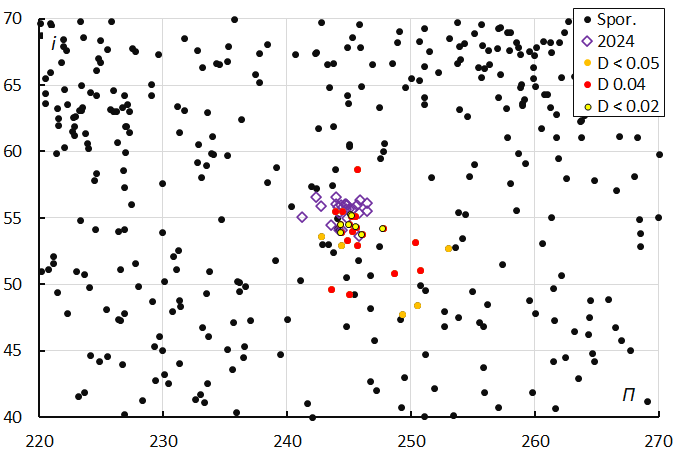
Figure 8 – The diagram of the inclination i versus the longitude of perihelion Π color-coded for different classes of D criteria thresholds, for λʘ between 36° and 39°.
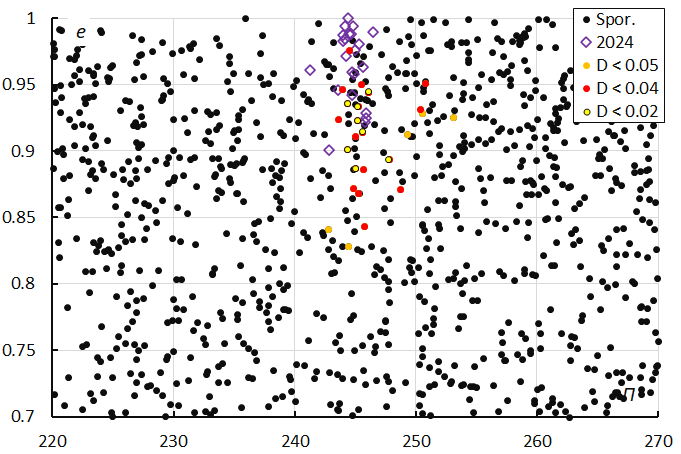
Figure 9 – The diagram of the eccentricity e versus the longitude of perihelion Π color-coded for different classes of D criteria thresholds, for λʘ between 36° and 39°.
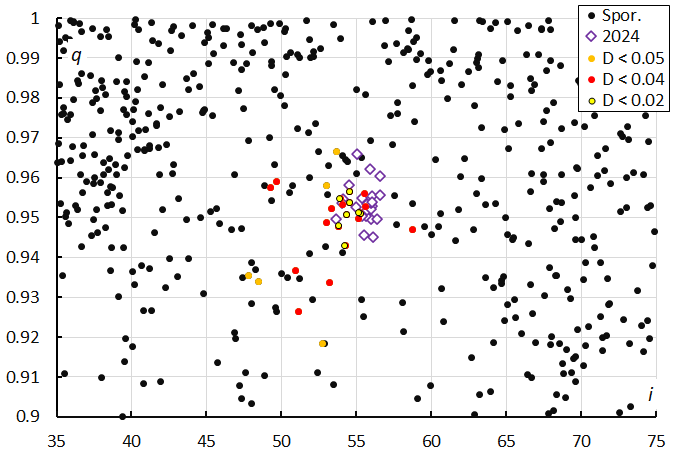
Figure 10 – The diagram of the perihelion distance q versus the inclination i color-coded for different classes of D criteria threshold, for λʘ between 36° and 39°.

Figure 11 – Comparing the GMN solution for M2024-H1 in 2025 (blue) and in 2024 (red). (Plotted with the Orbit visualization app provided by Pető Zsolt).
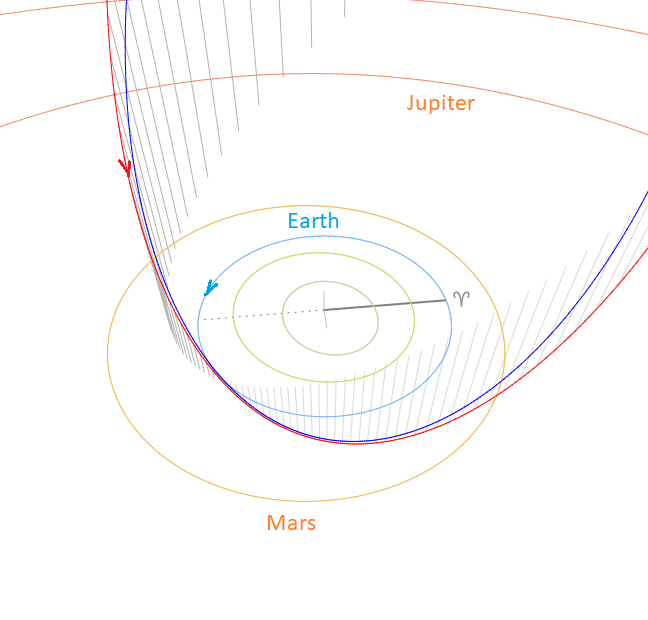
Figure 12 – Comparing the GMN solution for M2024-H1 in 2025 (blue) and in 2024 (red), close-up at the inner Solar System. (Plotted with the Orbit visualization app provided by Pető Zsolt).
The M2024-H1 meteoroids recorded in 2025 appeared less concentrated and with a slower geocentric velocity than in 2024 (see Table 1). The difference in velocity affects the orbital elements that are most sensitive for differences in velocity like the semi-major axis a, the eccentricity e and to less extend the inclination i. The radiant positions agree very well for both years, but the mean orbits in the solar system differ. There is no clear explanation for this and it looks like the dust encountered in 2025 was situated far inside the 2024 orbit. Figure 11 shows the significant difference in semi-major axis. Figure 12 visualizes the M2024-H1 orbit in the inner solar system. The meteoroid stream encounters the Earth orbit at its descending node from far above the ecliptic plane.
The Tisserand’s parameter relative to Jupiter differs a lot between 2024 and 2025 as this parameter depends mainly upon the semi-major axis. Both values, Tj = 0.84 in 2024 and Tj = 1.31 in 2025, identify the orbit as of a Mellish type comet orbit. A parent body search did not return any known object with a similar orbit.
5 Past observations
A search was made through the meteor orbit datasets to check for activity of this shower using the orbit identification criteria with DSH < 0.1 & DD < 0.04 & DJ < 0.1. GMN data had only one candidate in 2023, 6 in 2022, 1 in 2021, 1 in 2020 and none in 2019. SonotaCo Net had nine for the entire dataset covering 2007–2024: 2 in 2023, 1 in 2019, 4 in 2017 and 2 in 2007. EDMOND had five candidates for the period 2002–2023: 3 in 2014, 1 in 2013 and 1 in 2012. CAMS had only one candidate in 2016 for the period 2011–2016.
6 Conclusion
The activity of M2024-H1 has been confirmed in 2025 with a radiant at the same position as in 2024 but with a slightly lower geocentric velocity. Most M2024-H1 meteors in 2025 were recorded during the same short duration interval as in 2024 but the level of activity was only half compared to 2024.
The short duration of this meteor shower, the very compactness of the radiant and orbits in 2024 indicates there was an outburst in 2024 while the activity recorded in 2025 appeared more dispersed inside the 2024 orbit. The number of candidate meteors in earlier years is statistically too small to confirm any past activity. Most likely this is an episodic meteor shower which is absent in most years. A very short duration of activity like observed in 2024 makes such shower vulnerable to weather circumstances so that earlier occurrences may have been clouded out or appeared during daylight. The activity level, even during an outburst, is too low to be detected by most observing techniques except for low light camera network with a dense global coverage. Future observations are required to determine the periodicity if the shower proves to be episodic.
Acknowledgments
This report is based on the data of the Global Meteor Network (Vida et al., 2020a; 2020b; 2021) which is released under the CC BY 4.0 license. We thank all 825 participants in the Global Meteor Network project for their contribution and perseverance. A list with the names of the volunteers who contribute to GMN has been published in the 2024 annual report (Roggemans et al., 2025). The following 80 cameras detected M2024-H1 in 2024–2025 : AU0045, AU004B, BE0002, BE0006, BE0015, CA002J, CA002R, CZ0003, CZ0007, CZ0008, CZ000C, CZ000R, DE0001, DE0004, DE000Q, DE000S, DE000W, DE0013, DE0016, ES000U, ES0016, ES001F, HR002F, HR002J, HR002K, HU0003, IT0001, IT0004, NL0006, NL000G, NL000K, NL000M, NL000N, NL000S, NL000U, NL0011, NL0013, NL0014, NL0019, PT0002, SI0002, UK002F, UK002K, UK0034, UK0035, UK003U, UK0041, UK0042, UK004M, UK005E, UK005G, UK005M, UK006D, UK006P, UK0079, UK007H, UK007Y, UK008C, UK008F, UK008T, UK0098, UK0099, UK009U, UK00A0, UK00A4, UK00AJ, UK00AN, UK00AT, UK00BJ, UK00CC, UK00CJ, US001P, US003N, US003T, US005B, US005P, USL00B, USL00K, USL014.
References
Drummond J. D. (1981). “A test of comet and meteor shower associations”. Icarus, 45, 545–553.
Jopek T. J. (1993). “Remarks on the meteor orbital similarity D-criterion”. Icarus, 106, 603–607.
Jopek T. J., Rudawska R. and Pretka-Ziomek H. (2006). “Calculation of the mean orbit of a meteoroid stream”. Monthly Notices of the Royal Astronomical Society, 371, 1367–1372.
Moorhead A. V., Clements T. D., Vida D. (2020). “Realistic gravitational focusing of meteoroid streams”. Monthly Notices of the Royal Astronomical Society, 494, 2982–2994.
Roggemans P., Johannink C. and Campbell-Burns P. (2019). “October Ursae Majorids (OCU#333)”. eMetN Meteor Journal, 4, 55–64.
Roggemans P., Campbell-Burns P., Kalina M., McIntyre M., Scott J. M., Šegon D., Vida D. (2025). “Global Meteor Network report 2024”. eMetN Meteor Journal, 10, 67–101.
Roggemans P., Vida D., Šegon D., Scott J.M., Wood J. (2026). “29-Piscids (PIS#1046) return in 2025”. eMetN Meteor Journal, 11, to be published.
Southworth R. B. and Hawkins G. S. (1963). “Statistics of meteor streams”. Smithsonian Contributions to Astrophysics, 7, 261–285.
Vida D., Gural P., Brown P., Campbell-Brown M., Wiegert P. (2020a). “Estimating trajectories of meteors: an observational Monte Carlo approach – I. Theory”. Monthly Notices of the Royal Astronomical Society, 491, 2688–2705.
Vida D., Gural P., Brown P., Campbell-Brown M., Wiegert P. (2020b). “Estimating trajectories of meteors: an observational Monte Carlo approach – II. Results”. Monthly Notices of the Royal Astronomical Society, 491, 3996–4011.
Vida D., Šegon D., Gural P. S., Brown P. G., McIntyre M. J. M., Dijkema T. J., Pavletić L., Kukić P., Mazur M. J., Eschman P., Roggemans P., Merlak A., Zubrović D. (2021). “The Global Meteor Network – Methodology and first results”. Monthly Notices of the Royal Astronomical Society, 506, 5046–5074.
Vida D., Šegon D. (2024). “New shower in Hercules”. eMetN Meteor Journal, 9, 161–164.