By Yury Harachka
Abstract: A possible new meteor shower has been discovered during the night of December 12-13, 2025 (at λʘ = 260.9°) by Belarusian and Ukrainian video meteor networks. The radiant is situated in the constellation Draco at α = 212.4° and δ = +66.1°, the meteors had a geocentric velocity vg of 40.9 ± 0.8 km/s. The new meteor shower has been listed in the IAU-MDC Working List of Meteor Showers under the temporary name-designation: M2025-Y1.
Observations
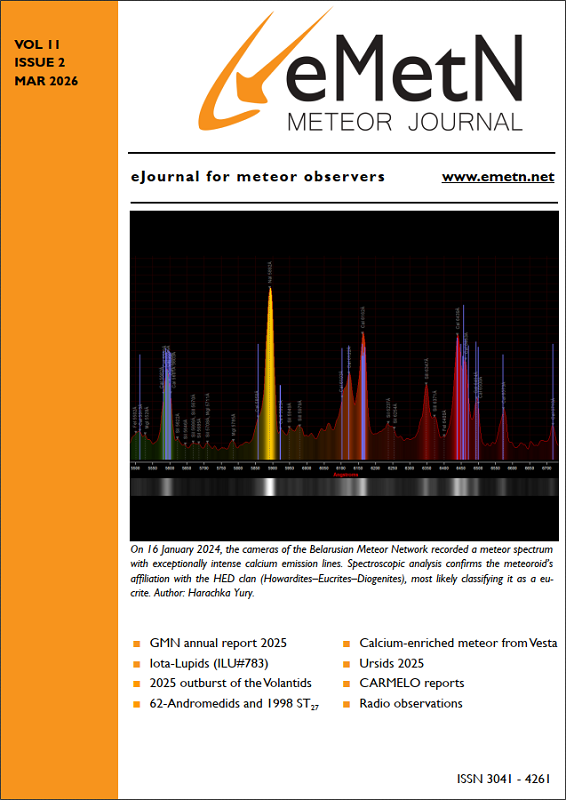
During the night of 12–13 December 2025, the Belarusian and the Ukrainian meteor networks recorded activity from an unidentified radiant in the constellation Draco. 10 multi-station meteors within a concentration of radiants were captured. Figure 1 shows images of four meteors from this activity, which had a medium angular velocity and absolute magnitudes in the range –1.4m to +0.5m.
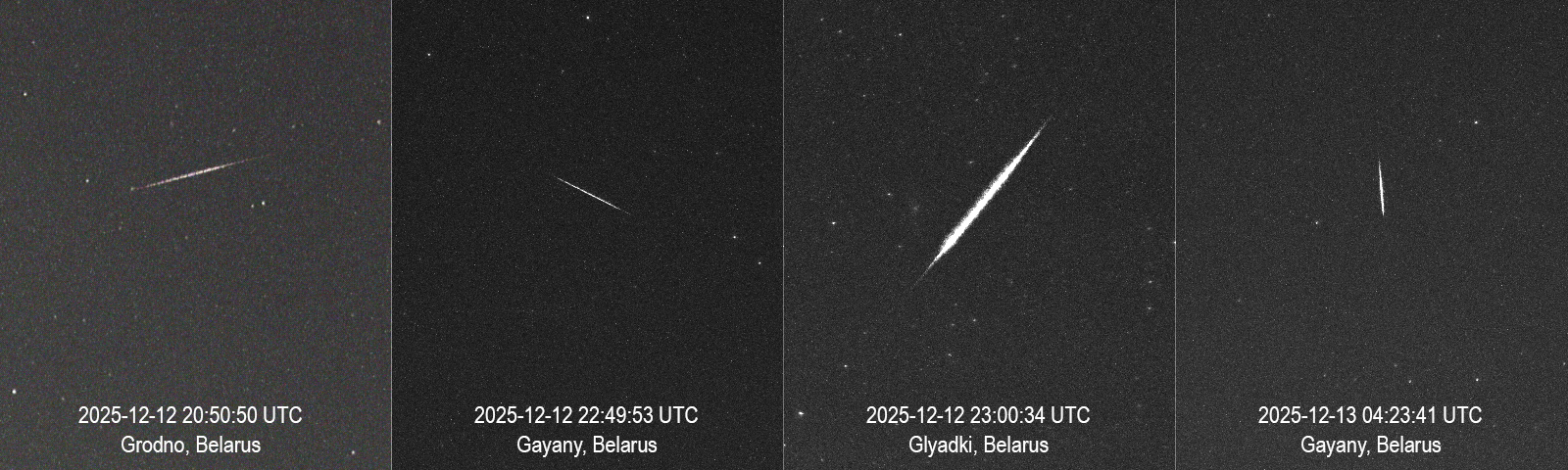
Figure 1 – Four meteors from the possible new meteor shower recorded during the night of 12–13 December 2025.
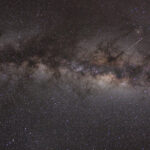
Figure 2 shows the locations of the camera stations and the projection of recorded meteors onto the Earth’s surface.
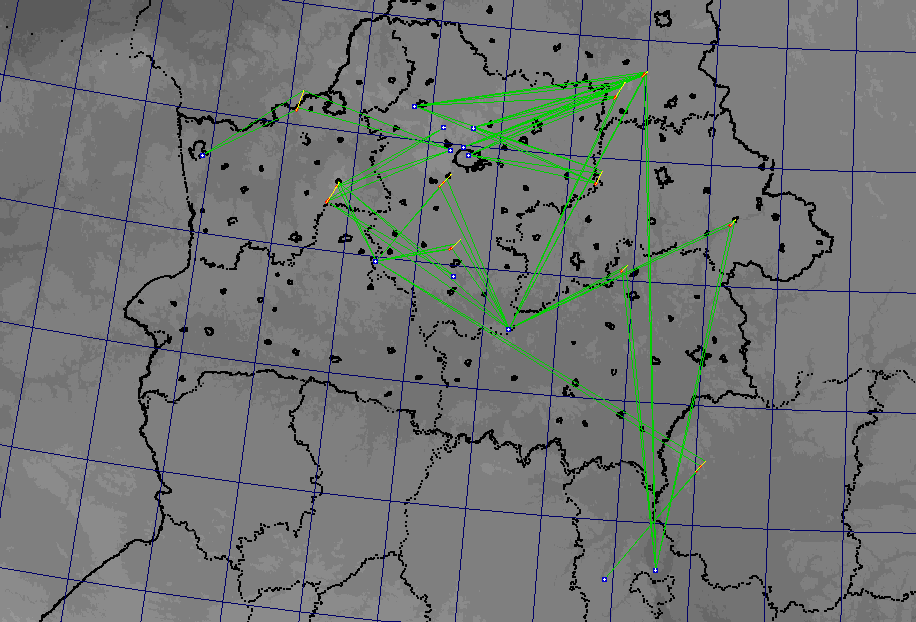
Figure 2 – Meteor trajectories from this unknown meteor shower projected on the Earth’s surface.
Results
The data were processed in UFOOrbit (SonotaCo). Table 1 shows the calculated individual parameters for each meteor on the night of December 12th to 13th, 2025.
Table 1 – The orbital parameters of the ten meteors recorded from the possible new meteor shower M2025-Y1.
| # | λʘ (°) | αg (°) | δg (°) | Vg (km/s) | a (A.U.) | q (A.U.) |
e | ω (°) | Ω (°) | i (°) | Abs Mag | Dur (sec) |
Hbeg (km) |
Hend (km) |
| 1 | 260.7272 | 213.60 | 67.15 | 40.50 | 9.397 | 0.970 | 0.8967 | 194.22 | 260.73 | 66.72 | 0.1 | 0.488 | 106.2 | 94.7 |
| 2 | 260.7764 | 212.04 | 65.15 | 42.00 | 11.218 | 0.974 | 0.9132 | 192.34 | 260.78 | 69.55 | -0.2 | 0.376 | 106.8 | 97.1 |
| 3 | 260.8112 | 210.38 | 65.78 | 41.74 | 9.324 | 0.970 | 0.8960 | 194.47 | 260.81 | 69.27 | 0.5 | 0.511 | 108.4 | 93.8 |
| 4 | 260.8188 | 214.36 | 67.09 | 39.99 | 7.553 | 0.971 | 0.8714 | 193.92 | 260.82 | 66.11 | -1.2 | 0.643 | 105.6 | 89.0 |
| 5 | 260.9185 | 212.78 | 66.13 | 41.14 | 9.551 | 0.972 | 0.8983 | 193.43 | 260.92 | 68.03 | -0.3 | 0.354 | 103.9 | 92.2 |
| 6 | 260.9576 | 213.98 | 65.73 | 40.60 | 7.229 | 0.974 | 0.8653 | 192.34 | 260.96 | 67.49 | 0.3 | 0.448 | 107.2 | 91.7 |
| 7 | 260.9594 | 211.60 | 65.81 | 39.70 | 4.440 | 0.970 | 0.7814 | 194.73 | 260.96 | 67.01 | -0.4 | 0.284 | 105.1 | 95.4 |
| 8 | 260.9682 | 209.14 | 65.99 | 41.67 | 8.427 | 0.967 | 0.8853 | 195.82 | 260.97 | 69.30 | 0.2 | 0.233 | 101.9 | 93.3 |
| 9 | 261.0109 | 212.62 | 66.69 | 40.68 | 8.351 | 0.970 | 0.8839 | 194.48 | 261.01 | 67.29 | -1.4 | 0.407 | 105.3 | 89.8 |
| 10 | 261.0469 | 213.05 | 65.16 | 40.62 | 5.982 | 0.974 | 0.8372 | 192.38 | 261.05 | 67.98 | -1.0 | 0.269 | 103.8 | 93.2 |
The radiant parameters and orbital elements averaged for the ten meteors are as follows:
λʘ = 260.8995° ± 0.1082°
αg = 212.36° ± 1.63°
δg = 66.07° ± 0.71°
Vg = 40.9 ± 0.8 km/s
a = 8.15 ± 1.95 AU
q = 0.971 ± 0.002 AU
e = 0.873 ± 0.039
ω = 193.813° ± 1.177°
Ω = 260.899°
i = 67.88° ± 1.18°
Tj = 1.10
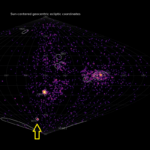
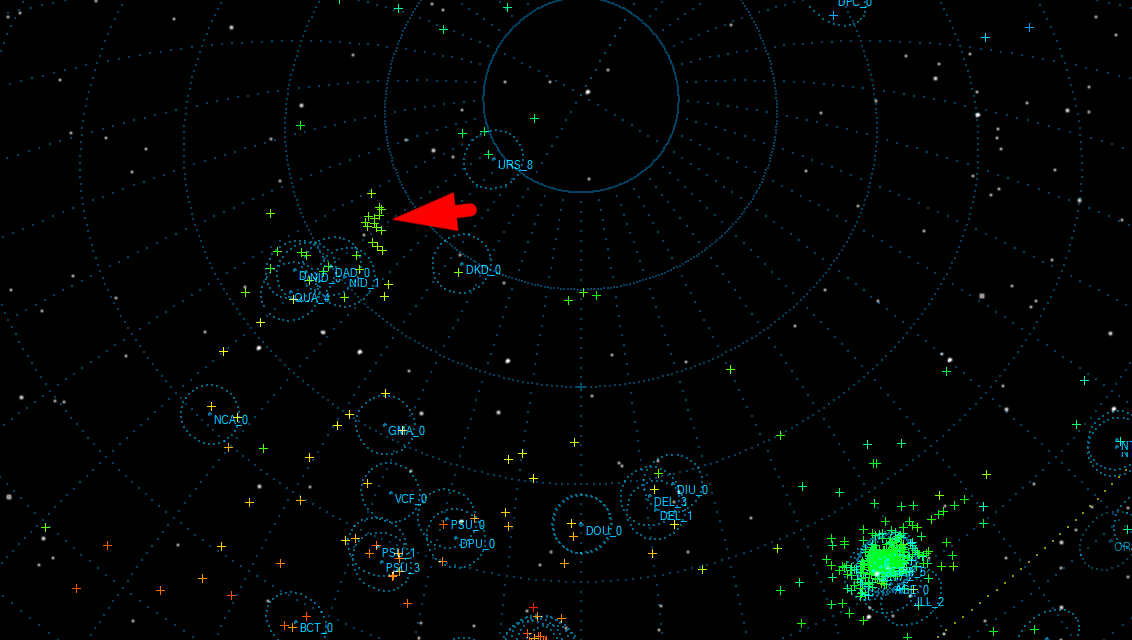
Figure 3 shows the distribution of the radiants at the celestial sphere in the constellation Draco. A concentrated group of radiants is located within a circle with a diameter of 3 degrees on the celestial sphere. There are three more radiants to the south-west and one to the north-east of the main group. They may also belong to the unknown shower. However, due to their separation from the main group, it was decided not to take these meteors into account.
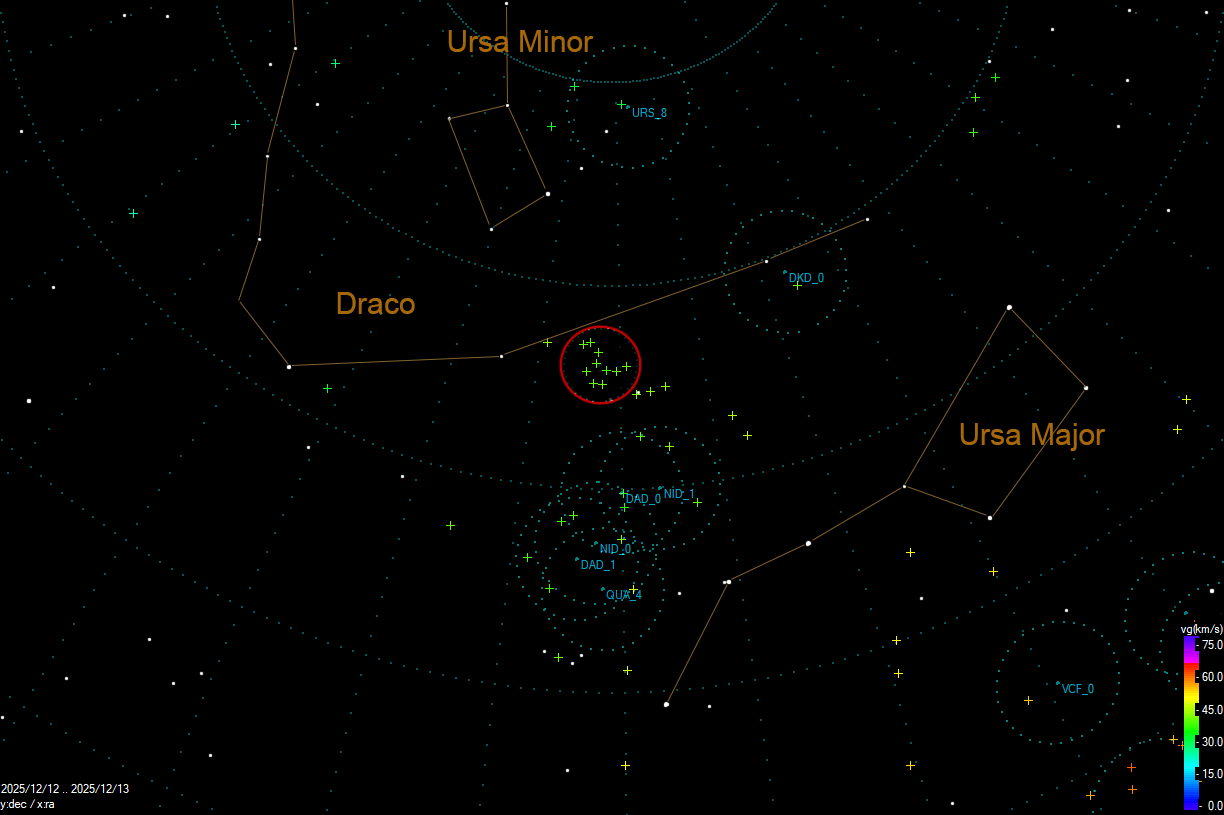
Figure 3 – Distribution of the radiants at the celestial sphere. The red circle indicates the radiant area of the possible new meteor shower. The blue circles show the established meteor showers according to the IAU MDC.
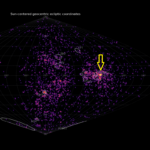
Approximately 5 degrees south are the radiants of the established meteor showers December alpha-Draconids (DAD, #00334, peak activity on 8 December), the November i-Draconids (NID, #00392, peak activity on 24 November) and the Quadrantids (QUA, #00010, peak activity on 2 January). To the west is the radiant of the December kappa-Draconids (DKD, #00336, peak activity on 4 December). The discovered unidentified concentration of radiants is located too far from known meteor showers, which display their peak activity either much earlier (DAD, NID, DKD) or much later (QUA). All this may indicate that the detected activity may belong to a new meteor shower, which, however, may be dynamically related to already known showers. Figure 4 shows the orbits in space which belong to the Mellish-type showers.
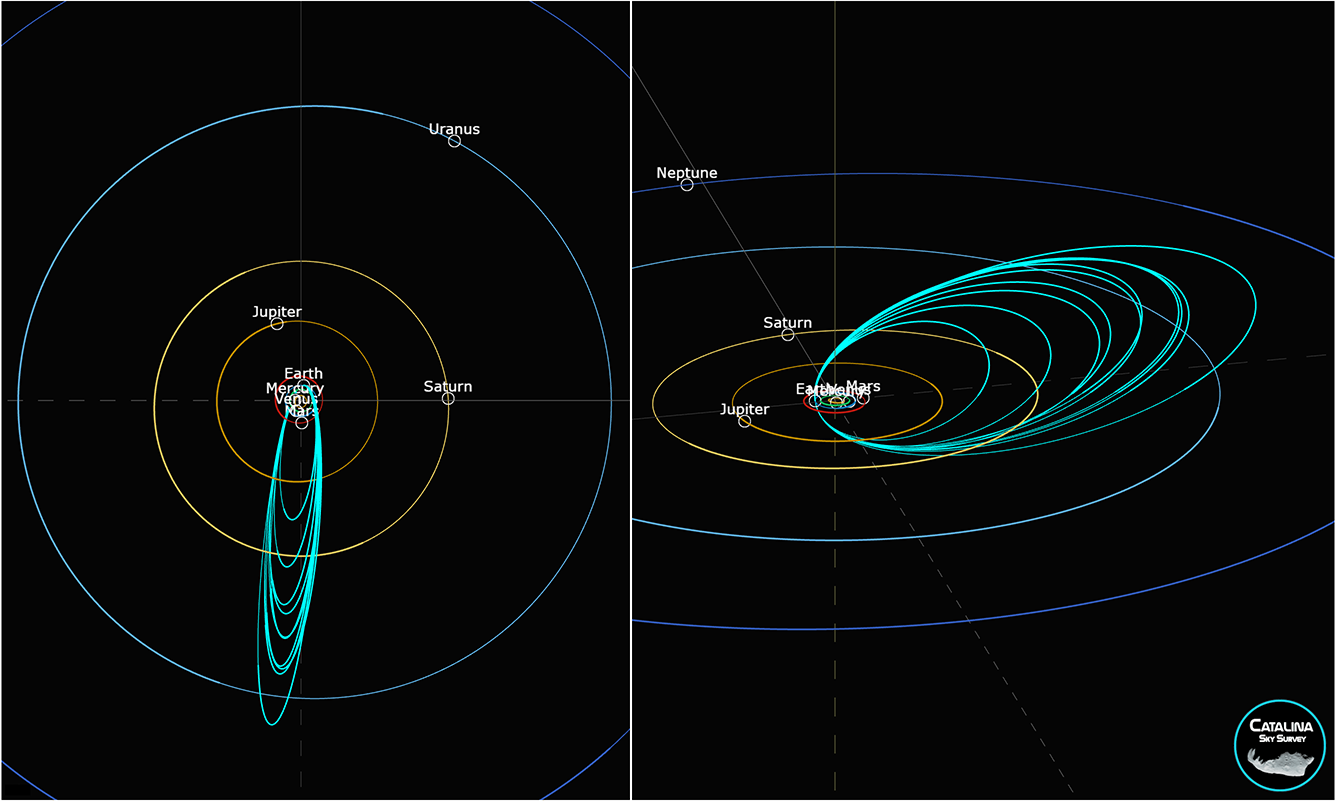
Figure 4 – The plotting of the orbits was made using the CSS Orbit View application.
Spectrum
One of the cameras, equipped with a diffraction grating, captured the spectrum of a meteor (#4 in Table 1) from an unidentified shower with a magnitude of –0.3m. Due to the insufficient brightness of the meteor, the spectrum image turned out to be dim and slightly noisy, but the main peaks were clearly visible. This allowed us to determine the spectral type of the meteor based on the methodology suggested by Borovička et al. (2005). After calibrating the spectrum and taking into account the spectral sensitivity of the equipment, the intensities of the MgI – 2, FeI – 15, and NaI – 1 multiplets were measured. The spectrum and ternary diagram are shown in Figure 5. The position of the spectrum on the ternary diagram (relative intensities are MgI: 34.3%, FeI: 19.2%, NaI: 46.5%) indicates that this spectrum belongs to the Fe-poor type. Meteoroids of this type are rich in magnesium and have a normal sodium content, but their iron content is significantly depleted. This indicates the cometary origin and it is typical for meteoroids with Halley-type orbits.
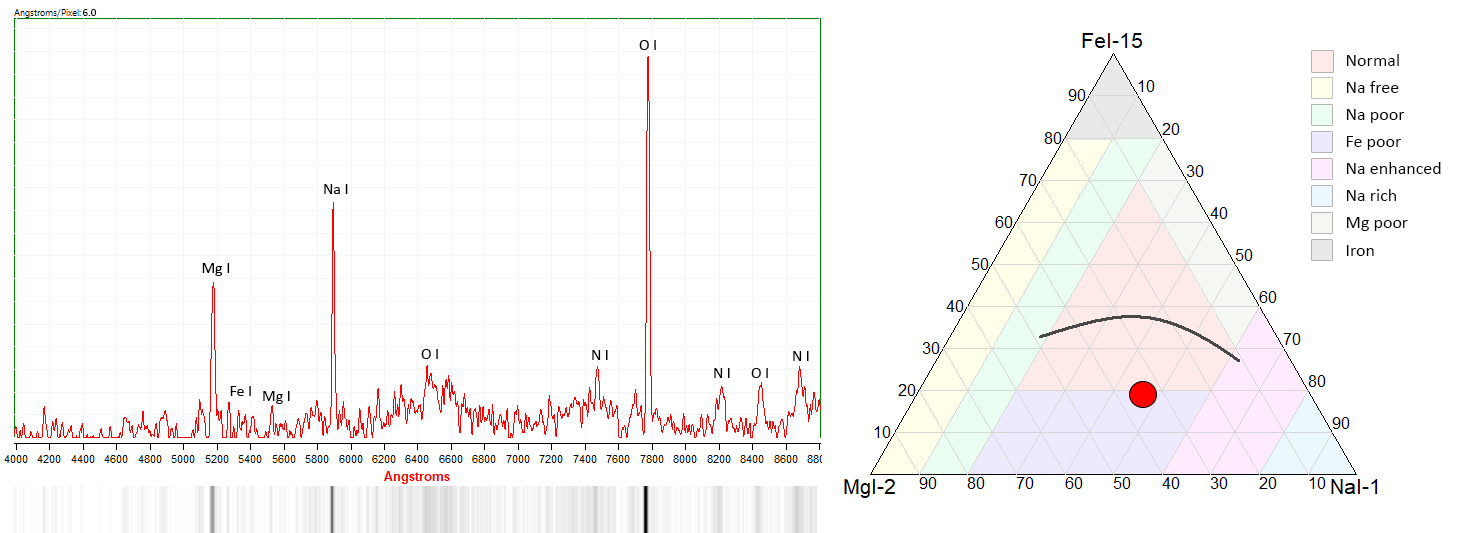
Figure 5 – Meteor spectrum from an unidentified shower on the left side and ternary diagram on the right side, showing the measured relative intensities of the MgI – 2, FeI – 15, and NaI – 1 multiplets in this meteor spectrum. The black curve on the ternary diagram shows the typical position of meteor spectra for chondritic composition. The red circle shows the position of the meteor spectrum from an unidentified shower.
Acknowledgment
The author would like to thank all operators and people involved in the Belarusian and Ukrainian meteor networks. We would especially like to thank our Ukrainian colleagues who continue to be involved in meteor astronomy even despite constant blackouts during this difficult time for Ukraine. The author would also like to thank Paul Roggemans for his help in writing this report.
- Belarusian meteor network: Alexander Mikulich, Andrey Prokopovich, Andrey Shohan, Ivan Sergei, Konstantin Morozov, Mikhail Abgarian, Ruslan Zavadich and Aliaksei Chernik.
- Ukrainian meteor network: Alexander Aitov.
References
Borovička J., Koten P., Spurný P., Boček J., Štork R. (2005). “A survey of meteor spectra and orbits: evidence for three populations of Na-free meteoroids”. Icarus, 174, 15–30.
SonotaCo, www.sonotaco.com
IAU MDC, https://www.ta3.sk/IAUC22DB/MDC2022/Roje/roje_lista.php?corobic_roje=0&sort_roje=0
CSS Orbit View, https://neofixer.arizona.edu/css-orbit-view