Mariasole Maglione (GAV, Gruppo Astrofili Vicentini)
Lorenzo Barbieri (CARMELO network and AAB, Associazione Astrofili Bolognesi)
Introduction
November is the month of the Leonids (LEO), but this year the CARMELO network did not record particularly intense activity around the predicted peak of the shower.
Methods
The CARMELO network consists of SDR radio receivers. In them, a microprocessor (Raspberry) performs three functions simultaneously:
- By driving a dongle, it tunes the frequency on which the transmitter transmits and tunes like a radio, samples the radio signal and through the FFT (Fast Fourier Transform) measures frequency and received power.
- By analyzing the received data for each packet, it detects meteoric echoes and discards false positives and interference.
- It compiles a file containing the event log and sends it to a server.
The data are all generated by the same standard, and are therefore homogeneous and comparable. A single receiver can be assembled with a few devices whose total current cost is about 210 euros.
To participate in the network read the instructions on this page.
November data
In the plots that follow, all available at this page, the abscissae represent time, which is expressed in UT (Universal Time) or in solar longitude (Solar Long), and the ordinates represent the hourly rate, calculated as the total number of events recorded by the network in an hour divided by the number of operating receivers.
In fig.1, the trend of signals detected by the receivers for the month of November.
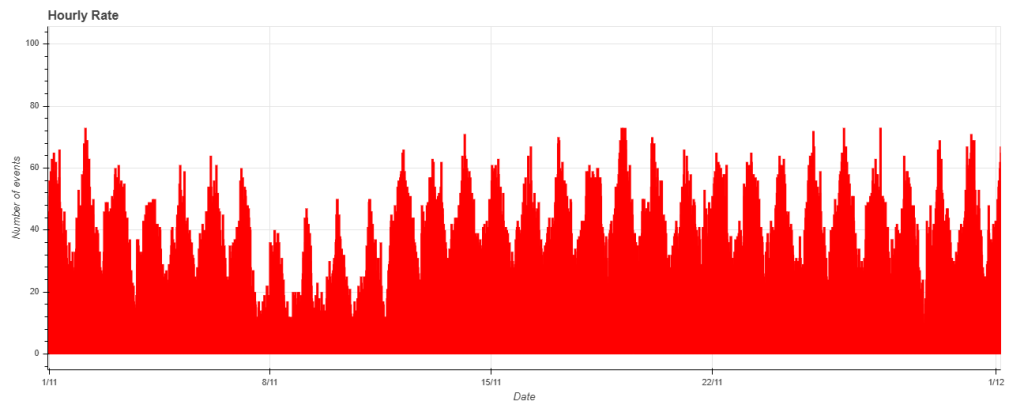
Fig. 1: November 2025 data trend.
Leonids
In November, the sky once again hosts the Leonid (LEO) meteor shower, associated with the periodic comet 55P/Tempel–Tuttle and linked to its orbital cycle of about 33 years. Each time the comet passes perihelion, it releases a new trail of debris responsible for the spectacular meteor “storms” observed in years like 1966 or, more recently, 2001.
In recent years, however, the reservoir of dust encountered by Earth in mid-November has gradually become depleted. Until the comet’s next return, expected in 2031, the shower will continue to exhibit increasingly modest activity. According to estimates from the International Meteor Organization (IMO), this year Earth crossed two segments of the 1699 trail on the evening of November 17, with a predicted rate of about 15–20 meteors per hour (1). However, the radiant, located in the constellation Leo, rose only around 23:30 in Italy, right at the time of the expected peak, preventing the detection of a high number of events.
Models also indicated possible encounters with older trails: the 1167 trail (forecast for November 9), the 1633 trail (November 15), and an initial passage through the 1699 trail. Yet, as often happens with the Leonids during this material-poor phase, the predictions came with a wide margin of uncertainty.
The activity recorded this year by the CARMELO network confirms the overall weakness of the shower. Even visual observations, such as those reported by the Global Meteor Network (GMN, 2), showed a very low ZHR, with no significant variations at the expected peak times.
The only slightly more noticeable increase in CARMELO detections appears on the morning of November 19, around solar longitude 236.8° (see fig. 2, where the radiant-height graph is shown in blue).
Given the high speed of Leonids, about 72 km/s, one would normally expect to detect radio echoes featuring strong head echoes and clear Doppler shifts, which are characteristic signatures of the fastest meteors. Even in this respect, however, the network’s data indicate a very low presence of events attributable to high-velocity meteors.
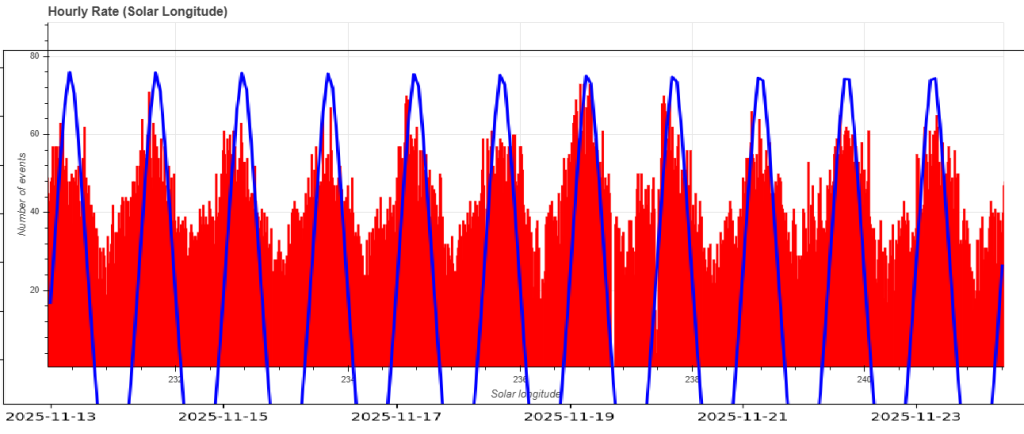
Fig. 2: Hourly rate of events recorded between November 13 and 23, based on solar longitude.
The CARMELO network
The network currently consists of 14 receivers, 12 of which are operational, located in Italy, the UK, Croatia and the USA. The European receivers are tuned to the Graves radar station frequency in France, which is 143.050 MHz. Participating in the network are:
- Lorenzo Barbieri, Budrio (BO) ITA
- Associazione Astrofili Bolognesi, Bologna ITA
- Associazione Astrofili Bolognesi, Medelana (BO) ITA
- Paolo Fontana, Castenaso (BO) ITA
- Paolo Fontana, Belluno (BL) ITA
- Associazione Astrofili Pisani, Orciatico (PI) ITA
- Gruppo Astrofili Persicetani, San Giovanni in Persiceto (BO) ITA
- Roberto Nesci, Foligno (PG) ITA
- MarSEC, Marana di Crespadoro (VI) ITA
- Gruppo Astrofili Vicentini, Arcugnano (VI) ITA
- Associazione Ravennate Astrofili Rheyta, Ravenna (RA) ITA
- Mike German a Hayfield, Derbyshire UK
- Mike Otte, Pearl City, Illinois USA
The authors’ hope is that the network can expand both quantitatively and geographically, thus allowing the production of better quality data.
References
(1) IMO, J. Rendtel (2025): “2025 Meteor Shower Calendar”, p. 17
(2) Global Meteor Network